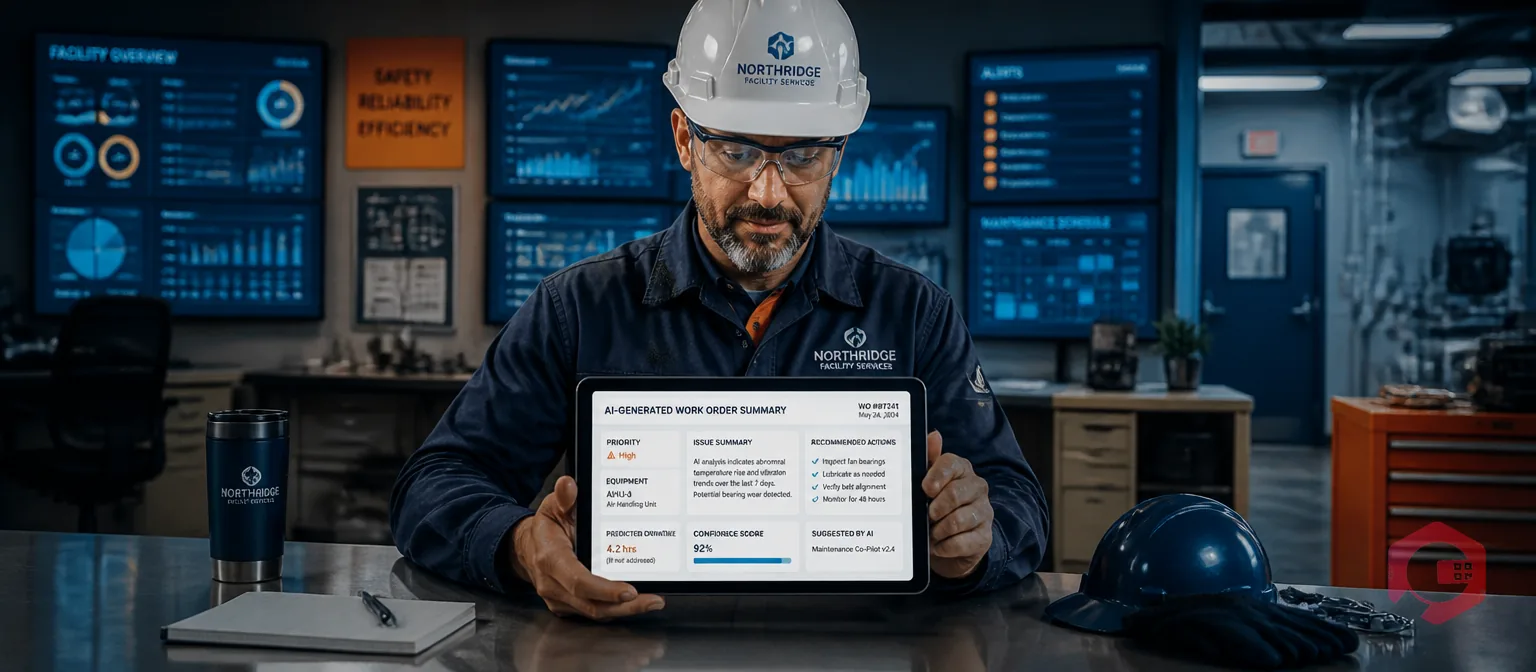
AI-powered work order summaries are automatically generated reports that condense the full lifecycle of a maintenance job — fault description, technician activity, parts used, root cause, and resolution — into a structured document without requiring a technician or supervisor to write a single word manually. Teams that adopt AI summary tools in their CMMS reduce maintenance reporting time by 40 to 60%, according to industry benchmarks from Plant Engineering.
Most maintenance teams spend between 3 and 5 hours per technician per week on documentation alone — writing work order close-outs, compiling shift reports, updating asset logs, and preparing summaries for management. That time adds up to more than 200 hours per year per technician that goes into paperwork instead of maintenance. The problem is not effort. It is a process built around manual data entry that AI can now handle automatically.
This guide explains exactly what AI work order summaries are, where the time savings come from, what to look for in a solution, and how Cryotos CMMS generates these summaries in practice — so your team can shift from reporting on maintenance to actually doing it.

An AI work order summary is a machine-generated document that captures and synthesizes all relevant data from a completed maintenance job into a readable, structured report. It pulls from the work order itself, the technician's activity log, parts consumed from inventory, any IoT or sensor readings attached to the job, and the technician's own notes — then organizes this into a coherent summary without human editing.
A standard work order close-out is whatever the technician types into the completion field before hitting submit. In practice, this ranges from detailed and precise to almost useless. The quality of the record depends entirely on the individual technician and how much time they have at shift end.
An AI summary does not depend on the technician's writing. It pulls structured data from every touchpoint in the work order — check-in timestamps, parts scan logs, tool checkouts, sensor readings before and after the job, and any voice or photo notes captured during the repair — and generates a standardized, complete summary that looks the same regardless of which technician performed the work or how busy they were.
A well-structured AI summary typically contains the following elements in a consistent format:
The visible cost of poor maintenance reporting is the time technicians and supervisors spend writing reports. The hidden cost is the decisions that get made based on incomplete or inconsistent data — and the failures those decisions cause.
Research from the International Maintenance Conference consistently shows that maintenance technicians spend 15 to 25% of their working hours on administrative tasks unrelated to actual repairs. For a team of 10 technicians working standard 40-hour weeks, that is 600 to 1,000 hours per week absorbed by documentation, reporting, and data entry.
The problem compounds at the supervisory level. Maintenance managers in facilities without AI-assisted reporting typically spend 8 to 12 hours per week compiling shift summaries, preparing KPI updates for leadership, and chasing technicians for missing close-out details. According to a McKinsey analysis of industrial maintenance productivity, management and coordination tasks account for up to 30% of a maintenance supervisor's time in reactive-heavy operations.
Beyond time, manual close-outs create a data quality crisis that affects every downstream decision. When a technician writes "fixed pump" instead of specifying which pump seal failed, under what conditions, and what torque was applied on reassembly, that work order becomes a dead record. It cannot be used to detect failure patterns, improve PM intervals, or train future technicians on the right repair procedure.
A plant that processes 500 work orders per month and has even 30% low-quality close-outs is throwing away 150 maintenance records that could have informed better decisions. Over a year, that is 1,800 lost learning opportunities buried in a CMMS that was supposed to make the operation smarter.
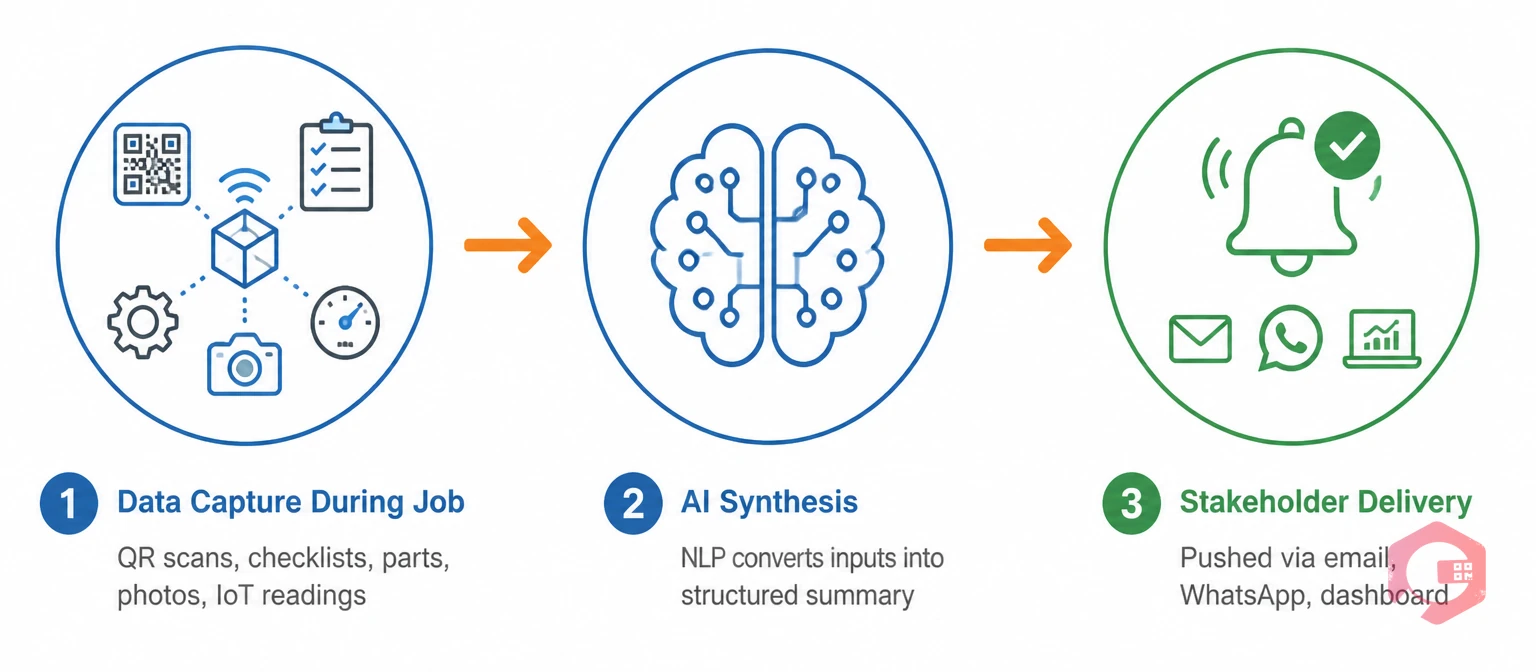
The mechanics behind AI work order summaries are straightforward once you understand what data the system has access to. The AI is not inventing information — it is organizing and synthesizing structured data that the CMMS has already captured through the work order process.
The quality of an AI summary depends on the richness of data collected during the job. Modern CMMS platforms like Cryotos capture this through multiple channels simultaneously: the technician scans the asset QR code on arrival, triggering a timestamp; checks off each step in the digital checklist; scans parts out of inventory using barcodes; attaches photos at key inspection points; and can speak notes into the system using voice-to-text while both hands stay on the job. IoT sensors connected to the asset log pre- and post-repair condition data automatically.
None of this requires the technician to stop and write. The data is captured as a byproduct of doing the work correctly — following the process the CMMS enforces rather than creating additional documentation effort.
When the technician closes the work order, the AI engine processes all captured data points and generates a structured summary. Using natural language processing, it converts checklist completions into readable action statements, maps parts consumption to the specific steps where those parts were used, calculates all time metrics automatically, and classifies the job by fault type and resolution category.
The result is a summary that reads coherently — not like a list of database fields — and contains more accurate, complete information than most manually written close-outs. The AI does not judge the technician's writing quality. It produces a consistent output regardless of how much or how little the technician typed.
The generated summary does not sit passively in the CMMS waiting to be found. Configured delivery rules push summaries to the right people automatically: the maintenance supervisor receives a digest of completed jobs at shift end; the plant manager gets a daily summary of critical asset events; the reliability engineer gets a notification any time a job is closed with a root cause that matches a pattern they are monitoring. The email and WhatsApp notification builder in Cryotos handles these delivery rules without requiring any custom integration work.

The 40 to 60% time reduction that AI work order summaries deliver does not come from a single efficiency gain. It comes from eliminating five separate sources of reporting friction that accumulate throughout the maintenance workflow.
Before AI summary tools, a typical maintenance manager at a 200-asset manufacturing facility spends Monday morning collecting the weekend's work orders, half of which have missing or incomplete close-out descriptions. They spend two hours filling in the gaps — calling technicians to get details that should have been logged at the time, cross-referencing paper logs kept as backup. By Wednesday, they are preparing the weekly KPI update for the plant director — running reports from the CMMS, noticing data gaps, and manually correcting entries before the numbers make sense. Another 90 minutes that should be automatic.
After implementing AI work order summaries, the same manager's Monday morning looks different. Every weekend work order has a complete, structured close-out generated at the moment of job completion. The shift digest was automatically delivered to the manager's WhatsApp at shift end Saturday and Sunday. On Monday, they spend 15 minutes reviewing the summaries — not creating them.
The Wednesday KPI update is pulled from the CMMS with one click. Because every work order is structured consistently, the report runs clean without manual correction. The manager's week has approximately six hours back in it — time that can go into actual maintenance planning, technician coaching, and root cause work that was previously crowded out by reporting tasks.
A plant that tracked this transition found that a team of eight technicians recovered 34 hours per week in aggregate reporting time within the first quarter of deploying AI summary tools. Research from Deloitte's Industry 4.0 analysis supports this order of magnitude, estimating that AI-assisted documentation can reduce maintenance administrative time by 35 to 55% in structured deployment scenarios.
Not every CMMS that advertises AI capabilities delivers genuine work order summary functionality. These are the specific features that separate tools that actually reduce reporting time from tools that add complexity without saving effort:
Cryotos CMMS has built AI-assisted work order management directly into the core maintenance workflow. The process starts at work order creation, where Cryotos supports AI-powered work order generation via voice command or photo analysis with annotations. A technician who spots a fault can speak the description while standing next to the failing asset and Cryotos structures that input into a properly classified work order automatically.
During the job, every technician action is timestamped and logged. Digital checklists built into the work order ensure each inspection step is completed before the job can be closed. Parts scanned out of the Cryotos inventory management system are automatically linked to the specific job and step where they were used. If the asset is connected to IoT sensors through Cryotos's IoT meter reading integration, pre- and post-repair readings are attached to the work order automatically.
When the job is closed, Cryotos generates a structured summary that draws from all of these inputs. The BI Dashboard in Cryotos makes these summaries available at every organizational level — from individual asset history to department-level performance to plant-wide reporting — with drill-down capability so any manager can move from a high-level summary to the raw work order detail in seconds.
The notification system then delivers the right summary to the right person. Using Cryotos's configurable email and WhatsApp notification builder, supervisors can set up shift-end digests, critical asset event notifications, and weekly management summaries — all generated and delivered automatically without any manual compilation. Maintenance teams using Cryotos consistently report 30% reductions in unplanned downtime and 25% faster repair times — in part because the reporting infrastructure frees maintenance leadership to focus on reliability improvement rather than documentation management.
If your team is spending hours each week on maintenance reporting that could be automated, Cryotos CMMS gives you the platform to reclaim that time and put it back into the work that actually keeps your equipment running. Book a free demo today to see the AI summary workflow in action for your specific maintenance environment.
An AI work order summary is a machine-generated report that synthesizes all data captured during a maintenance job — including technician activity, parts consumed, sensor readings, and checklist completions — into a structured, readable document. It is produced automatically at job close-out without requiring the technician to write a narrative description, ensuring consistent, complete records regardless of who performed the work.
Teams implementing AI work order summary tools in their CMMS typically recover 3 to 6 hours per technician per week in reporting time, with supervisors recovering 6 to 10 hours per week in report compilation, data correction, and status update communication. A team of 10 technicians can realistically recover 30 to 60 hours of productive capacity per week.
The best implementations require minimal behavior change from technicians. The data capture happens through actions technicians are already doing — scanning asset QR codes, checking off job steps, scanning parts out of inventory — rather than adding a separate documentation task. Voice-to-text input means technicians can add context during the job without stopping to type.
Yes. AI-generated summaries that pull from digitally signed checklists, timestamped actions, and structured data fields are more audit-ready than manually written close-outs because they are verifiable against the underlying data. Every action in the summary can be traced back to the specific data point that generated it, creating an unbroken audit trail that satisfies ISO 55000, OSHA, and regulatory compliance requirements.
Standard reporting tools require a user to configure and run a report — they pull structured data from completed records. AI work order summarization generates narrative-style summaries by synthesizing unstructured inputs like voice notes and photos alongside structured data, at the moment of job completion, and delivers the output automatically without a user triggering the process.
The reporting process that exists in most maintenance operations today was designed around paper, not data. Technicians write close-outs manually, supervisors compile those close-outs into reports manually, and managers review those reports — all while the underlying data that could generate everything automatically already exists in the CMMS. AI summaries close that gap by converting the data that is already being captured into structured, useful documentation without adding any steps to the technician's workflow.
The 3 to 6 hours per technician per week that manual reporting consumes is a significant productivity drain. Redirecting that time into actual maintenance work is one of the highest-return investments an operations team can make in their CMMS configuration. If your team is ready to make that shift, Cryotos CMMS gives you the tools to build it. Book a demo to see the AI work order summary workflow applied to your specific environment.


Cryotos AI predicts failures, automates work orders, and simplifies maintenance—before problems slow you down.