

A maintenance approval workflow is a structured, multi-step authorization process that every work order must pass through before a technician touches an asset. Without one, your maintenance team is operating reactively — spending unbudgeted money, skipping safety checks, and leaving no audit trail. According to AssetWorks research, organizations without formal approval controls spend up to 30% more on unplanned maintenance annually. The shift from reactive to governed maintenance is not a luxury — it is a business requirement.
In this guide, you will learn exactly what maintenance approval workflows are, why the absence of them costs far more than the time they take, and how a modern work order management system can automate the entire process across your team.
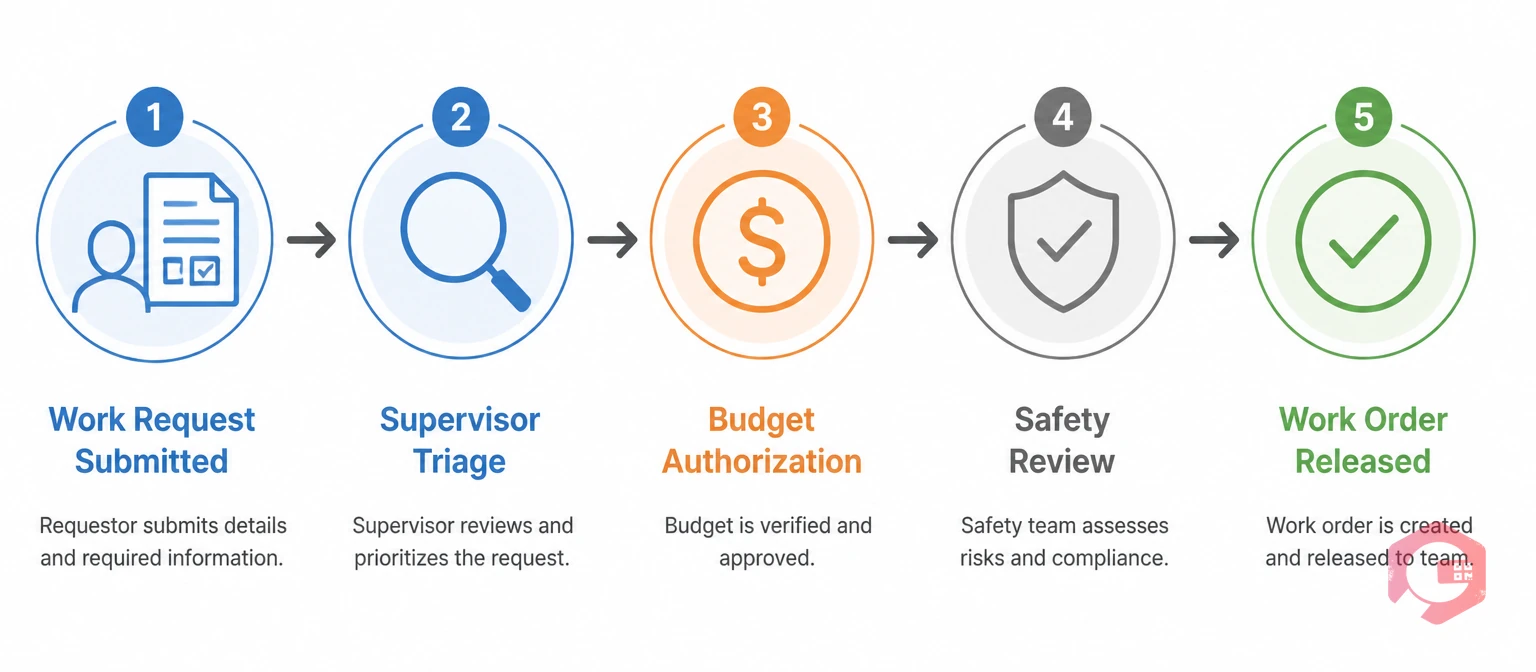
A maintenance approval workflow is a defined sequence of review and sign-off steps that a maintenance request must clear before work begins, resources are consumed, or costs are committed. Think of it as a chain of custody for every maintenance task — from the moment someone spots a problem to the moment a technician is authorized to fix it.
In practice, this means a requestor submits a work request describing the issue. That request routes automatically to a supervisor or maintenance manager for triage. If the work requires budget beyond a set threshold, a department head or finance approver joins the chain. Once all sign-offs are collected, the work order is released and a technician is dispatched. Every step is time-stamped and logged, creating a complete audit trail.
The key distinction: a work request is a problem report; a work order is an authorized instruction to act. The approval workflow is the bridge between the two. Without it, organizations blur that line — and pay for it in budget overruns, safety incidents, and compliance failures.
Reactive maintenance — acting only after something breaks — is the default mode for teams without governed workflows. It feels faster in the moment, but the numbers tell a different story. The Reliable Plant Journal estimates that reactive maintenance costs 3 to 5 times more per repair than planned maintenance, primarily because of emergency parts sourcing, overtime labor, and collateral damage from delayed intervention.
The financial damage compounds when you layer in the organizational costs:
The irony of purely reactive teams is that their attempt to save time by skipping approvals actually creates more emergency work, which further strains the team and entrenches the reactive cycle. Governed maintenance breaks the loop.
The difference between a reactive team and a governed one is not just cultural — it shows up in measurable outcomes across cost, compliance, and asset life. Here is how the two approaches compare across the dimensions that matter most:
| Dimension | Reactive (No Approval Workflow) | Governed (Approval Workflow Active) |
|---|---|---|
| Cost Control | Unbudgeted emergency spend, no pre-approval | Every cost pre-authorized against budget thresholds |
| Audit Trail | Verbal instructions, no documentation | Full digital log with timestamps and approver names |
| Safety Compliance | Safety checks skipped under urgency | Safety sign-off built into every approval stage |
| Response Speed | Fast to start, slow to resolve (rework, duplication) | Small delay to start, faster total resolution |
| Resource Allocation | Technicians self-assign based on availability | Manager assigns best-fit technician per skill and workload |
| Regulatory Readiness | Unprepared for audits; gaps in maintenance records | Audit-ready at all times with approved work records |
| Asset Longevity | Deferred decisions accelerate asset degradation | Timely authorized repairs extend asset life |
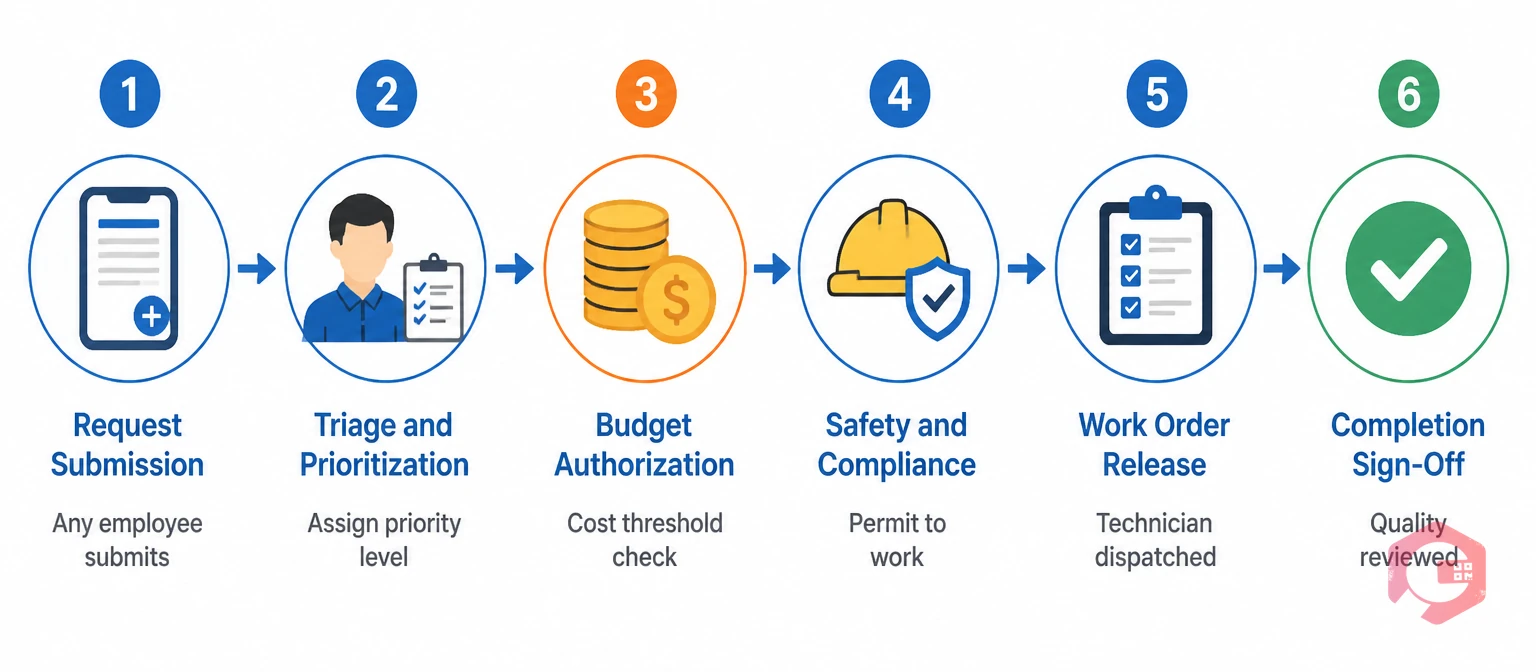
A well-designed maintenance approval workflow is not a single gate — it is a series of checkpoints, each adding a specific layer of control. Here are the core stages every organization should build into their process:
Each stage is time-stamped and logged automatically in a modern maintenance management system, so there is never any ambiguity about who approved what or when.
One of the most common mistakes organizations make when building approval workflows is applying a one-size-fits-all approach — every work order, no matter how routine or how costly, routes to the same single approver. This creates bottlenecks for small tasks and insufficient oversight for large ones.
A smarter model uses tiered authorization based on cost, risk, and asset criticality:
Role-based access controls in your CMMS make this tiering automatic. The system reads the work order attributes and routes it to the correct approver without manual forwarding or email chains. The user role and access management module in a modern CMMS handles this routing logic out of the box.
Managing approval workflows manually — through spreadsheets, email, or verbal sign-offs — is unsustainable at any meaningful scale. A CMMS platform transforms approval workflows from a manual chore into an automated, trackable system. Here is what that looks like in practice with Cryotos:
The result is a workflow that is faster than manual approval, more thorough than ad-hoc decisions, and fully documented for every stakeholder who needs to see the record.

Organizations that move from reactive to governed maintenance consistently report measurable improvements across cost, safety, and asset performance. According to Plant Engineering's annual maintenance survey, teams with formal approval workflows report 20–35% reductions in maintenance budget overruns within the first year of implementation. The core benefits include:
A work request is an unverified problem report submitted by anyone — an operator, a facility user, or an automated sensor alert. A work order is an authorized instruction to perform a specific task, assigned to a specific technician, with defined parts, time, and cost parameters. The maintenance approval workflow is the process that converts a request into an order, ensuring only valid, budgeted, and safe tasks get executed.
Most organizations operate effectively with two to four tiers. Low-cost routine tasks may need only supervisor approval or auto-approval via template matching. High-cost or high-risk work needs manager and safety sign-off. The right number of tiers depends on your cost thresholds, regulatory environment, and asset criticality classification. Start with two tiers and add layers as you identify gaps in your current process.
Well-designed workflows include an emergency bypass path for critical equipment failures. In Cryotos, a "critical" priority flag routes a work order directly to the on-call manager with a mandatory 15-minute response SLA, bypassing standard queues. The bypass still generates a log entry, preserving the audit trail even for emergency responses. This means speed and governance are not mutually exclusive.
Any industry with regulated assets, high maintenance spend, or safety-critical equipment benefits significantly. This includes manufacturing, healthcare, oil and gas, pharmaceuticals, and food and beverage. That said, any organization spending more than $50,000 per year on maintenance will see measurable ROI from formalized approval controls.
The key is to show technicians that the workflow removes friction rather than adding it. When approvals are mobile-first and approvers respond quickly, technicians spend less time waiting for verbal authorization and more time on actual repair work. Pair the rollout with clear escalation rules so technicians know exactly what to do if an approver is slow to respond. Early wins — faster parts ordering, fewer rework jobs — build the trust that sustains the process long-term.
Maintenance approval workflows are the foundation of a governed, cost-controlled, and audit-ready maintenance operation. If your team is still relying on verbal sign-offs, email chains, or gut-feel prioritization, you are leaving budget, safety, and reliability on the table. Cryotos gives you a complete workflow automation platform built for maintenance teams — with role-based approvals, real-time notifications, mobile sign-off, and a full audit trail from request to closure. See how Cryotos can move your maintenance operation from reactive to governed.




Cryotos AI predicts failures, automates work orders, and simplifies maintenance—before problems slow you down.



