

Energy-triggered work orders are automated maintenance tasks that fire the moment an asset’s energy consumption crosses a defined threshold — eliminating the wait for a scheduled inspection or a visible breakdown. Instead of running equipment on a fixed calendar or reacting after a failure, your work order management system acts the instant power draw, voltage, or meter readings indicate something is wrong. According to the U.S. Department of Energy, condition-based maintenance programmes cut maintenance costs by 10–25% and reduce unplanned downtime by up to 70%. Energy-triggered work orders sit at the heart of that shift — turning raw consumption data into timely, targeted action before costs spiral.
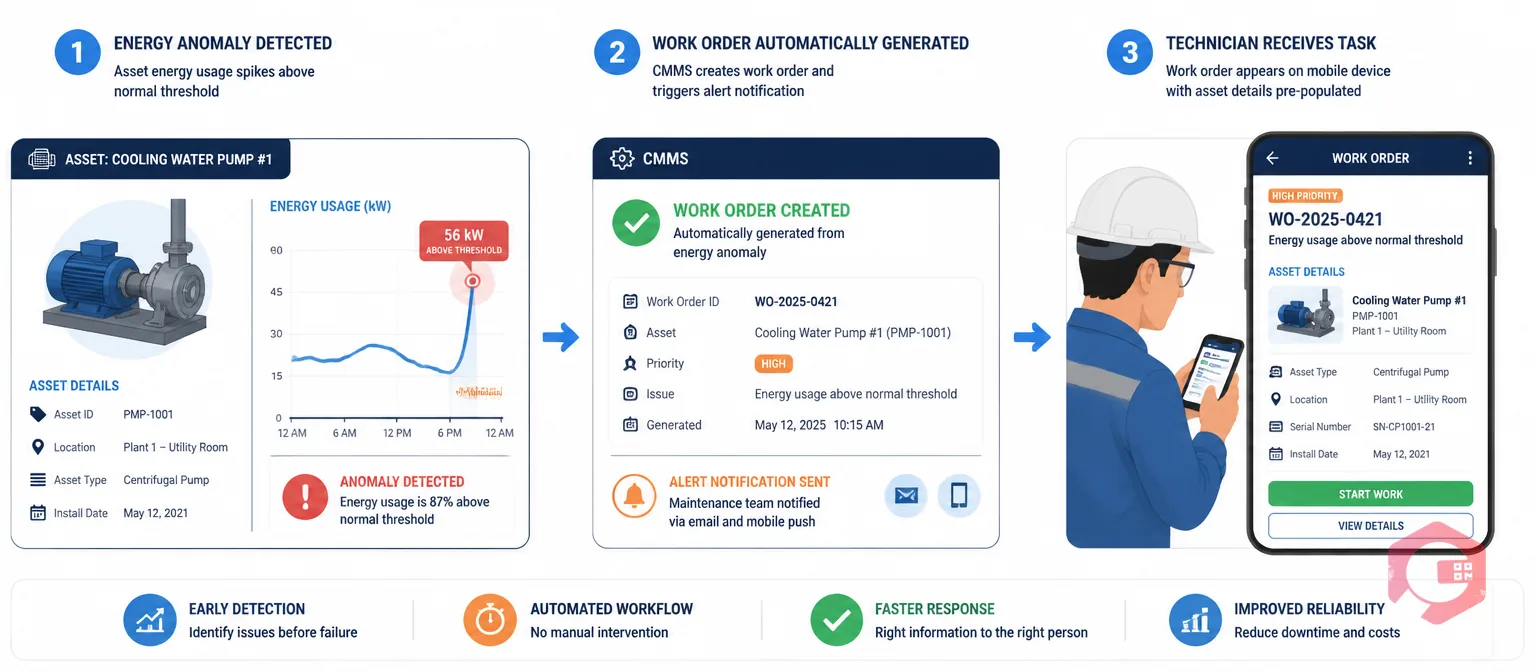
An energy-triggered work order is a maintenance task automatically created by your CMMS when a connected asset sends an energy-related signal that breaches a preset rule. The trigger can be a spike in kilowatt-hours, a sustained rise in current draw, an unexpected drop in motor efficiency, or a meter reading that exceeds a rated operating band. Unlike a time-based PM that runs every 30 days regardless of actual asset condition, an energy-triggered order fires only when real data says it should.
This approach sits within the broader family of condition-based maintenance — where the asset’s own behaviour sets the maintenance schedule. Energy consumption is one of the most reliable early-warning signals available because most mechanical degradation (bearing wear, winding insulation breakdown, pump cavitation) shows up as abnormal power draw well before it causes a failure.
Time-based work orders follow a fixed schedule. They are predictable and easy to plan, but they create two problems: over-maintenance of assets that are running fine, and under-maintenance of assets that degrade faster than the schedule assumes. Reactive work orders, by contrast, only appear after a failure — at maximum cost and disruption. Energy-triggered orders occupy the middle ground: they respond to actual need, not guesswork. You maintain the asset when its energy signature says it needs attention, not before and not after.
The process starts with data. Every asset that draws electrical power, burns fuel, or runs fluid through a meter is a potential data source. Modern facilities already collect much of this data via smart meters, PLCs, and SCADA systems — the gap, historically, has been connecting that data to maintenance workflows. A CMMS with IoT meter reading integration closes that gap by pulling live readings into a rules engine that can act on them automatically.
Smart energy meters, current transformers, and IoT sensors feed real-time consumption data into the CMMS at intervals as short as one minute. The system logs every reading against the asset record, building a baseline of normal operating consumption. Once a baseline exists — typically 2–4 weeks of data — the rules engine has a reference point. A pump that normally draws 4.2 kW under load and suddenly reads 5.8 kW is running 38% above baseline. That deviation is the trigger.
Common energy inputs used as maintenance triggers include total power consumption (kWh), peak current draw (amps), power factor degradation, run-hour accumulation, fuel consumption rate, compressed air flow rate, and water or steam flow anomalies. Each can be configured independently with its own threshold and its own resulting work order type.
Thresholds are set at the asset level, usually in collaboration with the OEM specification and your historical data. When a reading crosses the threshold, the CMMS creates a work order automatically, assigns it to the relevant technician or team, and sends a notification via mobile, email, or WhatsApp. The work order pre-populates with the asset ID, the specific reading that triggered it, the normal baseline value, and suggested task steps pulled from the AI knowledge base. The technician arrives knowing exactly what the data showed and what to check first — no guesswork, no time lost diagnosing from scratch.
Running costs cover energy consumed, labour spent on maintenance, spare parts consumed, and production lost during downtime. Energy-triggered work orders attack all four simultaneously.
Unplanned failures are the most expensive maintenance event. A breakdown-triggered repair typically costs 3–5 times more than the same repair done proactively, because it involves emergency labour rates, expedited parts procurement, collateral damage to surrounding components, and production losses. Energy triggers catch the conditions that precede failure — overheating motors, degrading insulation, clogged filters causing pumps to overwork — and turn them into planned interventions. The asset gets fixed at a scheduled time, at normal cost, before anything breaks.
A degrading asset does not just cost more to repair. It also costs more to run every hour until it fails. A motor with bearing wear draws excess current. A heat exchanger with fouled surfaces runs its compressor harder. A compressed air system with a developing leak drives the compressor longer. In a mid-sized manufacturing plant, these “running degraded” losses can account for 8–15% of total energy spend according to research from the U.S. Department of Energy’s Advanced Manufacturing Office. Energy-triggered work orders intervene before prolonged degradation inflates the energy bill.
When you know a bearing is showing early signs of wear through elevated motor current, you order one bearing. When you react to a seized motor, you replace the bearing, the shaft seal, and potentially the motor itself — and you pay for expedited shipping. Triggered maintenance lets your spare parts inventory management operate on planned demand rather than emergency demand, cutting parts costs and eliminating the holding cost of excess safety stock kept “just in case”.
| Cost Factor | Reactive Maintenance | Energy-Triggered Work Orders |
|---|---|---|
| Labour Cost per Event | Emergency rates, overtime common | Standard scheduled rates |
| Parts Cost | Expedited + collateral damage parts | Targeted single-component replacement |
| Energy Waste Before Fix | Weeks/months of degraded operation | Caught within hours of threshold breach |
| Production Downtime | Unplanned, often cascading | Planned, minimal production impact |
| Asset Lifespan Impact | Shortened by repeated failures | Extended through early intervention |
| Typical Cost Saving vs Reactive | Baseline (0%) | 25–40% lower per repair event |
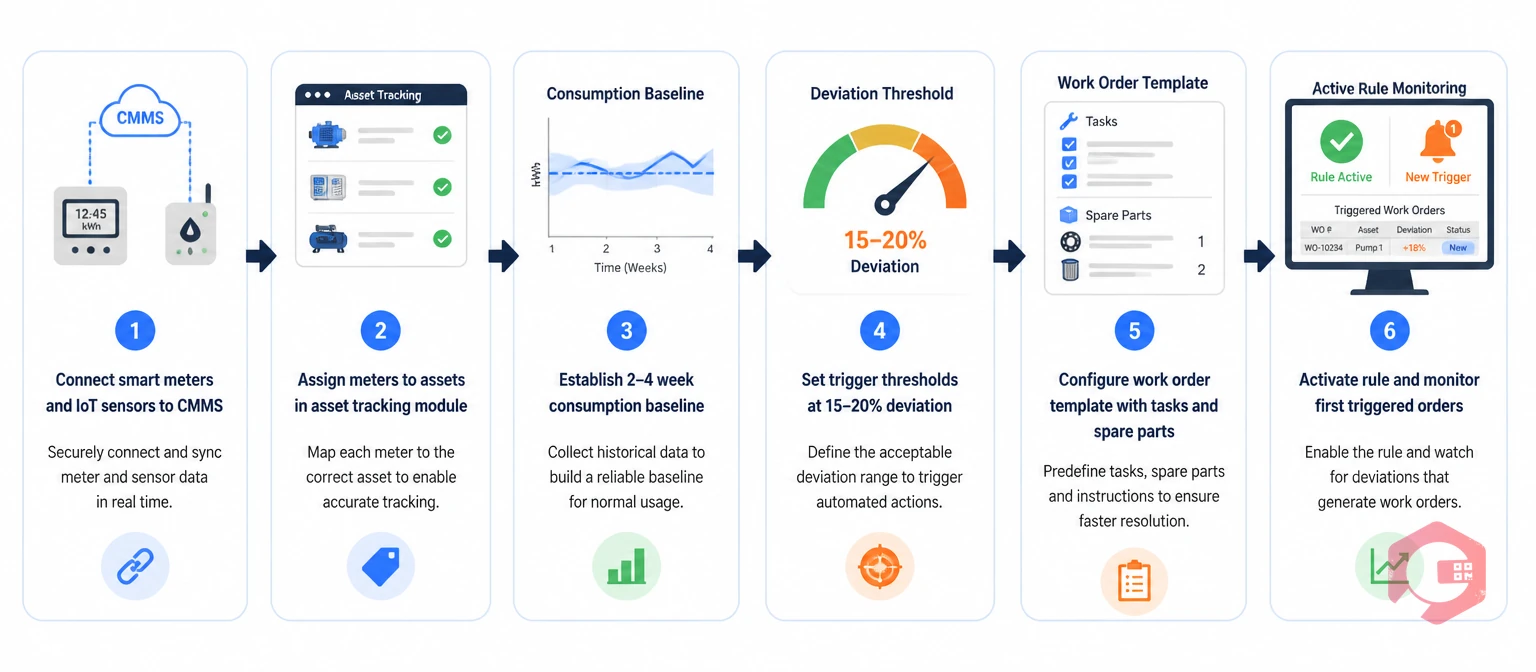
Getting energy triggers working is a configuration task, not a development project. If your CMMS supports IoT integration and workflow automation, the setup follows a clear sequence.
The workflow automation module handles the rule engine, escalation paths, and technician notifications — so no manual handoff is needed once the threshold is breached.
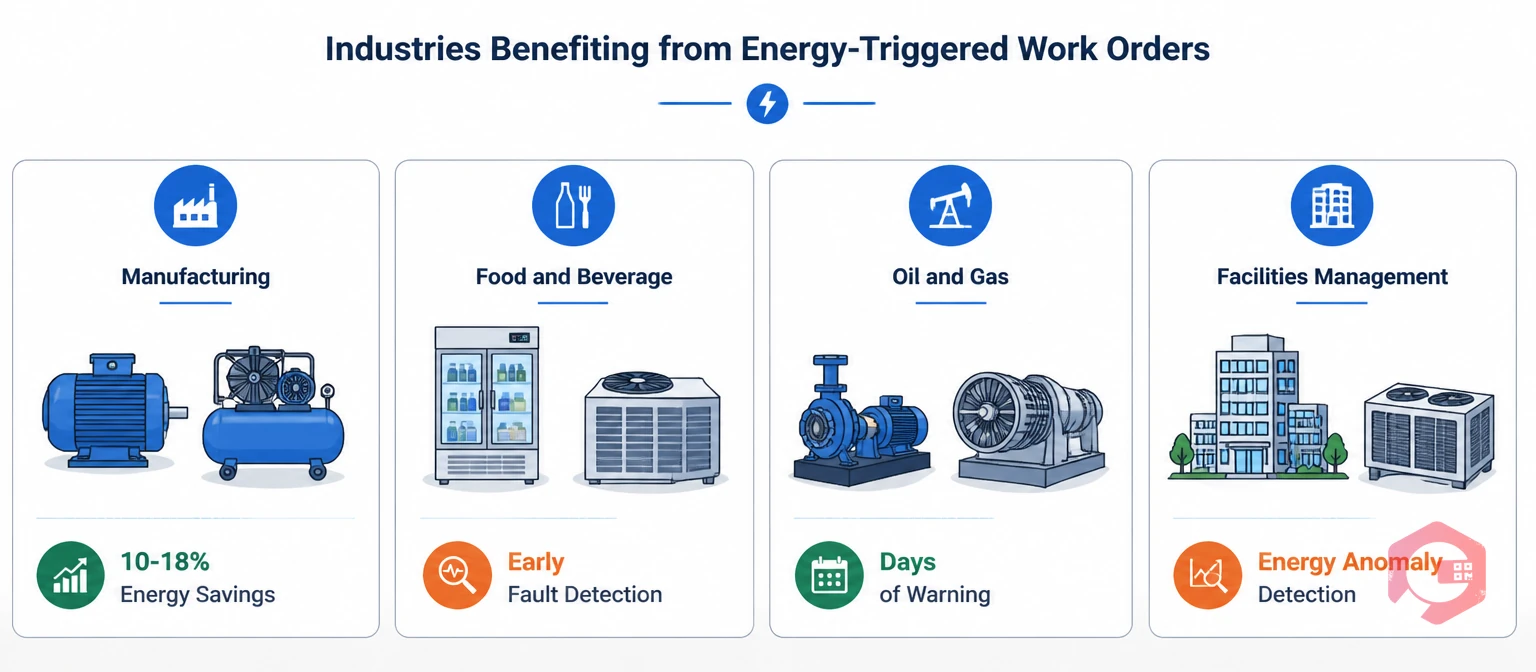
Energy-triggered maintenance delivers the clearest return in asset-intensive industries where energy is a significant operating cost and equipment failures are expensive.
Manufacturing operations typically run motors, compressors, and conveyors at high utilisation rates. Any deviation in motor current or compressed air draw indicates wear or inefficiency. Plants using energy-triggered work orders in manufacturing maintenance programmes report energy savings of 10–18% on targeted asset classes within the first year.
Food and beverage facilities rely on refrigeration and HVAC running within tight energy bands. A 10% rise in compressor power draw on a chiller often precedes a coil fouling or refrigerant issue. Catching it early avoids both food safety risk and expensive emergency compressor repair.
Oil and gas operations run high-value rotating equipment — pumps, turbines, compressors — where a single unplanned failure can cost hundreds of thousands of dollars in downtime. Energy monitoring on these assets gives maintenance teams days or weeks of warning, not minutes.
Facilities management teams managing large building portfolios use energy triggers on HVAC, lighting control systems, and pumps. A building that consumes 12% more power than its baseline in a given week almost always has a maintenance issue driving that increase — and the triggered work order finds it before the energy bill arrives. The facility management software ties energy data directly to the maintenance workflow.
Research from the International Energy Agency’s 2023 Energy Efficiency report finds that industrial energy efficiency measures, including condition-based maintenance, could reduce global industrial energy use by up to 25% by 2030 — reinforcing that energy-triggered maintenance is not an edge case but a mainstream cost reduction strategy.
Any asset with a consistent and measurable energy load is a good candidate — motors, compressors, pumps, HVAC units, conveyors, and refrigeration systems top the list. Assets that run continuously at known load profiles give the cleanest baseline data, making threshold deviations easy to detect and act on.
If your facility already has smart meters, PLCs, or a SCADA system, you likely have the hardware you need. The CMMS connects to these existing data sources via standard protocols. For assets without existing monitoring, a current transformer or IoT energy sensor — typically costing $50–$200 per point — is all that is required to start capturing data.
Energy-triggered maintenance is a practical, accessible subset of condition-based maintenance. Predictive maintenance typically involves more complex analytics — vibration analysis, thermography, oil analysis — and often requires specialised tools. Energy triggering uses data your facility already collects and acts on it with rules you configure yourself, making it faster to implement and easier to maintain.
Most teams see measurable results within 3–6 months of activation. The first 4–8 weeks are used to establish baselines and calibrate thresholds. Once the first wave of triggered work orders closes, you can compare repair costs, parts spend, and downtime tracking data against your pre-trigger baseline to quantify the saving directly.
Yes. You do not need a complex IoT infrastructure to start. A small facility can begin with two or three high-value assets — the ones most likely to fail or most expensive to run — and expand coverage as results demonstrate the value. A single prevented compressor failure typically covers the cost of setup for an entire year.
Energy-triggered work orders give your maintenance team the right information at the right time — firing automatically when your assets say they need attention, not when a calendar says so. If you want to see how this works in practice, Cryotos CMMS connects your energy data to your work order workflow — from IoT meter readings through to auto-assigned tasks and real-time technician notifications. Teams using Cryotos report up to 30% less unplanned downtime and 25% faster repair times. Book a demo to see how energy triggers can be configured for your asset base in under a day.




Cryotos AI predicts failures, automates work orders, and simplifies maintenance—before problems slow you down.



