

Missing downtime data in your work orders costs more than most maintenance teams realise. Every time a technician closes a work order without recording when the equipment stopped, when it restarted, and why it failed, your organisation loses the one piece of information it needs to prevent that failure from happening again. This article breaks down exactly what that loss costs you — in money, in repeat failures, and in missed maintenance decisions — and shows you how to fix it for good.
Downtime tracking inside a work order means recording four things: the time the asset stopped producing, the time it came back online, the category of failure (mechanical, electrical, operator error, etc.), and any contributing factors. Together, these fields give you the raw data to calculate Mean Time to Repair (MTTR), Mean Time Between Failures (MTBF), and overall equipment availability.
Without these fields, a work order is just a task record. With them, it becomes an asset intelligence report.
A complete downtime record inside a work order includes more than a start and end timestamp. The fields that teams most often leave blank are failure category, production impact (units lost or revenue affected), and the verified restart confirmation. These gaps are small individually. Across hundreds of work orders per month, they add up to a data black hole your maintenance strategy can't see through.

Technicians skip downtime fields for three main reasons. First, the fields are optional in the CMMS — and optional means skippable under pressure. Second, the connection between filling in a timestamp and preventing a future breakdown is abstract when you're standing next to a broken conveyor at 2 a.m. Third, in many operations, there is no feedback loop: technicians never see a report that references the data they entered, so it feels pointless.
The compounding problem is this: one missed downtime record is noise. Fifty missed records over a quarter is a pattern that looks like "we don't have enough data to analyse." Maintenance managers then make budget and scheduling decisions based on gut feel and tribal knowledge rather than actual failure history. Those decisions are frequently wrong — and the failures keep repeating.
According to a 2023 ABI Research study, manufacturers lose an average of $50 billion annually to unplanned downtime globally. A significant portion of that loss is preventable with better data capture — not better equipment.
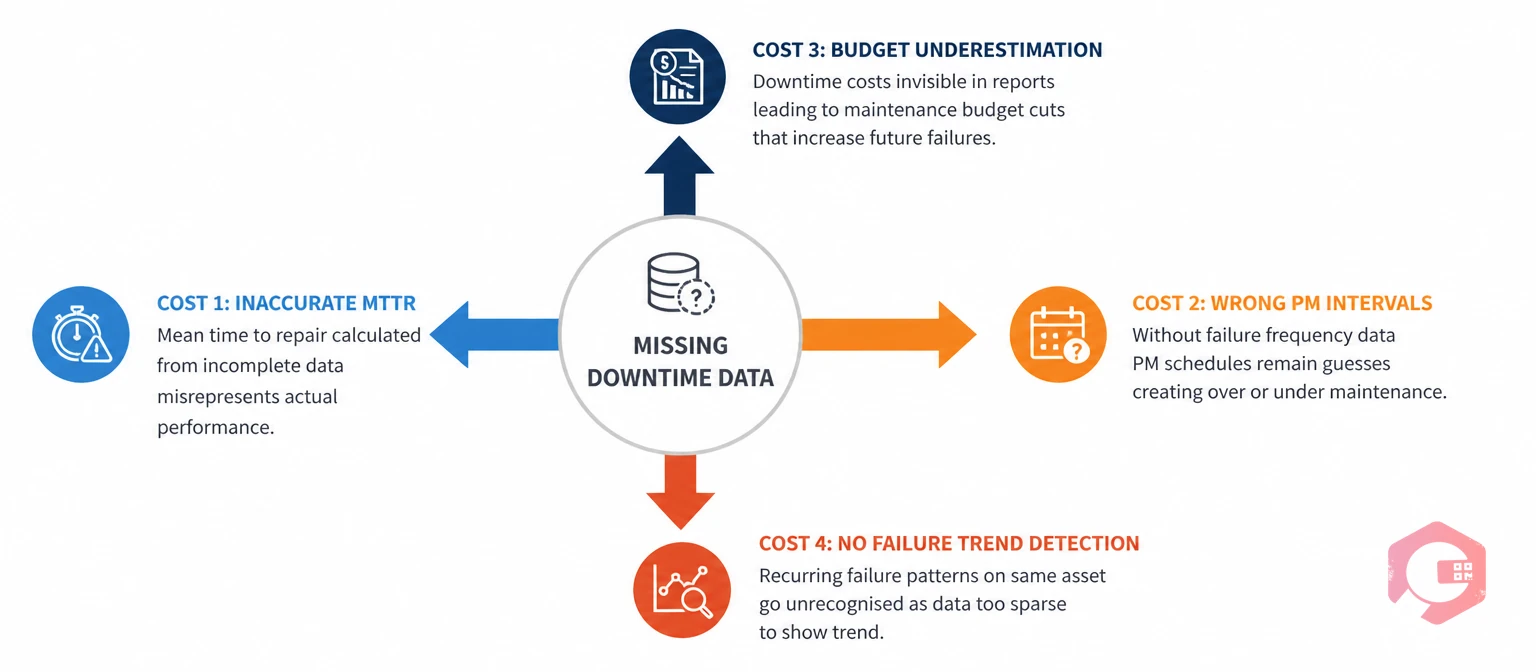
The financial impact of missing downtime data operates on three levels. The first is visible: you don't know your true cost per downtime event. The second is operational: your preventive maintenance schedule is based on guesses. The third is strategic: you can't make a reliable business case for capital investment in new equipment because you have no failure baseline to reference.
MTTR and MTBF are the two most important reliability metrics in maintenance. MTTR tells you how long repairs take on average. MTBF tells you how often a specific asset fails. Both require complete downtime timestamps from every work order to be meaningful. If 30% of your work orders are missing downtime start or end times, your MTTR is understated and your MTBF is overstated — both in the direction that makes your maintenance programme look healthier than it is. Use the MTTR calculator and MTBF calculator to see how much your current gaps are distorting your numbers.
Without downtime data, you can't rank assets by failure cost. That means budget tends to flow toward the assets that generate the most complaints, not the assets that generate the most downtime cost. A quiet pump that fails for four hours every six weeks may be costing you far more than the noisy compressor that gets all the attention. Downtime data in work orders is what surfaces that discrepancy.
The Plant Engineering 2024 Maintenance Survey found that 47% of maintenance managers reported making budget decisions without confidence in their downtime cost data. That uncertainty directly translates to overspending on low-impact assets and underspending on high-risk ones.
The clearest sign that downtime data is missing from your work orders is a repeat failure rate you can't explain. When failure category and root cause aren't captured at work order close, root cause analysis becomes retroactive archaeology — pulling technicians off active work to reconstruct events from memory. Most of the time, the real cause never surfaces, the fix is symptomatic rather than structural, and the same asset fails again in three months.
The difference between a complete and an incomplete work order isn't just cosmetic. Here is what each produces downstream:
| Factor | Work Order With Downtime Data | Work Order Without Downtime Data |
|---|---|---|
| MTTR Accuracy | Calculated from real timestamps | Estimated or unavailable |
| MTBF Reliability | Based on verified failure history | Based on incomplete records |
| Root Cause Visibility | Failure category captured at close | Requires manual reconstruction |
| Budget Justification | Supported by cost-per-downtime data | Relies on manager judgement |
| PM Schedule Quality | Interval tuned to actual failure frequency | Based on manufacturer default or guesswork |
| Repeat Failure Rate | Detectable and addressable | Invisible until failure recurs |
| Compliance Evidence | Audit-ready timestamped records | Gaps flagged in audits |
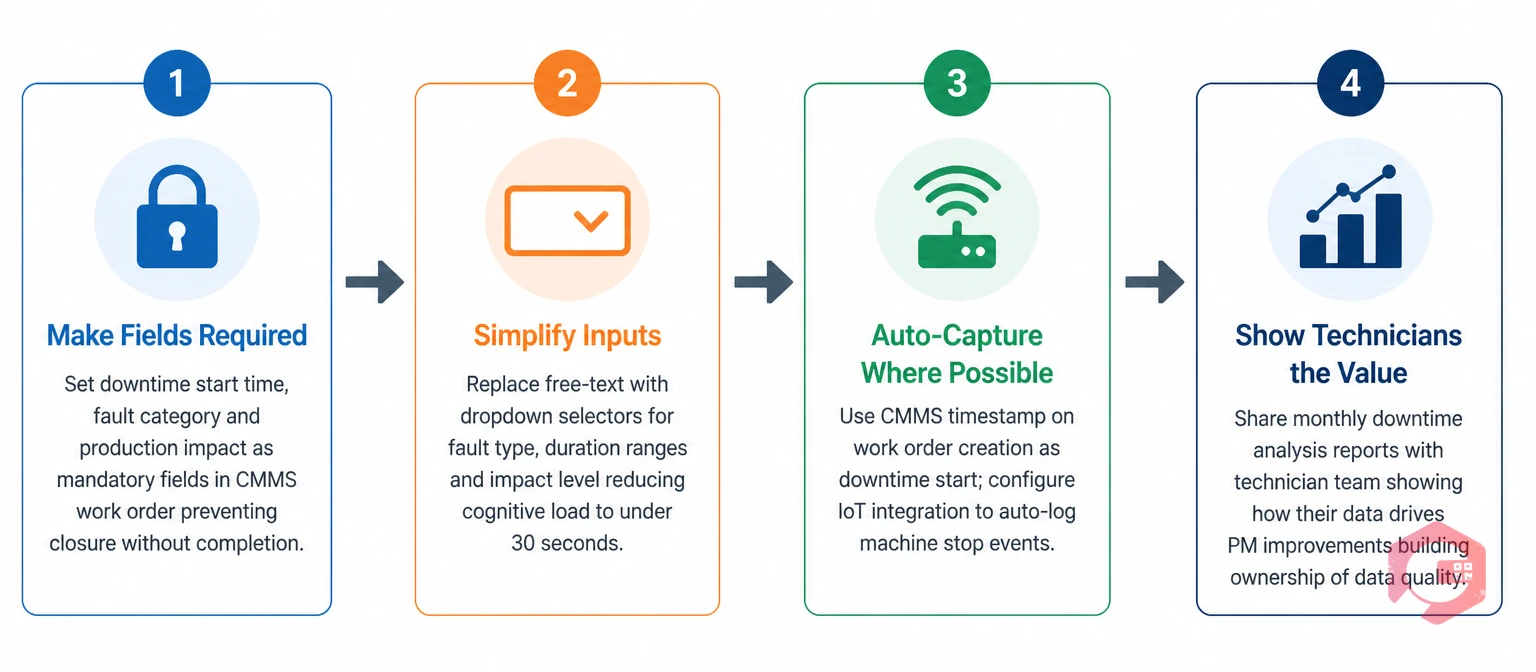
Fixing this problem doesn't require a technology overhaul. It requires four deliberate changes to how work orders are structured and closed.
According to Reliability Web, operations that mandate downtime field completion at work order close reduce their MTTR calculation errors by up to 40% within 90 days.
Cryotos downtime tracking is built directly into the work order workflow — not bolted on as a separate module. When a technician opens a work order on the mobile app, the system timestamps the start of the response. When they mark the asset as back online, the system timestamps the restart. Both are captured automatically, without the technician needing to remember to enter them manually.
Failure categories are configured as mandatory dropdowns, which means every work order closes with a structured failure record. That data feeds directly into the BI Dashboard, where maintenance managers can see MTTR, MTBF, downtime by department, downtime by asset class, and availability percentage — updated in real time, without any manual reporting.
Teams using Cryotos report a 30% reduction in downtime and 25% faster repairs within the first six months of deployment, driven primarily by the shift from incomplete work order records to complete, structured downtime data. The report builder lets you schedule automated downtime reports to leadership weekly, replacing the manual spreadsheet pull that most maintenance managers dread.
If you want to see how much your current downtime gaps are costing you, the unplanned downtime calculator will give you a baseline in under two minutes.
When downtime isn't recorded, you lose the ability to calculate accurate MTTR and MTBF metrics. Over time, this means your preventive maintenance schedules are based on assumptions rather than real failure patterns, which leads to both over-maintenance on reliable assets and under-maintenance on failure-prone ones. It also makes root cause analysis retroactive and unreliable.
The cost varies by industry and asset criticality. A general benchmark from Industry Week puts unplanned downtime at $260,000 per hour for automotive manufacturers and $50,000 per hour for mid-size food and beverage operations. Without downtime records, you can't identify which failures are driving the most cost — making every improvement initiative a guess.
The most common reasons are that the fields are optional in the system, there is no visible feedback showing how that data is used, and under production pressure, anything that isn't mandatory gets skipped. The fix is making downtime fields required at work order close and showing technicians the pattern data those records generate.
Yes. Modern CMMS platforms like Cryotos auto-timestamp work order open and close events, capturing response time and repair duration without technician input. IoT-connected assets can push downtime triggers directly into work orders via IoT meter reading, eliminating manual entry entirely for instrumented equipment.
Pull a report on your last 90 days of work orders and check the completion rate of downtime start time, end time, and failure category fields. If more than 15% of closed work orders are missing any one of these fields, you have a data gap that is materially affecting your reliability metrics. Most CMMS platforms can generate this report from the work order module in under five minutes.
Missing downtime data in your work orders is a silent tax on your maintenance operation. It inflates your repair times, distorts your reliability metrics, hides your most costly failures, and makes every maintenance budget conversation harder than it needs to be. The fix starts with making the right fields mandatory — and choosing a CMMS that captures them automatically. See how Cryotos turns every closed work order into a complete downtime record and gives your team the data it needs to stop repeat failures before they happen.




Cryotos AI predicts failures, automates work orders, and simplifies maintenance—before problems slow you down.



