
AI-powered maintenance uses machine learning and sensor data to predict equipment failures before they happen, while traditional maintenance relies on fixed schedules and reactive repairs. The practical difference shows up in three places: traditional programs spend more on emergency labor and unplanned downtime, AI-powered programs spend more upfront on sensors and software, and the break-even point between the two usually lands within 12 to 24 months for asset-intensive operations. This guide compares both approaches on cost, efficiency, and return on investment, so you can decide which one fits your facility today.
Key Takeaways
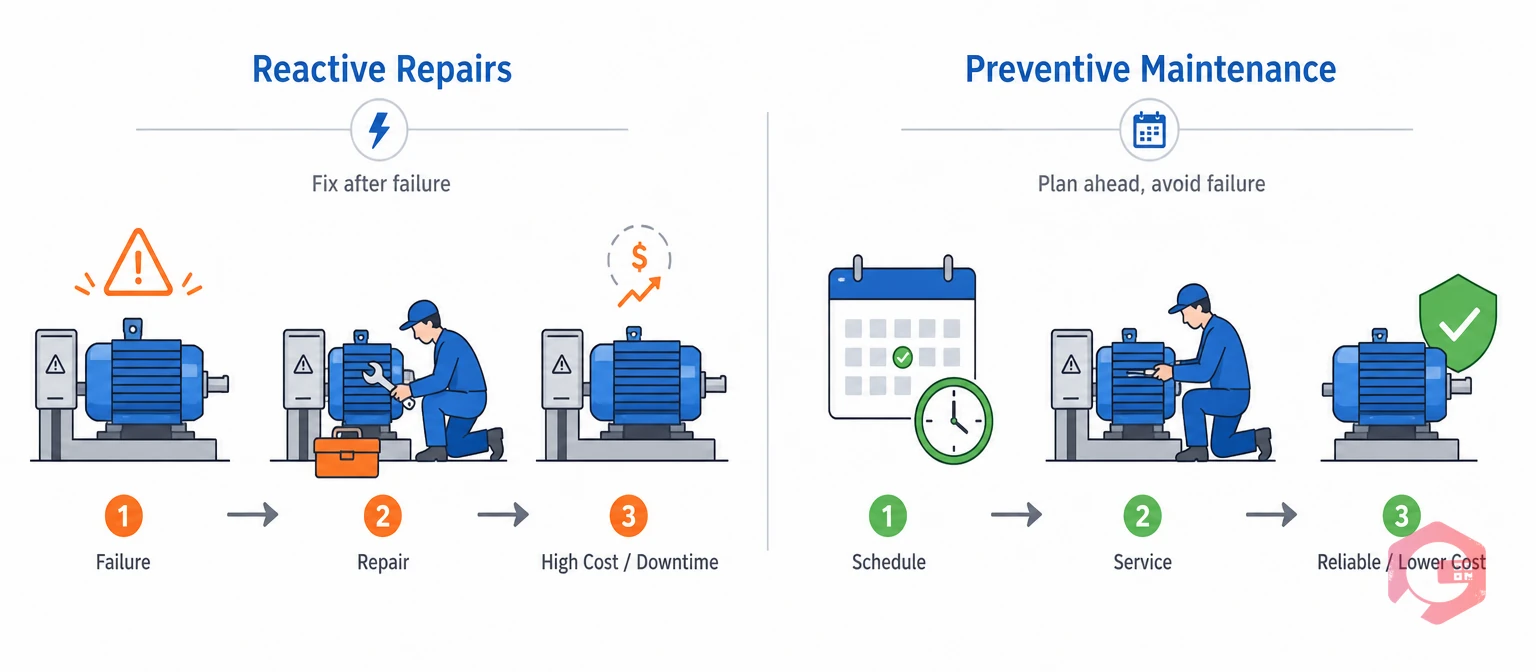
Traditional maintenance is a combination of reactive repairs and calendar-based preventive maintenance, where technicians fix equipment after it fails or service it on a fixed schedule regardless of actual condition. It has run manufacturing plants, hospitals, and facilities for decades because it's simple to plan and doesn't require sensors or software beyond a basic Computerized Maintenance Management System.
Two strategies make up most traditional programs:
A traditional preventive maintenance program reduces surprise failures compared to reactive-only maintenance, but it still guesses at timing. A pump serviced every 90 days might fail on day 60, or it might have run fine untouched for 150. Neither outcome shows up until the schedule forces a look or the asset breaks first.
Cost and simplicity keep traditional maintenance in place at most sites. It needs no sensor infrastructure, no data science expertise, and no change management beyond training technicians on a schedule. For low-criticality assets — a spare hand tool, a backup fan — that simplicity is a genuine advantage, not a limitation.
Traditional maintenance also benefits from decades of institutional knowledge. Experienced technicians often know a specific machine's quirks well enough to catch early warning signs on instinct, even without a sensor telling them something's off. That expertise doesn't disappear when a facility adds AI-powered monitoring — it becomes the check that validates or questions what the model is predicting, especially in the early months of a new program.
AI-powered maintenance uses sensor data, machine learning models, and historical failure patterns to predict when a specific piece of equipment is likely to fail, triggering a work order before the failure happens. Instead of servicing on a calendar, technicians act on a signal — rising vibration, temperature drift, or an unusual current draw — that indicates real, developing wear.
This is a step beyond basic predictive maintenance software that simply reads a meter. AI adds a pattern-recognition layer: the system learns what "normal" looks like for each asset, flags deviations automatically, and improves its predictions as more failure data accumulates.
A motor's vibration signature starts drifting outside its normal range on a Tuesday morning. The system flags it, cross-references similar failure patterns from comparable assets, and opens a work order rating the issue as medium-priority with an estimated two-week runway before failure. A technician schedules the repair for a planned downtime window instead of responding to an alarm at 2 a.m. That shift — from reacting to a failure to acting on a prediction — is the core operational difference AI brings to maintenance work. Over a year, that same pattern repeats across dozens of assets, and the cumulative effect is a maintenance calendar built around actual equipment condition instead of a fixed date on a spreadsheet.
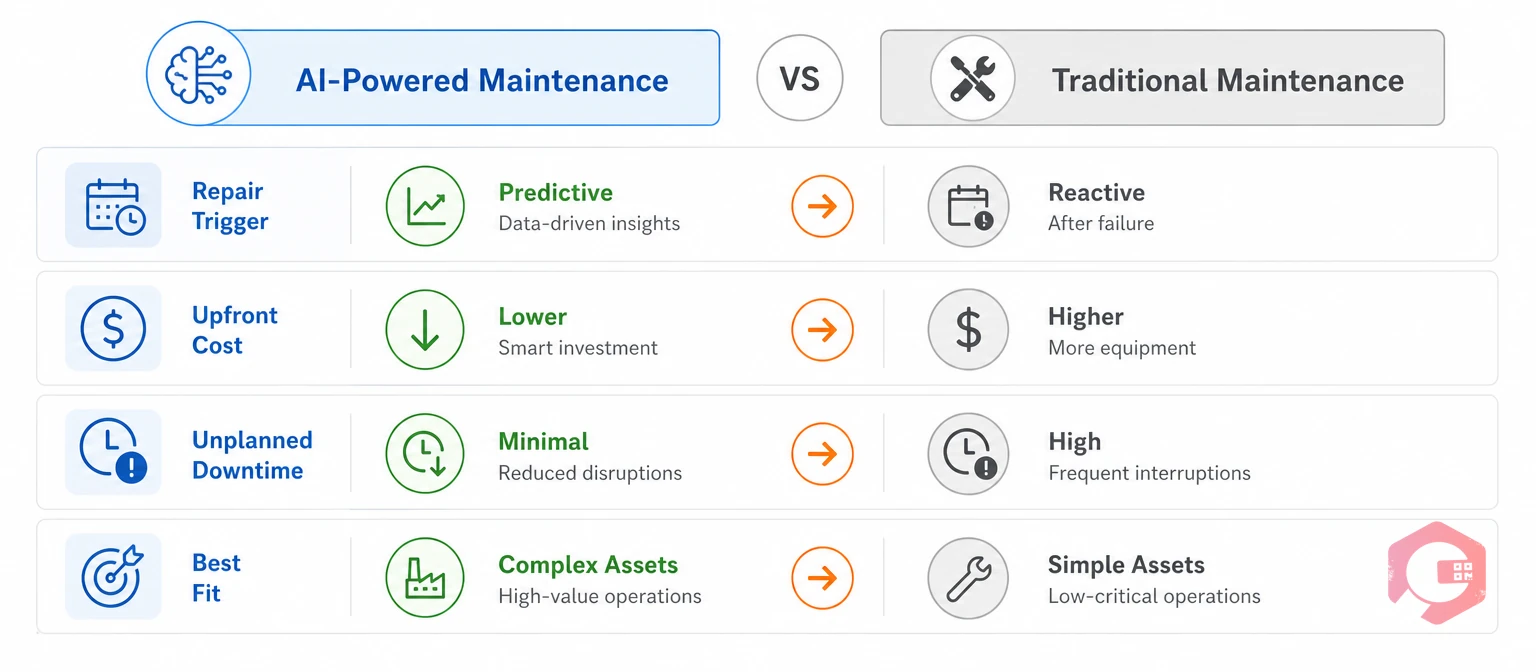
AI-powered and traditional maintenance differ most in timing, cost pattern, and how much manual judgment technicians need to apply. The table below compares both approaches across the factors that matter most when choosing between them.
| Factor | Traditional Maintenance | AI-Powered Maintenance |
|---|---|---|
| Trigger for repair | Fixed schedule or actual failure | Predicted failure signal from sensor data |
| Upfront cost | Low — mainly labor and basic software | Higher — sensors, integration, and platform cost |
| Ongoing cost driver | Emergency repairs and unplanned downtime | Software subscription and sensor upkeep |
| Unplanned downtime | Higher — failures often catch teams off guard | Lower — most failures are flagged in advance |
| Parts inventory needs | Broader safety stock to cover surprises | Leaner, since failure timing is more predictable |
| Best fit | Low-criticality, low-cost assets | High-value, high-downtime-cost equipment |
Neither approach is universally better — the table above is a starting point for deciding where each one fits, not a verdict that one should replace the other everywhere. A facility running mostly low-risk equipment gains little from AI monitoring on every asset, while a facility with a handful of production-critical machines can see outsized returns from adding it just there.
Curious what unplanned downtime is actually costing your operation today? Run your numbers through the MTTR calculator before deciding how much of your program to shift toward AI-powered monitoring.
Traditional maintenance costs less to start but more to sustain, while AI-powered maintenance costs more to start and less to sustain over time. The comparison only makes sense when you look at total cost of ownership, not just the sticker price of either approach.
| Cost Category | Traditional Maintenance | AI-Powered Maintenance |
|---|---|---|
| Initial investment | Minimal — existing tools and labor | Sensors, connectivity, and platform licensing |
| Labor cost pattern | Spikes during emergency repairs and overtime | More even, scheduled around planned windows |
| Unplanned downtime cost | Highest single cost driver in most programs | Reduced significantly through early warning |
| Spare parts carrying cost | Higher — buffer stock for unpredictable failures | Lower — parts ordered closer to actual need |
| Typical payback period | Not applicable — no new investment | Roughly 12 to 24 months on critical assets |
Maintenance costs are the total spend a facility incurs to keep equipment running, including labor, parts, downtime, and any monitoring technology. Facilities that only track labor and parts spend consistently underestimate their real maintenance costs, because downtime — lost production, missed orders, idle staff — rarely gets logged as a maintenance line item even though it's a direct consequence of how maintenance is run.
According to predictive maintenance research, unplanned downtime remains one of the largest hidden costs in asset-intensive industries, and it's precisely the cost category where AI-powered monitoring shows the clearest advantage over calendar-based schedules.
Consider two identical production lines over a three-year window. The line on traditional maintenance spends less in year one — no sensors, no new software — but absorbs six unplanned stops a year at roughly $8,000 in lost production and overtime each, adding up to about $144,000 across three years. The line running AI-powered monitoring spends $60,000 upfront on sensors and integration, then sees unplanned stops drop to two a year, bringing its three-year downtime cost to roughly $48,000 plus the initial investment. By year three, the AI-powered line has cost less in total, even though it started more expensive. That crossover point — not the sticker price in year one — is the number that should drive the decision.
The savings from AI-powered maintenance rarely come from cutting the maintenance budget outright. They come from shifting spend out of expensive, reactive categories — overtime labor, expedited parts shipping, production losses — into cheaper, planned ones. A facility that reduces unplanned downtime by even a fifth can free up meaningful budget without adding headcount, simply because fewer dollars are being spent putting out fires.
AI-powered maintenance changes efficiency by shifting technician time from diagnosis and firefighting toward planned execution. Traditional maintenance concentrates on scheduling; AI-powered maintenance concentrates on timing precision.
Unplanned downtime drops when a failure signal arrives days or weeks ahead of the actual breakdown, instead of the moment a machine stops. Maintenance teams using Cryotos have reported up to 30% reduction in unplanned downtime and 25% faster repair turnaround, largely because early warnings give planners room to schedule repairs during windows that don't interrupt production. Tracking this consistently requires reliable downtime tracking across every asset, not just the ones already wired with sensors.
Repairs move faster under AI-powered maintenance because technicians arrive knowing what's likely wrong instead of starting a diagnosis from zero. A predicted bearing failure, for example, lets a technician bring the right part and tool on the first trip, cutting the back-and-forth that stretches out a purely reactive repair.
Traditional preventive schedules often send technicians to inspect healthy equipment simply because the calendar says it's due. AI-powered maintenance redirects that same time toward assets actually showing early signs of wear, which most facilities describe as a better use of a scarce, skilled workforce.
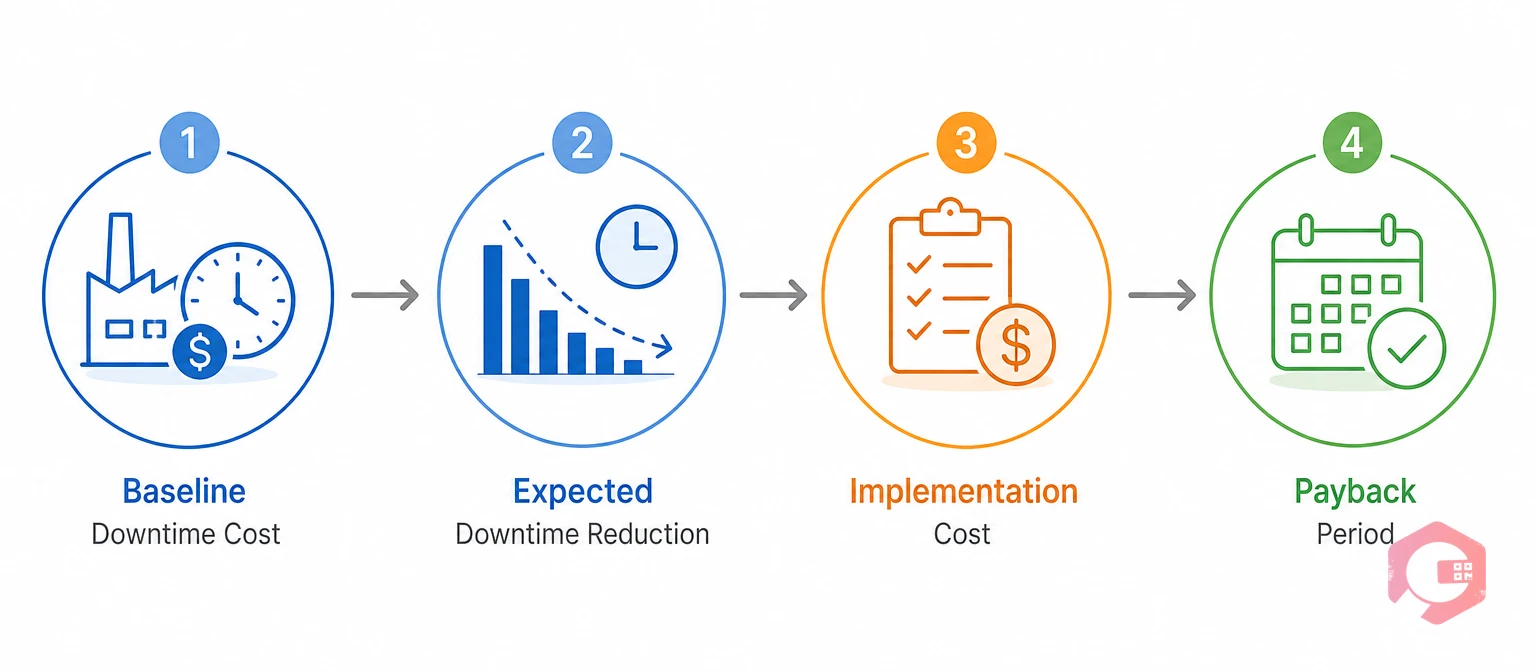
Return on investment for AI-powered maintenance depends on how much unplanned downtime costs today, how much a monitoring program actually reduces it, and how long that reduction takes to outweigh the platform's cost. The framework below breaks that calculation into four factors any maintenance leader can estimate from existing data.
The 4-Factor AI Maintenance ROI Framework:
A facility spending $400,000 a year on unplanned downtime that expects a 25% reduction would save roughly $100,000 annually. Against an implementation cost of $150,000, that puts payback at about 18 months — a timeline consistent with what most mid-size industrial facilities report for AI-powered monitoring on their highest-value assets.
Once implementation costs are paid off, the ongoing return comes almost entirely from avoided downtime and leaner parts inventory, since the sensor and software investment doesn't need to be repeated. Most facilities see the second and third year of an AI-powered program deliver a noticeably higher return than the first, simply because the upfront cost has already been absorbed.
Traditional maintenance still makes sense for low-criticality, low-cost assets, while AI-powered maintenance earns its cost fastest on equipment where a failure is expensive, unpredictable, or safety-relevant. The table below breaks down which approach fits which scenario.
| Scenario | Recommended Approach |
|---|---|
| Low-cost, easily replaceable asset | Traditional maintenance is usually sufficient |
| High-value production equipment | AI-powered monitoring pays back fastest here |
| Assets with unpredictable failure patterns | AI-powered maintenance catches what a fixed schedule misses |
| Safety-critical equipment | AI-powered monitoring adds an early-warning layer traditional PM can't match |
| Small facility, limited budget and data history | Start with traditional maintenance, add AI selectively later |
Most maintenance teams that succeed with AI-powered monitoring don't roll it out everywhere at once. They start with the assets where downtime is most expensive, prove out the return, and expand from there — leaving traditional preventive maintenance in place for everything else.
Five recurring obstacles slow down AI-powered maintenance adoption, even at facilities that clearly stand to benefit from it. None of them are unique to any one industry — they show up in manufacturing, healthcare facilities, and warehousing alike, which is part of why the same phased approach tends to work regardless of sector.
None of these barriers is permanent. Most facilities work through them by starting small — instrumenting a handful of critical assets first, tracking every alert's accuracy, and letting the results build the case for expanding the program, rather than trying to convert an entire facility at once.
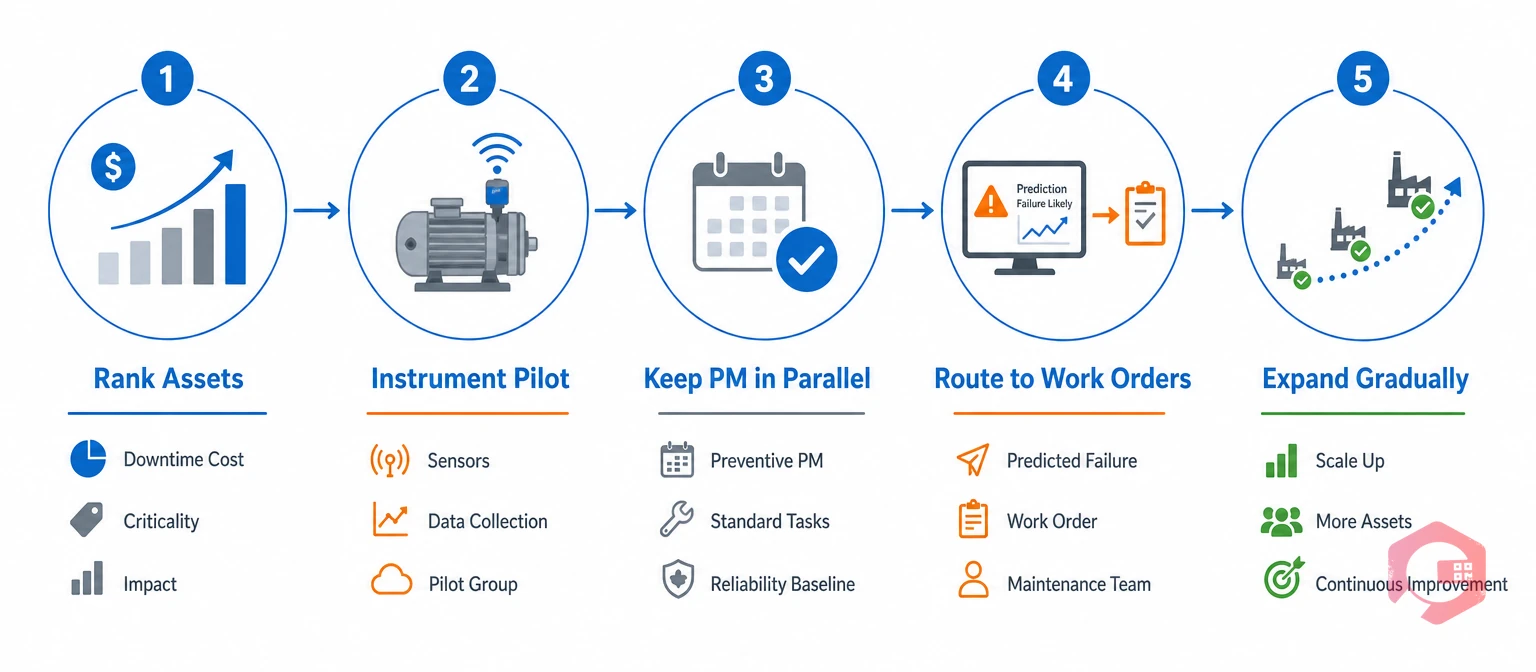
Moving from a traditional to an AI-powered maintenance program works best as a phased rollout, not a single system-wide switch.
A live view of what's actually happening across both systems makes this transition easier to manage. A BI dashboard that shows downtime, PM compliance, and alert accuracy side by side gives maintenance leaders one place to judge whether the pilot is working before committing more budget to it.
A few recurring patterns tend to show up before a facility formally decides to add AI-powered monitoring. Recognizing them early avoids months of avoidable downtime on assets that were already signaling trouble.
Any single sign here might be manageable on its own. Two or three together on the same set of assets usually mean the cost of staying on a fixed schedule has already exceeded what AI-powered monitoring would cost to add.
Picture a mid-size food and beverage plant running twelve production lines, each anchored by a handful of compressors and conveyor motors that have to run continuously during shifts. For years, the maintenance team ran a purely traditional program: preventive checks every 60 days, and reactive repairs whenever a compressor failed between scheduled visits.
Unplanned compressor failures were the single biggest source of downtime, averaging four unplanned stops a month, each costing several hours of lost production while a technician diagnosed the fault from scratch. The team's first move wasn't to replace the whole maintenance program — it was to instrument the six highest-value compressors with vibration and temperature sensors feeding into an AI-powered monitoring layer connected to their existing CMMS.
Within the first six months, the monitoring system flagged three developing bearing failures well before any of them caused an unplanned stop, giving the team time to schedule repairs during a planned changeover window instead of mid-shift. Unplanned downtime on those six compressors dropped by roughly a third, while the other machines on the plant floor — lower-value, lower-risk equipment — stayed on the traditional preventive schedule the team had always used.
The plant's maintenance manager made a deliberate choice not to instrument every asset at once. Spreading the sensor budget across the highest-downtime-cost equipment first meant the pilot proved its value quickly, which made the case for expanding the program to a second tier of assets the following year far easier to justify to finance. That sequencing — start with the assets where a failure costs the most, prove the return, then expand — is the same pattern that shows up across most successful AI-powered maintenance rollouts, regardless of industry.
It depends on asset value and downtime cost, not facility size alone. A small facility with a few high-value, high-downtime-cost machines can see a fast payback, while a small facility running mostly low-risk equipment may get little benefit from the added cost.
Implementation cost varies widely based on how many assets get instrumented and what sensor infrastructure already exists, but most mid-size deployments on a handful of critical assets fall in the tens of thousands of dollars rather than requiring a facility-wide overhaul.
Yes, and most facilities do exactly this. AI-powered monitoring typically covers the highest-value, highest-risk assets, while traditional preventive maintenance continues covering everything else.
Most facilities report payback within 12 to 24 months on critical assets, though the exact timeline depends on baseline downtime cost, implementation cost, and how much the program actually reduces unplanned failures.
No. It changes what technicians spend their time on — less time diagnosing failures from scratch, more time executing planned repairs — but the repair work itself still requires skilled hands.
A useful starting point is reliable asset history, downtime records, and enough sensor infrastructure on the pilot assets to feed the model real condition data. Facilities without any historical failure data can still start, but predictions take longer to become accurate.
Start with the equipment where an hour of unplanned downtime costs the most, not necessarily the equipment that fails most often. High-value, high-downtime-cost assets deliver the fastest, clearest return on a first pilot.
Often, yes. When failure timing becomes more predictable, teams can order parts closer to actual need instead of holding large buffer stock to cover unpredictable breakdowns, which frees up working capital tied up in inventory.
Choosing between AI-powered and traditional maintenance isn't really an all-or-nothing decision for most facilities — it's a question of where the return is largest and how fast you want to capture it. Schedule a free demo to see how Cryotos helps maintenance teams combine both approaches into one connected program.


Cryotos AI predicts failures, automates work orders, and simplifies maintenance—before problems slow you down.



