

AMC tracking is the practice of recording, for each asset, how many maintenance visits an annual maintenance contract promised, how many were delivered or skipped, and what the contract cost in total. It shows whether a contract is earning its fee while it runs, not only when it ends.
Most teams watch the expiry date and nothing else. A year can pass with visits missed or paid for but never delivered, and nobody sees it until renewal. This guide shows how to run AMC tracking visit by visit, mark skipped visits with a reason, and compare cost incurred against contract value. It also shows how a Computerized Maintenance Management System (CMMS) keeps that record for every asset.
Key Takeaways
AMC tracking is the visit-by-visit and cost-by-cost record of what an annual maintenance contract delivers for one asset. It turns a signed contract into a living checklist that maintenance teams can review at any point in the term.
An AMC is a service agreement under which a vendor carries out planned maintenance on an asset at set intervals. Those visits are a form of preventive maintenance, which is why they deserve the same discipline as any internal PM task.
Expiry and renewal alerts are a separate job, and expiration reminders handle them well. AMC tracking covers everything that happens between the start date and the end date.
A contract date tells you when coverage ends, not whether any service happened. An asset can sit under an active AMC for twelve months and still go without a single completed visit.
Picture a chiller with a four-visit AMC. The second visit is postponed because the plant is busy, the third is forgotten, and the contract renews on schedule. Maintenance teams in that position pay a full year of fees for half a year of service.
Asset management standards such as ISO 55000 centre on evidence that planned work is carried out and its results are reviewed. Visit-level records are the evidence that makes an AMC defensible. A contract you cannot measure is a contract you cannot manage.
AMC cost incurred is the contract fee plus every extra charge billed during the term. Tracking only the fee understates what the contract costs per delivered visit and hides the assets that keep generating add-on bills.
The clearest number in AMC tracking is cost per delivered visit: total cost incurred divided by the visits completed. A $1,200 contract with four visits plans for $300 per visit. If one visit is skipped and $150 of parts are billed, the cost becomes $1,350 across three visits, or $450 per delivered visit.
That gap is the signal to act on. The same view feeds a wider total cost of ownership picture for each asset, which helps when you decide whether to renew, renegotiate, or bring the work in house.
Want a quick benchmark for your own assets? Try the free mean maintenance cost calculator.
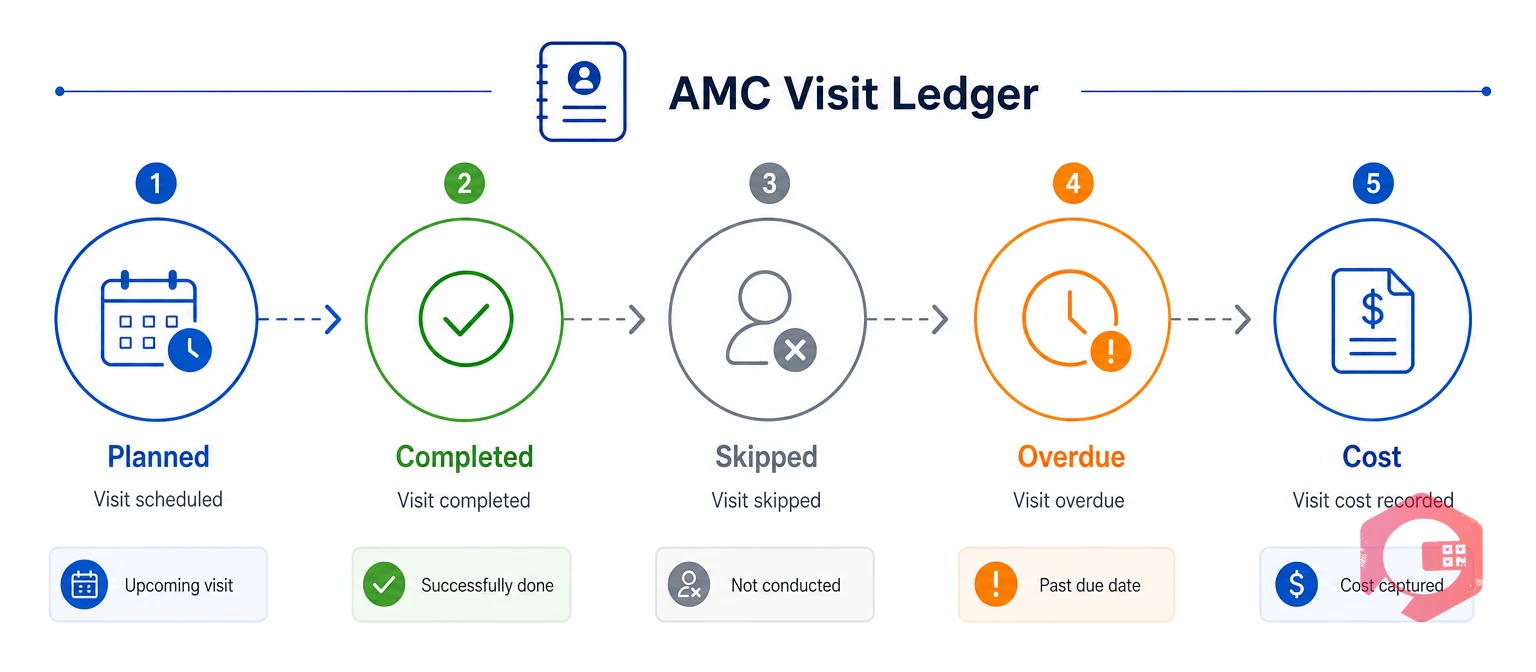
The AMC Visit Ledger is a five-part record that gives every visit on every contract a clear status and a clear cost. It keeps AMC tracking consistent across assets, vendors, and sites.
The AMC Visit Ledger:
Spreading visits evenly means dividing the days in the contract term by the number of visits. A 365-day AMC with four visits gives one visit about every 91 days, with the last visit landing on the final day of the term at the latest.
Because AMC visits behave like scheduled PMs, many teams manage them alongside their preventive maintenance software schedule, so contract visits and internal tasks sit on one calendar.
A sample AMC visit schedule shows how the ledger looks at the end of a term. The table below is illustrative: one asset, a $1,200 contract, four evenly spread visits.
| Visit | Scheduled (Day of Term) | Status | Cost Incurred | Note |
|---|---|---|---|---|
| Visit 1 | Day 91 | Completed | $0 | Service report signed on site |
| Visit 2 | Day 182 | Completed | $150 | Filter parts billed outside the contract |
| Visit 3 | Day 273 | Skipped | $0 | Plant shutdown; reason recorded and vendor informed |
| Visit 4 | Day 364 | Completed | $0 | Final visit before the end of the term |
Three of four visits were delivered, and total cost incurred was $1,350. That is $450 per delivered visit against a planned $300, and the skipped visit is on record with a reason you can raise with the vendor.
A skipped visit is a scheduled AMC visit that will not happen in its planned window, recorded with a reason instead of being left open or closed as done. Marking it keeps the record truthful and keeps the visit visible.
Skipping is a deliberate decision, not a failure to update the system. Common reasons include a plant shutdown, an asset taken out of service, restricted site access, or a vendor who cannot attend.
A skipped visit should never count toward completed visits, and it should not sit in the overdue list. It keeps its own status and stays in the visit list with its reason, so completion figures stay honest and a pattern of skips on one asset is easy to spot.
Teams that skip without recording it lose the argument at renewal. Teams that record it can ask for a credit or a make-up visit.
A CMMS beats a spreadsheet for AMC tracking because it creates the visits, updates their status from real work, and keeps cost with the contract. A spreadsheet depends on someone remembering to update it.
| Area | Spreadsheet | CMMS |
|---|---|---|
| Visit schedule | Dates typed by hand | Visits created from the start date, end date, and visit count |
| Visit status | Updated when someone remembers | Changes when the linked work order is closed |
| Skipped visits | A cell comment, if any | Recorded with a reason and kept in the visit list |
| Overdue visits | Found at the next review | Flagged against the scheduled date |
| Cost | Held in a separate finance file | Recorded against the AMC and the asset |
| Per-asset view | One tab per vendor | All contracts and visits on the asset record |
The gap widens with scale. A spreadsheet is fine for ten assets, and it fails when contracts, vendors, and sites multiply.
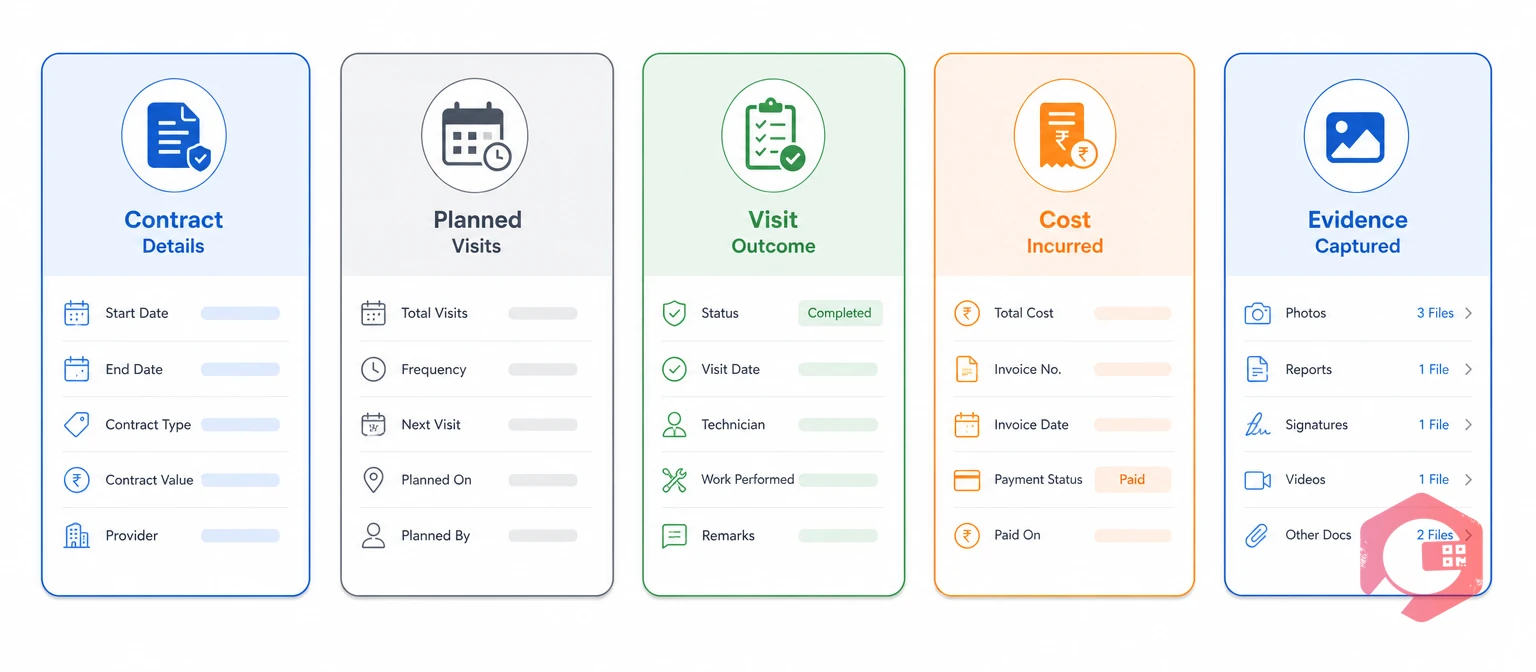
Cryotos tracks an AMC as a set of dated visits linked to each asset, so the contract is measured by delivery and not only by its end date. Each AMC of the Asset type carries the details below.
Visits run through work order management, so the technician, the checklist, and the sign-off are all captured. Contract details, provider, cost, remarks, and files live on the AMC itself, and the AMC appears on the asset record that your asset tracking already uses.
For wider reporting, Cryotos also offers a maintenance KPI dashboard that teams can use alongside the AMC jobs view.
Maintenance teams using Cryotos have reported up to 30% reduction in unplanned downtime and 25% faster repair turnaround. Reliable visit records are one of the habits that support results like these.
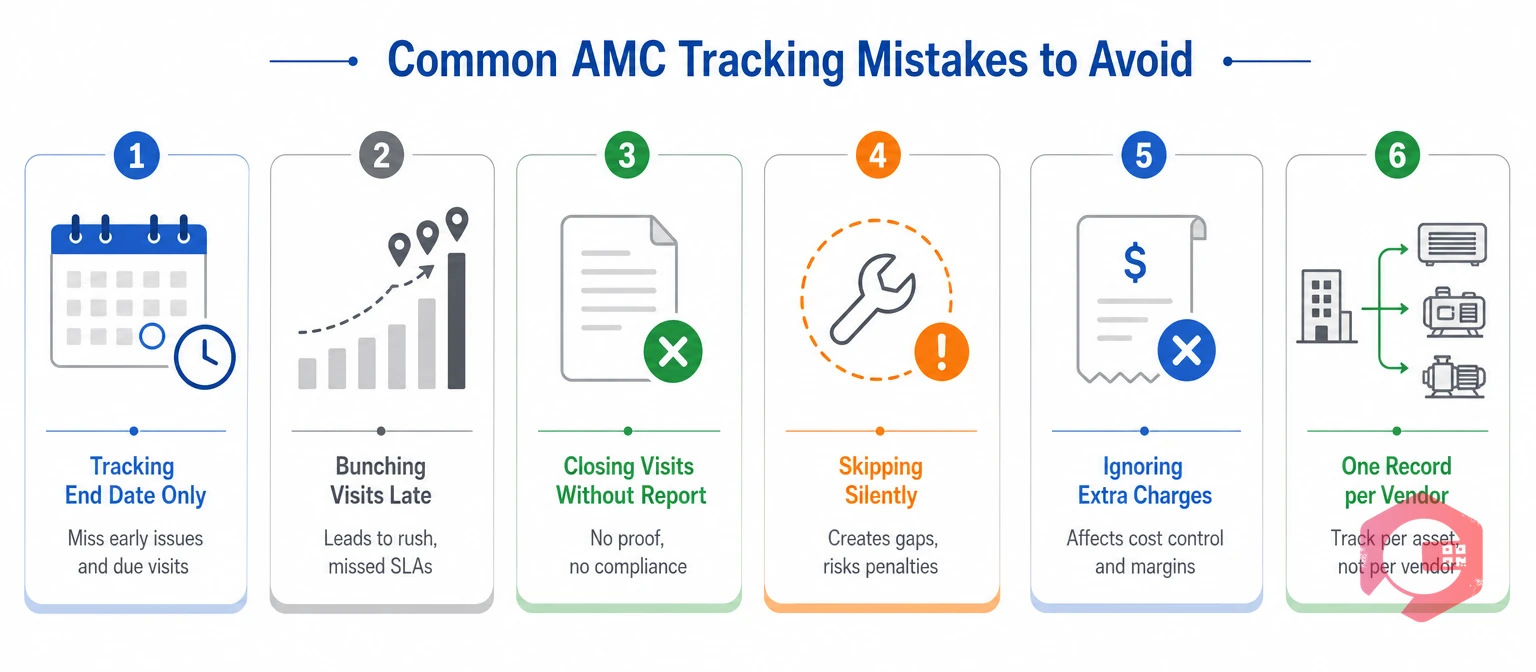
The most common AMC tracking mistake is treating the contract as a one-time purchase instead of a series of visits to verify. Operations that manage AMCs well avoid a short list of habits.
Each of these is a process gap rather than a vendor problem, and each closes once visits and costs are recorded against the asset.
AMC tracking for an asset is the record of how many service visits an annual maintenance contract promised, how many were completed or skipped, and what the contract cost. It lets you judge a contract by what it delivered during the term.
Match the visit count to the asset's servicing needs and the manufacturer's guidance. Quarterly visits suit many critical assets, while a lower-risk asset may need only one or two visits a year. Set the number in the contract, then track it visit by visit.
Mark the visit as skipped and record the reason, who approved it, and the date. Then agree with the vendor whether a make-up visit is owed. Never close a skipped visit as completed, because that hides a gap in service.
Add the contract fee to every extra charge billed during the term, including parts, extra call-outs, and travel. Then divide the total by the visits completed to get cost per delivered visit. Compare it with the planned cost per visit.
AMC expiry reminders alert you before a contract ends so you can renew it. AMC tracking records what happens during the term: the visits, the skips, and the cost. Strong teams use both.
Yes. A CMMS can create the visit schedule from the contract dates and visit count, link each visit to a work order, and show completed, overdue, and pending visits on a dashboard. Cost and contract details stay on the same record.
AMC tracking works when every visit, skip, and charge is recorded against the asset it belongs to. Schedule a free demo to see how Cryotos plans AMC visits, tracks job progress, and shows completed, overdue, and pending AMC jobs in one dashboard.



Cryotos AI predicts failures, automates work orders, and simplifies maintenance—before problems slow you down.



