

ISO 55000 is the international family of standards that defines how organizations plan, operate, and improve the way they manage physical assets. The goal is to get more value from equipment while controlling cost and risk. For maintenance teams already running a Computerized Maintenance Management System (CMMS), ISO 55000 doesn't ask you to start from scratch. It asks you to prove, with data, that the work you already do follows a structured, risk-based approach. The standard covers three linked documents: ISO 55000, 55001, and 55002. Its current edition, ISO 55000:2024, replaced the original 2014 version. This guide breaks down what the standard actually requires, how it maps to features already inside a CMMS, and what to change to move toward alignment.
Key Takeaways
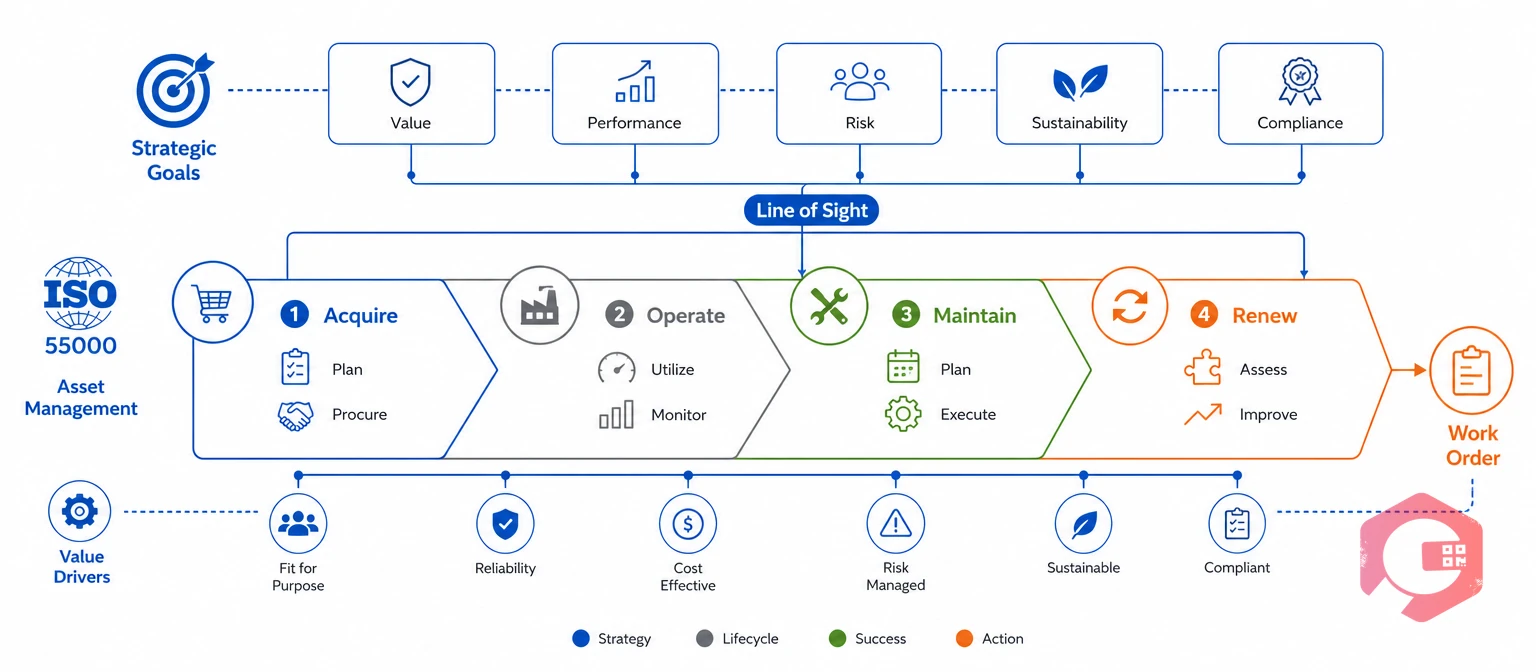
ISO 55000 is a standard that guides how organizations manage physical assets to control cost and risk. It was published by the International Organization for Standardization. It applies to any organization that owns or runs equipment, facilities, vehicles, or infrastructure. That includes small facilities teams, not just heavy industry.
The standard treats asset management as more than routine upkeep. It asks teams to connect day-to-day maintenance decisions back to strategic goals. The standard calls this the "line of sight." A work order on a single pump should trace back to a documented reason: risk, cost, or performance targets.
ISO 55000 covers the full asset lifecycle. That means acquisition, operation, maintenance, and eventual renewal or disposal. At each stage, decisions need to be risk-based. They also need to be written down, not made on the fly.
ISO 55000 was written for any organization that depends on physical assets to deliver value. That covers far more than heavy industry. The standard applies just as well to a hospital tracking medical equipment as it does to a power plant tracking turbines.
If your team already runs a CMMS, you likely have most of the raw material ISO 55000 expects. The work is mostly about organizing that data, not collecting new data from scratch. Small teams often finish this organizing work faster than large multi-site operations simply because there is less legacy data to untangle.
ISO 55000 is one of three related documents. Mixing them up is the most common mistake maintenance teams make when they first research the standard.
| Standard | Focus | Certifiable? |
|---|---|---|
| ISO 55000 | Overview, terminology, and principles | No |
| ISO 55001 | Requirements for an asset management system | Yes |
| ISO 55002 | Guidance for applying ISO 55001 | No |
Only ISO 55001 is certifiable. The other two documents support it with definitions and step-by-step guidance. Auditors check your organization against ISO 55001, not the other two.
ISO 55000:2014 was formally withdrawn. It was replaced by ISO 55000:2024 after a revision process that ran through mid-2024. The 2024 edition restructures the standard around a smaller set of core ideas.
For CMMS users, the practical impact is small. The underlying maintenance data requirements have not changed. What has changed is the emphasis on proving outcomes, which puts more weight on the reporting and trend-analysis tools already built into most maintenance software.
Cryotos' QR code asset tagging gives every asset a traceable identity from day one. That is the starting point most ISO 55000 gap assessments flag as missing.
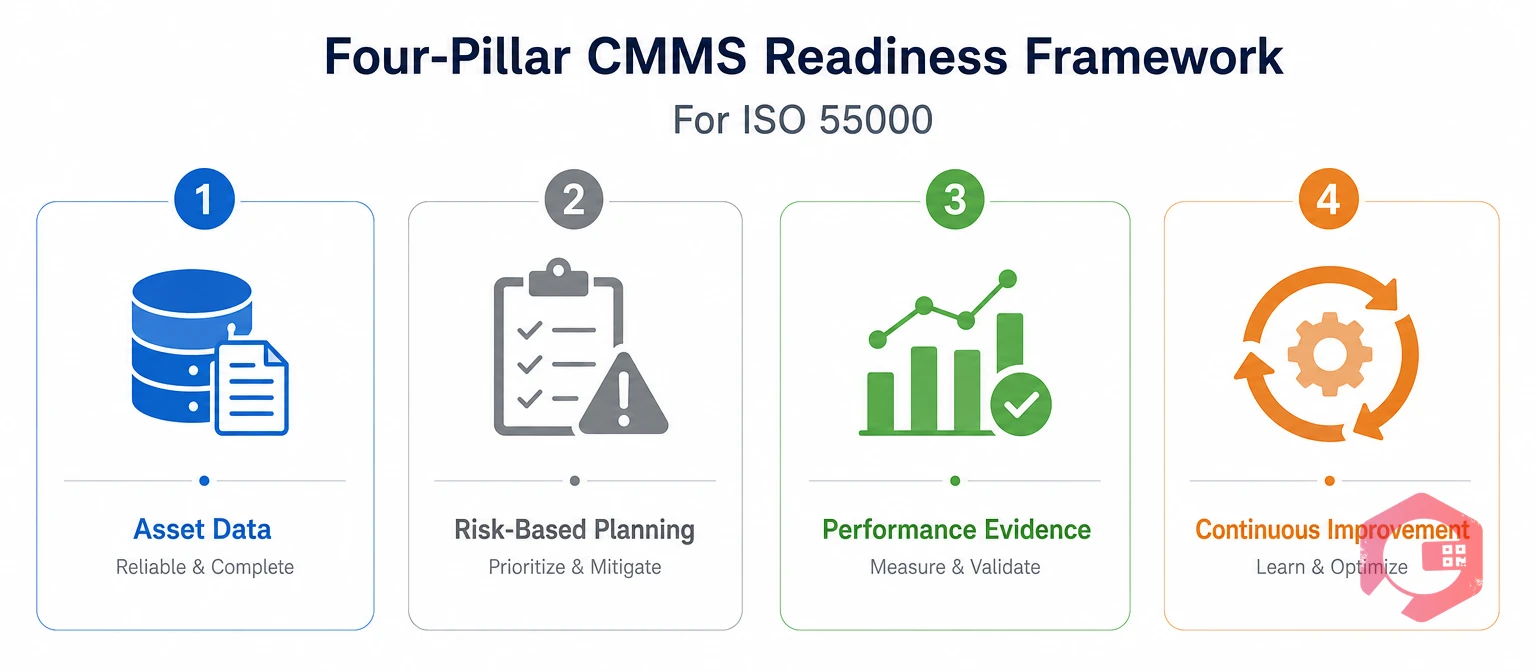
ISO 55001 does not name any specific software. But its clauses translate directly into features a CMMS already has. Most maintenance teams already own the pieces. ISO 55000 asks you to connect them in a formal, documented way.
The Four-Pillar CMMS Readiness Framework: a practical way to check where your maintenance software already supports ISO 55000, and where the gaps sit.
Most maintenance teams already sit at 60-70% alignment without realizing it. The missing piece is almost always a formal criticality classification, plus a documented link between failure history and PM schedule changes. Closing that gap is usually a data and process exercise, not a software purchase.
Auditors check evidence clause by clause. This matrix shows where each requirement area typically lives inside a CMMS.
| ISO 55001 Clause | Requirement | CMMS Capability | Typical Evidence |
|---|---|---|---|
| Clause 6 (Planning) | Risk assessment and asset objectives | Criticality tagging, risk-based PM scheduling | Risk register, PM frequency justification |
| Clause 7 (Support) | Competence and documented information | Role-based access, document storage | Training logs, SOP attachments, audit trail |
| Clause 8 (Operation) | Operational planning and control | Work order management, vendor tracking | Work order history, contractor records |
| Clause 9 (Performance Evaluation) | Monitoring and management review | KPI dashboards, MTTR/MTBF reporting | Dashboard exports, review minutes |
| Clause 10 (Improvement) | Corrective action and continual improvement | Root-cause tracking, CAPA workflows | Failure codes, corrective action logs |
Larger portfolios that combine a CMMS with EAM software get the same clause coverage. They also gain extra financial and capital-planning depth for Clause 6 and Clause 9. That extra depth helps once asset counts grow into the thousands. Budgeting decisions get easier with clearer cost data behind them.
Most teams do not fail an ISO 55000 gap assessment because they lack a CMMS. They fail because the CMMS is not being used the way the standard expects. A few patterns show up again and again.
None of these gaps require new software. They require a short, focused cleanup project inside the CMMS you already run. Most teams can close two or three of these gaps in a single quarter once someone owns the task and reports progress to leadership on a set schedule.
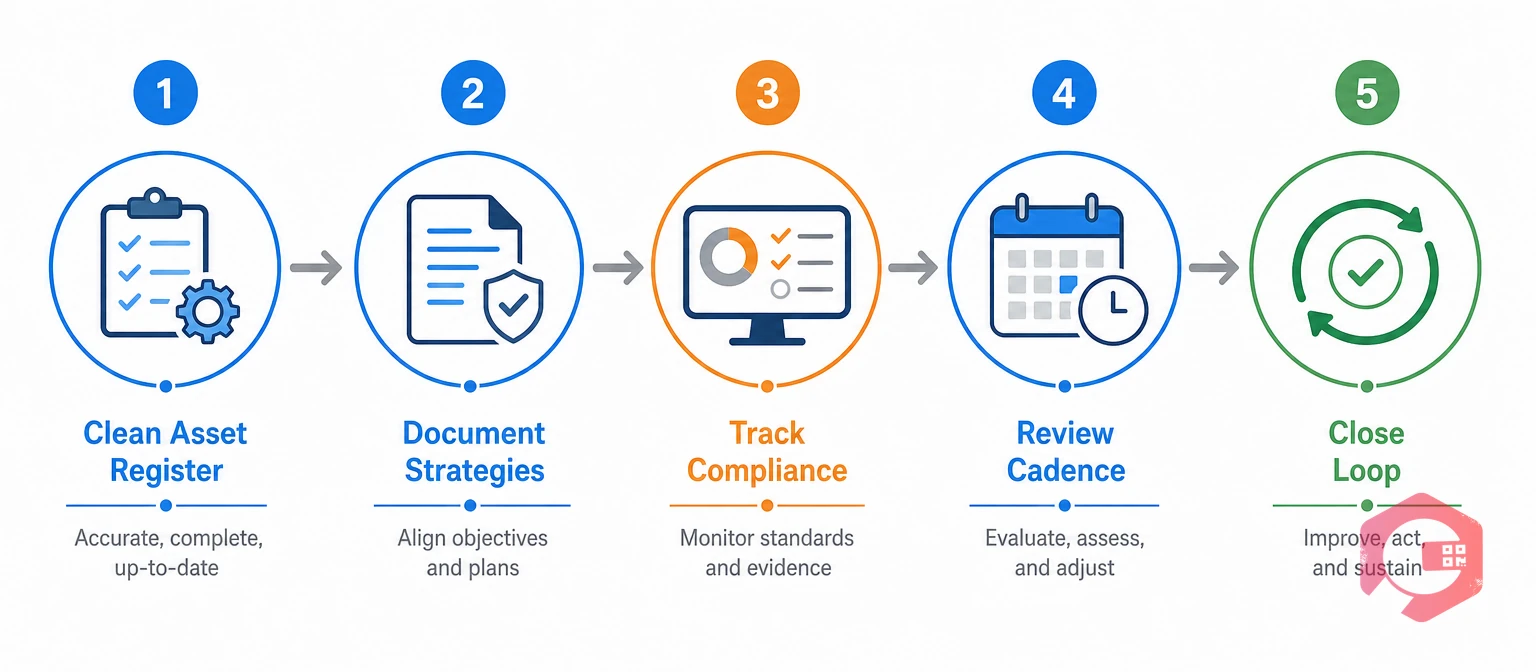
Getting audit-ready does not mean replacing your maintenance software. It means configuring and using it the way ISO 55000 expects.
The history of the ISO 55000 standard shows how far the discipline has moved since the 2014 release. That context is worth sharing with leadership. It helps frame this work as a value driver, not just a paperwork exercise.
It is a set of international guidelines for managing physical assets, from purchase to disposal. The goal is consistent value from those assets while keeping risk and cost under control. Think of it as a checklist for running maintenance like a disciplined business function instead of a series of one-off repairs.
No. A CMMS works with or without certification. Aligning it with the standard simply makes your maintenance data more structured, auditable, and useful for proving good practice to customers, insurers, or regulators. Many teams start aligning their CMMS long before they decide whether to pursue formal certification.
ISO 55000 explains the concepts and terms used across the family of standards. ISO 55001 sets the specific, certifiable requirements an asset management system must meet. Organizations get audited against ISO 55001, never against ISO 55000 directly.
No single tool creates compliance by itself. A CMMS supplies the asset data, risk records, and performance evidence auditors look for. Leadership commitment and documented processes still have to come from the organization.
Most organizations spend three to four months on this work. That time covers cleaning up asset data, documenting strategies for critical assets, and setting up a regular management review before the first formal gap assessment.
Aligning your maintenance program with ISO 55000 starts with the data already sitting inside your CMMS. Schedule a free demo to see how Cryotos turns everyday work orders into the asset management evidence ISO 55001 auditors expect.



Cryotos AI predicts failures, automates work orders, and simplifies maintenance—before problems slow you down.



