

Spare parts traceability is the ability to follow every component from its original manufacturer, through your storeroom, to the exact asset where it was installed. With a documented chain like that, a fake or unapproved part has far fewer places to hide. A maintenance system that records each handoff lets you prove where a part came from and isolate a bad batch in minutes.
Counterfeit parts are not only a defense or aerospace problem. Fake bearings, seals, breakers, and control boards now reach ordinary plants through gray-market sellers and rushed emergency buys. This guide explains what traceability means for maintenance teams, how fake parts get in, and how to build a traceability chain inside your CMMS that stops them.
Key Takeaways

Spare parts traceability is the documented record of where a part came from, who handled it, where it was stored, and which asset it was installed on. It turns every component into an item with a known history instead of an anonymous box on a shelf.
Asset traceability is the linked history of every part, repair, and inspection performed on a single piece of equipment. When the two are connected, you can look at a pump and see which seal kit, from which supplier and lot, went into it last March.
Traceability is built into several industry frameworks. Maintenance teams that follow them treat part history as a compliance record, not a nice-to-have:
In short, traceability means you can answer "where did this part come from?" with a record, not a guess.
Counterfeit components are a growing maintenance risk because they look real, cost less, and fail early. A fake bearing can pass a visual check and still seize after a few hundred hours. A cloned circuit breaker may not trip at its rated current.
The problem has scaled fast. A US Department of Commerce study found that reported counterfeit incidents grew from 3,868 in 2005 to 9,356 in 2008, more than doubling in three years. Electronics led the trend, but mechanical and electrical spares have followed as online marketplaces have grown.
The cheapest part on the invoice is often the most expensive part on the balance sheet.

Counterfeit parts enter maintenance supply chains through weak points in buying, receiving, and storage. Most facilities do not buy fakes on purpose. They buy them under time pressure, from a source nobody checked.
A common mistake is treating parts history as a purchasing problem only. In practice, the gap usually opens in the storeroom or on the shop floor, after the purchase order is closed.
Want to find these gaps in your own stores? Run through the MRO inventory checklist to see where untracked stock is building up.
Traceable spare parts carry a documented history at every stage, while untraceable parts rely on memory and trust. The comparison below shows how that difference plays out in daily maintenance work.
| Stage | Traceable Parts | Untraceable Parts |
|---|---|---|
| Sourcing | Bought only from approved, vetted suppliers | Bought from any seller with stock |
| Receiving | Certificate of conformance, lot, and serial checked and logged | Box counted and shelved |
| Storage | QR-labeled bin location with stock status | Mixed bins, unknown condition |
| Installation | Part serial linked to asset through the work order | No record of which part went where |
| Recall response | Affected assets found in minutes | Manual search across sites for days |
| Audit readiness | Full history exported on demand | Paper trail rebuilt from emails and invoices |
The gap is widest at installation. Many plants track purchases well but lose the thread once a technician takes a part off the shelf. That missing link is exactly what counterfeit parts exploit.
A Computerized Maintenance Management System enables spare parts traceability by connecting suppliers, stock, work orders, and assets in one record. Each transaction becomes a time-stamped entry that no one has to remember later.
The system holds a list of approved vendors for each part. Buyers and technicians can raise requests only against those sources, which cuts off gray-market buying at the start.
Every part, lot, or serialized item gets a unique ID and a label. With asset QR code scanning, a technician scans the bin and the machine, and the system records both the issue and the installation in one step.
When a part is issued against a work order, the CMMS writes its lot or serial number into the asset history. This creates the last link in the chain, from supplier to socket.
Cryotos ties all of these steps together in its spare parts inventory software, so every movement of a part is logged without extra paperwork.
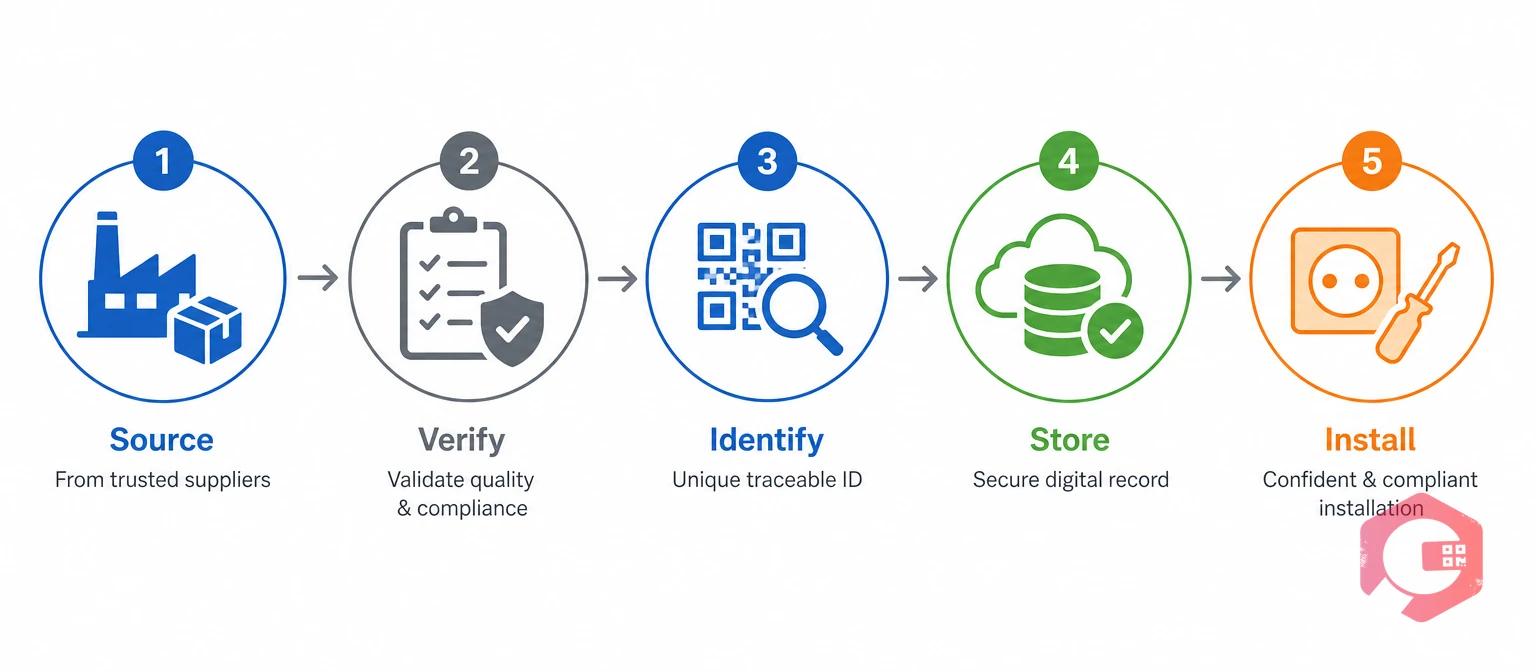
The Source-to-Socket Traceability Framework is a five-link model for keeping every spare part traceable from purchase to installation. If any single link breaks, the part loses its proof of origin.
The Source-to-Socket Traceability Framework:
A traceability gap is any point where a part changes hands without a recorded transaction. Auditing your process against these five links shows exactly where gaps sit today.
Teams that apply this framework often find that Link 4 and Link 5 are the weakest. Fixing those two links alone closes most counterfeit exposure in a typical plant.
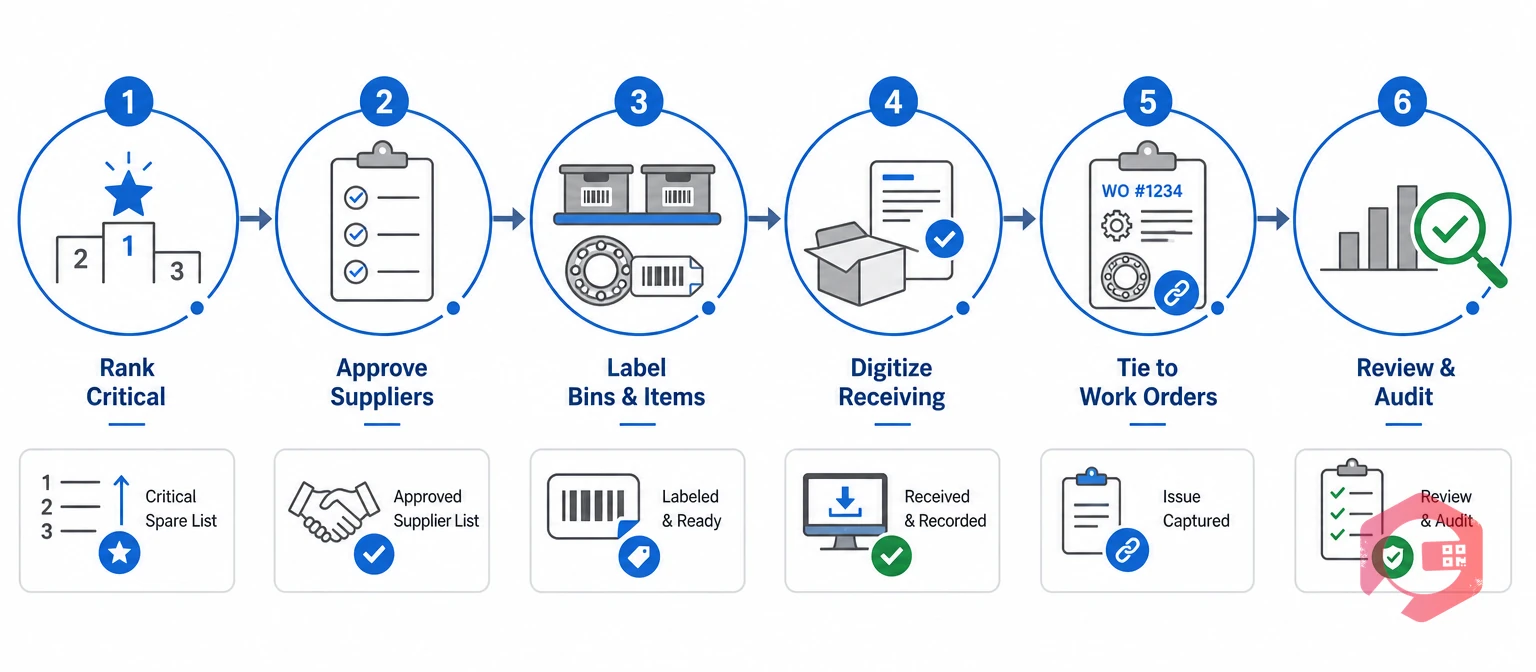
You can implement spare parts traceability in your CMMS in six practical steps. Start with critical spares, prove the process, then expand to the rest of the storeroom.
List parts whose failure causes safety risk, compliance exposure, or long downtime. These parts need full serial or lot tracking first.
Record OEMs and authorized distributors for each critical part. Block purchase requests to any vendor not on the list unless a manager approves the exception.
Print QR or barcode labels for bins, lots, and serialized parts. Clean up mixed bins as you go, separating new, used, and refurbished stock.
Add a receiving checklist to the system and require certificate uploads for critical parts. Route any mismatch to a quarantine location automatically.
Allow stock to leave the storeroom only against an open work order. This step builds the installation record that most plants are missing.
Good spare parts management keeps these steps running daily, with alerts when stock or records fall out of line.
Spare parts traceability pays off in reliability, safety, cost, and compliance at the same time. The benefits grow as more of your stock moves into the traced process.
Maintenance teams using Cryotos have reported up to 30% reduction in unplanned downtime and 25% faster repair turnaround, in part because the right verified part is found and issued faster. Linking parts to equipment through asset tracking gives every machine a complete, searchable history.
Inventory tracking tells you how many parts you have and where they are stored. Spare parts traceability goes further by recording where each part came from and which asset it was installed on. You need both, but only traceability helps you prove part origin and handle recalls.
Check for mismatched labels, poor print quality, wrong packaging, missing certificates, and prices far below market. Compare the part against OEM photos and specifications. If anything looks off, quarantine the part and contact the OEM or an authorized distributor to verify it.
No, most plants track high-value and safety-critical parts by serial number and track common consumables by lot or batch. Low-risk items like standard fasteners usually need only supplier and receipt records. Rank your spares by risk first, then choose the level of tracking for each group.
A CMMS cannot spot a fake by itself, but it removes the gaps that let fakes in. It enforces approved suppliers, forces receiving checks, and links every part to an asset. Combined with trained staff and inspection steps, it makes counterfeit exposure much rarer and much easier to trace.
Most facilities can set up traceability for critical spares in four to eight weeks. The longest step is usually labeling bins and cleaning up mixed stock. Once the process works for critical parts, you can extend it to the rest of the storeroom over the following months.
Counterfeit parts thrive where records stop, so a complete supplier-to-asset chain is your best defense. Schedule a free demo to see how Cryotos links suppliers, stock, and work orders into one traceable record for every spare part you install.



Cryotos AI predicts failures, automates work orders, and simplifies maintenance—before problems slow you down.



