APM vs EAM vs CMMS comes down to three jobs: a CMMS runs maintenance work, an EAM manages assets and their cost across the lifecycle, and Asset Performance Management (APM) uses data to predict and prevent failures. APM sits on top of the other two, reading their data and sending decisions back as work.
Most teams do not need to pick one. They need to know which layer solves their next problem. This guide defines each system, compares them side by side, shows where APM fits, and ends with a decision guide.
Key Takeaways

A CMMS is software that plans, assigns, and records maintenance work. A Computerized Maintenance Management System holds the asset register, work orders, preventive maintenance schedules, spare parts, and maintenance history.
Technicians and planners use it every day. SMRP publishes metrics such as schedule compliance, and a CMMS is where that data comes from. A CMMS answers one question: how do we get maintenance work done?
An enterprise asset management (EAM) system is a platform that manages assets and their costs from purchase to retirement. It includes CMMS functions, then adds lifecycle costing, procurement, contracts, capital planning, and links to finance and ERP systems.
ISO 55000 frames asset management as a system for getting value from assets over their life. EAM software supports that goal across sites and departments, and the enterprise asset management label often describes a strategy as much as a product. An EAM answers a broader question: how do we manage assets and cost across their whole life?
Asset Performance Management (APM) is the use of condition data and risk analysis to decide what maintenance an asset needs. Here APM means asset performance, not application performance monitoring, which is an IT term.
APM does not manage work orders, spares, or permits. It needs a CMMS or EAM to turn each insight into work. Sensor and meter feeds, such as IoT meter reading, supply the condition data.
Track reliability before you add analytics. Set your baseline with the MTBF calculator.
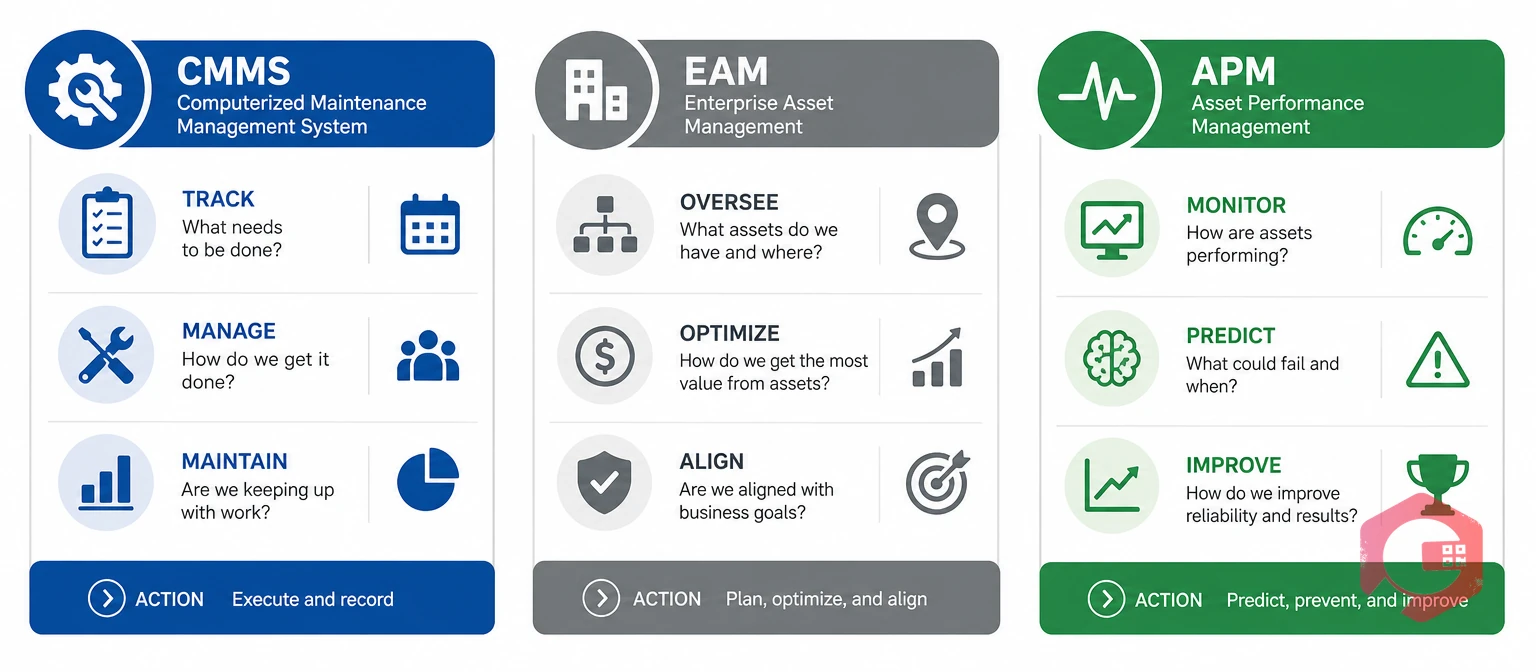
The table compares the three systems on the points buyers ask about most.
| Dimension | CMMS | EAM | APM |
|---|---|---|---|
| Core question | How do we complete maintenance work? | How do we manage assets and cost over their life? | Which assets will fail, and what should we do? |
| Main users | Technicians, planners | Asset managers, finance, procurement | Reliability engineers, analysts |
| Core functions | Work orders, PM, parts, requests | CMMS plus lifecycle cost, procurement, capital planning | Condition monitoring, health scores, prediction |
| Data used | Work history, asset records | Asset, cost, and contract data | Sensor, historian, and failure data |
| Key metrics | PM compliance, MTTR, backlog | Total cost of ownership, utilization | MTBF, availability, risk score |
| Effort to start | Lowest | Medium to high | High |
The APM vs EAM vs CMMS comparison shows overlap in asset records and reporting, but the core jobs stay separate. A CMMS is not a small EAM, and APM is not a large CMMS.

In the APM vs EAM vs CMMS stack, APM is the insight layer. It reads data from sensors, inspections, and past work, scores risk, and recommends action. The recommendation only matters once it becomes a work order.
The Execute-Govern-Advise Framework:
Think of the scopes as concentric. A CMMS sits inside the scope of an EAM, while APM draws on both and reaches outward to sensors and historians.
The failure code from that job returns to the asset history, so the next prediction improves. Without the CMMS, the alert never becomes a repair.
Most failed APM projects fail on data and process, not on software. Maintenance teams that succeed prepare four foundations first.
A clean hierarchy starts with solid asset tracking. Analytics on poor data produce confident but wrong answers, so fix the basics before you buy models.
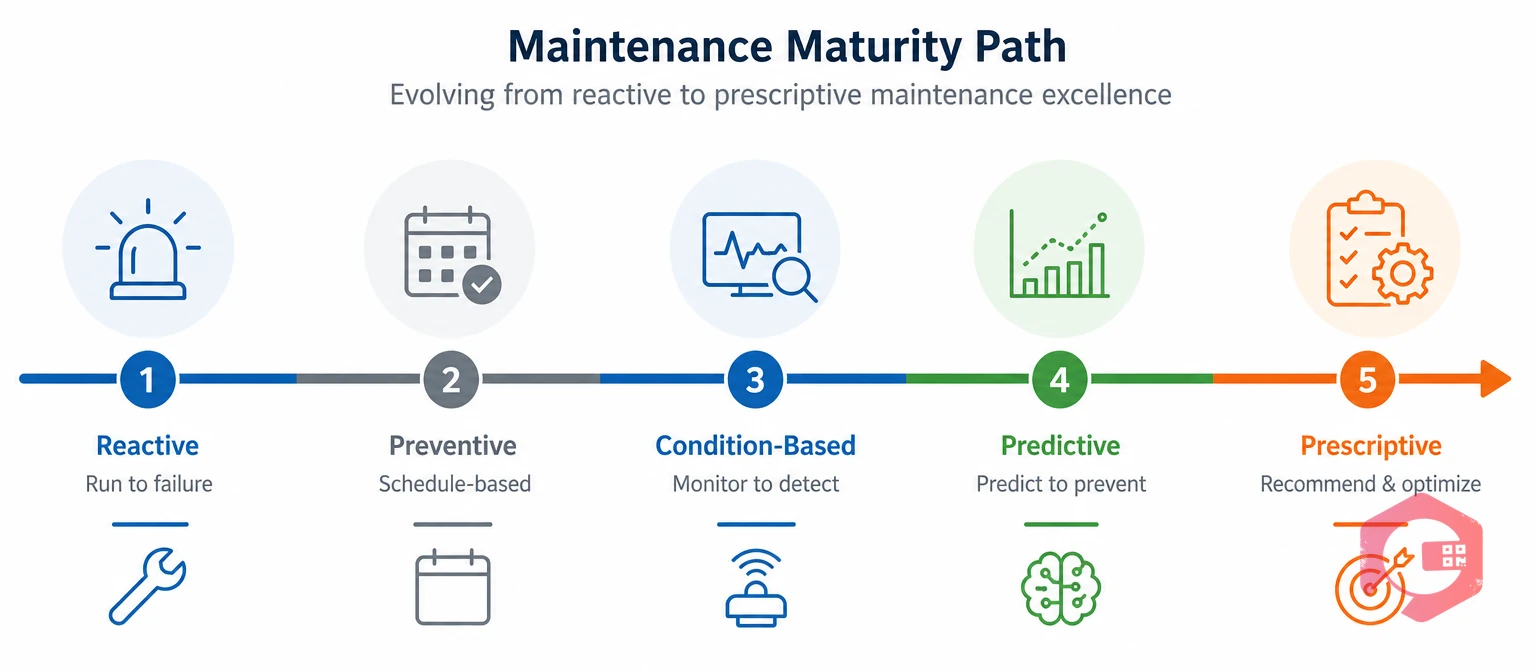
Maintenance maturity shows which system to add next. Each stage builds on the one before it.
Where your team sits on this path decides which of APM vs EAM vs CMMS to add next. Most teams gain more by mastering the third stage than by jumping to the fifth.
Add the layer that closes your biggest gap, then expand as data matures.
Prove value on a few critical assets within 90 days before you scale.
Most buying mistakes come from matching software to a label instead of a problem.
Avoiding these mistakes matters more in the APM vs EAM vs CMMS decision than any feature list.
Cryotos is a CMMS platform with EAM-class asset management, so it covers the execute and govern layers. It also holds the data APM depends on: asset history, work orders, downtime, and meter readings.
Maintenance teams using Cryotos have reported up to 30% reduction in unplanned downtime and 25% faster repair turnaround. Cryotos is not a full APM suite, so teams that need advanced failure prediction pair it with a dedicated APM for their most critical assets.
Teams weighing APM vs EAM vs CMMS can start with the foundation, then add analytics where they pay back.
No. A CMMS runs maintenance work. An EAM includes CMMS functions and adds lifecycle cost, procurement, and enterprise reporting. Every EAM contains a CMMS, but not every CMMS is an EAM.
APM stands for Asset Performance Management. It uses condition data, failure history, and risk analysis to predict failures and choose the right maintenance strategy. Do not confuse it with application performance monitoring in IT.
No. APM advises, but a CMMS or EAM executes the resulting work. APM reads data from those systems and sends recommendations back as work orders.
Not always. Preventive and meter-based maintenance in a CMMS cover many assets. Add APM when unplanned failures on critical equipment cost more than the data and analytics work required.
In the APM vs EAM vs CMMS choice, start with the biggest gap. Choose a CMMS for work execution, an EAM for lifecycle and cost control, and APM for critical assets with sensor data.
If you are weighing APM vs EAM vs CMMS, start with clean data and well-run work. Schedule a free demo to see how Cryotos connects work orders, asset history, and condition data in one place.


Cryotos AI predicts failures, automates work orders, and simplifies maintenance—before problems slow you down.