Applying PMBOK to manage shutdowns, turnarounds, and outages (STO) means structuring every phase of your STO event — from initial scope definition through post-event review — around the five PMBOK Process Groups: Initiating, Planning, Executing, Monitoring and Controlling, and Closing. This approach transforms what is typically a chaotic, high-cost maintenance event into a repeatable, data-driven project with clear accountability and measurable outcomes.
STO events are among the most expensive maintenance activities any industrial facility undertakes. According to McKinsey's operations research, major turnaround projects regularly run 20–40% over budget, with schedule overruns averaging 30 days or more. Applying a proven project management framework like PMBOK closes that gap by giving every stakeholder — from the maintenance planner to the plant director — a shared language, defined processes, and traceable documentation at every step.
What Are Shutdowns, Turnarounds, and Outages (STO)?
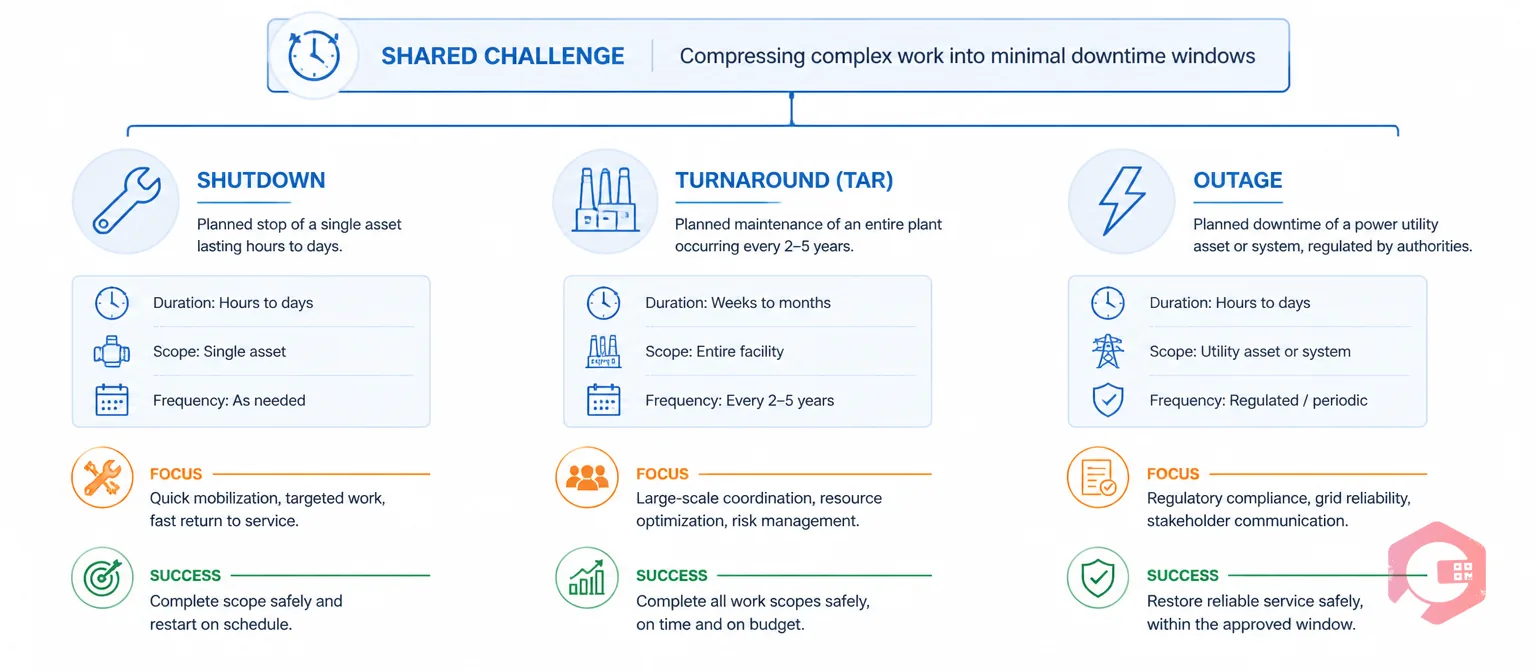
Shutdowns, turnarounds, and outages are planned maintenance events that require a full or partial halt of industrial operations to complete work that cannot be done while equipment is running. Each term carries a slightly different meaning in practice:
Shutdown: A planned stop of a single asset, system, or unit for inspection, repair, or replacement. Shutdowns are typically shorter in duration — hours to a few days — and narrower in scope than turnarounds.
Turnaround (TAR): A comprehensive, scheduled maintenance event covering an entire plant or process unit. Turnarounds happen every 2–5 years depending on the industry and regulatory requirements. They involve hundreds to thousands of work orders, multiple contractors, and significant capital expenditure. In oil and gas, petrochemical, and refinery environments, turnarounds are the single largest maintenance investment a facility makes.
Outage: Common in power generation and utilities, an outage refers to a planned maintenance period for turbines, boilers, generators, or grid infrastructure. Outages are tightly regulated, often require third-party inspection, and carry significant penalties if they run over schedule.
All three event types share the same core challenge: they compress an enormous volume of complex, interdependent work into the shortest possible window. A 24-hour schedule slip on a refinery turnaround can cost $500,000 or more in lost production. That pressure makes structured project management not a luxury but a necessity.
Why PMBOK Works for STO Management
The Project Management Body of Knowledge (PMBOK), published by the Project Management Institute (PMI), defines five Process Groups and ten Knowledge Areas that govern how projects are initiated, planned, executed, and closed. STO events fit the PMBOK project model precisely: they have a defined start and end date, a specific scope, a budget, a team, and deliverables that must be achieved before the plant restarts.
What makes PMBOK particularly well-suited to STO management is its emphasis on integration management — the discipline of coordinating every element of a project so that nothing falls through the cracks when hundreds of work orders are running simultaneously across different contractors and shifts. Traditional STO planning often fails because it manages scope, schedule, and resources in separate systems that do not talk to each other. PMBOK's framework explicitly addresses this, creating a single integrated plan that connects all Knowledge Areas.
Industries that have formalized PMBOK application in their STO programs — including pharmaceutical manufacturing, power generation, and petrochemicals — consistently report shorter outage durations, lower cost overruns, and better safety outcomes than those using informal planning methods.
Initiating Process Group — Defining STO Scope and Authorization
The Initiating Process Group formally authorizes your STO event and defines its high-level scope. For a shutdown or turnaround, this means producing two key PMBOK deliverables: the Project Charter and the Stakeholder Register.
Your STO Project Charter should document the business justification for the event (regulatory inspection window, equipment end-of-life, insurance requirement), the high-level scope boundaries, the key milestones (first wrench-on, unit restart), the budget authorization level, and the named STO Manager who holds accountability. Without a formal charter, STO events tend to expand as additional work requests are submitted after the planning window closes — a phenomenon known as scope creep that is one of the leading causes of turnaround overruns.
The Stakeholder Register maps every party with an interest in the STO outcome: operations, maintenance, safety, engineering, finance, contractors, insurers, and regulatory bodies. Identifying stakeholders early prevents the last-minute surprises — a regulatory inspection requirement discovered two weeks before execution, for example — that blow schedules apart.
Practical Initiating deliverables for your STO:
STO Project Charter signed by plant management
Stakeholder Register with communication responsibilities assigned
Scope freeze date — the last day new work orders can be added to the STO scope
Go/No-Go criteria for proceeding with execution
Planning Process Group — Building a Bulletproof STO Work Plan
Planning is where the majority of STO management effort should be invested. The PMBOK principle that "plans are useless but planning is indispensable" applies directly to turnarounds: the plan will change during execution, but the discipline of planning forces the team to think through every dependency, resource constraint, and risk before the first wrench turns.
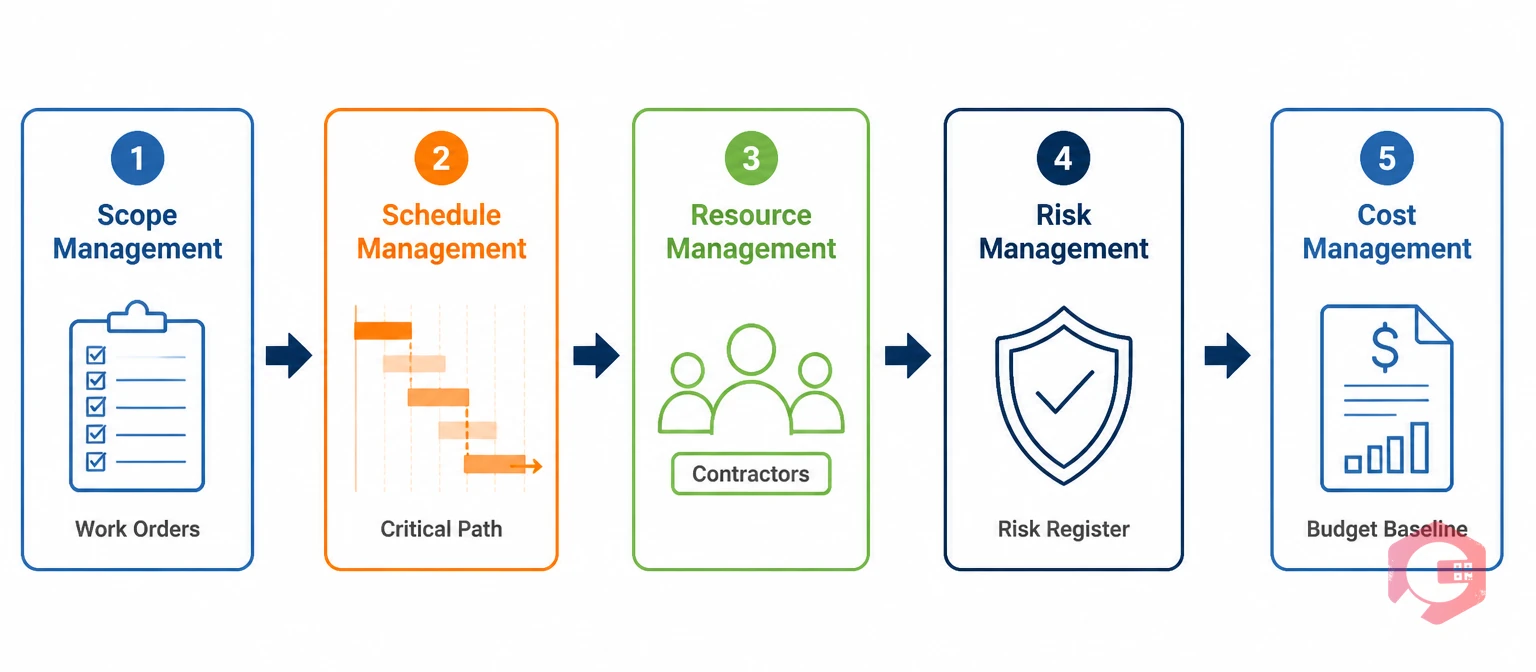
The critical STO planning outputs that align with PMBOK Knowledge Areas include:
Scope Management — Work Order List and Job Cards: Every task in the STO must be documented as an individual work order with a scope description, estimated man-hours, required skills, required materials, and a sequence dependency map. A refinery turnaround may involve 3,000–8,000 individual work orders. Without a complete, detailed work order list, your schedule and resource plan will be built on assumptions.
Schedule Management — Critical Path Method: PMBOK's schedule management Knowledge Area requires you to sequence activities, estimate durations, and identify the planned downtime critical path — the chain of dependent tasks that determines the minimum STO duration. Any delay on the critical path extends the outage. Turnaround planners should target having 80% of their critical path work orders ready for execution at scope freeze.
Resource Management — Contractor and Crew Planning: STO events require specialized contractors alongside your own maintenance team. PMBOK resource management requires you to identify the skills needed, the headcount required for each work period, and the procurement lead times for specialty services (vessel inspection, catalyst replacement, heat exchanger re-tubing). Book critical contractors at least 6–12 months before execution for major turnarounds.
Risk Management — Risk Register and Mitigation Plans: Every STO carries significant risks: hidden equipment damage discovered during opening inspections, late material deliveries, adverse weather for outdoor units, permit delays. A PMBOK-aligned risk register scores each risk by probability and impact, assigns an owner, and documents a response strategy before execution begins.
Cost Management — Budget Baseline and Contingency: Establish your cost baseline during planning, including a documented contingency reserve (typically 10–15% of the STO budget for turnarounds) for scope changes discovered during execution. PMBOK's earned value management approach then gives you the framework to track actual spend against the baseline in real time during the event.
The Planning Process Group typically represents 50–70% of total STO management effort and should begin 12–24 months before execution for a major turnaround. Facilities that compress this window consistently overspend.
Executing Process Group — Coordinating STO Work on the Ground
Execution is the phase most people think of as "the turnaround" — but by this point, a well-managed STO is largely following the plan established in Planning. The Executing Process Group focuses on directing and managing the actual work, assuring quality, managing communications, and engaging stakeholders.
The most critical execution disciplines for STO events are:
Daily Work Planning and Scheduling: The STO schedule should be reviewed and updated every 24 hours during execution. A daily planning meeting with the STO Manager, area supervisors, and key contractors aligns the team on progress, re-sequences work around emerging constraints, and ensures that the critical path is actively managed rather than passively monitored.
Work Order Management and Permit Control: Every task executed during the STO must be governed by an authorized work order. Permit-to-work (PTW) control is a legal and safety requirement in most industrial jurisdictions — OSHA confined space entry and lockout/tagout regulations require documented authorization before work begins on any hazardous energy source. Integrating your work order system with PTW control eliminates the paper-based delays that are one of the biggest sources of STO schedule loss.
Quality Assurance: PMBOK's quality management Knowledge Area requires that work meets defined acceptance criteria before it is signed off. For STO events, this means inspector sign-off on opened vessels before closure, pressure tests at specified hold points, and non-destructive testing (NDT) documentation that satisfies regulatory and insurance requirements. Build inspection hold points into your work orders during planning so they cannot be bypassed under schedule pressure during execution.
Communications Management: A major turnaround is a communications-intensive event. PMBOK requires a Communications Management Plan that defines who receives what information, at what frequency, and in what format. For STO events, this typically means a daily progress report to plant management, a weekly cost report to finance, and a real-time dashboard for the STO management team.
Monitoring and Controlling — Tracking Progress and Managing Change
Monitoring and Controlling runs in parallel with Executing throughout the STO. PMBOK defines this Process Group as the work of tracking, reviewing, and regulating progress and performance — and managing change when the plan needs to be adjusted.
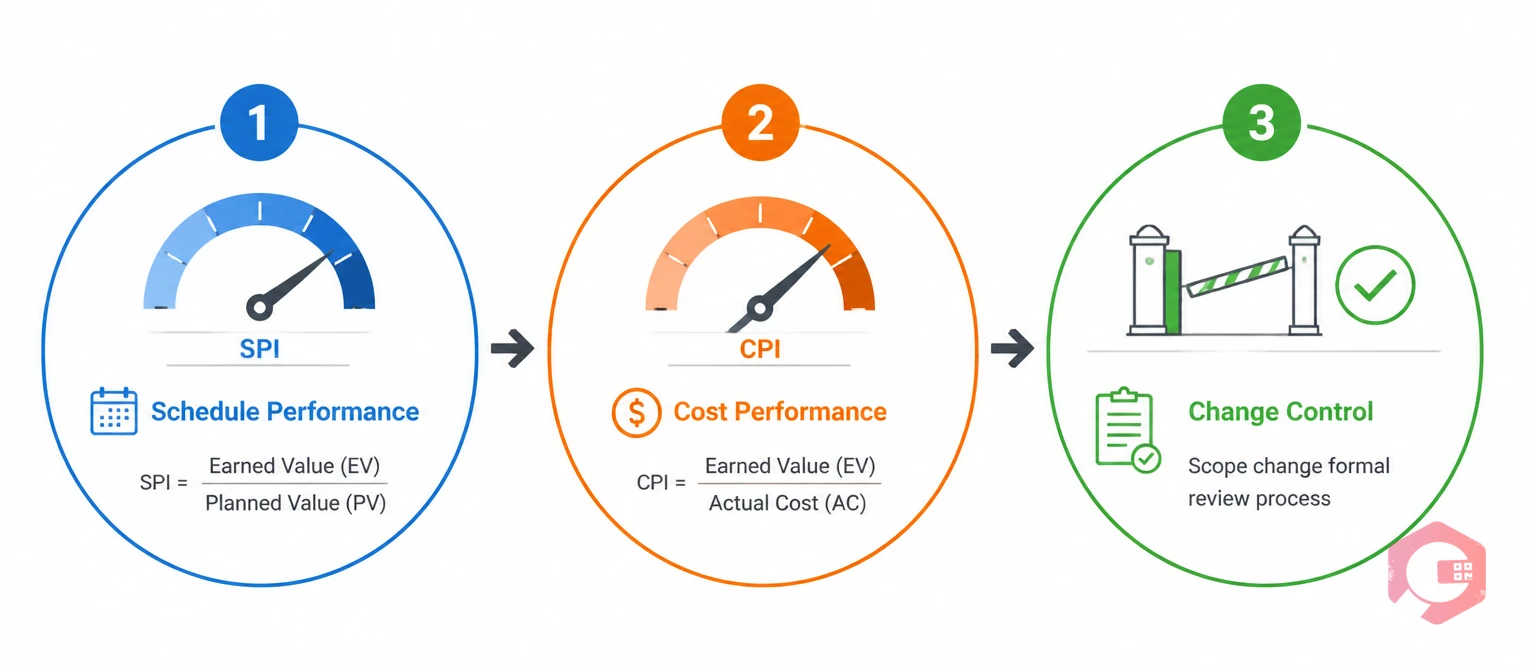
The three most important monitoring disciplines for STO management are:
Schedule Performance Monitoring: Track actual progress against the baseline schedule daily. Calculate Schedule Performance Index (SPI = Earned Value / Planned Value) to quantify whether you are ahead of or behind schedule. An SPI below 1.0 means you are behind plan. For a 21-day turnaround where every day of delay costs $300,000 in lost production, an SPI of 0.9 identified at Day 5 must trigger immediate corrective action — not a wait-and-see response.
Cost Performance Monitoring: Earned Value Management (EVM) lets you compare the value of work completed against the cost of completing it. Cost Performance Index (CPI = Earned Value / Actual Cost) below 1.0 means you are spending more than planned for the work completed. For STO events with large contractor workforces, daily cost accruals against the baseline catch overspend early enough to act on it.
Change Control: Scope changes during STO execution are inevitable. Equipment opened during a turnaround reveals damage not visible in the planning phase. PMBOK's integrated change control process requires that every scope addition during execution is formally evaluated for its schedule and cost impact, approved by an authorized decision-maker, and documented before the work begins. Without formal change control, scope creep is the primary cause of turnaround overruns.
Facilities that implement rigorous STO monitoring using downtime tracking and real-time BI dashboards consistently report better performance against their baseline schedule and budget than those relying on manual progress updates.
Closing Process Group — Post-STO Reviews and Documentation
The Closing Process Group is the most frequently skipped phase of STO management — and the one that has the biggest impact on the next event. PMBOK's Closing Process Group requires that you formally close the project, document lessons learned, archive project records, and release resources.
For STO events, Closing deliverables include:
Post-Shutdown Review (PSR): A structured review meeting within 30 days of plant restart that evaluates actual performance against the plan. Cover schedule performance, cost performance, quality outcomes, safety incidents, and scope changes. The PSR findings become the primary input to planning the next STO event.
Lessons Learned Register: Document what worked well and what failed — by process area, contractor, and work type. Facilities that maintain a structured lessons-learned database across multiple STO events consistently reduce their turnaround duration cycle-over-cycle. Even a 5% reduction in a 21-day turnaround represents more than 25 hours of additional production uptime.
Work Order Closeout and Documentation Archive: Every work order executed during the STO must be formally closed with the actual work performed, parts used, man-hours charged, and inspection outcomes documented. This record becomes part of the asset's maintenance history and is required for regulatory compliance, insurance claims, and future STO planning. Asset history gaps discovered during the next turnaround are almost always caused by incomplete closeout at the end of the previous one.
Contractor Performance Evaluations: Rate each contractor against their scope, schedule, quality, and safety commitments. These evaluations feed the next turnaround's contractor pre-qualification process.
How Cryotos CMMS Supports PMBOK-Based STO Management
Applying PMBOK to STO events requires a digital backbone that can manage thousands of work orders, track schedule performance in real time, control permits, manage parts inventory, and generate the documentation that PMBOK's process groups require. Cryotos CMMS provides that backbone across every phase of the STO lifecycle.
Work Order Management at Scale: Cryotos's work order management software handles the full STO work order lifecycle — creation, prioritization, assignment, execution, quality sign-off, and closeout — with real-time status visibility for the STO management team. Voice and photo-based AI work order creation speeds up field-level documentation during high-tempo execution phases.
Preventive Maintenance Scheduling: STO events are the primary opportunity to complete interval-based preventive maintenance tasks that cannot be done during normal operations. Cryotos automatically identifies which PM tasks are due during the STO window and incorporates them into the work order plan.
Inventory and Spare Parts Control: Materials management is one of the biggest sources of STO schedule loss. Cryotos's spare parts inventory software tracks material reservations against specific work orders, manages minimum stock thresholds, and provides real-time stock visibility across multiple warehouses — ensuring that a missing part does not delay a critical path job.
Downtime and Performance Tracking: Cryotos tracks actual progress against the STO schedule in real time, with downtime tracking and reporting that gives the STO Manager a live view of critical path status, man-hour consumption, and cost performance. The BI Dashboard surfaces MTTR and schedule performance data without manual report compilation.
Document Management and Compliance: Regulatory inspection records, pressure test certificates, NDT reports, and PTW documentation are stored directly against the relevant assets and work orders in Cryotos — creating the audit-ready compliance record that PMBOK's Closing Process Group requires.
Mobile Offline Access: Cryotos's mobile app works offline in areas of the plant without network connectivity — common during STO events when congestion or scaffolded structures disrupt signals. Technicians can receive work orders, complete checklists, and capture digital signatures without connectivity, with automatic sync when back in range.
Maintenance teams using Cryotos report a 30% reduction in downtime and 25% faster repair times — outcomes that translate directly into shorter STO durations and better performance against the baseline schedule. Explore how Cryotos can bring PMBOK discipline to your next shutdown or turnaround at cryotos.com.
Frequently Asked Questions
What is the difference between a shutdown, a turnaround, and an outage?
A shutdown is a planned stop of a single asset or system, typically lasting hours to a few days. A turnaround is a comprehensive planned maintenance event covering an entire plant or process unit, occurring every 2–5 years and involving hundreds or thousands of work orders. An outage is the power generation and utilities equivalent of a turnaround — a planned maintenance period for turbines, boilers, or grid infrastructure. All three require the same project management discipline to execute successfully.
How does PMBOK apply to STO management?
PMBOK's five Process Groups — Initiating, Planning, Executing, Monitoring and Controlling, and Closing — map directly to the phases of an STO event. Initiating defines scope and authorization, Planning builds the integrated work plan, Executing coordinates the actual work, Monitoring and Controlling tracks schedule and cost performance, and Closing documents lessons learned for the next event. Applying PMBOK gives every STO stakeholder a shared framework that reduces scope creep, schedule overruns, and cost surprises.
Why do turnarounds go over budget?
Turnaround budget overruns have three primary causes: inadequate planning (scope not fully defined before execution begins), poor change control (scope additions approved without evaluating cost and schedule impact), and insufficient monitoring (performance problems identified too late to correct). PMBOK directly addresses all three through its integrated planning, change control, and earned value monitoring disciplines.
What is the critical path in STO management?
The critical path is the sequence of dependent work orders whose total duration determines the minimum possible STO duration. Any delay on a critical path activity extends the overall STO by the same amount. Identifying and actively managing the critical path is the single most important schedule management discipline in STO planning. A well-prepared turnaround team should know their critical path six months before execution and update it daily during the event.
How far in advance should an STO be planned?
Major turnarounds should begin the planning process 18–24 months before execution. This window provides time to develop a complete work order list, perform engineering studies on complex jobs, procure long-lead materials and specialty contractors, and complete the risk assessment and permitting processes. Smaller shutdowns typically require 3–6 months of planning. Compressing the planning window is the most predictable path to a cost and schedule overrun.