MRO inventory turnover measures how many times your maintenance, repair, and operations spare parts stock is used and restocked each year over a defined period — most commonly one year. The formula is straightforward: divide the total cost of MRO parts used by the average value of MRO inventory on hand. A higher MRO inventory turnover ratio means stock is moving efficiently. A lower ratio points to dead stock, over-purchasing, or inaccurate reorder points tying up working capital.
According to the Society for Maintenance and Reliability Professionals (SMRP), MRO inventory management is one of the top five drivers of maintenance cost variance — yet most facilities still track it manually or not at all. Getting your MRO inventory turnover under control starts with knowing what the number means, then building the data to calculate it correctly.
Key Takeaways

MRO inventory turnover is the cost of MRO parts consumed divided by the average value of MRO parts on hand during the same period. A turnover ratio of 3.0 means your MRO stock was effectively replaced three times during the year — parts were consumed through maintenance activity and replenished at roughly one-third of the annual consumption cost at any given time.
The formula has two components teams often confuse. The numerator is what you consumed — not what you purchased. Parts bought in December but sitting on the shelf in January do not count. The denominator is the period average — not your current stock value. Use (opening value + closing value) ÷ 2 as a starting point.
According to standard inventory management practice, MRO turnover benchmarks vary by maintenance intensity. High-volume plants target 3 to 6 turns per year. Asset-light facilities often run at 1 to 2 turns. The key question is not which benchmark you match — it is whether your ratio is improving and whether the data is clean enough to trust.
Maintenance teams using Cryotos have reported up to 30% reduction in unplanned downtime and 25% faster repair turnaround — and improved MRO turnover is consistently part of that shift, as better work order data makes consumption visible for the first time.

The numerator of your MRO turnover formula — cost of parts used — is only as accurate as your work order consumption records. Every part issued for a maintenance job needs to be logged against the work order that consumed it, at the correct unit cost, before that consumption counts toward your turnover calculation.
Most facilities that report low confidence in their MRO turnover numbers have a consumption data problem, not a calculation problem. Technicians pull parts verbally, or paper notes never reach the system. The result: a numerator that understates actual consumption and makes your stock look less efficient than it really is.
Cryotos's inventory management supports three costing methods — LIFO, FIFO, and Average Cost — each of which produces a different cost figure for the same physical consumption. FIFO assigns costs from the oldest purchase price. LIFO assigns costs from the most recent purchase price, reflecting current replacement cost more accurately. Average Cost smooths fluctuations across all stock on hand.
Whichever method you choose, stick with it. Switching mid-year makes your numerator incomparable to prior periods and breaks year-over-year trends.
Average inventory value is the denominator that most facilities get wrong — not because the math is hard, but because they use point-in-time snapshots instead of true period averages. If your storeroom runs high at year-end (pre-shutdown stock) and low mid-year, a single December count will overstate your average and suppress the turnover ratio.
The simplest fix is to use monthly closing balances rather than two data points. Sum twelve monthly values and divide by twelve. This smooths seasonal patterns and gives a denominator that reflects real stock behavior, not two arbitrary snapshots.
Facilities with multiple storerooms — a main warehouse plus line-side cribs, satellite locations, or contractor-managed stock — need to consolidate all locations before calculating average inventory value. Stock sitting in a satellite crib is still MRO inventory. Excluding it understates your denominator, inflates your apparent turnover ratio, and gives a misleading picture of how efficiently your total MRO investment is working.
Cryotos's spare parts inventory software maps warehouse structure down to bin level — so every location is included in the stock value calculation automatically. QR and barcode scanning captures every put-away and pick transaction with a timestamp and quantity, giving you the per-period closing balances you need for an accurate average without a manual stocktake.
Want to start measuring your MRO turnover without the data gaps? Cryotos's inventory management module gives your team real-time stock visibility across every storeroom from day one.
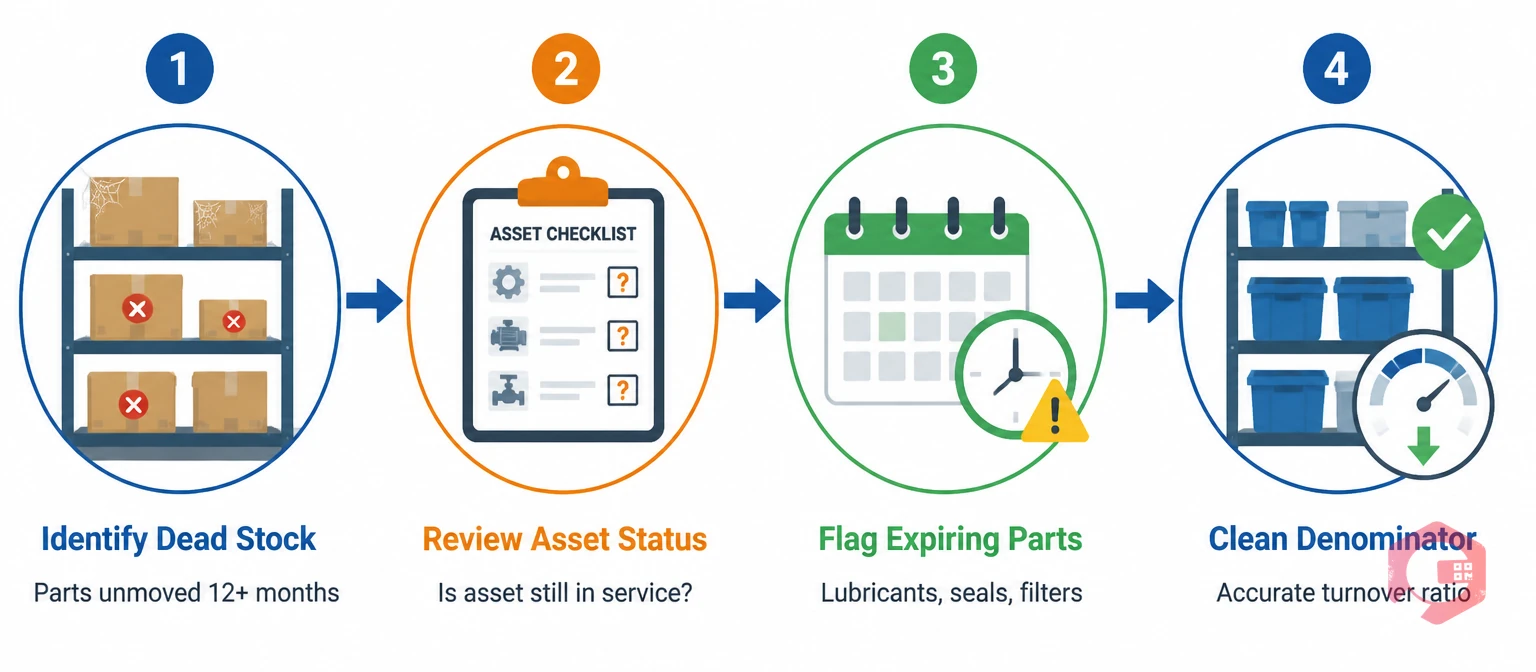
Dead stock — parts that have not moved in 12 months or more — is the single biggest suppressor of your MRO inventory turnover ratio. These items inflate your average inventory value without contributing to the numerator. They drag the ratio down and tie up cash that could fund better-stocked fast-movers.
Identifying dead stock requires a stock movement report filtered by last-issue date. Any part with no consumption in 12 months is a review candidate. The question is simple: is this part still in active service on an asset you maintain? If the asset has been retired, the spares are likely obsolete. If the asset is still running but the part has never been consumed, check whether the PM tasks that would trigger consumption are actually being performed.
Time-sensitive MRO items — lubricants, filters, seals, calibration standards — past their shelf life inflate average inventory value without contributing to usable stock. Expired parts sitting on the shelf count toward your denominator just like active stock, but they cannot be consumed without a compliance or safety risk.
Cryotos's expiration reminder module flags time-sensitive parts before they lapse, allowing your team to consume or return them before they become dead stock. Combined with the MRO inventory checklist, this keeps your denominator clean. Your turnover ratio then reflects active, usable stock — not a mix of good parts and write-off candidates.
Cryotos's warehouse management module maps bin locations and tracks every issue against a work order, so slow-moving parts surface automatically in consumption reports without manual analysis.
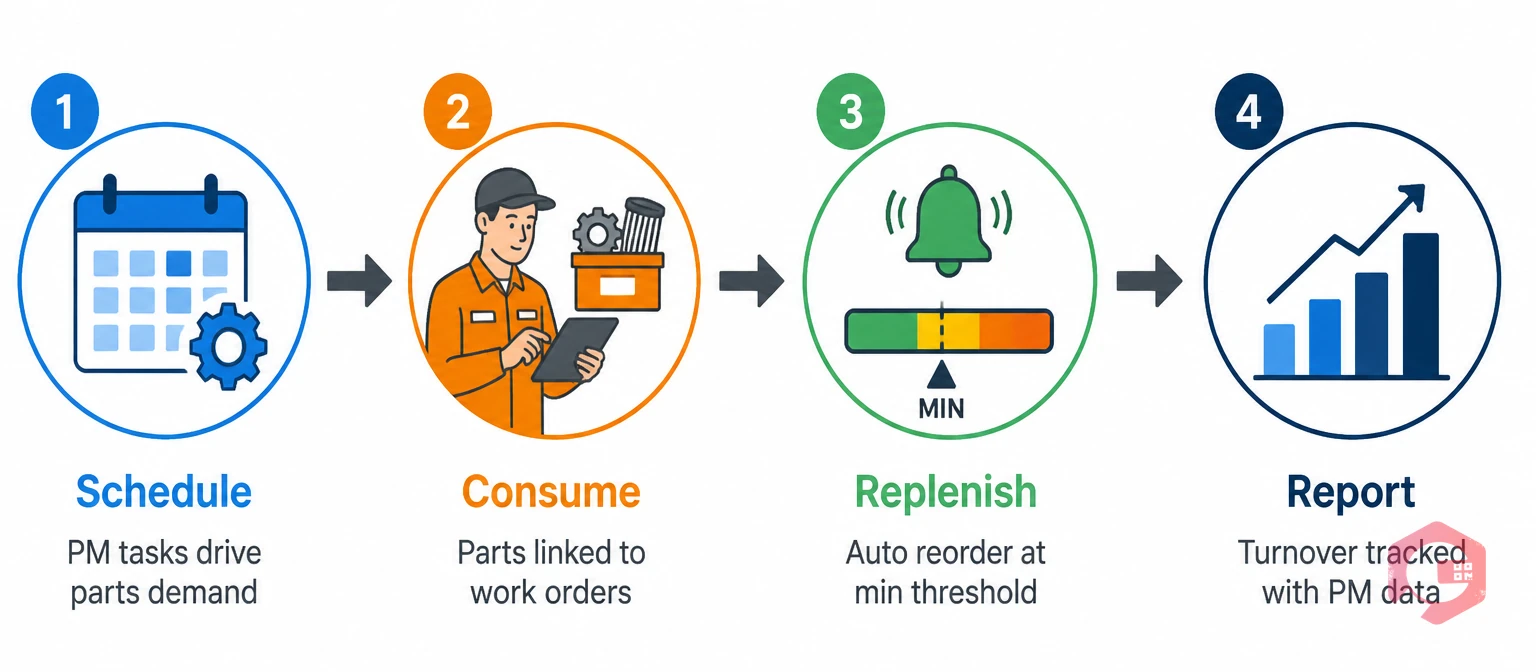
Your MRO inventory turnover ratio only becomes useful when it is tracked over time and connected to the maintenance activity that drives it. A single turnover number tells you little. A trend showing whether the ratio is rising or falling quarter by quarter tells you whether your stocking strategy is improving or drifting toward over-procurement.
The most important cross-reference is turnover against PM compliance. If scheduled PM runs at 90% compliance and MRO turnover is healthy, parts are flowing because maintenance is being done — not just because of emergency pulls. If PM compliance drops but turnover holds, reactive maintenance is likely up.
The MRO Turnover Loop is a four-stage cycle that connects your maintenance program to your inventory efficiency:
The ISO 55000 asset management standard emphasizes that inventory decisions should be driven by lifecycle cost data, not procurement habits — and MRO turnover is the metric that makes that principle measurable.
Cryotos's BI Dashboard consolidates parts consumption, stock levels, PM compliance, and downtime into one view. Maintenance managers can build a custom MRO turnover report with scheduled email delivery to procurement and maintenance leadership — no manual data pulling required.
MRO inventory turnover becomes a finance-grade metric when your consumption data and your accounting system agree. The most common gap: parts consumed in the CMMS but not yet invoiced in the ERP. This splits the maintenance view from the finance view of the same consumption event.
Closing this gap needs two-way data flow between your Computerized Maintenance Management System and your ERP. When a work order closes and parts are logged in Cryotos, the transaction updates the ERP ledger automatically. When a purchase order arrives in the ERP, the updated unit cost flows back into Cryotos to keep costing current.
Cryotos integrates natively with SAP and Microsoft Dynamics 365. Parts consumption syncs to the finance system in real time. Procurement teams get the history they need to negotiate better pricing. Finance gets an MRO turnover figure they can reconcile to the general ledger.
Most manufacturing maintenance operations target an MRO turnover ratio between 3 and 6 turns per year, though the right benchmark depends on equipment density, maintenance strategy, and lead times for critical parts. A ratio below 2 typically indicates excess stock or significant dead parts. A ratio above 8 may signal that stocking levels are too lean and stockouts are increasing repair lead times. The trend matters more than the absolute number — a facility improving from 1.5 to 3.0 over 24 months is demonstrating real inventory discipline regardless of where it sits relative to industry averages.
Scheduled preventive maintenance creates predictable parts demand, which is the foundation of efficient MRO stocking. When PM tasks are planned in a CMMS and linked to specific parts, procurement teams can stock based on forecasted consumption rather than reactive emergency orders. This reduces over-procurement of rarely consumed items and improves turnover by keeping the denominator lean relative to actual maintenance activity.
MRO inventory turnover covers all maintenance, repair, and operations stock — including consumables like lubricants, cleaning supplies, and PPE alongside mechanical spare parts. Spare parts turnover focuses specifically on components used in asset repair and replacement. In practice, most maintenance teams calculate both metrics separately, since consumables typically turn much faster than long-lead capital spares and mixing them produces a blended ratio that obscures the behavior of each category.
To calculate average inventory value accurately, sum the closing stock value for all locations at each period end — month end works best — then divide by the number of periods. Include every storeroom, satellite crib, and contractor-managed location. Any location you exclude will inflate your ratio and give a false read on how efficiently your MRO investment is working.
Tracking MRO inventory turnover accurately needs the right data behind both the numerator and denominator — clean consumption records tied to work orders, consistent costing, and real-time stock visibility across every location. Schedule a free demo to see how Cryotos connects your maintenance work orders, parts inventory, and BI reporting so MRO turnover becomes a metric your team can track and improve every quarter.



Cryotos AI predicts failures, automates work orders, and simplifies maintenance—before problems slow you down.