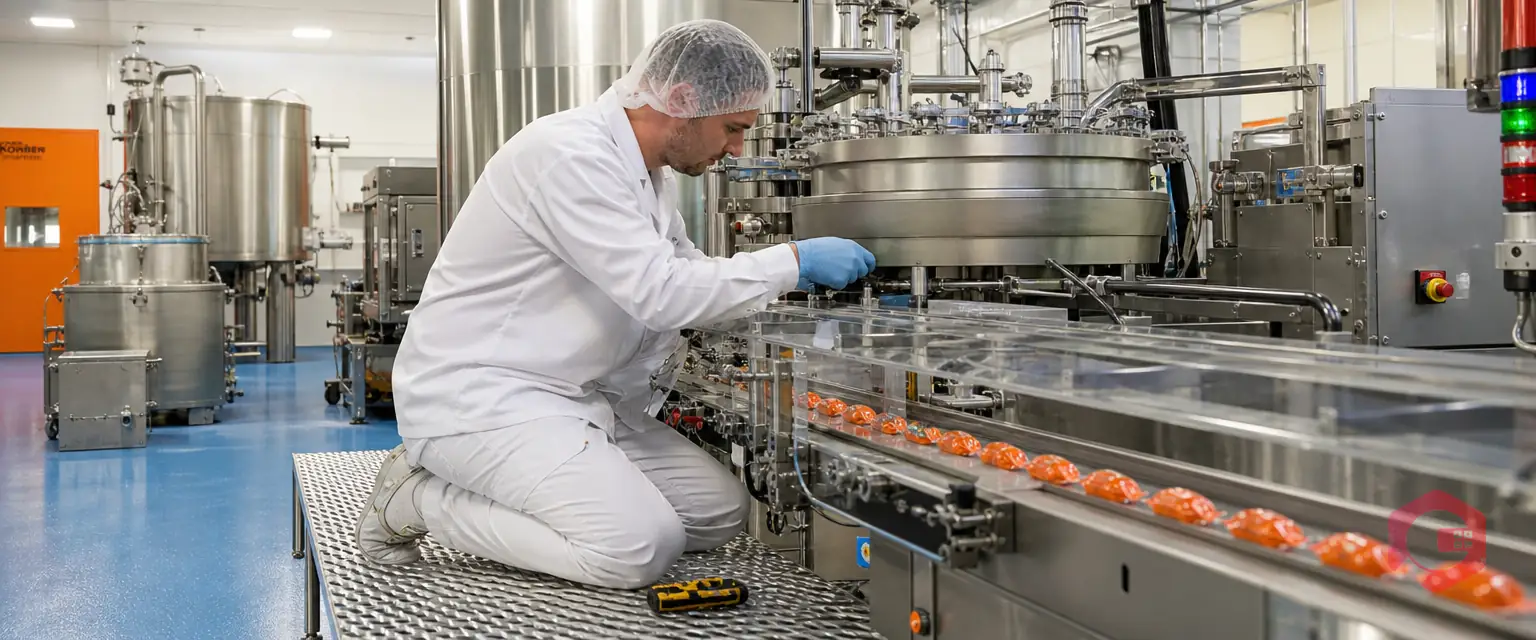
Asset maintenance management software for FMCG is purpose-built to optimize the upkeep of high-speed production lines, cold chains, and facilities while ensuring strict regulatory compliance.
In the high-volume, low-margin FMCG sector, downtime is exceptionally costly.A single unplanned stoppage can cost up to $20,000 per hour in lost production and risk failed GMP audits. The manufacturing sector faces yearly unplanned downtime expenses that exceed $10 billion while a 1% increase in Overall Equipment Effectiveness (OEE) results in recovered output worth millions.
This guide covers everything maintenance managers and plant directors in FMCG need to know what these platforms do, which features matter most, how to choose the right one, and what results to expect after implementation.
Asset maintenance management in FMCG is the systematic process of scheduling, executing, tracking, and improving all maintenance activities across the equipment and infrastructure that keeps a fast-moving consumer goods facility running. This includes production machinery, utilities (compressed air, steam, refrigeration), conveyors, packaging lines, and quality control equipment.
In the FMCG context, "asset management" goes beyond simply fixing things when they break. It means understanding the health of every asset in real time, predicting failures before they happen, and maintaining the documentation chain that auditors from the FDA, BRC Global Standards, or FSSC 22000 will want to review.
FMCG production assets have three characteristics that set them apart from, say, a steel mill or an auto plant:
A well-run FMCG maintenance program is built on five pillars. Miss any one of them and the whole structure starts to wobble:
Many FMCG manufacturers are still running maintenance on spreadsheets, paperwork orders, and tribal knowledge stored in the heads of senior technicians. This approach worked when production lines ran slower, and SKU counts were lower. It doesn't work now.
At 500+ units per minute, a single failed bearing or a clogged nozzle doesn't just cause a line stoppage — it can trigger a cascade of quality rejections, line clearances, and restarting procedures that eat up 45 minutes of production time. According to Plant Engineering, 82% of companies have experienced at least one unplanned downtime event in the past three years, with the majority caused by failures that had detectable warning signs days or weeks earlier.
Standards like ISO 55000, GMP, BRC Global Standard for Food Safety, and FSSC 22000 all require documented evidence that equipment is maintained to a defined schedule, calibrations are current, and corrective actions are completed on time. Without a centralised system, pulling this documentation for an audit becomes a panicked scramble through filing cabinets and email threads.
When three shifts share the same line, maintenance history falls through the cracks. The day shift logs into a vibration issue in a notebook; the night shift doesn't see it; the problem compounds until the asset fails on a Saturday morning at full production. SKU changeovers make this worse — each product switch requires a documented clean-in-place (CIP) cycle, calibration check, and first-article inspection, none of which are easily managed without a connected system.
Not all maintenance software is built for the pace and compliance demands of FMCG. When evaluating platforms, these are the features that matter on the plant floor:
The software should support both static PM schedules (every 500 hours, every 30 days) and dynamic schedules triggered by usage data or sensor readings. Look for drag-and-drop calendar management, automatic work order generation, and the ability to define complex "either/or" conditions — for example, "perform this task every 1,000 hours OR every 6 months, whichever comes first."
Every piece of equipment needs a digital identity: a unique ID, a complete maintenance history, warranty information, spare parts linkage, and real-time status. The best platforms support QR code scanning, so a technician can pull up an asset full history just by scanning a label on the machine.
Every maintenance action — planned or reactive — should generate an immutable, timestamped record. The system should be able to produce GMP-compliant maintenance logs, calibration certificates, and corrective action reports in a format that regulators and third-party auditors can review.
Platforms that integrate with IoT sensors — temperature, vibration, pressure, flow rate — allow maintenance teams to move beyond scheduled checks and respond to actual equipment behavior. Look for integrations with SCADA systems, PLCs, and edge computing devices, with threshold-based alerts that trigger work orders automatically.
Mobile apps with offline capability, QR code scanning, photo and video attachment, and digital signature capture let technicians complete and close work orders at the point of work — not after the fact, when details are forgotten and records are incomplete.
This is one of the most common questions FMCG operations directors face: "We already have SAP. Why do we need separate CMMS?
ERP systems like SAP or Microsoft Dynamics are designed for enterprise-wide resource management — financials, procurement, supply chain, HR. Their maintenance modules (like SAP PM) exist to support the ERP's broader workflows, not to give maintenance technicians a fast, intuitive tool for day-to-day work.
A dedicated CMMS is purpose-built for the maintenance workflow. It's faster to configure, easier for technicians to use on mobile, and delivers richer maintenance-specific analytics — OEE, MTTR, MTBF, asset availability — than any ERP module can match out of the box.
The two systems aren't mutually exclusive. In large FMCG enterprises, the right architecture is a CMMS handling day-to-day maintenance execution, integrated with the ERP for procurement (spare parts purchasing), financials (maintenance cost allocation), and master data (asset registry).
Use this checklist as a starting point for your FMCG plant's PM program. Import it directly into your CMMS to create scheduled work orders for each task category.
The mechanism is straightforward: you can't manage what you can't measure, and most FMCG plants can't accurately measure their downtime until they have a CMMS in place. Once they do, the data tells a consistent story — and it drives action.
FMCG manufacturers using Cryotos CMMS have reported a 30% reduction in unplanned downtime within the first six months of deployment, alongside a 25% improvement in mean time to repair (MTTR). A packaged goods manufacturer using downtime tracking module identified that 40% of their unplanned stops were caused by just three assets on a single filling line, recovering over 200 production hours per quarter after targeted PM adjustments.
The OEE Foundation benchmarks world-class OEE at 85% for discrete manufacturers. Most FMCG plants operate in the 65–75% range before implementing a structured CMMS program. With post–implementation, plants typically move 8–15 OEE percentage points higher within 12 months.
preventive maintenance module allows plants to automate their entire PM calendar — scheduling, assigning, notifying, and closing — without a single manual reminder.
Every maintenance activity in Cryotos generates a timestamped, audit-ready record. GMP compliance logs, calibration records, and LOTO documentation are stored centrally and can be pulled for any asset, any date range, in minutes. During a BRC or FDA audit, what used to take two days of document preparation now takes two hours.
The Reliable Plant benchmarks suggest that well-maintained industrial equipment lasts 30–40% longer than equipment maintained reactively. For a mid-sized FMCG plant with $10 million in production equipment, that's a significant capital cost deferral.
Cryotos asset management software meets all of these requirements and is deployed in FMCG, food and beverage, and consumer goods facilities across multiple geographies. The inventory management module connects directly to the maintenance workflow — so when a technician raises a work order, spare parts can be reserved and issued in the same system without switching tools.
What is asset maintenance management software for FMCG?
Asset maintenance management software for FMCG is a digital platform — typically a CMMS (Computerized Maintenance Management System) — that helps fast-moving consumer goods manufacturers schedule, execute, document, and analyze all maintenance activities across their production equipment and facilities. It replaces paper-based systems and spreadsheets with a centralized, mobile-accessible solution that drives preventive maintenance, regulatory compliance, and operational efficiency.
How does CMMS improve compliance with FMCG plants?
A CMMS automatically creates a timestamped, tamper-proof record of every maintenance activity — who did it, when, what was found, and what action was taken. This gives FMCG plants the audit trails required by GMP, BRC, FSSC 22000, and FDA regulations without the manual effort of maintaining paper records. Compliance reports can be generated in minutes rather than days, and calibration due dates are tracked and alerted automatically.
What is the average ROI of CMMS software for FMCG manufacturers?
ROI varies by plant size and starting maturity, but FMCG manufacturers typically report a 30–40% reduction in unplanned downtime, a 20–25% improvement in MTTR, and a 15–20% reduction in maintenance costs within the first year of full deployment.
Can FMCG companies integrate CMMS with their ERP system?
Yes. Modern CMMS platforms including Cryotos offer native integrations with SAP and Microsoft Dynamics 365. The most common integration points are asset master data, spare parts procurement, and maintenance cost allocation.
If your maintenance team is still managing work orders on spreadsheets or chasing paper records for audits, you're leaving production capacity and compliance confidence on the table. Cryotos CMMS gives FMCG maintenance managers the tools to run a structured, data-driven, audit-ready maintenance program — from the plant floor to the boardroom. Request a demo and see how FMCG plants like yours are transforming their maintenance operations.



Cryotos AI predicts failures, automates work orders, and simplifies maintenance—before problems slow you down.