A Guide to Developing a Comprehensive Asset Management Plan

Calendar
Duration:
10 min read
calendar today
Published on
May 20, 2026
Featured Image

An asset management plan is a documented framework that defines how an organization will acquire, operate, maintain, and dispose of its physical assets over their full lifecycle — optimizing performance, controlling costs, and managing risk at every stage. Without one, maintenance becomes reactive, budgets are unpredictable, and asset failures catch teams off guard.

According to the ISO 55001 Asset Management Standard, organizations that implement a structured asset management plan reduce unplanned downtime by up to 35% and extend average asset lifespan by 20-25% compared to facilities that operate without one. In asset-intensive industries — manufacturing, utilities, facilities management — the absence of an AMP doesn't just cost money. It puts equipment, people, and business continuity at risk.

This guide walks you through every component of a strong asset management plan, a practical step-by-step development process, and how a modern CMMS like Cryotos turns a paper plan into daily operational reality.

What Is an Asset Management Plan?

An asset management plan (AMP) is a strategic document that details how an organization will manage each physical asset across its entire lifecycle — from acquisition and installation through operation, maintenance, and eventual disposal. It bridges the gap between high-level organizational goals and the day-to-day decisions made by maintenance and operations teams.

An effective AMP answers four core questions for every significant asset in your portfolio:


  • What do we own? — A complete asset register with location, specifications, and condition.
  • What is it worth? — Current replacement value, depreciation schedule, and lifecycle cost.
  • What condition is it in? — Health score, failure risk, and maintenance history.
  • What do we do next? — Maintenance strategy, investment priorities, and replacement timeline.


It is important to distinguish an asset management plan from a maintenance plan. A maintenance plan covers the specific tasks, schedules, and procedures for keeping assets running. An AMP is broader — it encompasses the entire lifecycle, including capital investment decisions, risk management, and long-term financial planning. The maintenance plan sits inside the AMP as one of its key execution layers.


Why Every Asset-Intensive Organization Needs One

Without an asset management plan, organizations default to reactive management. Maintenance happens when things break. Replacement decisions are made based on urgency rather than data. Budgets are built on guesswork. The consequences show up as cost overruns, unexpected downtime, and regulatory non-compliance.

The numbers make the case clearly. A Reliable Plant benchmark study found that reactive maintenance costs 3 to 5 times more per repair event than equivalent planned maintenance. McKinsey research on industrial operations found that companies in the top quartile of asset management maturity spend 20-30% less on maintenance per unit of output than average performers — while achieving significantly higher equipment availability.

A structured asset management plan delivers five measurable outcomes:


  • Lower total cost of ownership: Planned maintenance, optimized inventory, and data-driven replacement decisions cut lifecycle costs significantly.
  • Reduced unplanned downtime: Criticality-based maintenance strategies target your highest-risk assets before they fail.
  • Better capital planning: A clear view of asset age, condition, and replacement timelines enables accurate multi-year budget forecasting.
  • Regulatory compliance: Documented maintenance records and inspection trails satisfy ISO, OSHA, and industry-specific audit requirements.
  • Risk management: Systematic identification of assets whose failure would cause safety incidents, environmental damage, or major production loss allows proactive risk mitigation.


The 7 Core Components of an Asset Management Plan

A well-built asset management plan covers seven interconnected components. Each one informs the others — the quality of your asset register determines the accuracy of your lifecycle costs, which shapes your maintenance strategy, which drives your risk management approach.


1. Asset Register and Inventory

The asset register is the foundation of every other AMP component. It is a complete, structured database of every maintainable asset in your facility — including location, specifications, installation date, current condition, warranty status, and maintenance history. Without an accurate register, everything that follows — criticality assessments, maintenance strategies, replacement planning — sits on uncertain ground.

A strong asset register goes beyond a spreadsheet. Each asset should have a unique identifier linked to a physical QR code or NFC tag, giving technicians instant mobile access to the full asset profile. Most facilities discover 15-20% discrepancies between their existing records and physical reality during their first formal inventory audit — cleaning up those gaps is the single highest-ROI step in any AMP development process.


2. Asset Lifecycle Management

Lifecycle management tracks each asset from acquisition through to disposal, capturing the total cost of ownership at every stage. This includes the initial purchase price, installation cost, operating expenses, maintenance spend, and eventual replacement or decommissioning cost. Understanding the full lifecycle cost of an asset — not just its purchase price — is what enables sound investment decisions.

The lifecycle view also informs end-of-life planning. An asset running past its design life may still be functional, but increasing failure frequency and rising maintenance cost per unit of output will eventually make replacement more economical than continued operation. Your AMP establishes the data-driven thresholds that trigger those replacement decisions.


3. Asset Criticality Assessment

Not every asset deserves the same level of attention. A critical production pump whose failure halts an entire line demands a fundamentally different maintenance strategy than a secondary lighting circuit. An asset criticality assessment ranks every asset based on the consequence of failure across four dimensions: production impact, safety risk, environmental risk, and repair cost.

Assets are typically classified into three tiers: Tier 1 (critical — failure causes immediate production halt or safety incident), Tier 2 (important — failure degrades performance or creates secondary risks), and Tier 3 (non-critical — failure has minimal operational impact). Your maintenance strategy and investment priorities flow directly from this tiering.


4. Maintenance Strategy Definition

The maintenance strategy section specifies the right maintenance approach for each asset class based on its criticality, failure behavior, and the cost-benefit relationship of different interventions. The four primary strategies are reactive maintenance (run-to-failure, appropriate only for non-critical assets), preventive maintenance (scheduled at fixed time or usage intervals), condition-based maintenance (triggered by real-time asset health data), and predictive maintenance (AI-driven failure forecasting).

A mature AMP applies all four strategies — not uniformly, but intelligently mapped to each asset class. Tier 1 critical assets typically receive condition-based or predictive monitoring. Tier 2 assets run structured preventive schedules. Tier 3 assets may run to failure where safe to do so.


5. Risk Management and Failure Analysis

The risk management section documents the failure modes, probability, and consequences for your highest-criticality assets. Failure Mode and Effects Analysis (FMEA) is the standard framework — it systematically identifies how each component can fail, what happens when it does, and what controls are in place to prevent or detect that failure.

According to the U.S. Occupational Safety and Health Administration, facilities that conduct formal FMEA reviews on critical assets and implement the resulting preventive controls reduce safety-related maintenance incidents by an average of 40%. The FMEA output feeds directly into your maintenance strategy and capital investment priorities.


6. Financial Planning and Capital Budgeting

A sound AMP translates your asset lifecycle data into a multi-year financial plan. This includes the annual maintenance budget (broken down by asset class and maintenance type), a capital replacement schedule projecting major asset renewals 3-10 years out, and a risk-adjusted contingency for unexpected failures on critical assets.

The capital replacement schedule is particularly valuable for leadership and finance teams. When you can show a data-backed projection of which major assets will require replacement in years 3, 5, and 7 — and what those replacements will cost — it transforms the maintenance budget conversation from an annual negotiation into a strategic planning exercise.


7. Performance Monitoring and KPIs

The final component defines how you will measure whether the AMP is working. Core asset management KPIs include Overall Equipment Effectiveness (OEE), Mean Time Between Failures (MTBF), Mean Time to Repair (MTTR), planned maintenance percentage (PMP), and maintenance cost as a percentage of replacement asset value (RAV). These metrics close the loop — they validate that your strategies are working, or flag where adjustment is needed.


Building an Asset Criticality Matrix

The asset criticality matrix is one of the most practical tools in an asset management plan. It gives maintenance managers a structured, defensible basis for prioritization decisions — replacing gut feel with a consistent scoring methodology.

A standard criticality matrix scores each asset across four dimensions, each rated on a 1-5 scale:


  • Production impact (1-5): 1 = No production impact if this asset fails. 5 = Complete production stoppage.
  • Safety and environmental risk (1-5): 1 = No safety or environmental consequence. 5 = Potential fatality or major environmental incident.
  • Mean time to repair (1-5): 1 = Repaired in under 1 hour. 5 = Repair takes more than 24 hours or requires specialist access.
  • Failure frequency (1-5): 1 = Fails less than once per year. 5 = Fails more than once per month.


Multiply the four scores to produce a criticality rating. Assets scoring 200-500 are Tier 1 (critical), 50-199 are Tier 2 (important), and below 50 are Tier 3 (non-critical). This scoring framework establishes a consistent, repeatable methodology that your team agrees on and can apply across your full asset portfolio.


Step-by-Step Guide to Developing Your Asset Management Plan

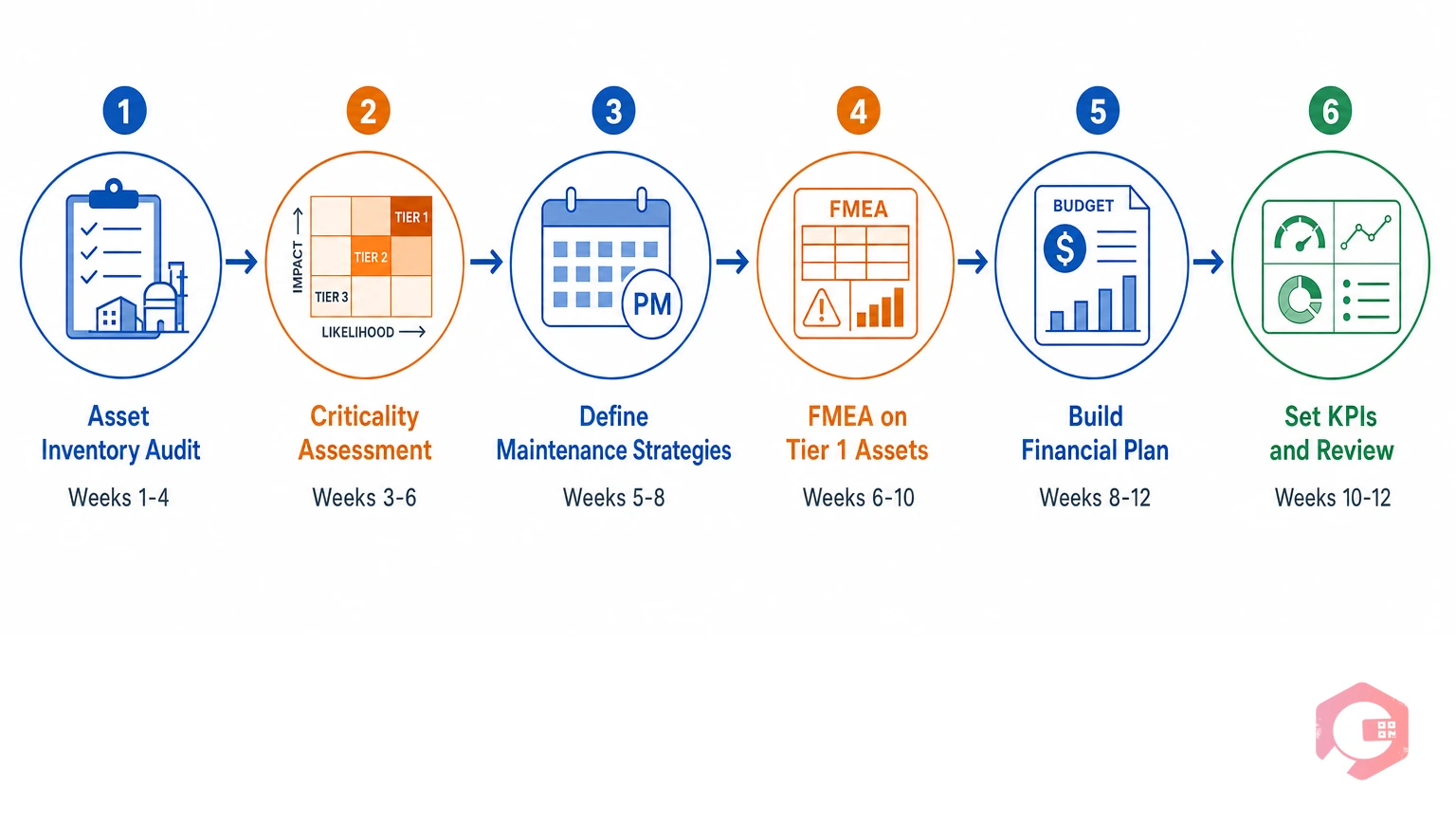
Developing an asset management plan does not need to be a multi-year initiative. A focused, phased approach delivers meaningful results within 3-6 months, with the full program maturing over 12-18 months as data accumulates and processes embed.


Step 1: Conduct an Asset Inventory Audit (Weeks 1-4)

Start on the ground. Walk every facility and physically verify every maintainable asset. For each asset, record the make, model, serial number, installation date, location, and current condition. Apply QR code or NFC labels to every asset that doesn't already have one. Upload this data into your CMMS asset register — it becomes the master record that every other AMP component references.

Most facilities discover significant gaps between their existing records and physical reality during this audit. Completing it thoroughly takes longer than expected but pays back the investment immediately when you can trust the data your AMP is built on.


Step 2: Assess Asset Criticality (Weeks 3-6)

Once your asset register is current, score every asset using the criticality matrix methodology above. Involve your senior technicians, operations managers, and HSE team in the scoring process — the people closest to the equipment bring irreplaceable knowledge of failure behavior and consequences that no database captures. The output is a tiered asset list that becomes the foundation for every subsequent resource allocation decision.


Step 3: Define Maintenance Strategies by Tier (Weeks 5-8)

With criticality established, assign a maintenance strategy to each asset tier. Tier 1 assets get condition-based or predictive monitoring, with PM schedules for tasks that cannot be condition-monitored. Tier 2 assets get structured preventive maintenance schedules based on OEM recommendations adjusted for your actual operating conditions. Tier 3 assets run with minimal planned intervention — monitoring for safety-relevant failures but otherwise running to failure.

Build the PM task library for each asset class in your CMMS at this stage: the specific tasks, intervals, checklists, required tools, and estimated labor time. This transforms your strategy from a document into an executable schedule.


Step 4: Conduct FMEA on Tier 1 Assets (Weeks 6-10)

For your highest-criticality assets, perform a structured Failure Mode and Effects Analysis. Document every significant failure mode for each critical component, the probability of occurrence, the severity of consequence, and the current detection capability. Where detection is poor or consequence is severe, add specific maintenance tasks, inspections, or monitoring sensors to close the gap.

FMEA is not a one-time exercise. Schedule an annual review for each critical asset, incorporating actual failure data from your CMMS to validate or update the analysis.


Step 5: Build Your Financial Plan (Weeks 8-12)

Translate your asset data into financial projections. Calculate the annual maintenance budget by asset class and maintenance type. Build a 5-10 year capital replacement schedule using asset age, condition scores, and replacement cost data from your register. Set maintenance cost targets as a percentage of replacement asset value — typically 2-4% RAV is the world-class benchmark for well-maintained industrial facilities.


Step 6: Set KPIs and Review Cadence (Weeks 10-12)

Define the KPIs that will tell you whether the AMP is working. Set baseline values from your current CMMS data and establish 90-day improvement targets. Institute a monthly maintenance review meeting where OEE, MTBF, MTTR, PM compliance, and downtime data are reviewed with the operations team. This accountability loop is what sustains the AMP over time — it prevents the plan from becoming a document that sits on a shelf.


Aligning Your Plan with ISO 55001

ISO 55001 is the international standard for asset management systems. It does not prescribe a specific format for your asset management plan, but it defines the organizational requirements that a compliant AMP must satisfy.

The key ISO 55001 requirements most directly addressed by a well-structured AMP are: documented evidence of asset information (your register), a documented asset management policy linked to organizational objectives, defined roles and responsibilities, a structured approach to risk and opportunity assessment, and evidence of continual improvement through KPI measurement and review.

For organizations pursuing ISO 55001 certification, the asset management plan is the primary document auditors review. A CMMS that maintains the asset register and generates maintenance records automatically produces much of the evidence the certification body will want to see — without manual documentation effort before each audit.


How a CMMS Turns Your Plan Into Action

An asset management plan is only as valuable as its execution. The most common reason AMPs fail to deliver their intended outcomes is not bad planning — it is the gap between the plan document and the daily operations of the maintenance team. A CMMS closes that gap by embedding the plan's strategies into automated, daily workflows.

Cryotos CMMS addresses every major component of your AMP directly:


  • Asset register and lifecycle tracking: Cryotos maintains a complete digital profile for every asset — specifications, maintenance history, warranty status, cost history, and condition data — all accessible via mobile QR code scan from anywhere in the facility. The asset register stays current automatically as work orders are completed and parts are consumed.
  • Criticality-based PM scheduling: PM schedules in Cryotos support both time-based intervals and usage-based triggers (every 500 runtime hours or after 10,000 production cycles). For Tier 1 critical assets, complex scheduling conditions — "service every 200 hours OR 45 days, whichever comes first" — are configured without coding. Automated alerts ensure nothing is missed across hundreds of concurrent PM schedules.
  • IoT and condition-based monitoring: Cryotos integrates with SCADA systems, PLCs, and IoT edge devices to pull real-time sensor data. When a vibration sensor on a critical pump exceeds its defined threshold, Cryotos automatically creates a high-priority work order, assigns it to the nearest qualified technician, and notifies supervisors via mobile and WhatsApp — before the failure occurs.
  • Downtime and KPI reporting: The Cryotos BI Dashboard tracks OEE, MTBF, MTTR, PM compliance rate, and maintenance cost per asset in real time. Scheduled reports deliver these metrics to maintenance managers and plant directors automatically, without manual compilation.
  • Inventory management linked to the AMP: Cryotos connects spare parts inventory to the asset register, tracking consumption by asset and triggering automatic reorder alerts at configurable minimum thresholds. Parts availability is confirmed before planned maintenance work orders are dispatched — preventing the delays that occur when technicians arrive without the right components.


Teams using Cryotos report an average 30% reduction in unplanned downtime and 25% faster repair times within six months of implementation. These gains reflect exactly what a well-executed asset management plan is designed to deliver — not as a theoretical projection, but as a measured operational outcome.


Common Mistakes to Avoid When Building Your Asset Management Plan

Even well-intentioned asset management planning efforts fail when they fall into predictable traps. Here are the most common mistakes and how to avoid them.


  • Starting without a clean asset register: Building an AMP on incomplete or inaccurate asset data undermines every decision that follows. Before anything else, conduct a physical audit and validate your register against ground truth. Garbage in, garbage out — this principle is absolute in asset management.
  • Applying one maintenance strategy to all assets: Treating every asset identically wastes resources on non-critical equipment while under-protecting critical ones. The criticality assessment exists precisely to prevent this — use it to differentiate your approach meaningfully.
  • Creating a plan that lives in a document: An AMP that is written, reviewed once, and filed creates a false sense of security. Your plan must be operationalized through your CMMS and reviewed on a regular cadence. The monthly review meeting is not optional.
  • Ignoring the financial dimension: An AMP without a capital replacement schedule and maintenance budget target leaves finance and leadership without the long-range visibility they need. The plan must connect asset condition to financial projections.
  • Building the plan without frontline input: The most knowledgeable people about how your assets actually behave are the technicians who work on them daily. FMEA, criticality scoring, and maintenance strategy selection should involve them — not be handed down from management as a finished document.


Frequently Asked Questions


What is the difference between an asset management plan and a maintenance plan?

An asset management plan covers the full lifecycle of physical assets — acquisition, operation, maintenance, and disposal — including financial planning, risk management, and performance monitoring. A maintenance plan is narrower, focusing specifically on the tasks, schedules, and procedures for keeping assets operational. The maintenance plan is one component within the broader asset management plan.


How long does it take to develop an asset management plan?

A focused development effort produces a functional asset management plan in 3-6 months for a mid-size facility. The asset inventory audit typically takes 4-6 weeks. Criticality assessment and maintenance strategy definition take another 4-6 weeks. Financial planning and KPI setup complete the core plan within the 3-month window. Full program maturity — with real operating data validating and refining the strategies — comes at 12-18 months.


What assets should be included in an asset management plan?

Every maintainable physical asset that materially affects production capacity, safety, regulatory compliance, or operational cost should be included. In a manufacturing facility, this typically includes production equipment, utilities (compressors, HVAC, power distribution), material handling systems, and support infrastructure. The asset criticality assessment determines the depth of management each asset receives — not every asset warrants the same level of attention.


Is a CMMS required to implement an asset management plan?

A CMMS is not strictly required, but it is the difference between an asset management plan that works and one that doesn't. Without a CMMS, executing hundreds of concurrent PM schedules, tracking real-time asset condition, maintaining complete maintenance histories, and generating the KPI reports your AMP requires is practically impossible at scale. A paper-based or spreadsheet-driven AMP may work for very small operations with fewer than 20 assets. Beyond that, a CMMS is essential.


How does an asset management plan support ISO 55001 compliance?

ISO 55001 requires organizations to have documented asset management objectives, plans, and processes — exactly what a well-structured AMP provides. The standard's requirements for asset information, risk assessment, performance evaluation, and continual improvement are all addressed by the seven components described in this guide. A CMMS that maintains the asset register and generates maintenance records automatically produces much of the evidence that ISO 55001 auditors require.


A well-executed asset management plan converts asset data into better decisions — lower maintenance costs, higher asset availability, safer operations, and capital investment choices grounded in evidence rather than instinct. The organizations that build this capability consistently outperform those that react to failures as they occur.

Cryotos CMMS provides the digital infrastructure to build and execute your asset management plan — from the asset register and criticality-based PM scheduling through to IoT-triggered condition monitoring, financial reporting, and real-time KPI dashboards. Book a free demo and see how Cryotos turns your asset management plan into measurable operational results from day one.

Want to Try Cryotos CMMS Today?

Get Free Demo

Let AI Take Control of Your Maintenance

Cryotos AI predicts failures, automates work orders, and simplifies maintenance—before problems slow you down.

Try AI-Powered CMMS
🡢