
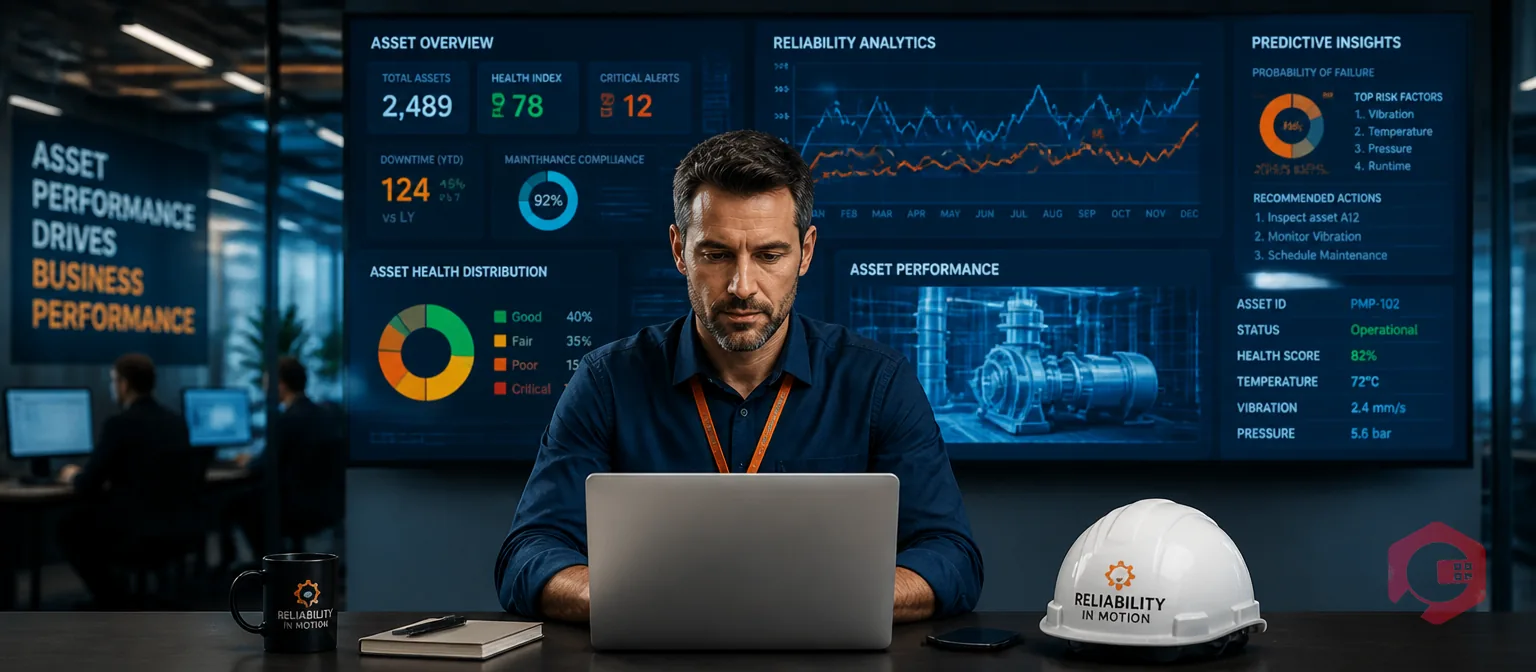
Asset Performance Management (APM) software helps industrial organizations monitor, analyze, and optimize the health and performance of physical assets — from manufacturing equipment and power generation turbines to pipelines and facility infrastructure. Unlike traditional preventive maintenance systems, APM platforms use real-time sensor data, machine learning, and predictive analytics to identify failure risks before they cause downtime. According to a Deloitte Industry 4.0 report, predictive maintenance enabled by APM technology can reduce unplanned downtime by 30 to 50 percent and cut maintenance costs by 10 to 25 percent. In 2026, the best APM tools combine IoT integration, digital twin capabilities, and mobile-first workflows that maintenance teams can actually use on the floor.
In this guide, we compare the top 10 asset performance management software platforms available in 2026, covering their strengths, ideal use cases, and what to look for when choosing a solution for your operation.
Asset Performance Management software is a category of industrial technology that monitors the real-time health of physical assets, predicts failure before it occurs, and helps maintenance teams prioritize their work based on actual risk — not calendar schedules. APM systems pull data from IoT sensors, SCADA systems, PLCs, and operational historian databases to build a continuous picture of how your equipment is performing relative to its expected baseline.
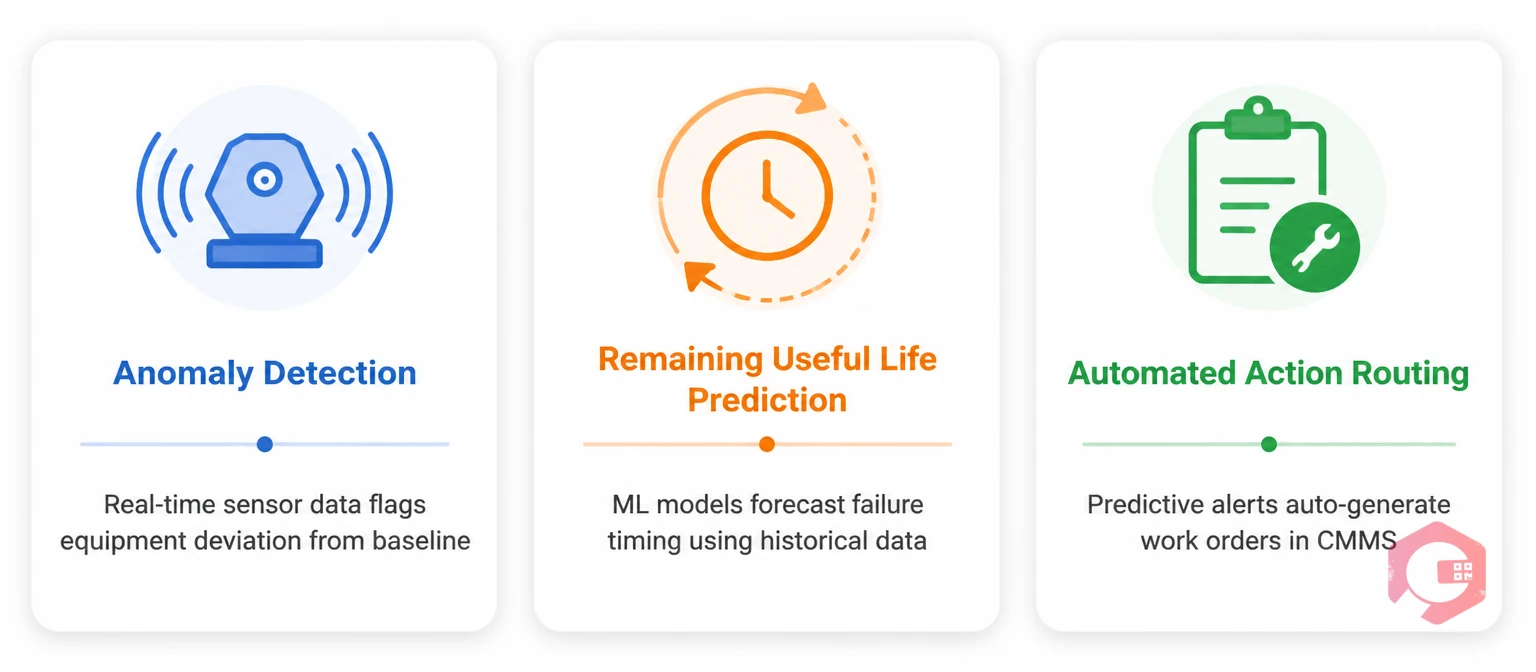
A mature APM platform does three things that traditional maintenance software cannot. First, it detects anomalies in equipment behavior — a compressor drawing 15 percent more current than its baseline, or a rotating shaft vibrating at a frequency pattern that precedes bearing failure. Second, it predicts the remaining useful life (RUL) of assets using reliability models trained on historical failure data. Third, it automatically surfaces recommended actions — generate a work order, escalate to engineering, or adjust a process parameter — and routes those actions to the right people in your maintenance system.
According to Gartner's definition, APM encompasses four functional layers: asset health management, reliability-centered maintenance, condition monitoring, and predictive analytics. Platforms vary significantly in which layers they address — some focus purely on condition monitoring through sensor data, while others offer full reliability analysis and lifecycle cost optimization.
These three categories are frequently confused, and vendors often use the terms interchangeably for marketing purposes. Understanding the real distinction saves you from buying the wrong tool for your operation.
| APM vs CMMS vs EAM — Key Differences | |
|---|---|
|
CMMS Computerized Maintenance Management System |
The operational system of record for maintenance execution — work orders, PM schedules, asset history, spare parts inventory, and technician management. Core Question: "What maintenance work needs to be done, when, and by whom?" |
|
EAM Enterprise Asset Management |
Extends CMMS capabilities to cover the full financial lifecycle of assets — capital planning, procurement, depreciation, and eventual disposal. Core Question: "What is the total cost of ownership for each asset, and when should it be replaced?" |
|
APM Asset Performance Management |
An analytics-first methodology software. It uses sensor data, reliability models, and machine learning to generate predictive intelligence that feeds into your CMMS as prioritized work orders or maintenance recommendations. Core Question: "Which of my assets are at risk of failing, why are they degrading, and what should I do about it first?" |
| In practice (2026 Strategy): The most effective maintenance programs combine all three layers: CMMS for execution, EAM for financial lifecycle management, and APM for predictive intelligence. Many modern platforms blend these categories — particularly CMMS and APM — into unified tools that handle both execution and prediction seamlessly. | |
APM delivers the strongest return on investment in operations where unplanned equipment failure is expensive, where assets are complex and numerous, and where maintenance resources are limited enough to require intelligent prioritization. Industries that consistently see the highest APM ROI include oil and gas, power generation, mining, chemical manufacturing, and large-scale industrial facilities. That said, modern cloud-based APM platforms have brought the technology within reach of mid-sized manufacturing operations and facility management teams that would have found enterprise APM prohibitively expensive just five years ago.

Not all APM platforms are equal — and the right choice depends heavily on your asset base, operational context, and the CMMS or ERP systems you already use. Before evaluating vendors, build a shortlist of must-have capabilities based on your actual failure modes and maintenance workflows.
The most important capabilities to evaluate:
Cryotos is a mobile-first CMMS and asset maintenance platform built for industrial operations that need both maintenance execution and predictive asset intelligence in one system. While many APM vendors focus exclusively on analytics dashboards, Cryotos closes the loop between a predictive alert and a completed maintenance action — the part that most standalone APM platforms leave as a manual handoff.
Cryotos connects directly to SCADA systems, PLCs, and IoT edge devices via standard industrial protocols. When a sensor reading on a critical pump crosses a user-defined threshold — say, vibration amplitude exceeding 4 mm/s — the system automatically generates a high-priority work order, assigns it to the nearest qualified technician based on skill set and location, and sends real-time alerts via mobile push, email, or WhatsApp. The entire chain from anomaly detection to maintenance dispatch happens without human intervention.
The platform's asset management module supports complex asset hierarchies — plant to system to component — with full maintenance history, warranty tracking, and reliability KPIs (MTBF, MTTR, OEE, availability percentage) surfaced in real-time BI dashboards. Preventive maintenance scheduling supports both calendar-based and usage-based triggers, with "Either/Or" logic so a work order fires on whichever condition — time or runtime hours — is reached first.
What makes Cryotos particularly effective for maintenance-heavy industries is its mobile-first design. Technicians use an offline-capable app to receive work orders, scan asset QR codes for full history, complete digital checklists, and close jobs with digital signatures — even in areas with no network connectivity. Managers get a live view of every open work order, asset health status, and downtime event across departments and plants from a single dashboard.
IBM Maximo has been the benchmark for enterprise asset management for decades, and its current Maximo Application Suite (MAS) adds AI-powered APM capabilities on top of its established EAM foundation. The suite includes Maximo Predict (predictive maintenance using asset health scoring and anomaly detection), Maximo Monitor (IoT asset monitoring), and Maximo Health (asset health dashboards and failure risk assessment).
IBM Maximo is the strongest choice for large, complex enterprises — utilities, oil and gas companies, and government agencies — that need a single platform managing everything from capital planning and procurement through to predictive failure detection. The depth of functionality is unmatched, but so is the implementation complexity and cost.
SAP's asset management capabilities — now consolidated in SAP S/4HANA Asset Management — provide deep integration with SAP's ERP ecosystem. For organizations already running SAP for finance, procurement, and supply chain, SAP PM eliminates the data silos that occur when maintenance runs on a separate system. Parts consumption automatically flows to inventory. Labor costs automatically hit the maintenance cost center.
Bentley's AssetWise platform is purpose-built for infrastructure-intensive industries — rail networks, roads and bridges, water utilities, and power transmission and distribution networks. Its APM capabilities are particularly strong for linear infrastructure assets and engineered structures that require reliability analysis grounded in engineering models rather than just sensor data.
GE Digital's APM platform is one of the most established dedicated APM tools in the market, with particular depth in the process industries — oil and gas, chemicals, and power generation. Its reliability engineering toolkit is thorough: Reliability-Centered Maintenance (RCM), Failure Modes and Effects Analysis (FMEA), mechanical integrity management, and risk-based inspection (RBI) planning are all natively supported.
Emerson's AMS Device Manager specializes in the asset health management of instrumentation and control assets — valves, transmitters, analyzers, and other field devices. Where most APM platforms focus on rotating equipment, AMS Device Manager fills a gap by providing condition monitoring and predictive diagnostics specifically for the control and measurement devices that most plants manage poorly.
Uptake is an industrial AI platform focused on predictive analytics for heavy equipment — mining trucks, locomotives, wind turbines, and construction equipment fleets. Its strength is the quality of its machine learning models, trained on billions of hours of equipment sensor data. Rather than requiring customers to build their own models, Uptake provides pre-built failure prediction models for common equipment classes that are ready to deploy with minimal configuration.
Limble CMMS is a modern, cloud-based maintenance management platform that has added condition-based maintenance and meter-based PM triggering capabilities. It is not a full-featured APM platform in the GE or IBM sense, but for a manufacturing facility making its first move from reactive to data-driven maintenance, Limble provides an accessible starting point with one of the best-rated technician mobile apps in the category.
Infor EAM is a mature enterprise asset management platform with strong multi-site and multi-organization management capabilities. Its APM extensions add predictive and condition-based maintenance on top of a solid EAM foundation. Infor EAM is particularly strong for regulated industries like healthcare, life sciences, and nuclear power that require deep audit trails and compliance tracking within the same system that manages maintenance execution.
Fiix is a cloud-based CMMS that Rockwell Automation acquired in 2021 and has since deepened its integration with Rockwell's FactoryTalk industrial platform. For Rockwell users — particularly automotive, electronics manufacturing, and CPG factories running Allen-Bradley PLCs — this integration means maintenance data and production data live closer together than on any other CMMS platform.
Use this summary to quickly identify which platforms align with your operation's scale, industry, and primary use case:
| Platform | Best For |
|---|---|
| Cryotos CMMS | Best for mid-to-large industrial operations wanting IoT-driven predictive maintenance integrated with maintenance execution — manufacturing, mining, energy, facilities. |
| IBM Maximo | Best for large enterprises needing full-spectrum EAM and APM with deep AI capabilities and global support. |
| SAP PM / S/4HANA | Best when SAP is already the enterprise backbone and maintenance-ERP data integration is the top priority. |
| Bentley AssetWise | Best for infrastructure operators — rail, roads, utilities — managing engineered structures and linear assets. |
| GE Digital APM | Best for oil and gas, chemicals, and process industries with formal reliability engineering programs and RBI requirements. |
| Emerson AMS | Best for process plants with large instrumentation populations looking to add specific control device APM. |
| Uptake | Best for heavy equipment fleet operators — mining, locomotive, wind — who want pre-built predictive models without building their own. |
| Limble CMMS | Best for mid-market operations making their first move to digital, data-driven maintenance from spreadsheets or paper. |
| Infor EAM | Best for regulated industries like healthcare and life sciences already using Infor's ERP platform. |
| Fiix by Rockwell | Best for discrete manufacturers running Rockwell Allen-Bradley PLCs who want tight production-maintenance data integration. |
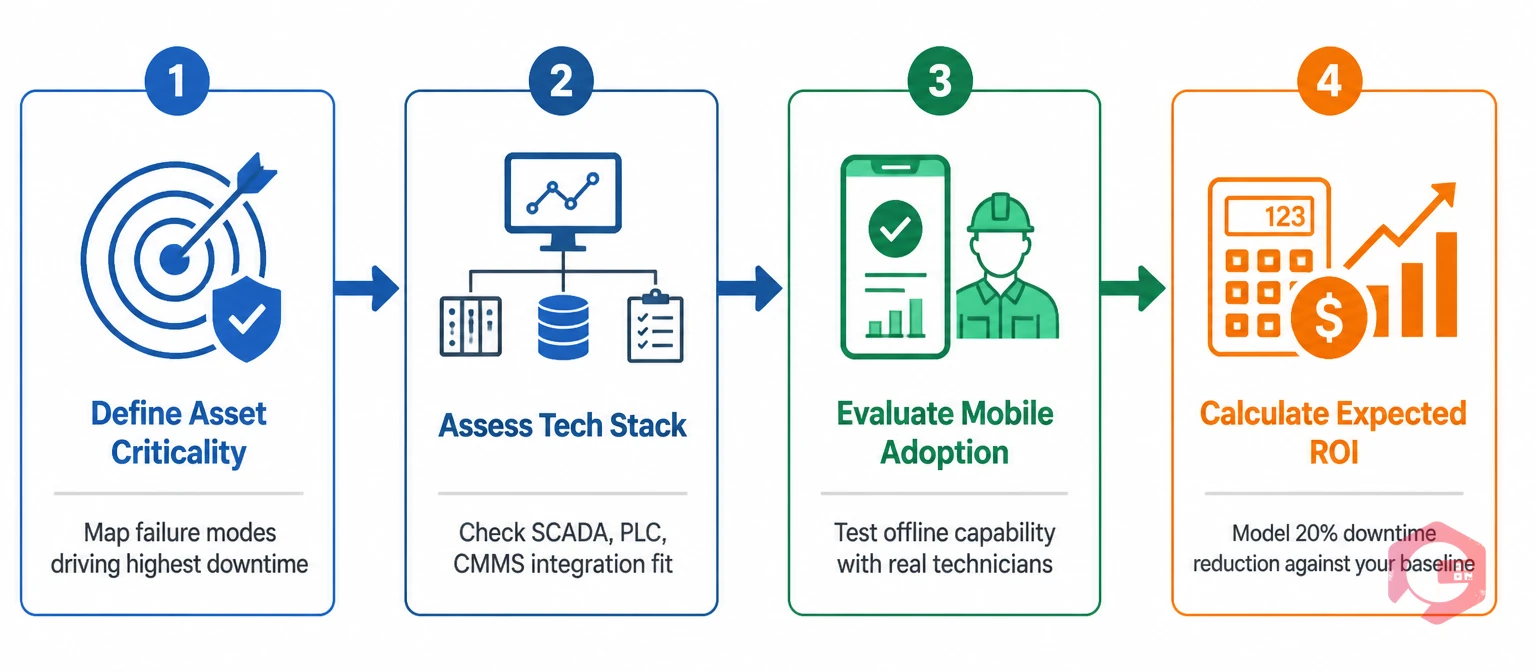
The wrong APM selection creates a compounding problem: high implementation costs, low technician adoption, and predictive alerts that never connect to actual maintenance action. Use this four-step framework to narrow your selection before engaging vendors.
Before evaluating platforms, map which assets drive the most downtime and which failure modes you need to predict. A mining operation trying to predict haul truck powertrain failures needs ML models trained on mobile heavy equipment — a general CMMS with threshold alerting will not deliver the prediction accuracy required. Match the platform's predictive analytics depth to the actual failure modes causing your highest downtime costs.
An APM platform that cannot connect to your existing SCADA system, PLC network, or maintenance CMMS will require either a complete infrastructure replacement or manual data entry. Evaluate each platform's native integration capabilities against your actual systems. According to McKinsey's research on maintenance digitalization, integration complexity is the single largest risk factor in APM implementation failure.
An APM system that generates predictions no one acts on produces no value. The critical link is the connection between a predictive alert and a technician completing a work order in the field. Evaluate each platform's mobile experience with actual technicians during the pilot — not just with procurement managers during a sales demo. Test offline capability in the connectivity dead zones your technicians actually work in.
Use your own baseline data to build a realistic ROI calculation. Conservative APM improvement estimates — 20% reduction in unplanned downtime, 15% reduction in reactive maintenance spend — applied to your baselines give you a credible payback timeline. Most mid-to-large industrial facilities recover APM investment within 12 to 18 months. Reliable Plant benchmarks consistently show that predictive maintenance programs reduce total maintenance costs by 12 to 18 percent within the first year of full deployment.
A CMMS is a maintenance execution system — it manages work orders, PM schedules, asset history, technician assignments, and spare parts inventory. APM software is a predictive intelligence layer — it uses sensor data, analytics, and machine learning to identify which assets are at risk of failing and why. The two systems are complementary: APM generates the intelligence, CMMS executes the response. Many modern platforms combine both capabilities, particularly CMMS tools that integrate directly with IoT sensor data to trigger condition-based work orders automatically.
APM software pricing varies enormously by platform tier. Enterprise platforms like IBM Maximo and GE Digital APM typically cost $100,000 to $500,000+ per year for large deployments, with significant additional implementation costs. Mid-market CMMS platforms with APM capabilities typically range from $30 to $200 per user per month, with lower implementation costs and faster time-to-value. Most vendors require a direct quote based on asset count, user licenses, and integration requirements.
Not necessarily. If your CMMS supports IoT integration, condition-based maintenance triggers, and real-time asset health monitoring, it may already cover the core APM capabilities you need — particularly for manufacturing, facilities, and mid-market industrial operations. Standalone enterprise APM platforms deliver additional value for organizations with complex reliability engineering requirements, large sensor infrastructures, or regulatory risk-based inspection mandates.
The industries with the highest APM ROI are those where unplanned asset failure is most expensive and where assets are complex enough to generate useful predictive signals. Oil and gas, power generation, mining, chemical manufacturing, and large-scale industrial facilities consistently show the strongest APM business cases. Modern cloud-based APM platforms have also made the technology accessible to mid-sized manufacturers and facility management operations.
Implementation timelines vary significantly by platform and operational complexity. Enterprise APM deployments on IBM Maximo or GE Digital typically take 6 to 18 months. Modern cloud-based CMMS platforms with APM capabilities can be operational on a pilot asset set within 4 to 8 weeks. The variable that most influences timeline is data readiness — how clean your existing asset register is, what sensor infrastructure is already in place, and how well-defined your maintenance workflows are before the project begins.
If your operation is managing critical assets reactively and your current CMMS does not connect to your sensor infrastructure or generate automatic work orders from equipment health alerts, Cryotos bridges that gap with IoT integration, automated condition-based work order creation, and the mobile tools your technicians need to act on every predictive alert that fires. Explore Cryotos asset maintenance management software or book a free demo to see how the platform works for operations like yours.



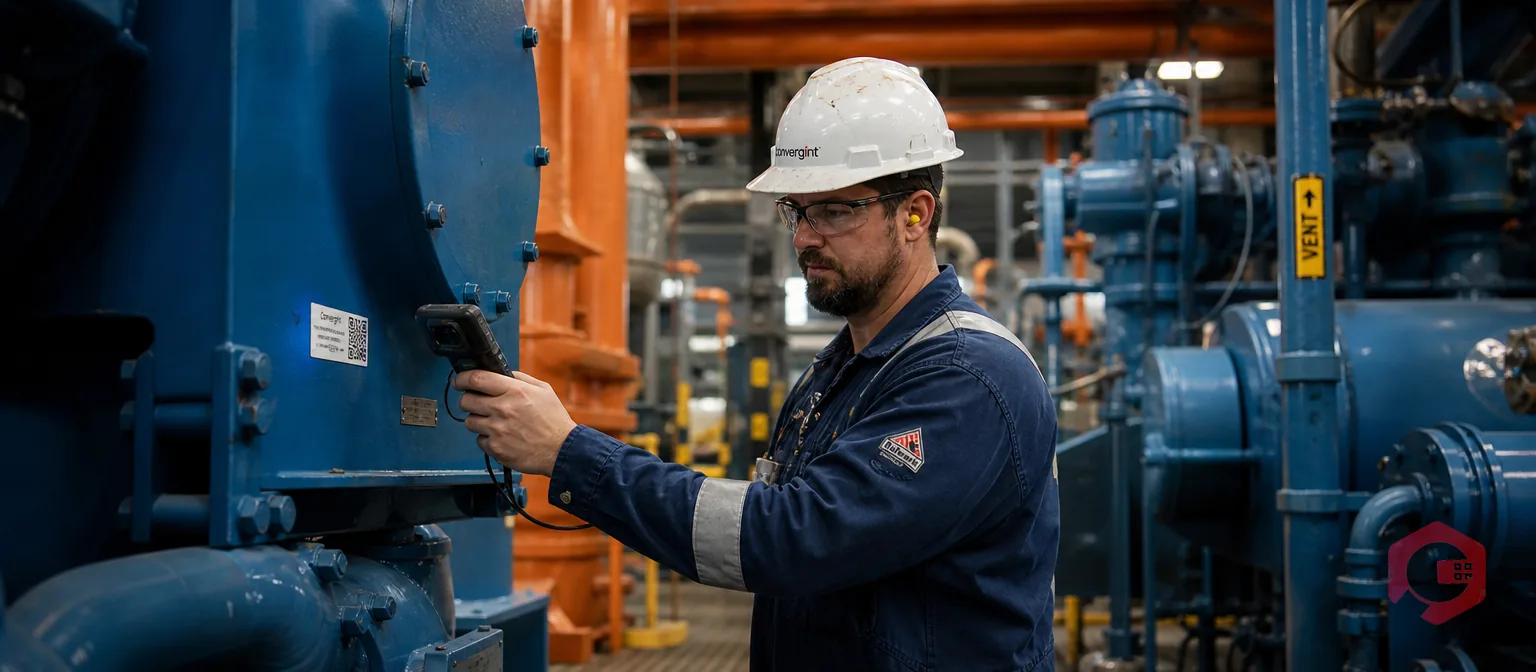
Cryotos AI predicts failures, automates work orders, and simplifies maintenance—before problems slow you down.



