Asset management for textile machinery is the systematic process of tracking, maintaining, and optimizing every machine across its full operational lifecycle — from procurement through decommissioning. In a textile plant where ring frames, rapier looms, dyeing units, and stenters run around the clock, that visibility is what separates mills that hit delivery windows from those that burn margins on emergency repairs.
McKinsey estimates poor maintenance costs manufacturers between 5% and 20% of production capacity. For a 24/7 textile mill operating on tight order books, that impact is direct and compounding. This guide gives you a complete working framework: what to register, how to schedule PMs by machine type, where a CMMS fits, the right KPIs to track, and a real Tirupur case study showing 30% fewer unplanned breakdowns in nine months.
Key Takeaways

Asset management for textile machinery is not simply keeping a spreadsheet of what you own. It means knowing the runtime hours on every ring frame, the last calibration date on every tension roller, the service interval on every compressor — all accessible the moment a technician approaches a machine. That level of visibility is what turns a reactive maintenance team into a proactive one.
The discipline runs across four sequential phases. Procurement sets the baseline: OEM specifications, warranty terms, spare-parts criticality, and the initial PM schedule. Operation captures daily and shift-level activity: run hours, production counts, parameter changes, and operator notes. Maintenance executes PMs and corrective work orders against the living asset record. Lifecycle management then uses the accumulated data to make sound repair-versus-replace decisions, budget for overhauls accurately, and retire assets at the economically correct moment.
When those four phases run in one connected system, the whole team operates from the same picture. When they run in separate spreadsheets and paper diaries, the gaps between them create the breakdowns that cost mills their margins.
A textile mill carries machines across five broad categories. Each has its own failure modes, wear patterns, and service cycles that a maintenance team must manage distinctly.

Textile plants run on tight delivery windows and thinner margins than most manufacturing sectors. When a critical machine drops, the whole production line ripples: output halts, orders slip, expedited logistics costs spike, and customer goodwill erodes. When asset tracking is weak, five specific problems compound quickly and continuously.
Industry benchmarks consistently show planned PM costs three to nine times less per event than reactive emergency repair when total costs — parts, labor, lost production, expedited logistics — are counted. Most mills that struggle with chronic downtime have their PM-to-reactive ratio inverted: 30% planned, 70% reactive. The target is the opposite. The ISO 55001 standard for asset management systems provides the international framework best-in-class mills use to structure, audit, and improve their programs.
These three terms describe overlapping but distinct tools and approaches. Understanding the difference helps you match the right level of investment to your plant's actual size and complexity — rather than over-engineering or under-equipping.
| Tool | What It Covers | Best For | Typical ROI Timeline |
|---|---|---|---|
| CMMS | Work orders, PMs, asset register, spares inventory, KPI reports, mobile execution | Single-site and multi-site mills wanting fast ROI and mobile-first maintenance | 3 to 6 months |
| EAM Software | Everything in CMMS plus full lifecycle costs, capital planning, compliance management, and financial integration | Large conglomerates managing asset portfolios across 10 or more plants and regions | 12 to 24 months |
| Basic Spreadsheets | Static asset lists and manual PM calendars | Very small operations — not realistically scalable beyond 50 assets | Immediate but limited |
Most textile mills — from 5,000 to 100,000 spindles — find that a CMMS hits the right balance of power, speed, and cost. EAM software makes economic sense for large textile groups managing 10 or more plants where centralized capital budgeting, compliance reporting, and financial consolidation justify the additional complexity and implementation time.

Start with a clean, complete asset register: every machine listed with its make, model, serial number, location, installation date, warranty status, OEM manual reference, and full maintenance history. Each asset gets a unique ID tied to a physical QR code or NFC tag mounted directly on the machine body in a visible, durable location.
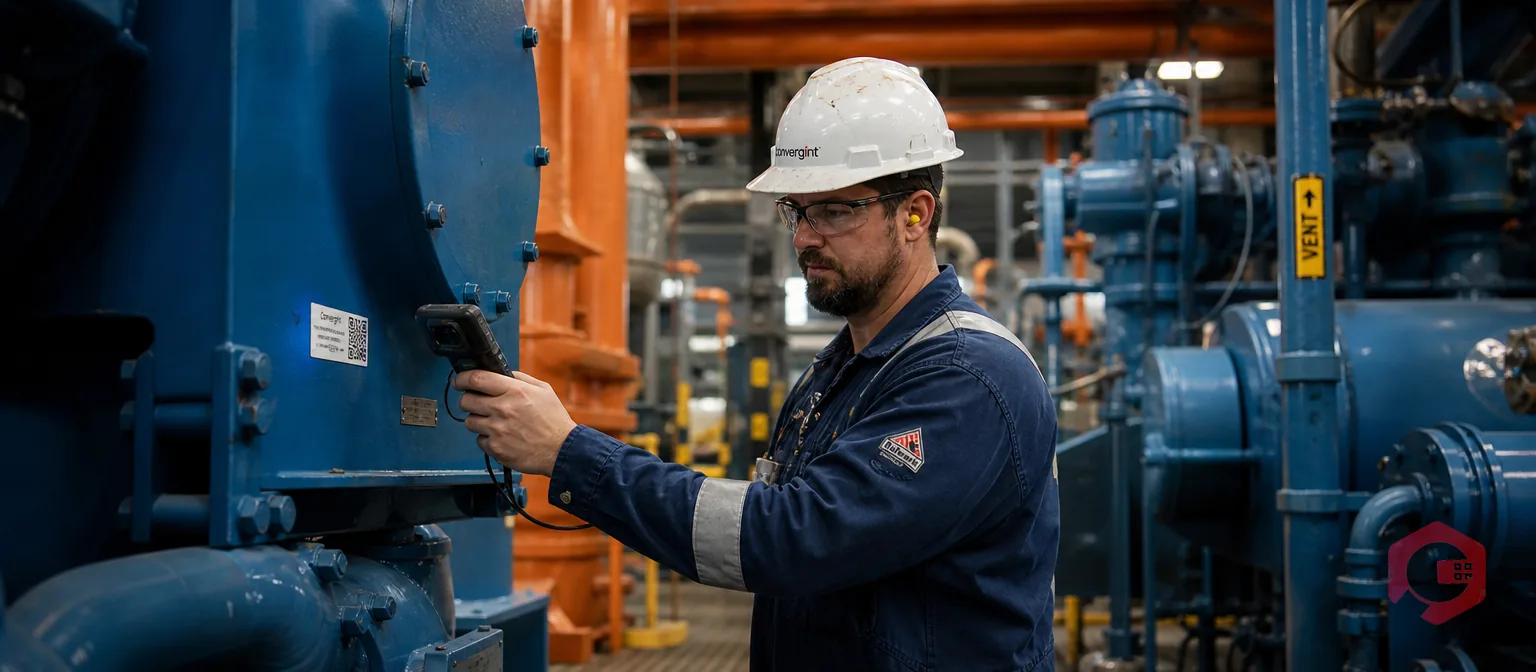
A technician scans the loom with a phone and the full profile opens instantly: last service date, open work orders, attached manuals, and the linked spare-parts list. Cryotos supports QR code scanning directly from the mobile app, with full offline capability so floor staff can log work even when Wi-Fi is patchy in the weaving shed or basement utility room.
Without a clean, complete register, every other component — PM scheduling, spares linking, downtime analysis, lifecycle costing — sits on guesswork. The asset register is always the first 30 days of any rollout, and it pays for itself before day 60.
Each machine needs a PM schedule built from OEM manuals, actual run hours, and your plant's operating conditions — not a generic calendar. PMs cover lubrication routes, belt tension checks, bearing inspections, lint clearing, seal replacement, calibration of speed and tension settings, and nozzle condition on air-jet looms.
A structured preventive maintenance software platform triggers work orders by date or runtime automatically — not by a paper calendar that gets skipped under production pressure. When a ring frame hits 720 operating hours, the system creates the work order, assigns the right technician by skill level, checks that the required spares are in stock, and sends a WhatsApp or email alert before the job is due.
Modern textile plants plug machines into IoT sensors that stream live data: spindle speed, motor temperature, vibration amplitude, current draw, and power consumption. That data lands on a live dashboard that maintenance supervisors can view from anywhere. The plant moves from reactive to predictive — catch a bearing heating up two days before it seizes, schedule the fix during the next planned gap, and avoid the breakdown entirely.
GPS and RFID tags help on the plant floor too. Portable tools, fabric carts, creel stands, and trolleys can be located in seconds rather than searched for across three shifts. Reducing tool hunt time alone typically recovers 15 to 20 minutes per technician per shift in larger spinning plants.
Every breakdown should log a cause code, the affected machine, duration, resolution steps, and parts consumed. After 90 days of consistent data, the causes of 80% of your unplanned downtime become obvious — and addressable. Downtime tracking in Cryotos ties each event to the asset record so you see patterns across machine families, shifts, operators, and production seasons — the data that makes a board-level case for investment in targeted PM upgrades.
When spares are managed separately from assets, two failures happen simultaneously: stockouts on critical parts and overstocking on slow-moving ones. Linking inventory to the asset register means the CMMS knows which spares each PM requires, checks stock before creating a work order, and triggers an automatic reorder alert when bins drop below minimum thresholds — before the breakdown, not during it.
OEM manuals publish PM intervals, but experienced maintenance managers in high-production environments often tighten these based on actual run hours and operating conditions. The intervals below reflect industry practice for mills running two to three shifts.
| Machine Type | Daily / Shift PM | Weekly PM | Monthly PM | Runtime-Triggered PM |
|---|---|---|---|---|
| Ring Frame | Lint clearing, traveller inspection | Spindle lubrication, ring gauge check | Belt tension, bearing check, gear oil level | Full overhaul at 720 operating hours |
| Rapier Loom | Rapier head condition, shed geometry | Tension roller check, guide rail lubrication | Reed and heddle frame inspection, nozzle clean | Full service at 1,500 operating hours |
| Air-Jet Loom | Air pressure check, nozzle inspection | Filter cleaning, reed condition | Compressor feed line inspection, solenoid check | Nozzle replacement at 2,000 hours |
| Stenter | Pin/clip condition, chain tension | Chain lubrication, burner check | Heat element inspection, blower bearing | Full chain service at 3,000 operating hours |
| Dyeing Machine | Seal and gasket inspection | Pump pressure check, valve operation | Heat exchanger descaling, liquor ratio calibration | Seal replacement at 500 dye cycles |
| Compressor | Oil level, temperature, pressure check | Belt tension, air filter inspection | Oil change, valve check, air-oil separator | Full overhaul at 8,000 operating hours |
| Draw Frame | Drafting zone lint clearing | Roller bearing inspection, apron check | Gear drive oil level, calendar roller check | Roller replacement at 600 operating hours |
These intervals are starting points. A CMMS with IoT integration lets you move from fixed-interval PMs to condition-based maintenance on your highest-criticality assets — where the PM triggers when sensor data crosses a threshold rather than when the calendar says so. For most mills, the practical path is fixed-interval PMs for 80% of assets and condition-based for the 20% whose failure causes the most production loss.
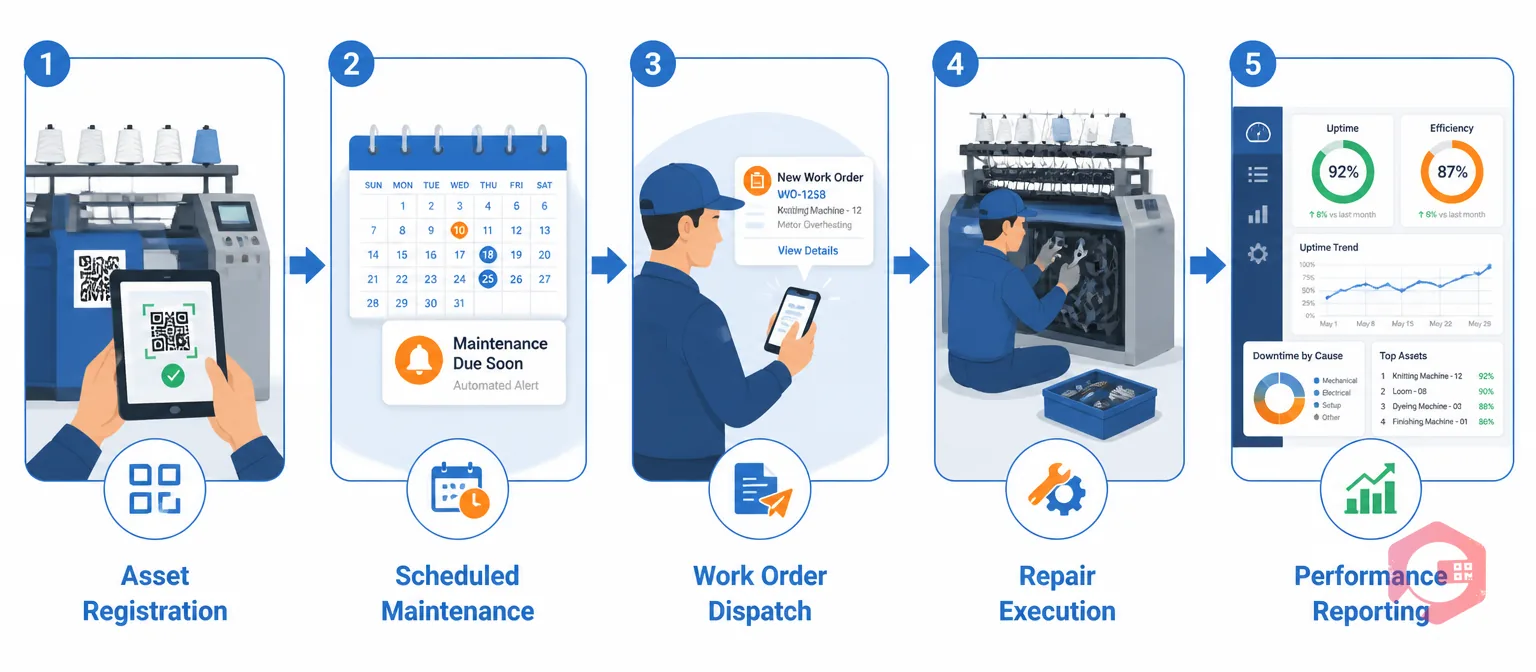
A CMMS pulls the asset register, PM schedule, work-order flow, spares inventory, and KPI reports into one system the entire team operates from — across shifts, departments, and if needed, multiple plants. Here is what that looks like in a working textile operation, not a marketing brochure.
For textile manufacturers specifically, Cryotos offers a purpose-built textile manufacturing maintenance software module with machine-type templates already configured for ring frames, rapier looms, air-jet looms, and stenters — cutting setup time significantly compared to building from a generic CMMS from scratch.
Understanding where your plant sits on this spectrum is the first step to improving it. Most mills struggling with chronic downtime do not realize how reactive they actually are until the data is in front of them in a format they can act on.
| Factor | Reactive Maintenance | Preventive Maintenance | Predictive Maintenance |
|---|---|---|---|
| Trigger | Machine fails | Fixed schedule or runtime threshold | Sensor data crosses alert threshold |
| Average cost per event | 3 to 9x higher than planned | Baseline planned cost | Lower than preventive — only when needed |
| Production impact | Unplanned halt, ripple across line | Planned gap, minimal disruption | Minimal — fix before failure at planned time |
| Parts availability | Emergency procurement, premium pricing | Pre-planned, standard pricing | Ordered ahead with lead time buffer |
| Infrastructure needed | None — just respond to failures | CMMS with PM scheduling | CMMS plus IoT sensors and data pipeline |
| Asset lifespan | Shortened by accumulated unaddressed wear | Extended through consistent planned care | Maximized — interventions only when needed |
| Best fit | Non-critical, cheap-to-replace assets only | Most textile plant assets — the practical standard | Highest-criticality assets with high failure cost |
The shift from reactive to planned does not happen overnight, but it follows a predictable path: asset register first, then PM scheduling, then mobile execution, then KPI review, then selective IoT overlay. Most mills reach 80% planned maintenance within 9 to 12 months of a structured rollout. The Society for Maintenance and Reliability Professionals (SMRP) benchmarks world-class plants at 85% or more planned maintenance activity as the target state.
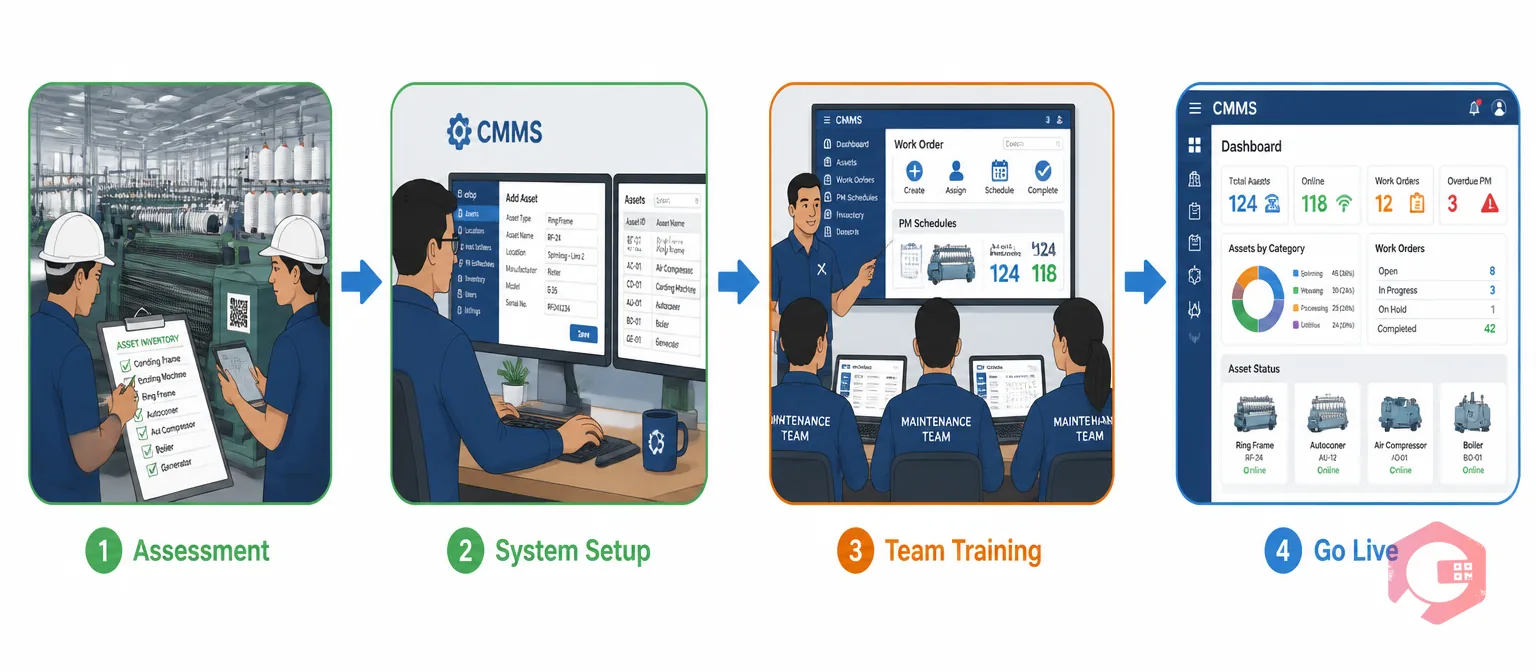
Most textile mills can stand up a functioning asset management program in 90 days when the rollout is phased correctly. Trying to digitize everything at once typically stalls by week six. This phased approach has worked consistently in Indian spinning and weaving operations.
Days 1 to 30 — Foundation: Build the Asset Register. List every machine across all five categories. Assign unique IDs. Print and fix QR codes to each asset. Populate the CMMS with OEM specs, install dates, warranty terms, and the last known service date for each machine. Prioritize the 20% of assets that cause 80% of your downtime for immediate attention — these are your A-criticality machines.
Days 31 to 60 — Activation: Stand Up PM Schedules and Mobile Work Orders. Build PM templates for each machine type using the interval table above as a starting point. Configure work orders to trigger automatically by date and runtime. Train the maintenance team on mobile execution — scanning, checklist completion, photo attachment, and digital sign-off. Run paper and digital in parallel for two weeks, then cut over to digital-only.
Days 61 to 90 — Integration: Link Inventory and Turn On Dashboards. Map spares to assets and PMs. Set minimum stock thresholds on all critical spares. Configure the reorder alert system. Activate the KPI dashboard — MTBF, MTTR, OEE, and PM compliance by machine and shift. Hold the first monthly maintenance review meeting with the data. This review is where the real ROI conversation starts.
After day 90, the program runs on its own rhythm. Most mills see their first meaningful KPI improvements in month three and clear cost reduction evidence by month six.
A 30,000-spindle ring spinning unit in Tirupur ran on Excel and paper logs through 2024. Unplanned breakdowns averaged 2.4 events per week across the three main machine families. The plant spent 22% of its maintenance budget on emergency repairs and duplicate spare orders. PM compliance hovered at 54%, meaning nearly half of scheduled maintenance was being skipped or deferred under production pressure.
The team rolled out Cryotos in 12 weeks, focusing first on three asset families: ring frames, draw frames, and the humidification plant. QR codes went on every machine within the first two weeks. PMs moved from monthly Excel calendars to runtime-triggered work orders. Spares were linked to assets with min-max thresholds configured on every critical bin. The maintenance head reviewed the KPI dashboard every Monday morning — something that had never happened under the paper system because there was no data to review.
Nine months later, the results were measurable across every dimension.
The maintenance head's summary: "We did not buy new machines. We just stopped losing track of the ones we have."
Run this 10-point checklist against your plant today. Each "yes" is a healthy sign. More than three "no" answers point to real downtime and cost leaks that a structured program can fix in months. For a detailed inspection checklist you can use on the floor, download the asset and equipment inspections checklist.
| # | Asset Management Practice | In Place? |
|---|---|---|
| 1 | Asset register is complete and current with unique machine IDs and OEM specs | Yes / No |
| 2 | QR codes or NFC tags fixed on all critical machines and utility assets | Yes / No |
| 3 | PM schedules exist for every major machine type, with runtime-based triggers for A-criticality assets | Yes / No |
| 4 | Maintenance history logged digitally — not on paper cards or shift diaries | Yes / No |
| 5 | Spare parts inventory linked to specific assets with minimum-stock thresholds configured | Yes / No |
| 6 | Every breakdown logged with cause code, duration, and resolution notes | Yes / No |
| 7 | MTBF, MTTR, OEE, and PM compliance reviewed at least monthly with the maintenance team | Yes / No |
| 8 | Statutory inspections — boilers, pressure vessels, lifting gear — scheduled in advance with reminder alerts | Yes / No |
| 9 | Lifecycle costs tracked per machine, with repair-versus-replace analysis available for aging assets | Yes / No |
| 10 | The maintenance team works from a CMMS — not spreadsheets or paper | Yes / No |
ISO 55001 sets the international standard for asset management systems. Many textile mills use it as a maturity benchmark while rolling out their program, with asset maintenance management software closing the gap between current state and ISO readiness systematically.
A machine's full cost is not its purchase price — it is the sum of purchase, installation, energy consumption, spare parts, planned maintenance, reactive repairs, and eventual disposal. That total is the lifecycle cost, and asset lifecycle management is the discipline designed to track and minimize it over the machine's full service life.
In textile plants, lifecycle cost visibility changes two critical decisions. First, repair versus replace: when a loom's cumulative repair costs over three years exceed 60% to 70% of its replacement value, the economics of continuing to repair usually break down. Finance teams consistently make better capital allocation decisions when this data is in a CMMS rather than scattered across shift diaries and informal estimates. Second, capital planning: operations leadership can build accurate multi-year budgets for refurbishments and new equipment purchases when the cost and condition data is structured and queryable.
Condition monitoring ties directly into lifecycle management. When sensors show a motor's vibration signature trending toward failure, you can plan a rewind or replacement at the next scheduled maintenance window — not as an emergency capital expense. That keeps the asset in the planned lifecycle budget instead of appearing as an unexpected line item. The ISO 55000 asset management framework overview on Reliabilityweb provides a deeper technical view of how lifecycle thinking connects to the full ISO standard for asset-intensive operations.
Asset management for textile machinery is the systematic process of tracking, maintaining, and optimizing every machine from procurement to decommissioning. It covers the asset register, PM scheduling, work order execution, spare parts linking, downtime analysis, and lifecycle cost tracking — all in one connected system so the maintenance team and plant leadership work from the same data.
Combine a digital asset register with physical QR codes or NFC tags on each machine, all managed inside a CMMS. Any technician pulls the full machine history with a phone scan. For larger mills or highest-criticality assets, add IoT sensors for live condition monitoring to shift from reactive to predictive maintenance without adding manual inspection load.
A CMMS centralizes the asset register, PM schedules, work orders, spare parts, and KPI reports in one system all shifts can access. For textile plants, that means fewer missed PMs, faster breakdown response with full machine history available instantly, and clear data on which machines drive the most downtime and maintenance cost — so resources go to the highest-impact problems.
Track OEE (Overall Equipment Effectiveness), MTBF (Mean Time Between Failures), MTTR (Mean Time to Repair), PM compliance rate, asset availability percentage, and maintenance cost per machine hour. Together these metrics show exactly how each machine is performing, where wear is accumulating, and where to focus the maintenance team's effort for maximum production impact.
Service intervals depend on machine type, production load, and operating conditions. Ring frames typically need full overhauls every 720 operating hours; rapier looms at around 1,500 hours; stenters every 3,000 hours. Most OEMs also publish daily, weekly, and monthly PM tasks on top of these runtime milestones. A CMMS makes runtime-based scheduling straightforward regardless of calendar complexity or shift patterns.
A focused 90-day rollout works for most mills. Days 1 to 30 build the asset register and tag every machine. Days 31 to 60 stand up PM templates and mobile work orders. Days 61 to 90 link inventory and activate dashboards. Plants typically see meaningful KPI improvement by month three and clear cost reduction evidence by month six.
Preventive maintenance runs on fixed intervals — every X hours or every Y days — regardless of the machine's actual condition. Predictive maintenance uses live sensor data (temperature, vibration, current draw) to trigger service only when the machine shows measurable signs of degradation. Predictive is more cost-efficient on high-criticality assets but requires IoT infrastructure. The practical path for most mills is preventive maintenance for 80% of assets and selective predictive monitoring on the 20% whose failures cause the most production loss.
Textile plants have unique characteristics that standard maintenance programs often underestimate: extremely high asset counts (a 30,000-spindle plant has thousands of individual components to track), fine tolerances on speed and tension settings that affect product quality when they drift, continuous three-shift operation with minimal scheduled downtime, significant utility dependencies (compressed air, humidification, steam), and statutory compliance requirements on boilers and pressure vessels. A CMMS configured for textile-specific machine types and PM templates handles these characteristics more effectively than a generic manufacturing maintenance setup.
Asset management for textile machinery is not complicated — but it does require consistency. A clean register, machine-specific PM schedules, mobile work execution, linked inventory, and a monthly KPI review form the foundation. Mills that build this foundation protect their margins, hit their delivery windows, and extend their machines' service lives. The ones that do not lose ground one breakdown at a time, often without knowing exactly why.
If your plant still runs on spreadsheets or paper logs, you are one bad night shift away from a serious production miss. Cryotos is purpose-built for textile maintenance — from QR-tagged assets to runtime-triggered PMs to live dashboards your plant manager and group leadership can see from anywhere. Schedule a free demo and we will map your top 10 critical assets and show you the first five PM templates to configure for your machine types.


Cryotos AI predicts failures, automates work orders, and simplifies maintenance—before problems slow you down.