Asset Management for Mining Companies: A Complete Guide to CMMS

Article Written by:

Created On:

April 8, 2026

Asset Management for Mining Companies: A Complete Guide to CMMS

Asset management for mining companies means systematically tracking, maintaining, and optimising every piece of heavy equipment - from haul trucks and conveyor belts to drilling rigs and crushers - to maximise uptime and slash unplanned failures. In an industry where a single haul truck breakdown can cost upwards of $50,000 per hour in lost production, getting asset management right isn't optional. It's the difference between hitting your quarterly targets and blowing them.

A Computerised Maintenance Management System (CMMS) purpose-built for mining gives your maintenance teams the tools to shift from reactive fire-fighting to planned, data-driven reliability. This guide covers everything you need to know - from the unique challenges mining assets present, to the features that matter most, to how companies like yours are already cutting downtime by 30% with the right platform.
Why Asset Management in Mining Is Uniquely Challenging

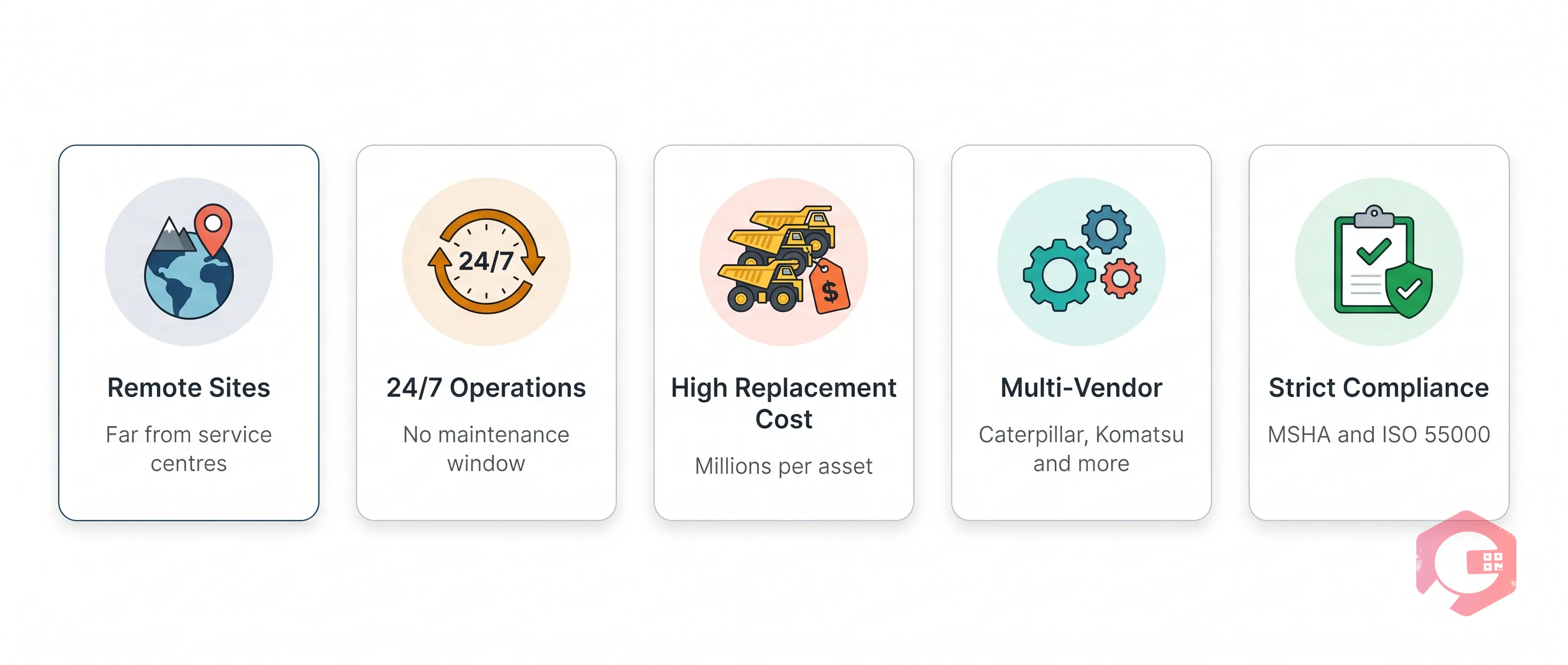
Mining operations push equipment harder than almost any other industry. Assets operate in extreme heat, dust, vibration, and corrosive environments - often 24 hours a day, 7 days a week, in locations far from the nearest service centre. This combination creates maintenance challenges you simply won't find in a manufacturing plant or logistics warehouse.

Here's what makes mining asset management distinctly difficult:


The result? Studies suggest that unplanned maintenance accounts for 30-40% of total maintenance costs in mining - well above the 20% benchmark for mature industrial operations. Closing that gap is where asset management software delivers its biggest ROI.

Key Asset Categories in Mining Operations

Effective mining asset management starts with understanding what you're managing. Mining operations typically run four broad asset categories, each with its own maintenance profile:

1. Mobile Mining Equipment

Haul trucks, excavators, front-end loaders, drill rigs, and graders are the workhorses of any mine site. These assets accumulate hours fast and need usage-based preventive maintenance schedules - not just calendar-based ones. Tracking engine hours, tyre wear, and hydraulic cycles is essential to avoiding catastrophic failures mid-shift.

2. Fixed Plant and Processing Equipment

Crushers, ball mills, SAG mills, conveyor systems, and flotation cells are capital-intensive and process-critical. Any failure here ripples through the entire production chain. These assets benefit most from predictive maintenance strategies - vibration analysis, oil sampling, and thermal imaging - to catch degradation before it becomes a breakdown.

3. Electrical and Infrastructure Assets

Substations, transformers, ventilation fans (especially critical underground), pump stations, and communication systems need scheduled inspections and compliance documentation. Failures here can trigger site shutdowns and regulatory investigations.

4. Support Equipment and Tools

Service trucks, fuel bowsers, lifting equipment, and specialised hand tools also need tracking - particularly for safety certifications and calibration records. A CMMS with a dedicated tool management module ensures nothing slips through the cracks.

How a CMMS Transforms Mining Asset Management

Before CMMS, most mine sites ran maintenance on whiteboards, spreadsheets, and institutional knowledge. The result was inconsistent PMs, reactive breakdowns, and hours wasted hunting for parts or work history. A purpose-built CMMS changes the game across five dimensions:


Companies using Cryotos CMMS report an average 30% reduction in downtime and 25% faster repair times - metrics that translate directly to higher ore throughput and lower cost-per-tonne.
Must-Have CMMS Features for Mining Companies

Asset Management for Mining Companies — scenario

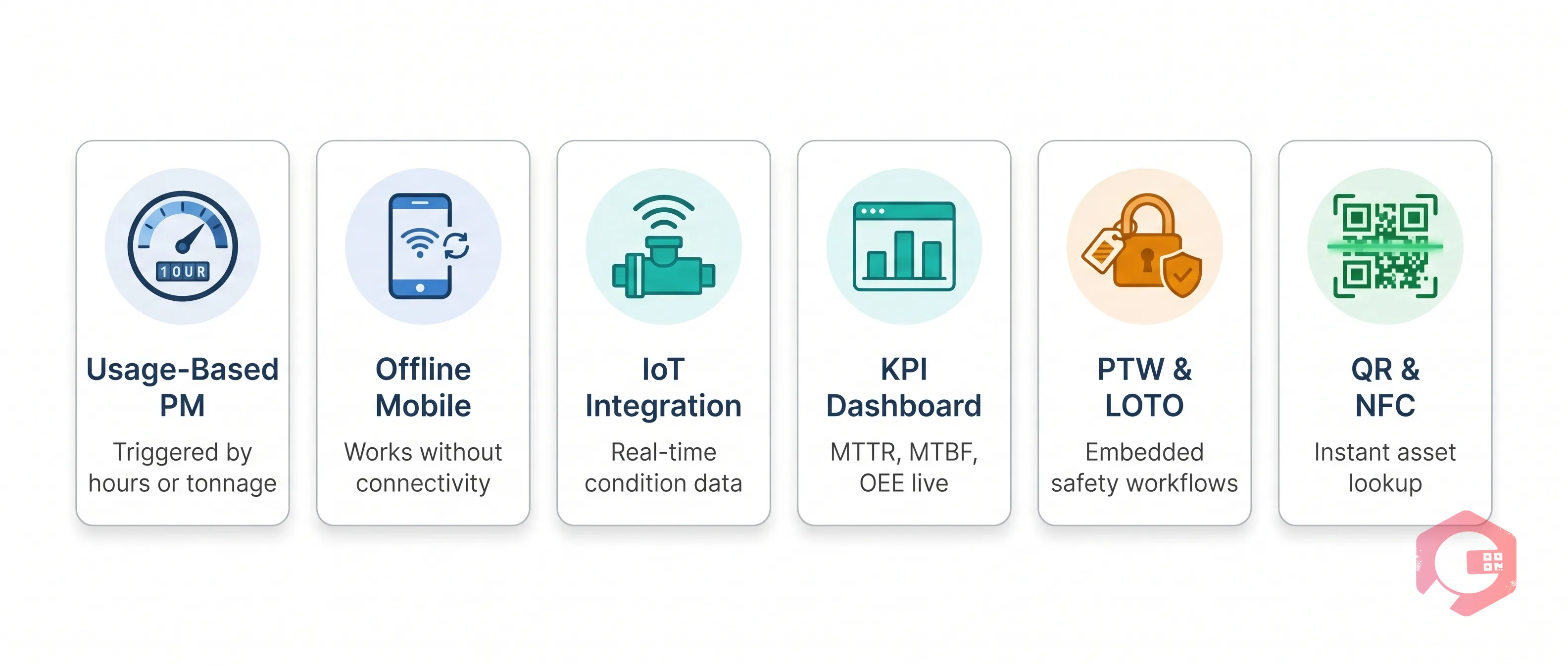
Not all CMMS platforms are built for the demands of a mine site. Here's what to look for when evaluating options:

Usage-Based Preventive Maintenance

Calendar-based PMs don't work for mining equipment that logs wildly variable hours depending on production cycles. Your CMMS needs to trigger maintenance based on engine hours, tonnes moved, or kilometres travelled - whichever metric applies. Look for systems that support both static (fixed interval) and dynamic (usage-based) scheduling, and "either/or" triggers so PMs fire on whichever condition comes first.

Mobile App with Offline Mode

Underground mines and remote open cuts have patchy or no connectivity. A CMMS mobile app that works offline - syncing when connectivity is restored - is non-negotiable. Technicians need to log work, scan QR codes on assets, and close work orders from wherever the equipment sits, not just from the surface office.

IoT and Sensor Integration

For high-value fixed plant, connecting your CMMS to vibration sensors, oil analysis systems, or SCADA/PLC data feeds enables true predictive maintenance. When a crusher's vibration signature crosses a threshold, the system auto-creates a work order before the failure happens. This integration capability separates modern CMMS platforms from legacy ones.

Downtime Management and KPI Reporting

Your CMMS should track downtime by asset, department, shift, and failure mode - and surface MTTR, MTBF, availability percentage, and OEE through a real-time BI dashboard. If you can't see your reliability KPIs without exporting to Excel, your CMMS isn't working hard enough.

Permit to Work and LOTO Automation

Mining maintenance is high-risk work. Automated PTW workflows and LOTO (Lockout/Tagout) procedures - built directly into work orders - reduce the chance of human error in safety-critical isolation steps. These should be non-negotiable for any site operating under MSHA or equivalent regulations.

Asset QR Code and Barcode Tracking

Scanning a QR code on a haul truck or conveyor drive should instantly pull up its full history, open work orders, spec sheets, and warranty status. NFC and GPS tracking take this further - letting you locate assets across a large site and verify that maintenance was performed at the correct location.

CMMS Evaluation Checklist for Mining

Asset Management for Mining Companies — problems grid

Use this checklist when comparing CMMS platforms for your mining operation:


Compliance and Safety: The Regulatory Angle

Asset Management for Mining Companies — workflow

Mining is one of the most heavily regulated industries on the planet - and for good reason. A CMMS plays a direct role in keeping your operation compliant with the standards that govern mine site safety and asset integrity.

MSHA Compliance (USA)

The Mine Safety and Health Administration requires documented pre-shift inspections for specific equipment categories, maintenance records for safety-critical systems, and evidence that equipment defects are corrected before operation resumes. A CMMS that digitises these inspection checklists and stores the results against the asset - with timestamps and technician signatures - gives you audit-ready proof without the paperwork pile.

ISO 55000 - Asset Management Standard

ISO 55000 sets the international framework for asset management systems. Mining companies pursuing or maintaining ISO 55000 certification need documented asset management plans, lifecycle tracking, risk-based maintenance strategies, and performance measurement - all of which a mature CMMS supports directly.

Permit to Work and LOTO

Maintenance-related fatalities and injuries most often occur when energy isolation procedures aren't followed correctly. Embedding PTW issuance and LOTO confirmation steps directly into the work order management workflow - with mandatory digital sign-off before work begins - is the most effective way to prevent incidents from cutting corners under production pressure.
How to Implement a Mining CMMS Successfully

Asset Management for Mining Companies — lifecycle

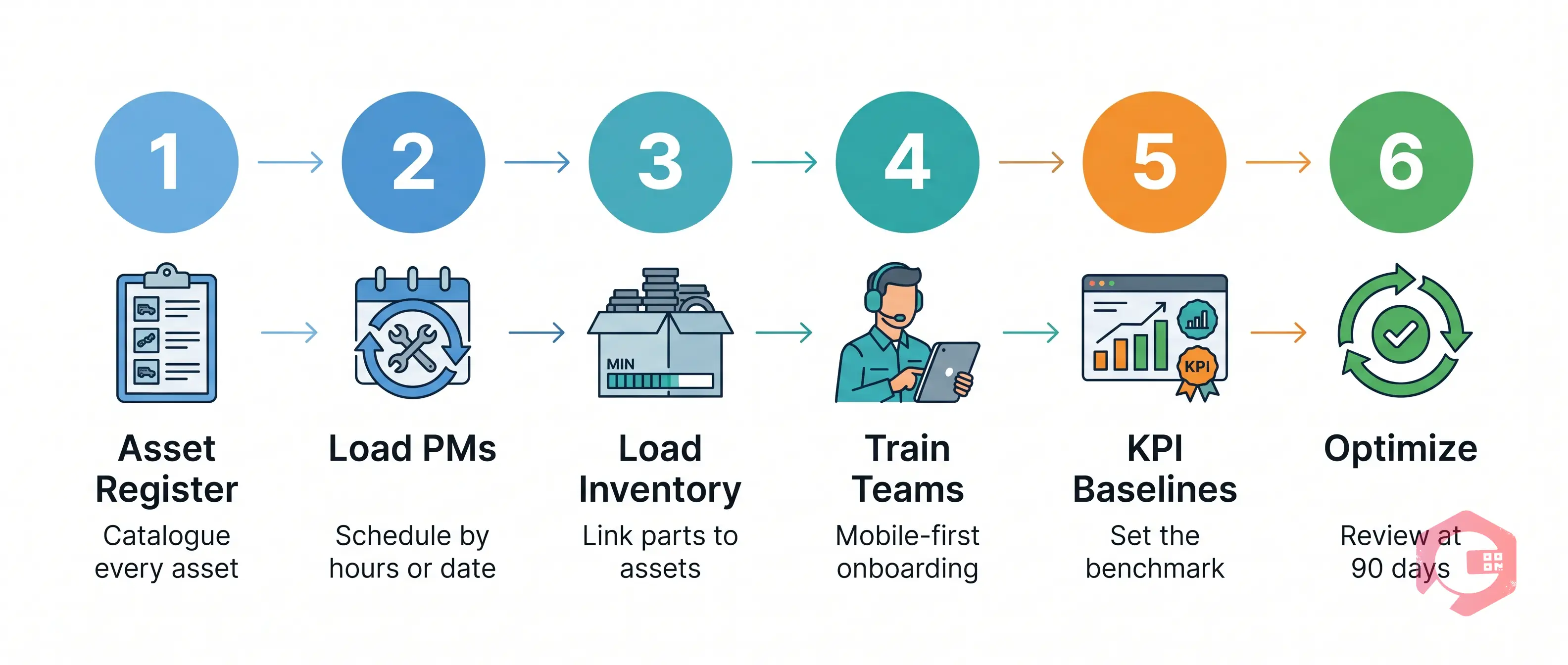
A CMMS implementation is only as good as the data you put into it and the processes you build around it. Here's a proven six-step approach for mining operations:


How Cryotos Supports Mining Asset Management

Cryotos CMMS is built for industries where asset reliability is mission-critical - and mining is exactly that kind of environment. Here's how Cryotos addresses the specific demands of mine site asset management:


Mining companies using Cryotos consistently report a 30% reduction in unplanned downtime and a 25% improvement in repair cycle times - results that pay back the implementation investment many times over in the first year.

Ready to see how Cryotos can work for your mine? Explore the platform or book a demo with our mining industry specialists today.

Frequently Asked Questions

What is asset management in the mining industry?

Asset management in mining is the systematic process of planning, tracking, maintaining, and optimising physical assets - including mobile fleet, fixed plant, electrical infrastructure, and support equipment - to maximise production uptime and minimise total cost of ownership over the asset's lifecycle. A CMMS is the software backbone that makes this possible at scale.

Why do mining companies need a CMMS?

Mining equipment failures are extremely costly - a single haul truck breakdown can cost $50,000-$100,000 per hour in lost production. A CMMS helps mining companies shift from reactive to planned maintenance, maintain compliance records digitally, track spare parts inventory in real time, and measure reliability KPIs like MTTR and MTBF - reducing unplanned downtime by up to 30%.

What is the difference between CMMS and EAM for mining?

A CMMS (Computerised Maintenance Management System) focuses on maintenance operations - work orders, PMs, downtime tracking, and inventory. An EAM (Enterprise Asset Management) system extends this to cover the full financial lifecycle of assets - depreciation, capital planning, and procurement integration. Modern CMMS platforms like Cryotos bridge this gap with ERP integrations and lifecycle tracking, giving mining companies most EAM functionality without the enterprise price tag.

How long does it take to implement a CMMS for a mining operation?

A typical CMMS implementation for a mid-size mining operation takes 6-12 weeks from data migration to full roll-out. The largest time investment is building a clean asset register and PM schedule library. Cloud-based CMMS platforms like Cryotos accelerate this with pre-built templates, Excel import tools, and dedicated implementation support - getting you to value faster.

Can a CMMS help with mining regulatory compliance?

Yes - significantly. A CMMS digitalises inspection checklists, stores compliance records against each asset with timestamps and signatures, automates Permit to Work and LOTO workflows, and generates audit-ready reports on demand. This is particularly valuable for operations subject to MSHA regulations, AS/NZS 4360 risk standards, or ISO 55000 certification requirements.


Want to Try Cryotos CMMS Today? Lets Connect!
Thank you! Your submission has been received!
Oops! Something went wrong while submitting the form.
Related Post

Asset Management for Mining Companies: A Complete Guide to CMMS

Calendar
Duration:
8 min read
person
calendar today
Published on
April 8, 2026
Featured Image

Asset management for mining companies means systematically tracking, maintaining, and optimising every piece of heavy equipment - from haul trucks and conveyor belts to drilling rigs and crushers - to maximise uptime and slash unplanned failures. In an industry where a single haul truck breakdown can cost upwards of $50,000 per hour in lost production, getting asset management right isn't optional. It's the difference between hitting your quarterly targets and blowing them.

A Computerised Maintenance Management System (CMMS) purpose-built for mining gives your maintenance teams the tools to shift from reactive fire-fighting to planned, data-driven reliability. This guide covers everything you need to know - from the unique challenges mining assets present, to the features that matter most, to how companies like yours are already cutting downtime by 30% with the right platform.

Why Asset Management in Mining Is Uniquely Challenging

Mining operations push equipment harder than almost any other industry. Assets operate in extreme heat, dust, vibration, and corrosive environments - often 24 hours a day, 7 days a week, in locations far from the nearest service centre. This combination creates maintenance challenges you simply won't find in a manufacturing plant or logistics warehouse.

Here's what makes mining asset management distinctly difficult:


The result? Studies suggest that unplanned maintenance accounts for 30-40% of total maintenance costs in mining - well above the 20% benchmark for mature industrial operations. Closing that gap is where asset management software delivers its biggest ROI.

Key Asset Categories in Mining Operations

Effective mining asset management starts with understanding what you're managing. Mining operations typically run four broad asset categories, each with its own maintenance profile:

1. Mobile Mining Equipment

Haul trucks, excavators, front-end loaders, drill rigs, and graders are the workhorses of any mine site. These assets accumulate hours fast and need usage-based preventive maintenance schedules - not just calendar-based ones. Tracking engine hours, tyre wear, and hydraulic cycles is essential to avoiding catastrophic failures mid-shift.

2. Fixed Plant and Processing Equipment

Crushers, ball mills, SAG mills, conveyor systems, and flotation cells are capital-intensive and process-critical. Any failure here ripples through the entire production chain. These assets benefit most from predictive maintenance strategies - vibration analysis, oil sampling, and thermal imaging - to catch degradation before it becomes a breakdown.

3. Electrical and Infrastructure Assets

Substations, transformers, ventilation fans (especially critical underground), pump stations, and communication systems need scheduled inspections and compliance documentation. Failures here can trigger site shutdowns and regulatory investigations.

4. Support Equipment and Tools

Service trucks, fuel bowsers, lifting equipment, and specialised hand tools also need tracking - particularly for safety certifications and calibration records. A CMMS with a dedicated tool management module ensures nothing slips through the cracks.

How a CMMS Transforms Mining Asset Management

Before CMMS, most mine sites ran maintenance on whiteboards, spreadsheets, and institutional knowledge. The result was inconsistent PMs, reactive breakdowns, and hours wasted hunting for parts or work history. A purpose-built CMMS changes the game across five dimensions:


Companies using Cryotos CMMS report an average 30% reduction in downtime and 25% faster repair times - metrics that translate directly to higher ore throughput and lower cost-per-tonne.

Must-Have CMMS Features for Mining Companies

Asset Management for Mining Companies — scenario

Not all CMMS platforms are built for the demands of a mine site. Here's what to look for when evaluating options:

Usage-Based Preventive Maintenance

Calendar-based PMs don't work for mining equipment that logs wildly variable hours depending on production cycles. Your CMMS needs to trigger maintenance based on engine hours, tonnes moved, or kilometres travelled - whichever metric applies. Look for systems that support both static (fixed interval) and dynamic (usage-based) scheduling, and "either/or" triggers so PMs fire on whichever condition comes first.

Mobile App with Offline Mode

Underground mines and remote open cuts have patchy or no connectivity. A CMMS mobile app that works offline - syncing when connectivity is restored - is non-negotiable. Technicians need to log work, scan QR codes on assets, and close work orders from wherever the equipment sits, not just from the surface office.

IoT and Sensor Integration

For high-value fixed plant, connecting your CMMS to vibration sensors, oil analysis systems, or SCADA/PLC data feeds enables true predictive maintenance. When a crusher's vibration signature crosses a threshold, the system auto-creates a work order before the failure happens. This integration capability separates modern CMMS platforms from legacy ones.

Downtime Management and KPI Reporting

Your CMMS should track downtime by asset, department, shift, and failure mode - and surface MTTR, MTBF, availability percentage, and OEE through a real-time BI dashboard. If you can't see your reliability KPIs without exporting to Excel, your CMMS isn't working hard enough.

Permit to Work and LOTO Automation

Mining maintenance is high-risk work. Automated PTW workflows and LOTO (Lockout/Tagout) procedures - built directly into work orders - reduce the chance of human error in safety-critical isolation steps. These should be non-negotiable for any site operating under MSHA or equivalent regulations.

Asset QR Code and Barcode Tracking

Scanning a QR code on a haul truck or conveyor drive should instantly pull up its full history, open work orders, spec sheets, and warranty status. NFC and GPS tracking take this further - letting you locate assets across a large site and verify that maintenance was performed at the correct location.

CMMS Evaluation Checklist for Mining

Asset Management for Mining Companies — problems grid

Use this checklist when comparing CMMS platforms for your mining operation:


Compliance and Safety: The Regulatory Angle

Asset Management for Mining Companies — workflow

Mining is one of the most heavily regulated industries on the planet - and for good reason. A CMMS plays a direct role in keeping your operation compliant with the standards that govern mine site safety and asset integrity.

MSHA Compliance (USA)

The Mine Safety and Health Administration requires documented pre-shift inspections for specific equipment categories, maintenance records for safety-critical systems, and evidence that equipment defects are corrected before operation resumes. A CMMS that digitises these inspection checklists and stores the results against the asset - with timestamps and technician signatures - gives you audit-ready proof without the paperwork pile.

ISO 55000 - Asset Management Standard

ISO 55000 sets the international framework for asset management systems. Mining companies pursuing or maintaining ISO 55000 certification need documented asset management plans, lifecycle tracking, risk-based maintenance strategies, and performance measurement - all of which a mature CMMS supports directly.

Permit to Work and LOTO

Maintenance-related fatalities and injuries most often occur when energy isolation procedures aren't followed correctly. Embedding PTW issuance and LOTO confirmation steps directly into the work order management workflow - with mandatory digital sign-off before work begins - is the most effective way to prevent incidents from cutting corners under production pressure.

How to Implement a Mining CMMS Successfully

Asset Management for Mining Companies — lifecycle

A CMMS implementation is only as good as the data you put into it and the processes you build around it. Here's a proven six-step approach for mining operations:


How Cryotos Supports Mining Asset Management

Cryotos CMMS is built for industries where asset reliability is mission-critical - and mining is exactly that kind of environment. Here's how Cryotos addresses the specific demands of mine site asset management:


Mining companies using Cryotos consistently report a 30% reduction in unplanned downtime and a 25% improvement in repair cycle times - results that pay back the implementation investment many times over in the first year.

Ready to see how Cryotos can work for your mine? Explore the platform or book a demo with our mining industry specialists today.

Frequently Asked Questions

What is asset management in the mining industry?

Asset management in mining is the systematic process of planning, tracking, maintaining, and optimising physical assets - including mobile fleet, fixed plant, electrical infrastructure, and support equipment - to maximise production uptime and minimise total cost of ownership over the asset's lifecycle. A CMMS is the software backbone that makes this possible at scale.

Why do mining companies need a CMMS?

Mining equipment failures are extremely costly - a single haul truck breakdown can cost $50,000-$100,000 per hour in lost production. A CMMS helps mining companies shift from reactive to planned maintenance, maintain compliance records digitally, track spare parts inventory in real time, and measure reliability KPIs like MTTR and MTBF - reducing unplanned downtime by up to 30%.

What is the difference between CMMS and EAM for mining?

A CMMS (Computerised Maintenance Management System) focuses on maintenance operations - work orders, PMs, downtime tracking, and inventory. An EAM (Enterprise Asset Management) system extends this to cover the full financial lifecycle of assets - depreciation, capital planning, and procurement integration. Modern CMMS platforms like Cryotos bridge this gap with ERP integrations and lifecycle tracking, giving mining companies most EAM functionality without the enterprise price tag.

How long does it take to implement a CMMS for a mining operation?

A typical CMMS implementation for a mid-size mining operation takes 6-12 weeks from data migration to full roll-out. The largest time investment is building a clean asset register and PM schedule library. Cloud-based CMMS platforms like Cryotos accelerate this with pre-built templates, Excel import tools, and dedicated implementation support - getting you to value faster.

Can a CMMS help with mining regulatory compliance?

Yes - significantly. A CMMS digitalises inspection checklists, stores compliance records against each asset with timestamps and signatures, automates Permit to Work and LOTO workflows, and generates audit-ready reports on demand. This is particularly valuable for operations subject to MSHA regulations, AS/NZS 4360 risk standards, or ISO 55000 certification requirements.
Want to Try Cryotos CMMS Today?

Get Free Demo

Let AI Take Control of Your Maintenance

Cryotos AI predicts failures, automates work orders, and simplifies maintenance—before problems slow you down.

Try AI-Powered CMMS
🡢