
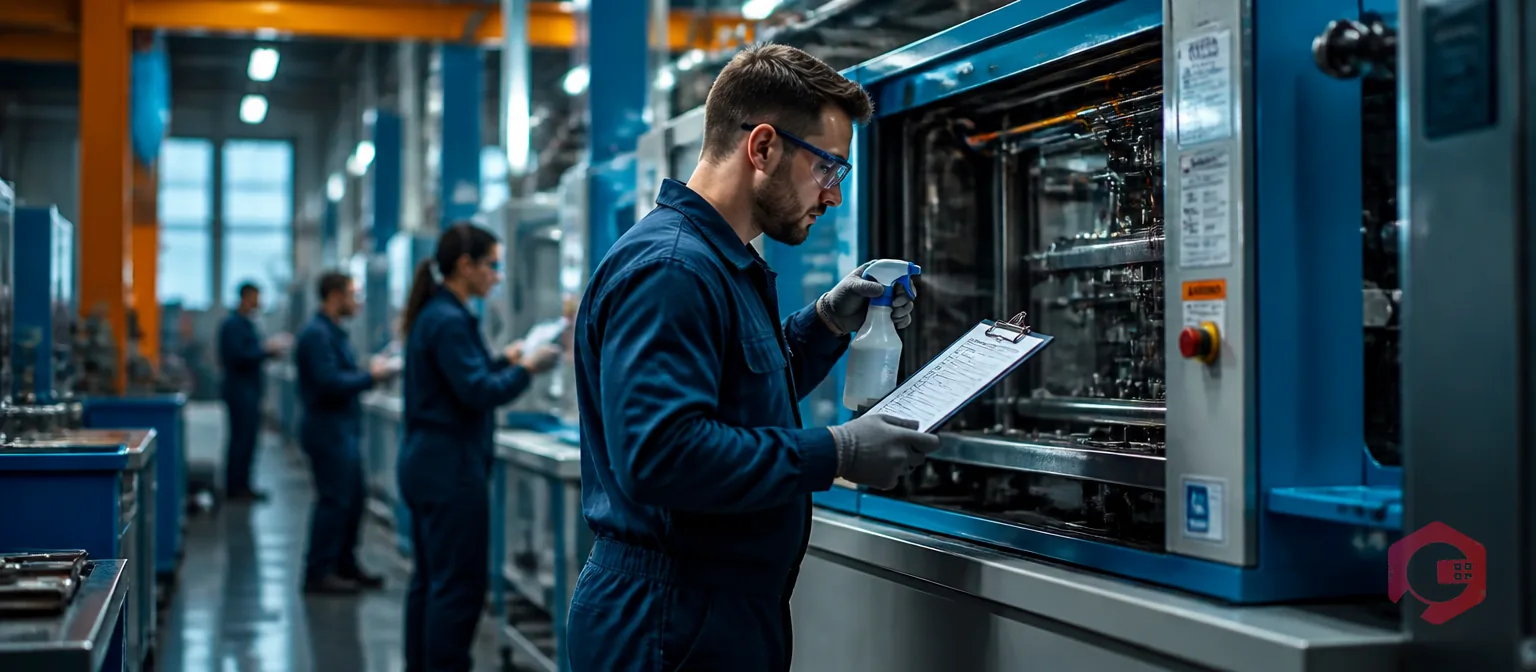
Autonomous maintenance (AM) is a Total Productive Maintenance (TPM) strategy where machine operators take responsibility for routine cleaning, inspection, and lubrication tasks — instead of waiting for a maintenance technician. Companies that implement AM correctly report up to 25% fewer unplanned breakdowns and measurable gains in Overall Equipment Effectiveness (OEE). This guide walks you through what autonomous maintenance is, why it works, the proven 7-step framework, and exactly how to build an AM program on your shop floor — starting today.
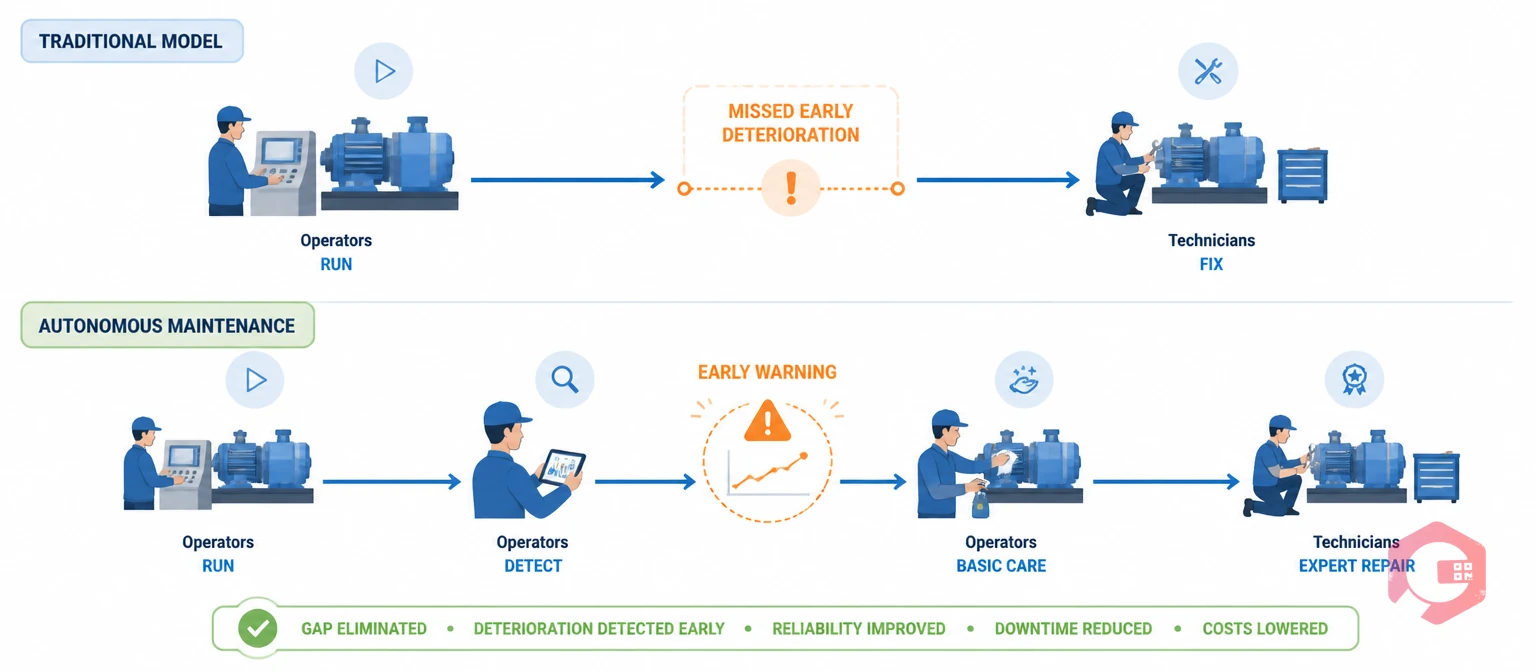
Autonomous maintenance is the practice of training and empowering equipment operators to perform basic, day-to-day maintenance on the machines they run. It is one of the eight pillars of Total Productive Maintenance (TPM) — a manufacturing philosophy developed in Japan in the 1970s that has since become the gold standard for production reliability worldwide.
In a traditional maintenance setup, operators run the equipment and call in a technician when something goes wrong. Autonomous maintenance flips that model. Operators learn to spot the early signs of wear, keep machines clean and properly lubricated, and flag abnormalities before a small issue turns into a costly breakdown. The maintenance team, freed from constant firefighting, can focus on planned work, reliability engineering, and continuous improvement.
The key word is ownership. AM is not about cutting the maintenance headcount. It is about building a culture where the people closest to the machines care about their condition as much as their output.
Operators often ask how autonomous maintenance differs from preventive maintenance. They share the goal of preventing failures, but they differ in scope, ownership, and timing. Here is a direct comparison:
| Factor | Autonomous Maintenance | Preventive Maintenance |
|---|---|---|
| Who Does It | Equipment operators | Maintenance technicians |
| Task Type | Cleaning, lubrication, visual inspection, tightening | Scheduled repairs, part replacements, calibrations |
| Frequency | Daily / per shift | Weekly, monthly, or usage-based intervals |
| Goal | Detect deterioration early; restore basic conditions | Replace or service components before they fail |
| Skill Required | Operator-level training (OPL, visual standards) | Certified technician knowledge |
| CMMS Role | Checklists, AM tags, defect logging | Work orders, spare parts, scheduling |
In practice, AM and preventive maintenance are complementary. Operators catch surface-level issues daily; technicians handle deeper scheduled work. Together, they close the gap that reactive maintenance leaves wide open.
The biggest driver of equipment failure is not age — it is neglect. Dust, coolant leaks, loose fasteners, and insufficient lubrication account for a significant share of unplanned stoppages in most manufacturing plants. Operators are on the floor every hour of every shift. They hear the machine when its vibration changes. They feel when a feed rate seems off. No maintenance team, however skilled, has that level of continuous contact with the equipment.
When operators own their machines, three things happen consistently:
According to the International Society for Pharmaceutical Engineering (ISPE), plants with mature autonomous maintenance programs see OEE improvements of 10–20 percentage points within 18–24 months of implementation. That is not a marginal gain — it is a fundamental shift in how the floor operates.
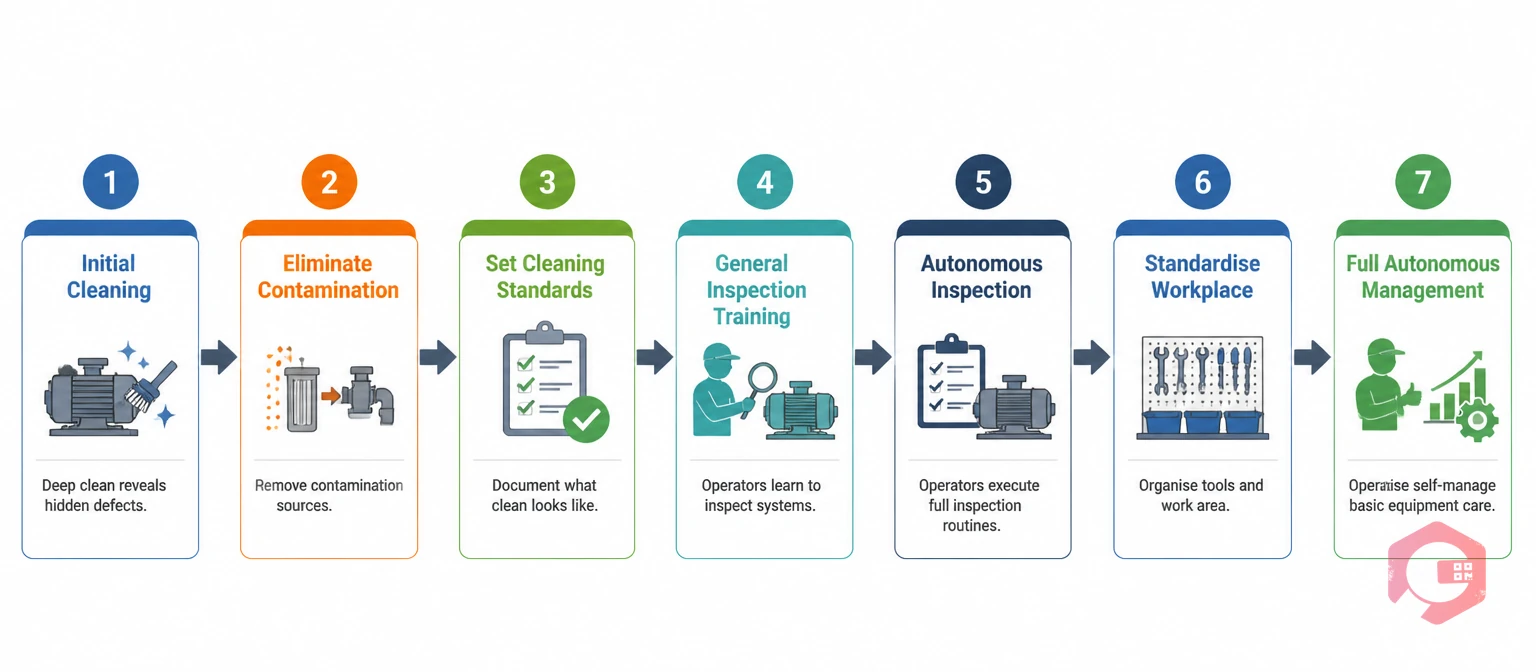
The TPM framework breaks autonomous maintenance into seven progressive steps. Each step builds the skills and discipline operators need before moving to the next level. Rushing through steps is the single most common reason AM programs fail.
Progress through all seven steps typically takes 2–4 years in a real manufacturing environment. That timeline is not a failure — it reflects how long it takes to genuinely change culture, not just compliance.
Knowing the seven steps is not the same as knowing how to actually start. Here is a practical sequence for launching AM on your shop floor.
Pick a pilot machine, not a whole line. Choose one machine — ideally one with a history of frequent small failures. Trying to roll out AM across an entire plant at once overwhelms operators and gives you no focused data to prove the concept.
Run an Initial Cleaning Event (ICE). Bring the operator, a maintenance technician, and a team leader together for a focused 2–4 hour deep clean of the pilot machine. Use this event to find every defect and tag it. Photograph the machine before and after. The visual contrast alone is a powerful motivator.
Create One-Point Lessons (OPLs). An OPL is a single-page visual standard — a photograph of the machine with annotations showing what good looks like, what bad looks like, and exactly what the operator should check. OPLs replace verbal instructions and survive shift changes. Pair them with digital maintenance checklists in your CMMS so completion is recorded, not assumed.
Close AM tags with a clear ownership rule. Red tags (operator-fixable) should be closed within 24 hours. Blue tags (maintenance team) go into the work order queue immediately. Use your work order management software to track every tag from creation to closure. If tags sit open for weeks, the program loses credibility fast.
Measure and display results publicly. Put a simple visual board near the pilot machine showing the number of defects found, tags closed, and the machine's availability trend over the past 30 days. When operators see their work producing real numbers, engagement follows. Connect this to your BI dashboard for plant leadership to track AM progress alongside other KPIs.
Expand after proven results. Once your pilot machine shows a measurable improvement in availability or reduction in unplanned stoppages over 60–90 days, you have the evidence to expand AM to the next machine or line — and the credibility to bring more operators on board without resistance.
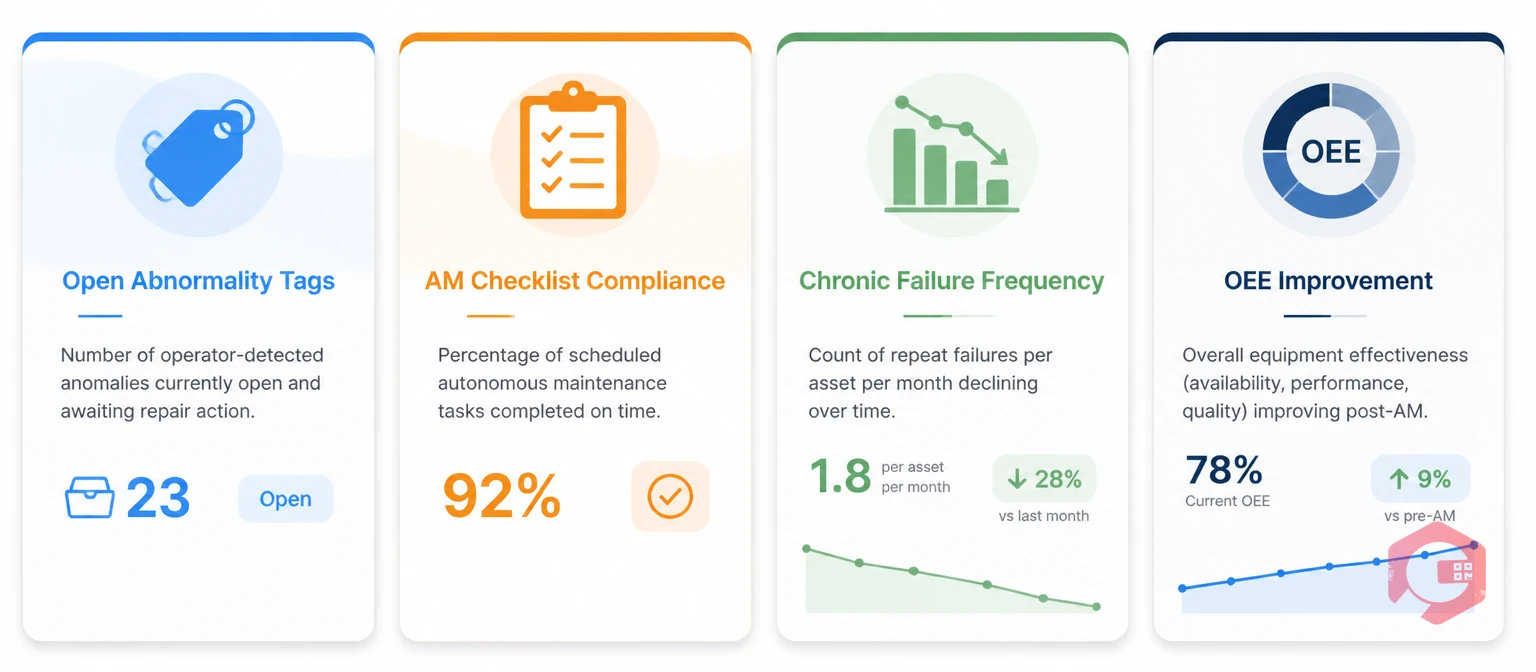
You cannot manage what you do not measure. These are the core metrics every AM program should track, along with the targets that indicate a healthy program:
| Metric | What It Measures | Healthy Target | Where to Track |
|---|---|---|---|
| AM Checklist Completion Rate | % of daily AM tasks completed on time | ≥ 95% | CMMS checklist module |
| AM Tag Closure Rate | % of defect tags resolved within target time | Red ≥ 90% in 24h; Blue ≥ 80% in 7 days | Work order module |
| MTBF (Mean Time Between Failures) | Average run time between unplanned failures | Increasing trend month-over-month | Downtime tracking module |
| OEE | Availability × Performance × Quality | ≥ 85% (world class) | BI dashboard |
| Unplanned Downtime | Hours of unexpected machine stoppage | Decreasing trend | Downtime tracking module |
| Defects Found per Inspection | Number of abnormalities caught by operators | High initially; trending down as conditions improve | AM tag log / CMMS |
Track these metrics weekly in the early months of your AM program. Use downtime tracking software to capture machine stoppages automatically so the data is objective, not dependent on operators self-reporting.
Most AM programs do not fail because the concept is wrong. They fail because of predictable, avoidable mistakes. Here are the ones that derail programs most often — and how to sidestep them.
The seven steps are: (1) Initial Cleaning and Inspection, (2) Eliminate Sources of Contamination, (3) Establish Cleaning and Lubrication Standards, (4) General Inspection Training, (5) Autonomous Inspection, (6) Standardisation, and (7) Autonomous Management. Each step builds on the previous one, progressively transferring equipment care skills from the maintenance team to the operators.
Autonomous maintenance is performed by operators on a daily or per-shift basis and focuses on cleaning, lubrication, visual inspection, and defect tagging. Preventive maintenance is performed by maintenance technicians on scheduled intervals and covers deeper servicing, part replacements, and calibrations. Both strategies work together — AM addresses daily deterioration while PM handles planned technical work.
A mobile CMMS gives your AM program structure, visibility, and accountability. It hosts digital AM checklists that operators complete on mobile devices, tracks AM tag creation and closure, generates work orders for blue-tag defects automatically, and provides the downtime and OEE data that proves whether AM is working. Without a CMMS, AM relies on paper checklists and verbal handovers — both of which break down quickly as the program scales.
A focused pilot on a single machine can show measurable results within 60–90 days. Full implementation of all seven AM steps across a production line typically takes 18–36 months. Completing all seven steps plant-wide in a mature TPM organisation typically takes 3–5 years. The speed of progress depends on management commitment, training investment, and how consistently AM standards are maintained day-to-day.
Autonomous maintenance gives operators real ownership of the machines they run — and the data consistently shows that ownership drives reliability. If you are ready to move from reactive repairs to a proactive, operator-led maintenance culture, Cryotos CMMS gives your team the digital checklists, work order workflows, and real-time dashboards to build and sustain an AM program that actually sticks. See how BorgWarner improved maintenance operations with Cryotos — and explore what the same approach could do for your shop floor.



Cryotos AI predicts failures, automates work orders, and simplifies maintenance—before problems slow you down.



