

Precision maintenance improves asset reliability by doing every installation, repair and service job to measured tolerances, then checking the result before the machine runs again. It cuts maintenance costs because it removes the hidden defects that maintenance itself creates, such as misalignment, poor lubrication and bad bearing fits.
This guide explains why small errors shorten asset life so sharply, the core precision maintenance practices, how they cut costs, and how to build a program that sticks.
Key Takeaways

Precision maintenance is maintenance done to measured tolerances and checked before restart. It uses proper tools and procedures, then records the result. Its defining feature is measurement: each job has a numeric limit and a recorded as-left value.
It is not a schedule. Preventive, predictive and reliability-centered maintenance decide when work happens. Precision decides whether that work helps the machine or harms it.
Asset management standards such as ISO 55000 link maintenance quality to life-cycle cost, and SMRP metrics such as MTBF give teams a way to measure the gain. Precision is the quality standard that sits under every maintenance strategy.
A maintenance-induced failure is a failure caused by errors made during installation, repair or service. A pump that fails three weeks after an overhaul is a common example, and many plants see this pattern without naming it.
The 1978 Nowlan and Heap study of airline components found that most failure patterns were not age-related. The most common pattern showed high failure rates soon after installation or overhaul, often called infant mortality. You can see this early peak on the left of the classic bathtub curve.
More overhauls do not improve reliability if each one adds a new defect. Fewer, better jobs do.
Small precision errors shorten asset life because they add load, and rolling-element bearing life drops sharply as load rises. Under the ISO 281 rating formula, ball bearing life scales with load to the power of three.
| Extra bearing load | Life remaining (ball bearing) | Life lost | Typical precision cause |
|---|---|---|---|
| +10% | About 75% | About 25% | Minor misalignment or belt over-tension |
| +20% | About 58% | About 42% | Soft foot or imbalance |
| +50% | About 30% | About 70% | Poor alignment plus pipe strain |
| +100% | About 12.5% | About 87.5% | Several defects combined |
The figures show sensitivity only, since real life also depends on lubrication, contamination and heat. The lesson is clear: a few tenths of a millimeter at installation can decide whether a bearing lasts years or months.
Want to see where your assets stand today? Use the MTBF calculator to set a baseline before you start.
Precision maintenance rests on a short list of practices, mostly for rotating equipment such as motors, pumps, fans and gearboxes. Each one has a measurable result. The OEM manual and site standards always set the final limits.
Standard job plans make these steps routine. Digital maintenance checklists can hold the tolerance and a mandatory as-left field for each one.

Precision maintenance reduces maintenance costs by preventing failures rather than paying for them. Each avoided failure saves parts, labor, lost production and often secondary damage.
Picture a process pump bearing that fails during a production run. The bill includes emergency labor and overtime, new bearings and seals, and often a damaged shaft or impeller from running to failure. On top of that comes lost output while the line waits, which is usually the biggest number of all.
Most facilities count the cost of a failure but not its cause. When a work order just says "replaced bearing", nobody sees that last month's overhaul caused it. Recording as-left values makes those links visible, and that is where precision maintenance starts to pay back.
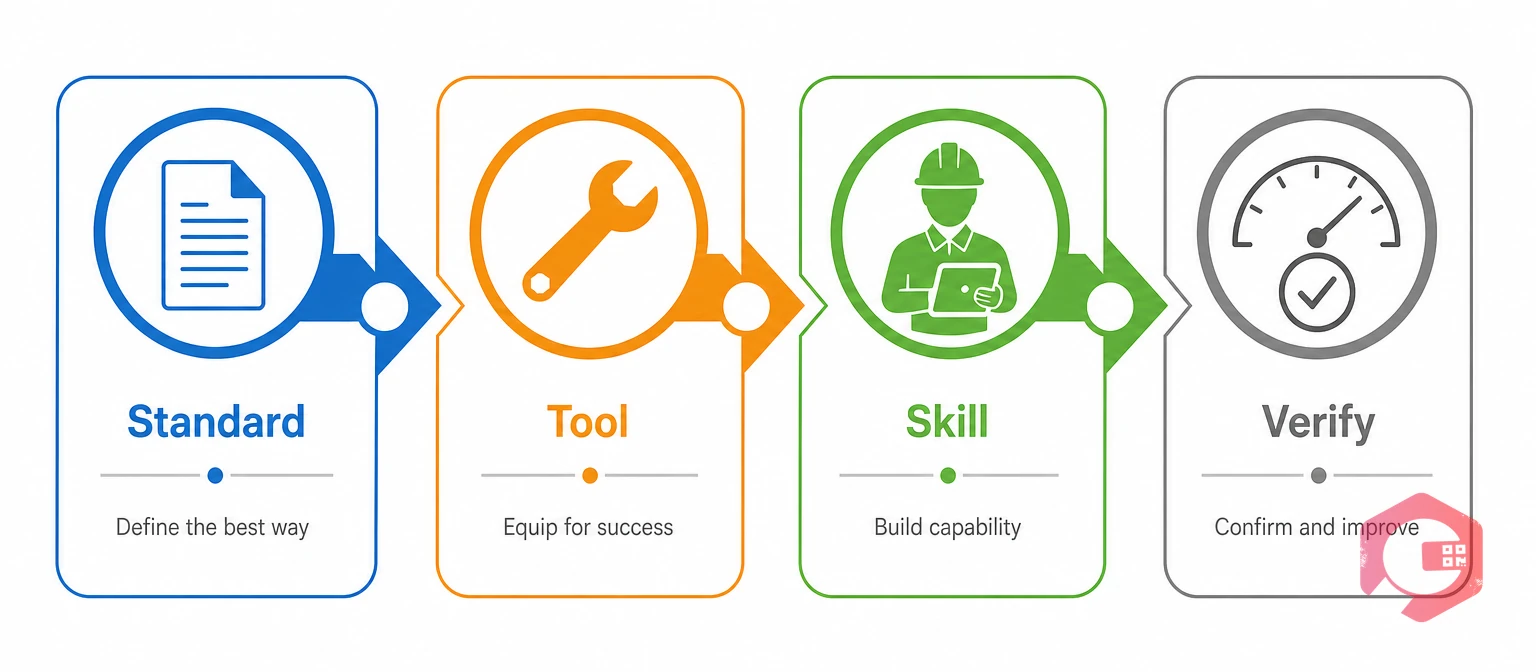
A precision maintenance program needs four things working together: written standards, the right tools, trained people and proof that the work met the standard. If one is missing, the chain breaks.
The Standard, Tool, Skill, Verify Framework:
A common mistake is buying tools first. A laser kit is useless without a tolerance to align to and a place to record the result.
The right KPIs show whether precision maintenance is improving reliability and cutting cost, not just adding paperwork. Track them monthly on pilot assets and compare them with your baseline.
Post-repair failure rate usually falls first, and MTBF and cost follow as more assets join the program.
A Computerized Maintenance Management System makes precision repeatable by building tolerances into every job and tracking what happens afterward. Maintenance teams using Cryotos have reported up to 30% reduction in unplanned downtime and 25% faster repair turnaround.
In this illustrative example, a technician opens the alignment job for pump P-101 and confirms lockout. They log as-found offset, shim a soft foot, record as-left values inside tolerance and add the laser report photo. A post-start vibration reading confirms the result, and the supervisor signs off.
Over time, these records feed asset maintenance management software reports on MTBF, repeat failures and cost per asset.
Predictive maintenance detects a developing fault, such as rising vibration, so you can repair it in time. Precision maintenance prevents many of those faults by doing the original work to specification. Most mature programs use both.
Rotating equipment benefits most, including motors, pumps, fans, gearboxes, compressors and conveyors. Start with critical assets that have a history of repeat failures.
Many teams see fewer repeat failures within a few months on pilot assets. Clear MTBF and cost trends usually need six to twelve months of recorded data.
Common tools include laser alignment systems, dial indicators, feeler gauges, calibrated torque wrenches, induction bearing heaters, filter carts, ultrasonic grease guns and vibration meters.
Track MTBF, repeat failures, failures within 30 days of a repair, the share of jobs with complete as-left data and maintenance cost per asset. Compare each against your baseline.
No. Any site with critical rotating equipment can start with one team, a few written tolerances and basic tools, then grow as results appear.
Doing the job right the first time is the cheapest reliability upgrade most plants can make. Schedule a free demo to see how Cryotos records every tolerance, reading and sign-off so precision becomes the way your team works.



Cryotos AI predicts failures, automates work orders, and simplifies maintenance—before problems slow you down.



