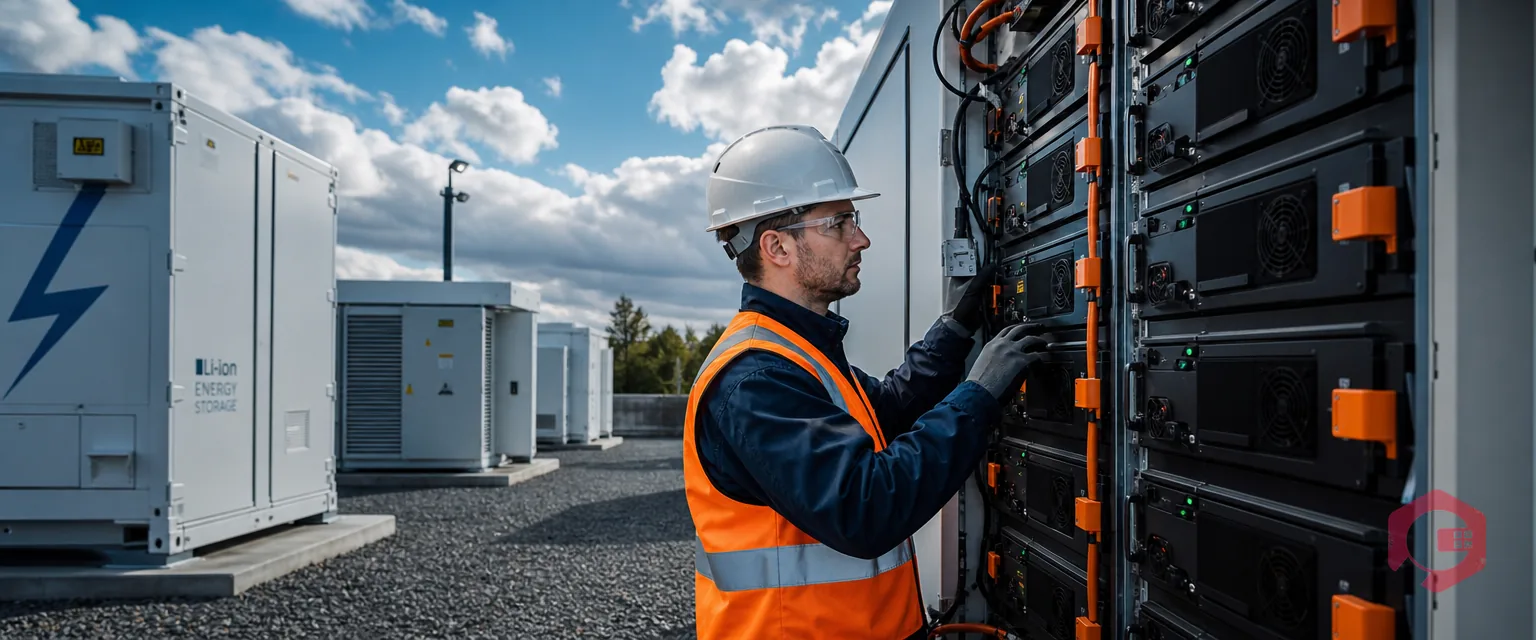
Battery energy storage system maintenance is the planned work that keeps a BESS safe, available and close to its rated capacity. It covers the battery racks, the battery management system, the power conversion system and the cooling that protects them. Unlike a pump or a turbine, a battery wears out even when nothing breaks, so the job is to track health, not just fix faults.
This guide covers the new challenges battery storage brings, a five-layer framework, seven best practices and a full schedule. Fire safety has its own guide on lithium-ion battery fires at solar storage sites. This one stays on day-to-day operations and maintenance (O&M).
Key Takeaways

Battery energy storage system maintenance covers four groups of equipment. These are the battery racks, the battery management system (BMS), the power conversion system (PCS) and support systems such as HVAC. Each group wears differently, so each needs its own tasks.
A battery management system (BMS) is the control layer that keeps each cell inside safe voltage and temperature limits. It also estimates charge and health, which makes its data the starting point for most maintenance decisions.
Several standards guide the work. IEC 62933 is the international series for grid energy storage systems, and NFPA 855 sets installation and safety rules in the United States. ISO 55000 frames the wider asset management system around them.
Research is moving fast too. Sandia National Laboratories has published work on predictive maintenance practices for BESS safety. A good maintenance program turns these standards into tasks with owners and records.
BESS maintenance is different because batteries age with use and time. Rotating machines mostly fail through wear you can hear, feel or measure. The table shows where the work changes.
| Aspect | Conventional plant (turbines, engines, pumps) | Battery energy storage system |
|---|---|---|
| How assets wear. | Mechanical wear, heat and vibration. | Chemical aging with every cycle and every hot day. |
| Early warning signs. | Vibration, noise, oil analysis, temperature. | Capacity fade, cell voltage spread, rising internal resistance. |
| Main maintenance driver. | Run hours and condition readings. | State of health, cycle count and energy throughput. |
| Typical failure points. | Bearings, seals, valves, gearboxes. | Inverters, HVAC, fans, contactors, communications, cells. |
| Role of software. | Supports monitoring. | Firmware and BMS settings directly change asset life. |
| End of life. | Overhaul or rebuild. | Augment with new modules or repower the system. |
The practical result is that maintenance teams need data skills as well as electrical and mechanical skills. A battery that passes every visual check can still be losing capacity faster than planned.
Ownership also changes. On many sites, the battery supplier, the inverter supplier and the site owner each hold part of the maintenance scope. Write down who does what, or tasks will fall between contracts.
A battery energy storage system brings challenges that most plant teams have not met before. The U.S. Department of Energy's battery energy storage systems report calls batteries and their power electronics key to cleaner, more resilient energy. Keeping them healthy takes a new set of skills.
State of health (SoH) is the usable capacity of a battery compared with its capacity when new. SoH falls slowly, so no alarm sounds until a site cannot meet its contract. You need condition monitoring that trends SoH over months, not a fault log.
Cells in a string drift apart in charge over time. The weakest cell then limits the whole string, so the rack delivers less energy even though most cells are fine.
Many operators find that inverters, fans, contactors and network links cause more lost uptime than the cells. These parts are familiar, but they work hard in a battery energy storage system. The site may cycle every day.
Heat speeds up battery aging, and uneven cooling makes some racks age faster than others. A clogged filter or a weak HVAC unit can shorten battery life long before it trips an alarm.
BMS settings, firmware versions and energy management rules all change how a battery is used. An untracked firmware update can change charge limits across a whole site in one night.
Battery warranties often require you to stay inside set limits for heat, cycling and upkeep. When you make a claim, the supplier will ask for records. Missing paperwork can cost more than a failed part.
Each of these challenges is easier to manage once it has an owner, a schedule and a record.
Want to know what an hour of lost availability costs your site? Try the free unplanned downtime calculator.

The BESS Health Stack splits a battery energy storage system into five layers, so every part of the site has clear tasks and an owner. Work from the bottom layer up when you build or audit a maintenance plan.
The BESS Health Stack:
Most maintenance teams handle Layers 3 and 4 well, because the equipment looks like familiar plant gear. The gaps usually sit in Layers 1 and 5, where the work is about data rather than tools.
The best battery energy storage system maintenance programs mix scheduled tasks with data checks. These seven practices close the gaps most sites have.
Pull SoH, cell voltage spread and temperature from the BMS each month and compare them with the warranty curve. Tools such as IoT meter reading can bring these values into the asset record automatically.
Researchers are pushing this further. A 2026 paper in Nature sets out a way to apply predictive maintenance for battery energy storage across sites. It works even as operating conditions change.
Many O&M providers run a full capacity test once or twice a year. Use the same method and conditions each time, so the results show real aging instead of test noise.
Record the starting temperature, the charge and discharge rate and the result for each block. Over a few years, these records become the best evidence you have for warranty claims and augmentation plans.
Schedule balancing and SoC recalibration as the manufacturer recommends. A wrong SoC reading can make the site stop charging early or run cells too deep.
Log every firmware update and setting change with who approved it and why. Test changes on one block before you roll them out across the site.
Keep a copy of the current settings for each block. If a fault appears after an update, the team can compare settings and roll back fast.
Inverter boards, fans, contactors, fuses and spare modules can have long lead times. Clear spare parts management with minimum stock alerts stops one failed part from taking a block offline for weeks.
Augmentation is adding new battery capacity to keep a site at its contracted energy rating. Use your SoH trend to forecast when capacity will fall below the contract, then plan space, budget and compatible modules years ahead.

A component schedule turns battery energy storage system maintenance into recurring work with clear owners. Treat these intervals as starting points, and set final ones from manufacturer manuals, warranty terms and local code.
| Component | Task | Frequency | Owner | Record to keep |
|---|---|---|---|---|
| BMS and alarms. | Review alarms, cell voltage spread and temperatures. | Daily | Control room operator. | Alarm log and work requests. |
| Battery racks. | Trend SoH and compare with warranty curve. | Monthly | Reliability engineer. | SoH trend report. |
| Battery racks. | Full capacity and efficiency test. | Every 6 to 12 months. | O&M contractor. | Signed test report. |
| HVAC and fans. | Clean filters, check fans and refrigerant. | Monthly or by dust level. | HVAC technician. | Checklist with photos. |
| Inverters (PCS). | Inspect, clean, check fans and error logs. | Quarterly | Electrical technician. | Inspection record. |
| DC and AC connections. | Thermal scan and torque check. | Quarterly to annually. | Electrician | Thermal images and torque sheet. |
| Fire detection and enclosure. | Test detectors and check seals. | Per manufacturer and code. | Qualified technician. | Test certificate. |
| Firmware and settings. | Review versions and approved changes. | Quarterly | Controls engineer. | Change log. |
Load each row into preventive maintenance software so it becomes a recurring work order with a named owner. A schedule only protects the site when missed tasks are easy to see.
A Computerized Maintenance Management System (CMMS) turns battery energy storage system maintenance into scheduled, assigned and recorded work. It does not replace the BMS or the energy management system. It makes sure the checks behind them happen on time and leave a record.
Maintenance teams using Cryotos have reported up to 30% reduction in unplanned downtime and 25% faster repair turnaround. Results vary by site, but the pattern holds: fewer missed tasks mean fewer surprise outages.
Most sites review BMS alarms daily, service HVAC monthly and inspect inverters quarterly. Capacity tests usually run every 6 to 12 months. Your manufacturer manual and warranty terms set the final intervals.
Many lithium-ion BESS projects are designed for 10 to 20 years of service. End of life is commonly defined as 70 to 80 percent of original capacity. Heat, depth of discharge and cycling rate all affect how fast that point arrives.
It typically covers preventive maintenance, remote monitoring, fault response, capacity testing and spare parts. Many contracts also include an availability guarantee. Check who owns firmware updates and augmentation, because contracts handle them differently.
Yes. BMS data such as cell voltage spread, temperature and internal resistance can show problems before they cause downtime. Trending this data monthly is the simplest place to start.
Many operators report that inverters, HVAC, fans, contactors and communications cause more downtime than the cells. Track failures by component in your maintenance records to see your own pattern.
Technicians need electrical safety training for high-voltage DC work, plus HVAC and inverter skills. They also need to read BMS data and spot trends. Many sites pair an electrician with a remote data analyst.
No. The BMS controls and protects the cells in real time. A CMMS schedules and records the maintenance work around it, so the two work side by side.
A battery storage site earns its keep only when its batteries, inverters and cooling stay healthy for years. Schedule a free demo to see how Cryotos schedules BESS inspections, tracks every repair and keeps warranty-ready records.

Cryotos AI predicts failures, automates work orders, and simplifies maintenance—before problems slow you down.