
A BBS observation card is a short field form. An observer fills it out while watching a work task. It records whether behaviors are safe or at-risk, plus what corrective action follows. Most facilities running a behavior-based safety program use one card per observation. Each card takes under five minutes to complete on the shop floor. This guide gives you a ready-to-copy template, three filled-out examples, and the process for turning raw observations into safer habits.
Key Takeaways

A BBS observation card is a structured checklist that a peer or supervisor uses to document safe and at-risk behaviors during a specific task. It's the core data-collection tool of behavior-based safety, often shortened to BBS. The idea behind BBS is simple. Most incidents trace back to at-risk acts, not just equipment failure.
Behavior-based safety programs treat observation as an ongoing habit rather than a one-time audit. OSHA's recommended practices for safety and health programs list worker observation and feedback as a core element of proactive hazard identification. That's exactly what a BBS card is built to capture.
The card itself stays short on purpose — most fit on a single index card or one mobile screen. This guide focuses on the card itself: the fields, the format, and what a filled-out example looks like. If you want the bigger picture of how observations get routed, escalated, and closed inside a CMMS, see our guide on building a safety observation workflow.

An at-risk behavior is any action that raises the chance of injury, even if nothing goes wrong that day. Skipping a harness tie-off is one example. Reaching over a running conveyor is another. So is bypassing a machine guard to clear a jam. Recording these before they cause harm is the entire point of the card, and it's why observers are trained to note near-misses even when no one gets hurt.
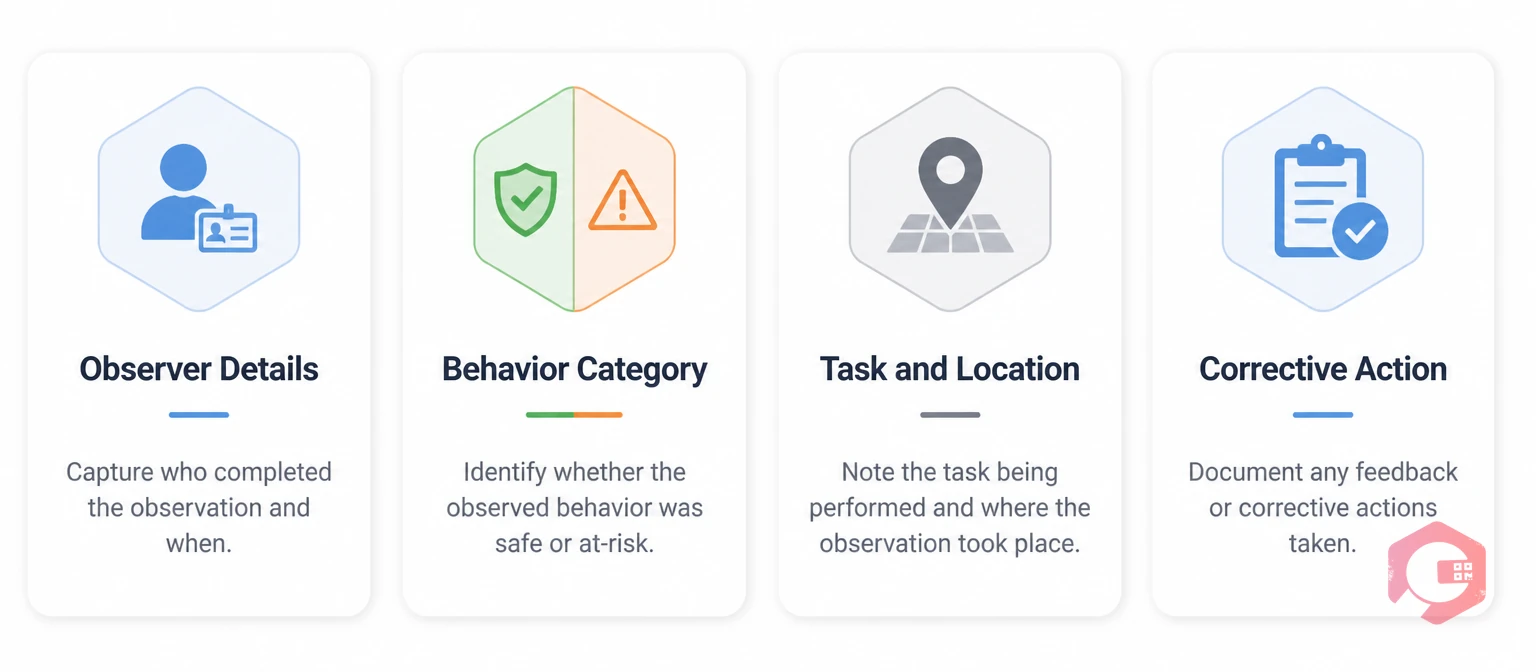
A usable BBS observation card template needs enough structure to compare data across observations. But it can't be so long that observers avoid filling it out. The table below breaks down the standard fields. It also shows what each one captures and a sample entry.
| Field | What It Captures | Example Entry | Why It Matters |
|---|---|---|---|
| Date & Shift | When the observation happened | 03/14/2026, Day Shift | Enables trend tracking by time of day |
| Location / Asset | Where the task was performed | Line 3, Packaging Station | Flags recurring hotspots |
| Task Observed | Specific job or action watched | Changing conveyor belt roller | Ties behavior to a defined procedure |
| Behavior Category | Safe or at-risk, by hazard type | At-risk — PPE | Supports root-cause categorization |
| Feedback & Follow-Up | What was discussed and next action | Reviewed glove policy on the spot | Closes the loop instead of just logging data |
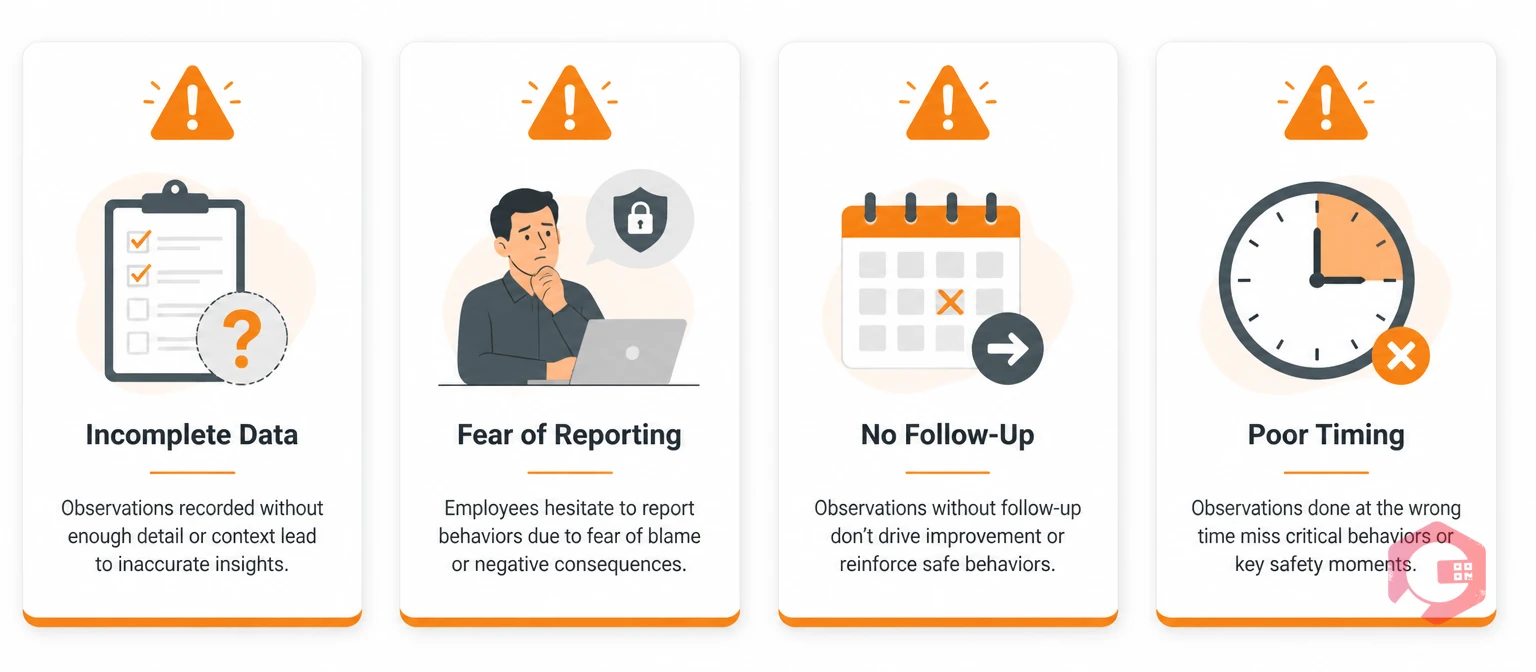
Keep the card to one page. Five to six fields is the sweet spot. Adding more slows observers down. It also cuts how many observations get logged each week, which weakens the patterns you're trying to spot.
A completed card is easier to copy than a blank one. Below are three filled-out BBS observation card examples from common maintenance and production tasks. They show one safe observation and two at-risk observations, each with corrective follow-up.
| Task | Behavior Observed | Category | Corrective Action Logged |
|---|---|---|---|
| Lockout-tagout on hydraulic press | Technician applied a personal lock and verified zero energy before starting | Safe | Praised on the spot; no follow-up needed |
| Forklift operation in warehouse aisle | Operator exceeded the posted speed limit near a blind corner | At-risk — Speed | Coached immediately; added to weekly toolbox talk |
| Manual lifting of spare parts crate | Worker lifted with a bent back instead of using the team-lift rule | At-risk — Ergonomics | Reviewed lifting technique; supervisor scheduled a refresher |
Notice that even the safe observation gets logged. A well-run BBS program reinforces safe behaviors as often as it corrects at-risk ones. Logging only problems trains observers to hunt for faults. It doesn't build a full behavior baseline.
Ready to stop tracking these on paper? A maintenance checklist software platform lets teams fill out and submit observation cards from a phone. Every entry gets a timestamp and stays searchable.
Filling out the card is only step one. Most facilities that see real safety gains from BBS follow a repeatable cycle. They don't treat each card as a one-off form.
The Four-Step BBS Observation Cycle:
Skipping the "Discuss" step is the most common reason BBS programs stall. Cards filed away without a conversation don't change behavior. They just pile up as paperwork.
A template only works if good habits back it up. Operations that successfully sustain a BBS program treat a few practices as non-negotiable.
Aim for two to five minutes per observation. Teams that stretch cards into 20-minute audits end up doing them once a month instead of several times a week. That starves the trend data of volume.
"Worker was careless" gives a supervisor nothing to act on. "Worker reached across the running conveyor instead of using the guard opening" gives a specific behavior a corrective action can target.
Peer-to-peer observation, not just supervisor-led, is a core BBS principle. Rotating observers across shifts and roles cuts blind spots. It also helps the program feel like a shared safety culture instead of a compliance check.
ISO 45001, the international standard for occupational health and safety management, calls for ongoing worker consultation and hazard identification as part of continual improvement. A steady stream of BBS observation cards gives a facility real evidence for that requirement, not just a policy statement.
Paper cards work, but they create a second job. Someone has to transcribe the data before anyone can spot a trend. Moving observations into a Computerized Maintenance Management System closes that gap. Every card becomes searchable, reportable data the moment it's submitted.
Cryotos supports this through customizable digital checklists that mirror your paper card fields — task, category, corrective action. Teams complete them from a phone, with photo attachments for at-risk conditions. Maintenance teams using Cryotos have reported up to 30% reduction in unplanned downtime and 25% faster repair turnaround. Part of that gain comes from hazards flagged during observations routing straight into a work order instead of sitting in a binder.
For programs covering isolation tasks, pairing observation cards with permit to work software keeps high-risk jobs like confined space entry or hot work under the same scrutiny as routine tasks. Larger sites often add a safety compliance checklist for audit-ready documentation alongside day-to-day BBS cards. Some also track corrective actions through a regulatory compliance checklist when observations tie back to a specific code requirement.
It documents specific safe and at-risk behaviors during a live task. This lets a facility spot patterns and act before an incident happens. It also gives observers a structured way to deliver on-the-spot feedback.
Most programs aim for several short observations per observer each week, not one long one per month. Frequency matters more than depth. A five-minute card done often builds a far better data set than a rare, exhaustive audit.
Safe behavior follows the established procedure — correct PPE, correct lockout steps, correct lifting technique. At-risk behavior is any deviation that raises injury risk, even without a near miss. Bypassing a guard or skipping a verification step both count.
Yes. Many facilities move BBS cards into mobile checklist software so entries sync automatically. Photos attach to at-risk findings, and trend reports build themselves instead of requiring manual data entry from paper forms.
A consistent BBS observation card is a small habit that adds up to a measurably safer floor. Schedule a free demo to see how Cryotos turns paper observation cards into a searchable digital safety record.



Cryotos AI predicts failures, automates work orders, and simplifies maintenance—before problems slow you down.