Equipment maintenance logs are structured records that document every maintenance activity performed on a physical asset — inspections, repairs, part replacements, calibrations, and lubrication — along with who performed the work, when it happened, and what was found or changed. According to a Plant Engineering industry survey, equipment failures with no prior maintenance history take 40% longer to diagnose and repair than those with documented records. A well-managed log isn't just paperwork — it's the institutional memory your maintenance team depends on to make faster, smarter decisions every day.
Key Takeaways
A maintenance log is an asset's medical chart: every inspection, repair, and part replacement should be recorded against the asset for its full operational life.
Ten fields are non-negotiable in every log entry: Asset ID, date and time, maintenance type, work performed, parts used, technician ID, condition before and after, failure code, labour hours, and next maintenance date.
Digital logs beat paper on every dimension: faster retrieval, mandatory field enforcement, mobile access, and automatic MTBF/MTTR calculation.
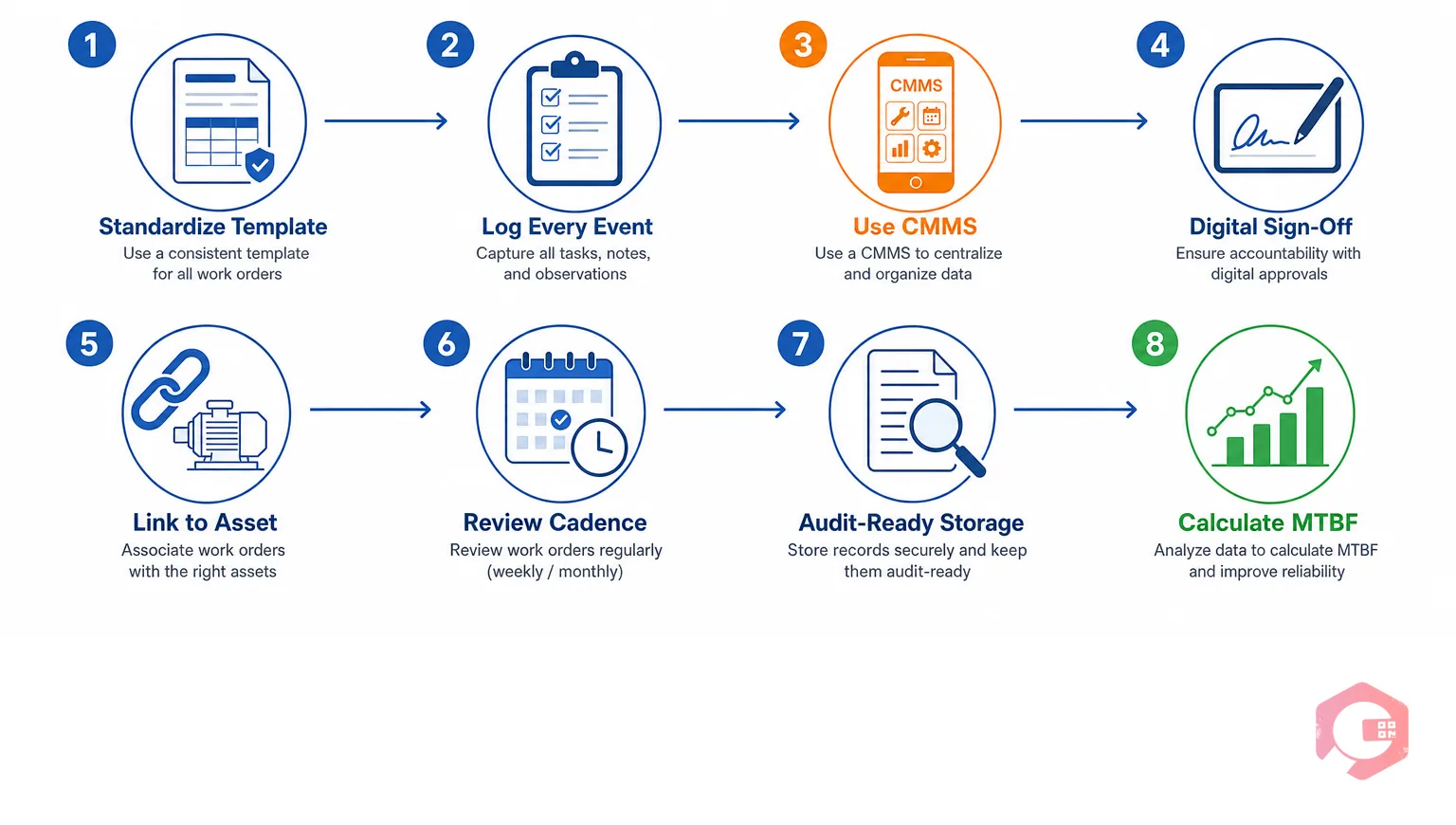
Eight practices separate high-performing teams from the rest: standardised templates, complete logging discipline, CMMS automation, digital sign-off, asset linkage, review cadence, audit-ready storage, and log-driven reliability metrics.
Facilities that follow these practices and use a CMMS report up to 30% less unplanned downtime and 25% faster repair times.
What Is an Equipment Maintenance Log?
An equipment maintenance log is a permanent, chronological record of every maintenance activity performed on a specific physical asset across its entire operational life. Think of it as a medical chart for your equipment — every visit, every procedure, every finding, every part replaced. Without that history, every breakdown starts from zero: technicians guess at root causes, order parts they might not need, and duplicate work that was already done three months ago.
Why Maintenance Logs Matter More Than Most Teams Realize
Accurate, complete maintenance logs unlock five downstream benefits that disorganised or incomplete records simply cannot deliver. First, faster diagnosis: when a technician arrives at a machine, they can read the last five service entries in 30 seconds and know which components were recently replaced, what failure mode appeared last time, and which parts are most likely to cause the current symptom. Second, reliable MTBF and MTTR calculations: without timestamped failure and repair records, your reliability metrics are guesses. Third, repair-or-replace decisions: a log that shows a motor has been rewound three times in 18 months is a clear signal that replacement is cheaper than the next repair. Fourth, compliance and audit readiness: regulators and insurers expect documented evidence — not a technician's memory. Fifth, warranty and insurance protection: missing logs can void coverage entirely, turning a warrantied component failure into a full out-of-pocket repair.
What Should an Equipment Maintenance Log Include?
A maintenance log entry is only as useful as the information it contains. A log that records "fixed machine" tells you nothing useful six months later. The ten essential fields every log entry needs are these:
Asset ID and Name: the unique identifier that ties the log entry to a specific physical asset in your system — not just a description.
Date and Time: exact timestamp of when work started and when it was completed, not just the date the form was filled out.
Maintenance Type: preventive, corrective, predictive, or condition-based — this determines how you analyse failure patterns later.
Work Performed: a specific, clear description of every action taken, not a generic summary. "Replaced left-side bearing on drive motor" is useful; "serviced motor" is not.
Parts and Materials Used: part numbers, quantities, and the supplier — essential for reorder planning and warranty claims.
Technician Name and ID: who performed the work, for accountability, training analysis, and regulatory compliance.
Equipment Condition Before and After: a brief, objective assessment — vibration level, temperature reading, oil clarity, noise description — that gives the next technician a baseline.
Failure Code or Cause: why the maintenance was needed, whether it was a scheduled task, an operator-reported symptom, or an unexpected failure.
Labour Hours: actual time spent, broken down by diagnosis, repair, and reassembly if possible — feeds your BI dashboard for maintenance cost tracking.
Next Scheduled Maintenance Date: the date the asset should be serviced again, auto-populated in a CMMS from the PM schedule.
If a field is missing, the log entry loses value exponentially. Missing failure codes mean you can't run root cause analysis. Missing part numbers mean you can't build a reliable spare parts inventory. Missing timestamps mean your MTBF calculations are wrong.
How Long Should You Keep Equipment Maintenance Records?
The minimum retention period depends on your industry and the applicable regulations. These are the baselines:
General manufacturing (OSHA): 3 to 5 years minimum for most maintenance records; The OSHA Lockout/Tagout standard (29 CFR 1910.147) requires documented procedures to be retained as long as they remain in use.
Healthcare and medical devices (FDA): minimum 2 years beyond the product's expected shelf life or the date of last manufacture, whichever is longer.
Aviation (FAA): at least 2 years for routine service records, and the full operational life of the aircraft for major structural repairs and modifications.
Food and beverage (FDA, USDA): typically 1 to 3 years depending on product type, with longer periods for equipment in contact with regulated products.
The practical best-practice baseline that applies across all industries: retain records for the full operational life of the asset, plus 2 years after decommissioning. This ensures you have complete history available for any regulatory audit, insurance claim, or litigation. In a digital work order management system, this retention is automatic — no manual archiving required.
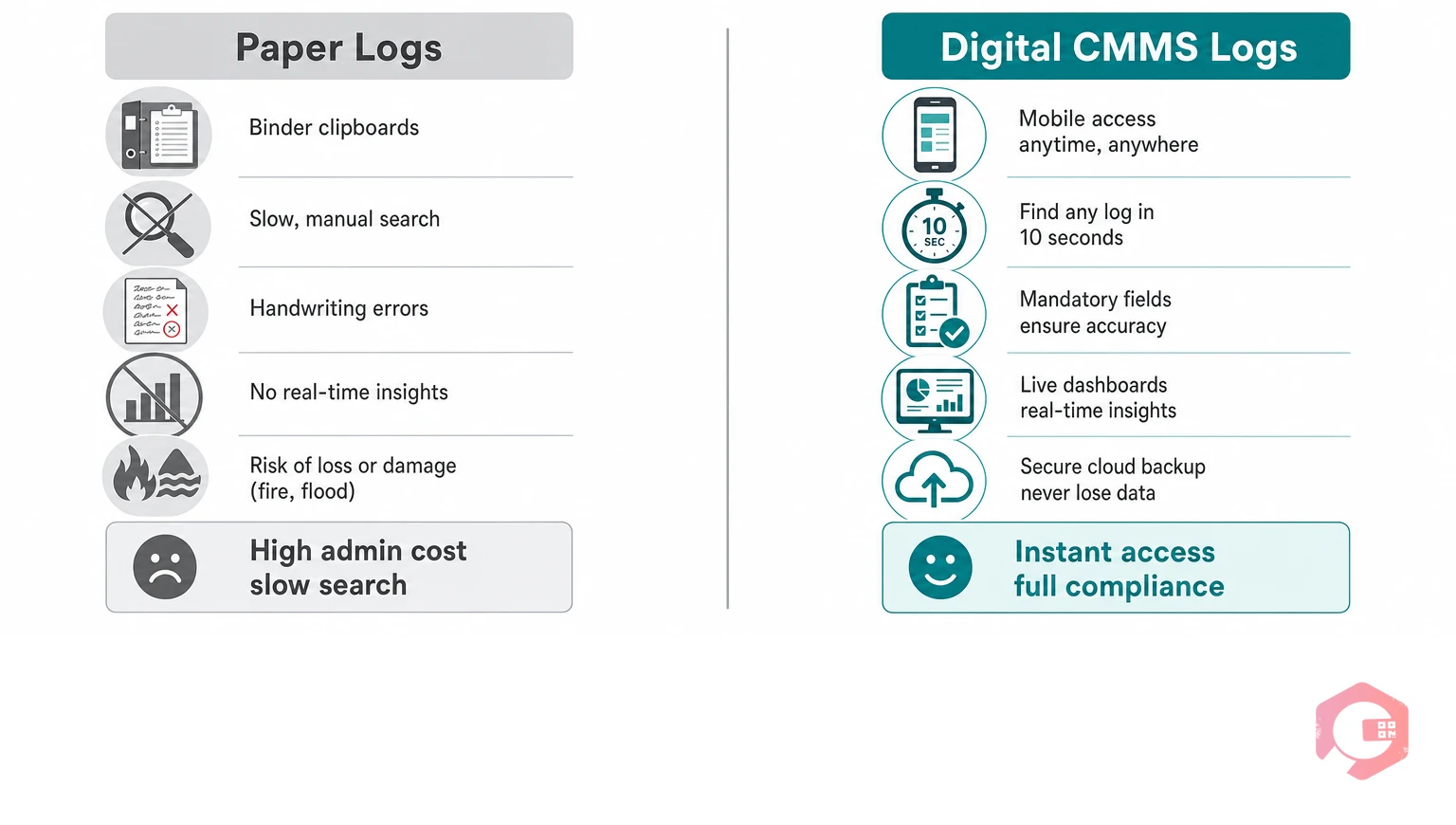
Paper vs. Digital Maintenance Logs: A Real Comparison
The choice between paper and digital logs isn't just a format preference — it's a decision that directly affects how quickly your technicians can diagnose faults, how accurately your reliability metrics are calculated, and how exposed you are during an audit.
Dimension
Paper Logs
Digital CMMS Logs
Accessibility
On-site binders only; unavailable remotely
Mobile access from anywhere, including offline
Search Speed
30+ minutes to locate a specific record
Under 10 seconds by asset, date, or technician
Data Quality
Incomplete entries pass unchecked
Mandatory fields enforce completeness before submission
Analysis Capability
Manual spreadsheet; hours of data entry
Live dashboards, MTBF/MTTR auto-calculated
Audit Readiness
Manual compilation; risk of missing records
Any asset's 2-year history in under 5 minutes
Loss Risk
Fire, flood, misfiling, physical damage
Cloud backup; permanently stored
PM Schedule Integration
Manual calendar; easy to miss
Auto-triggers next work order from log completion
Admin Time
High — transcribing, filing, compiling
Low — log entry is the final record
A mid-size facility switching from paper to digital typically recovers 2 to 3 hours of administrative time per week per technician — time previously spent transcribing, filing, and manually compiling reports that the CMMS generates automatically.
8 Best Practices for Managing Equipment Maintenance Logs
Standardise your log template across all assets: inconsistent formats make benchmarking impossible and allow technicians to skip fields that feel optional. One template, enforced by the system, for every asset class.
Log every maintenance event, not just breakdowns: partial records — where only corrective repairs are logged and preventive activities are skipped — skew failure pattern analysis. Every PM task completion needs a log entry, even if nothing was found wrong.
Use a CMMS to automate log creation: when the CMMS generates the work order, it pre-populates the asset ID, maintenance type, and scheduled task description. The technician adds what they did and what they found — eliminating the double-entry burden that causes log fatigue in paper systems.
Require digital sign-off for every entry: a technician's digital signature creates a legally defensible audit trail. It also establishes individual accountability, which consistently improves entry quality compared to unsigned paper forms.
Link logs to asset records, not just work orders: work orders are transactional — they get completed and closed. Asset records are longitudinal — they accumulate the full history of every maintenance activity across the asset's entire operational life. Your asset tracking system should automatically attach every completed work order log to the corresponding asset record.
Set a regular log review cadence: weekly or monthly supervisor reviews of recent log entries surface patterns worth investigating — a motor that has been lubricated three times in four weeks despite a monthly schedule, or a seal replaced twice in two months on the same pump. These patterns are invisible without a review habit.
Store logs where auditors can find them in minutes: according to the Society for Maintenance and Reliability Professionals, if your current system cannot produce any asset's full maintenance history for the past 2 years in under 5 minutes, you are not audit-ready. This is a non-negotiable standard for regulated industries.
Use log data to calculate MTBF and MTTR: your maintenance logs contain everything needed to calculate mean time between failures and mean time to repair automatically. If your CMMS isn't doing this from log data — use the MTBF calculator and MTTR calculator to run the numbers manually while you build the case for a digital system.
5 Common Equipment Maintenance Log Mistakes (And How to Avoid Them)
Even teams with the right intentions make these mistakes consistently. Knowing them in advance is the fastest way to avoid the audit failures, repeated breakdowns, and reliability gaps they create.
Logging after the fact instead of at the point of work: a log entry written three days after the repair from memory is unreliable. Parts used, exact findings, and timestamps are all subject to recall error. Best practice is mobile log entry at the asset, completed before the technician moves to the next job — which is exactly what the Cryotos mobile app with offline capability enables.
Treating the log as a compliance exercise rather than a diagnostic tool: when technicians are filling in logs to satisfy a requirement rather than to create useful records, the quality collapses. Write-only entries — where the log is never read by anyone — destroy the culture of useful logging. Supervisors should reference log data in every breakdown debrief.
Recording symptoms instead of root causes: "motor overheating" is a symptom. "Motor overheating due to blocked cooling vents caused by dust accumulation from adjacent grinding operation" is a root cause. The first entry produces repeat failures; the second drives the corrective action that prevents them. Use the 5 Whys method to anchor every corrective entry to a root cause.
Keeping maintenance logs separate from the asset register: logs stored in a separate system or binder from the asset register force technicians to cross-reference two sources — and in practice, they don't. Every log entry should be retrievable directly from the asset record, in chronological order, with no extra steps.
No escalation trigger for repeat failures: a log system that records the same failure mode three times on the same asset without triggering an alert or review is a passive system. Active systems — like a CMMS with configurable failure code thresholds — escalate automatically when a pattern is detected, turning the log from a historical record into a proactive reliability tool.
How Cryotos CMMS Makes Maintenance Log Management Effortless
Cryotos automates every step of the maintenance log lifecycle. Work orders are pre-populated with asset data, maintenance type, and scheduled task details — so technicians log what they did and what they found, not administrative metadata. Mobile-first log entry at the asset works in full offline mode and syncs automatically when connectivity returns, so remote and field teams have no excuse for delayed entries. Digital signatures and mandatory fields are enforced at submission — incomplete entries can't be closed without the required information. Every completed log entry is permanently linked to the asset record, building the longitudinal maintenance history that drives reliable root cause analysis and repair-or-replace decisions. MTBF and MTTR are calculated automatically from log data and displayed on the maintenance reporting dashboard in real time. And audit-ready record retrieval — any asset's full maintenance history for any date range — is available in minutes, not hours.
Facilities using Cryotos report a 30% reduction in unplanned downtime and 25% faster repair times. If your current log system is still running on paper binders or disconnected spreadsheets, every day without a change is a day of recoverable performance being left on the table. Schedule a free demo to see how Cryotos transforms maintenance log management for your team.
Frequently Asked Questions
What is an equipment maintenance log?
An equipment maintenance log is a permanent, chronological record of all maintenance activities performed on a specific asset — including preventive inspections, corrective repairs, part replacements, calibrations, and lubrication events. It captures who performed the work, when, what was found, what was done, and what parts were used.
How often should maintenance logs be updated?
Maintenance logs should be updated immediately after each maintenance activity — ideally before the technician moves to the next job. Logs completed at the point of work, while details are fresh, are significantly more accurate and complete than logs filled in from memory hours or days later.
Are maintenance logs required by OSHA?
The OSHA Lockout/Tagout standard (29 CFR 1910.147) requires documented procedures and records for hazardous energy control. OSHA's general duty clause also requires employers to maintain equipment in a safe condition — and documented maintenance records are the primary evidence of compliance.
What is the difference between a maintenance log and a maintenance work order?
A work order is the instruction — it authorises and describes the maintenance task to be performed. A maintenance log is the record — it captures what was actually done, what was found, what parts were used, and when. In a CMMS, completing a work order automatically generates the maintenance log entry linked to the asset record.
How long should equipment maintenance records be kept?
The minimum is 3 to 5 years for general manufacturing under OSHA, with longer requirements for regulated industries: 2 years beyond product shelf life for FDA-regulated devices, and full operational life plus 2 years post-decommissioning as a universal best practice baseline.
What happens if maintenance logs are incomplete or missing?
Incomplete logs create several cascading problems: longer diagnosis times for breakdowns, unreliable MTBF and MTTR calculations, failed regulatory audits, voided warranties, and denied insurance claims. In litigation involving equipment failure, missing maintenance records are frequently used as evidence of negligence.