
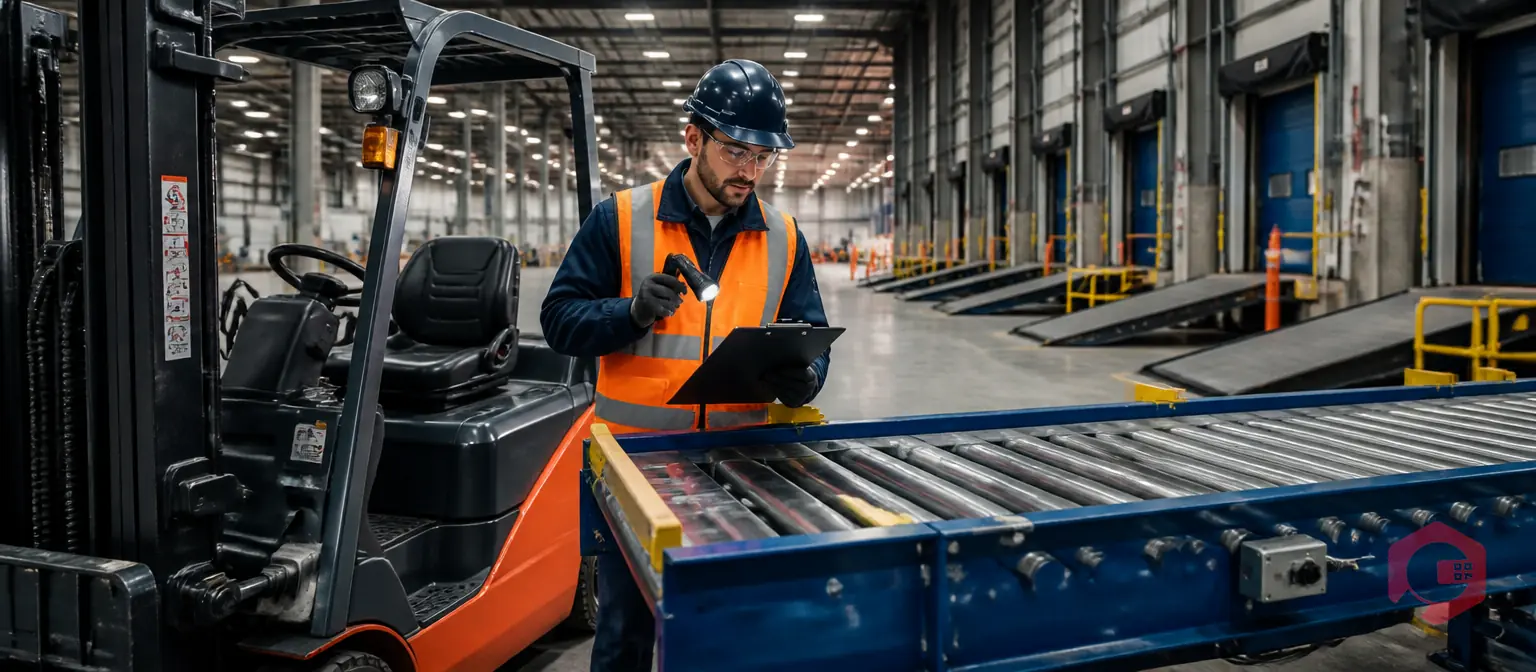
Warehouse equipment failures are not just operational inconveniences — they are safety events. Forklifts account for approximately 25% of all workplace transport accidents in the UK, according to the Health and Safety Executive. Conveyor entanglement incidents cause some of the most severe injuries in distribution and logistics operations. Dock leveller failures — hydraulic collapse or unexpected movement during loading — are a consistent source of crush injuries at loading bays across the warehousing sector. The legal framework governing all three asset types is clear: the Provision and Use of Work Equipment Regulations 1998 (PUWER) requires that work equipment is maintained in an efficient state, in efficient working order, and in good repair — and that maintenance records are kept.
This guide provides structured maintenance checklists for the three most critical warehouse equipment categories, explains the regulatory basis for each inspection frequency, and shows how a CMMS converts those checklists from paper forms into scheduled, tracked, auditable work orders.

PUWER 1998 places a legal duty on employers to ensure that work equipment — which includes forklifts, conveyors, and dock levellers — is inspected at appropriate intervals to identify deterioration that could create a risk to health and safety, and that the results of inspections are recorded. For lifting equipment (forklifts, scissor lifts, and dock levellers with lifting functions), the Lifting Operations and Lifting Equipment Regulations 1998 (LOLER) additionally requires thorough examination by a competent person at defined intervals — every 6 months for equipment used to lift persons, every 12 months for other lifting equipment — with formal examination reports issued by the competent person.
This dual framework — PUWER for all work equipment and LOLER for lifting equipment — means that the maintenance checklists below are not optional guidance. They reflect the legal minimum for equipment that warehouse operators are required to maintain and document. A maintenance manager who cannot produce inspection records for a forklift involved in an incident faces personal liability as well as corporate exposure. A CMMS makes this evidence available on demand.
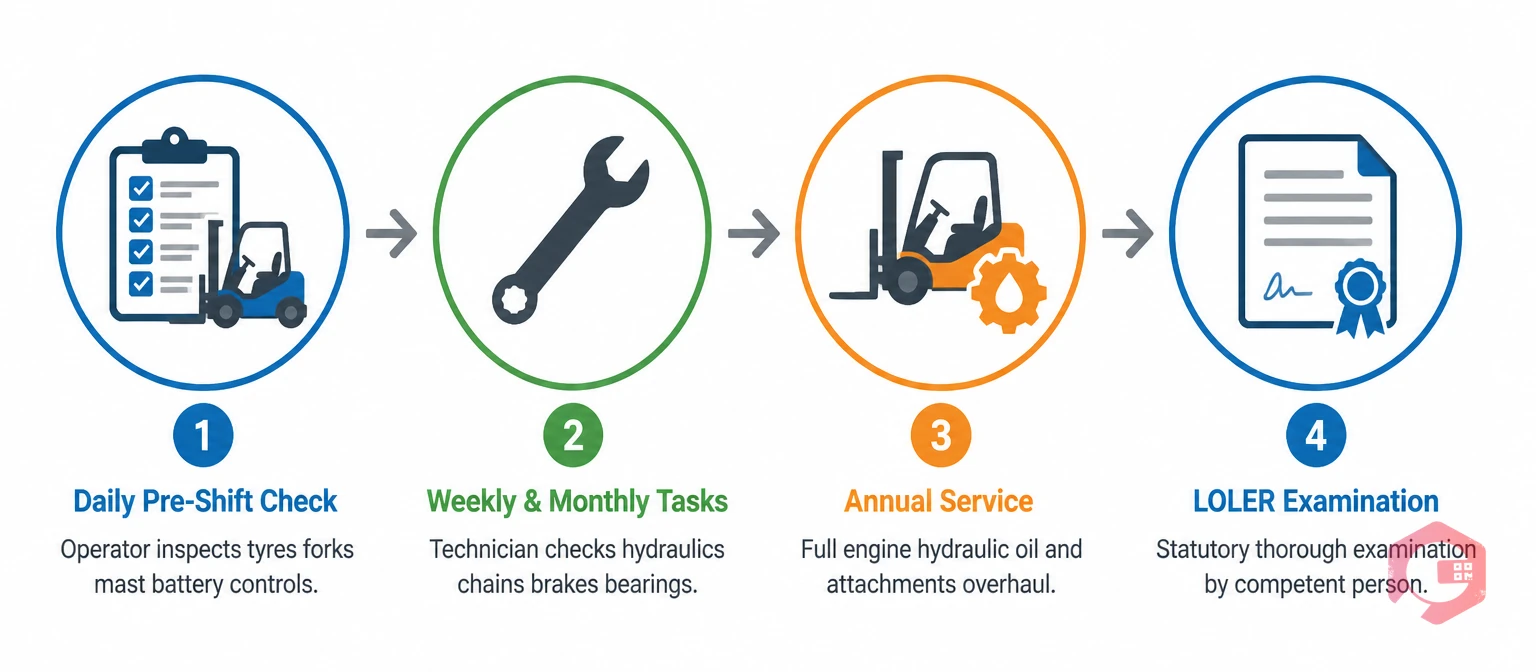
Forklift maintenance divides into three tiers: the operator's daily pre-shift check (required before every operating shift), periodic maintenance tasks performed by trained technicians, and the statutory examination required under LOLER. All three tiers must be completed and documented — the daily checks by operators and the periodic tasks and statutory examinations by competent persons.
Before every operating shift, the forklift operator must conduct and record a pre-use check. These checks are typically completed in 10–15 minutes and cover the systems most likely to create an immediate safety risk if they have deteriorated since the previous shift:
Beyond the daily operator check, a trained technician should perform more detailed maintenance tasks at weekly and monthly intervals. Weekly tasks include: checking hydraulic fluid level and topping up if required, lubricating lift chains with appropriate chain lubricant (dry conditions require more frequent lubrication), inspecting brake system for correct adjustment and pad wear, checking steering play and confirming it is within manufacturer tolerance, and verifying that all safety labels, load ratings plates, and serial number plates are legible and in place.
Monthly tasks extend to: full hydraulic system inspection including hose condition and fitting integrity; mast roller and bearing inspection with lubrication; checking attachment functionality if fitted (side-shifter, clamps, rotator); battery water top-up for lead-acid systems; reviewing engine oil level and condition for IC trucks; and inspecting the drive axle and differential for oil leaks. All monthly task completions should be recorded with the technician's name, date, and any defects found or parts replaced.
Under LOLER, forklifts must undergo thorough examination by a competent person at least every 12 months (or every 6 months if used to lift persons). The thorough examination is not a maintenance task — it is a statutory inspection conducted by a qualified engineer (typically from a CFTS-accredited provider in the UK) who produces a formal written report. Separately, the manufacturer's annual service schedule typically includes engine/motor service, full hydraulic oil analysis and replacement, chain replacement assessment, and brake system overhaul if required. Both the LOLER examination report and the manufacturer annual service record must be retained as the legal maintenance history of the truck.
Conveyor systems — whether belt conveyors, roller conveyors, or chain conveyors — require structured maintenance across multiple frequency tiers. The specific check items vary by conveyor type, but the framework below covers the core requirements applicable to most warehouse conveyor installations.
Daily conveyor checks are typically performed by the operational team before or at start-up each shift. They focus on conditions visible during operation or immediately apparent at visual inspection:
Weekly checks add: inspection of belt cleaners (primary scraper at the head pulley and secondary scraper on the return) with adjustment or blade replacement as required; checking tensioner weights or screw tensioner adjustment; and lubricating pulley shaft bearings on manual lubrication systems.
Monthly maintenance covers the systems that deteriorate more slowly than daily wear items: checking drive motor mounting bolts for tightness; inspecting gearbox oil level and checking the sight glass for contamination; checking coupling alignment between motor and gearbox; tightening all belt splices and inspecting splice condition for delamination or cracking; and checking all conveyor frame fasteners for looseness from vibration.
Quarterly tasks include: full belt inspection including tracking adjustment; gearbox oil sample analysis (on conveyors with continuous or high-duty operation); checking all cable entry points and junction boxes for moisture ingress; and testing all interlocks between adjacent conveyor sections to confirm that an e-stop on one section correctly stops connected sections as designed.
Annual conveyor maintenance covers the full mechanical and electrical system: full gearbox oil change; motor insulation resistance test (megger test) to confirm winding condition; belt replacement assessment based on wear measurement; full replacement of all bearings on conveyors operating in high-dust or moisture-exposed environments where annual replacement is the expected service life; and a formal PUWER inspection by a competent person who examines the entire installation for compliance with the original design intent and current safety standards. The PUWER inspection generates a written report that is part of the statutory maintenance record for the installation.
Dock levellers — the bridging platforms that connect the loading bay floor to trailer beds — are among the most failure-prone pieces of equipment in a distribution warehouse because they operate under high load cycles (every vehicle movement), in harsh environmental conditions (exposed to weather, contamination, and vehicle impact), and are frequently operated by personnel who are not trained technicians. PUWER requires dock levellers to be maintained in an efficient state, and LOLER applies to dock levellers with lifting functions (hydraulic and mechanical lip levellers).
Daily dock leveller checks should be integrated into the warehouse team's shift start procedures:
Weekly checks add: testing the full operating cycle with a loaded platform; checking bumper rubber condition and anchor bolts; cleaning accumulated debris from the pit to prevent hydraulic cylinder contamination.
Monthly dock leveller maintenance includes: lubricating all hinge pins, pivot points, and lip hinges with the correct grease grade for the operating environment; checking hydraulic fluid level in the reservoir; inspecting cylinder mounting brackets for cracks or movement; and confirming that all controls (push buttons, pendant controls) are operational and correctly labelled. Quarterly tasks add: hydraulic hose inspection for cracking, chafing, or deformation at fittings; relief valve pressure testing; and checking the leveller return system (spring return or hydraulic return) for correct function.
Under LOLER, dock levellers used in a lifting capacity must undergo thorough examination at least every 12 months by a competent person. The annual service additionally covers: full hydraulic oil change and filter replacement; hydraulic cylinder seal replacement assessment; relief valve calibration; and structural inspection of the pit installation for concrete cracking, anchor bolt condition, and frame integrity. The LOLER examination report and the annual service record must both be retained as the formal maintenance history of the leveller.
Use the following table to configure PM task schedules in your warehouse CMMS. Regulatory references are UK-applicable — confirm local requirements for other jurisdictions:
| Asset | Task | Frequency | Regulatory Basis | CMMS Record Type |
|---|---|---|---|---|
| Forklift | Pre-shift safety check (operator) | Before every shift | PUWER Reg. 6 | Operator inspection record (digital sign-off) |
| Forklift | Chain lubrication, hydraulic fluid, brake check | Weekly | PUWER Reg. 6; manufacturer schedule | PM work order (technician) |
| Forklift | Full service — engine/motor, hydraulics, attachments | Annual (or per manufacturer hours) | PUWER Reg. 6; manufacturer schedule | Annual service record (technician + parts log) |
| Forklift | Thorough examination (LOLER) | Every 12 months (6 months if persons lifted) | LOLER Reg. 9 | LOLER examination report (competent person) |
| Conveyor | Belt tracking, e-stops, roller check, guarding | Daily (shift start) | PUWER Reg. 6 | Operator shift check record |
| Conveyor | Belt cleaner adjustment, tensioner, bearing lubrication | Weekly | PUWER Reg. 6; manufacturer schedule | PM work order (technician) |
| Conveyor | Gearbox oil change, motor megger test, full belt inspection | Annual | PUWER Reg. 5 & 6 | Annual service record + PUWER inspection report |
| Dock Leveller | Lip operation, platform, hydraulic leak check, safety legs | Daily (shift start) | PUWER Reg. 6; LOLER (lifting function) | Operator shift check record |
| Dock Leveller | Hinge pin lubrication, hydraulic fluid, controls check | Monthly | PUWER Reg. 6; manufacturer schedule | PM work order (technician) |
| Dock Leveller | Full hydraulic service, LOLER thorough examination | Annual | LOLER Reg. 9; PUWER Reg. 6 | LOLER examination report + annual service record |
Each row in this table maps to a PM task configuration in the CMMS. The daily operator checks are best configured as mobile inspection forms — completed by the operator on a smartphone or tablet before each shift, generating a digital record against the asset without any paper or data transcription. The periodic technician tasks generate formal work orders with parts tracking. The statutory examinations are recorded as compliance events against the asset's maintenance history, with the formal examination report attached to the work order record.

A paper maintenance checklist and a CMMS-managed maintenance programme share the same content — the same items need to be checked. What they don't share is the consequence of a missed check. A paper checklist that wasn't completed this week is invisible until someone looks for it. A CMMS work order that wasn't completed this week is visible to the maintenance manager, generates an overdue flag, and — if configured — sends an alert before the SLA deadline passes.
For daily operator checks, the CMMS mobile app is the replacement for the clipboard. The operator scans the asset's QR code, completes the digital inspection form, and submits — the check is timestamped, attributed, and stored against the asset record. Any defect ticked during the check automatically creates a corrective work order for the maintenance team, with the specific defect pre-populated. The operator does not need to find the maintenance manager or remember to report verbally — the CMMS creates the work order the moment the defect is flagged.
For periodic technician tasks, the preventive maintenance software module generates work orders automatically at the correct frequency — weekly for chain lubrication, monthly for dock leveller lubrication, quarterly for conveyor gearbox oil samples — with the relevant checklist attached. The technician cannot close the work order without completing all mandatory checklist items, ensuring that the record accurately reflects what was actually checked rather than what should have been checked.
For statutory examinations (LOLER, PUWER), the CMMS tracks the next due date against each asset and generates a scheduling alert in advance — giving the maintenance manager time to book the competent person before the examination date lapses. The examination report is attached to the work order record, creating a permanent, retrievable statutory compliance history for every asset in the warehouse. The Report Builder can produce a compliance status report for the entire warehouse equipment fleet — showing which assets are current, which are approaching their next examination date, and which are overdue — in a format suitable for internal audit, insurance review, or HSE inspection.
Cryotos CMMS gives warehouse operations teams the asset register, mobile inspection workflow, and compliance tracking tools to manage forklifts, conveyors, and dock levellers systematically rather than reactively. Every asset carries its full maintenance history — daily operator checks, periodic PM work orders, annual service records, and LOLER examination reports — in a single, searchable record accessible to maintenance managers, operations directors, and external auditors from the same platform.
The asset management software module maintains the equipment register including each asset's identification, location, maintenance schedule, service history, and compliance status. When a forklift is due for its annual LOLER examination, the CMMS creates a reminder task 4–6 weeks in advance. When a dock leveller fails a daily inspection check, the corrective work order is created and assigned before the shift manager has finished reviewing the operator's report. The work order management software module tracks every corrective action from defect identification to resolution close, with parts consumed and technician time logged against each work order.
The BI Dashboard surfaces fleet-level performance data — which equipment categories are generating the most reactive work orders, which assets are approaching their inspection due dates, which shifts have the highest operator defect report rates — giving maintenance managers the fleet view that paper-based systems cannot provide. Teams using Cryotos report a 30% reduction in unplanned downtime, with warehouse operations consistently citing improved forklift and MHE availability as a primary outcome of moving daily operator checks and PM scheduling into the CMMS.
PUWER requires that forklifts are inspected at appropriate intervals to identify deterioration that could create a risk to safety. In practice, this means a daily pre-shift check by the operator before every operating period, periodic maintenance at intervals specified in the manufacturer's service schedule (typically weekly, monthly, and annual), and a thorough examination under LOLER by a competent person at least every 12 months. If the forklift is used to lift persons — for example, with an operator cage — the LOLER thorough examination frequency increases to every 6 months. All inspections must be recorded and the records kept available for inspection.
A daily forklift pre-shift check should cover: tyre condition and pressure (pneumatic) or physical condition (solid); fork condition including cracks, bends, and blade heel wear; mast and lift chain condition including lubrication and corrosion; overhead guard integrity and fastening; all hydraulic controls and functions; horn, lights, and safety devices; battery charge state and connector condition (electric trucks); gas cylinder connection and hose condition (LPG trucks); and fluid levels including hydraulic oil. The check should be completed and signed off (digitally or on paper) before the operator takes the truck into service. Any defect found must be reported and assessed before the truck is used — a truck with a known defect should not be operated until the defect is resolved.
Dock levellers should receive a daily operator check (lip function, platform condition, safety leg presence, hydraulic leak inspection) before first use each day. Monthly servicing by a technician should cover hinge pin and pivot point lubrication, hydraulic fluid level, controls function, and bumper rubber condition. Quarterly service covers hydraulic hose inspection and relief valve testing. Annual service includes full hydraulic oil change, filter replacement, cylinder seal assessment, and structural inspection of the pit installation. Under LOLER, dock levellers with lifting functions must receive a thorough examination by a competent person at least every 12 months, with a formal examination report issued and retained.
Yes — and for warehouses with multiple forklifts, conveyors, and dock levellers, CMMS-managed daily inspections produce significantly better compliance and defect capture than paper-based systems. The operator scans the asset's QR code on their smartphone, completes the digital inspection checklist, and submits. The check is timestamped and attributed to the operator, the record is stored against the asset in the CMMS, and any defect flagged during the check automatically creates a corrective work order assigned to the maintenance team. The CMMS also surfaces which assets did not receive their daily check on a given shift — a gap that is invisible in a paper system until someone physically checks the clipboard. For PUWER compliance, digital daily inspection records with operator attribution and timestamp are at least as reliable as paper records and significantly easier to retrieve during inspections or investigations.
Forklift, conveyor, and dock leveller maintenance is a statutory obligation under PUWER and LOLER — not a discretionary activity. The checklists in this guide reflect the legal minimum inspection frequencies and the evidence requirements that maintenance records must satisfy. A warehouse that manages these checklists on paper, in spreadsheets, or by memory will produce incomplete records that create legal exposure in the event of an incident and operational exposure every day that a defect goes undetected.
Moving warehouse equipment checklists into a CMMS converts them from static documents into active workflows — generating tasks, capturing completion evidence, creating corrective work orders from defect reports, and producing compliance histories that hold up to audit. For warehouse maintenance teams ready to bring their equipment maintenance programme up to the standard the law requires, Cryotos CMMS provides the asset register, inspection workflow, and compliance reporting infrastructure to manage forklifts, conveyors, and dock levellers at any fleet size. Book a free demo today and see what your warehouse equipment maintenance looks like when every check is tracked and every record is audit-ready.

Cryotos AI predicts failures, automates work orders, and simplifies maintenance—before problems slow you down.



