

A smart maintenance ecosystem is an integrated network of technologies — IIoT sensors, CMMS software, predictive analytics, and automation tools — that work together to move manufacturing plants from reactive repairs to data-driven, proactive asset management. Plants that build mature smart maintenance ecosystems report up to 25–40% reductions in unplanned downtime and 10–25% lower maintenance costs. This guide covers what a smart maintenance ecosystem includes, a five-step framework for building one, and the real-world results manufacturing plants can expect.

A smart maintenance ecosystem is a connected, technology-enabled framework in which machines, maintenance teams, and management systems share real-time data to prevent failures before they occur, automate routine work, and continuously improve asset performance. The defining characteristic is integration: each component feeds information to the others. A sensor detects an anomaly, the CMMS automatically generates a work order, a technician resolves the issue, and the analytics engine learns from the outcome to refine future predictions.
According to McKinsey & Company, manufacturers that fully adopt Industry 4.0 maintenance practices can reduce maintenance costs by up to 40% and equipment downtime by up to 50%.
A traditional CMMS schedules preventive maintenance based on time or usage intervals. A smart maintenance ecosystem uses live sensor data, machine learning, and automated decision-making to predict failures and optimise schedules dynamically.
| Core Element | Traditional | Smart Ecosystem |
|---|---|---|
| Trigger source | Calendar or meter-based | Real-time IIoT sensor data |
| Work order creation | Manual or scheduled | Automated, condition-triggered |
| Failure prediction | None | AI/ML-driven predictive alerts |
| Maintenance strategy | Preventive or reactive | Predictive, prescriptive, and autonomous |

Every smart maintenance ecosystem is built on five foundational layers. Removing any one of them limits the whole system's effectiveness.
Sensors are the ecosystem's nervous system. Vibration sensors, temperature probes, current transducers, and acoustic emission detectors capture continuous asset health data. According to Plant Engineering, plants with fully instrumented assets detect 70–80% of incipient failures before they cause unplanned downtime.
The CMMS sits at the centre of the ecosystem — receiving sensor data, triggering work orders, managing technician assignments, tracking parts inventory, and storing the historical data that analytics engines learn from.
Machine learning algorithms analyse patterns in sensor and maintenance history data to forecast when a specific asset is likely to fail. Instead of replacing a bearing on a fixed 90-day schedule, the system predicts that a particular motor's bearing will reach critical wear in 14 days — enabling a targeted, timely intervention.
A digital twin is a virtual replica of a physical asset, continuously updated with real-world sensor data. Gartner projects that 75% of industrial IoT solutions will incorporate digital twin functionality by 2027.
When the analytics engine flags an anomaly, the CMMS automatically creates and assigns a work order — with the right technician, required parts, and correct priority — without manual intervention.
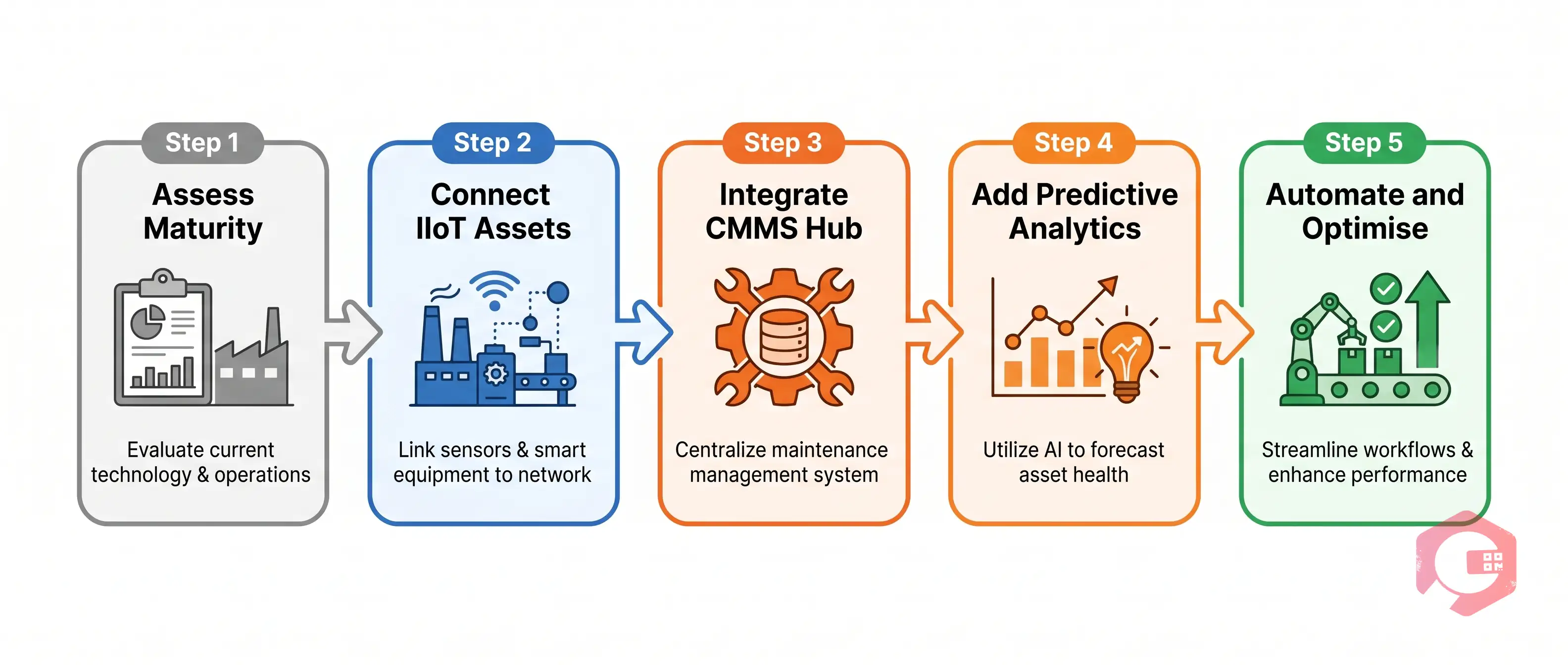
Building a smart maintenance ecosystem is a phased transformation, not a single technology purchase. This framework gives manufacturing plants a structured path from assessment to full automation.
Audit your asset register, document existing maintenance workflows, measure your current unplanned downtime rate, and identify the top five assets responsible for the most production losses.
Start with your highest-criticality assets. Install vibration, temperature, and current sensors and establish connectivity to route sensor data to your CMMS. Early, visible ROI from these assets builds the internal support needed for wider sensor rollout.
Configure your CMMS to receive live sensor feeds and set threshold-based alert rules. When a vibration reading exceeds a baseline, the CMMS generates a work order, assigns a technician, and flags required spare parts from inventory.
Once you have at least 90 days of sensor and work order history, predictive models can begin learning your asset failure patterns. The goal is to shift from time-based PM schedules to condition-triggered, data-driven interventions.
Full automation — where sensor anomalies trigger work orders, assign technicians, and order parts without human intervention — is the end state of a mature smart maintenance ecosystem.
Plants with mature predictive maintenance ecosystems consistently report: unplanned downtime falls by 25–45%; maintenance costs drop 10–25% within 18–24 months; and OEE improves by 5–15 percentage points, according to ISPE research on IIoT-enabled manufacturing.

Understanding where your plant sits on the maturity spectrum helps set realistic goals and investment priorities.
A mid-size plant typically invests $50,000–$250,000 over 12–24 months. Modular deployment — starting with the highest-criticality assets — allows plants to fund later phases from savings generated by early phases.
Most plants see measurable ROI within 12–18 months of deploying predictive analytics on their top asset categories.
The most widely used are vibration sensors (rotating equipment), temperature sensors (motors, bearings), current and power quality monitors (motor degradation), oil quality sensors (gearboxes, hydraulics), and acoustic sensors (leaks, early bearing wear).
Yes — cloud-based CMMS platforms and wireless IIoT sensors have removed the large upfront costs. A 50-person plant can start with five critical assets, a cloud CMMS, and wireless sensors for under $20,000 and build from there.
If your plant is ready to move beyond reactive maintenance, Cryotos CMMS serves as the integration hub at the centre of your smart maintenance ecosystem. Book a free demo today and see how Cryotos helps manufacturing plants move from preventive to predictive maintenance in weeks, not months.



Cryotos AI predicts failures, automates work orders, and simplifies maintenance—before problems slow you down.



