

ISA-95 is the international standard that defines how enterprise systems and manufacturing operations share data — and it's the backbone of smart manufacturing integration. For maintenance teams, understanding ISA-95 means understanding where a CMMS fits inside the broader manufacturing architecture and how it connects to ERP, SCADA, and production systems. When your CMMS aligns with ISA-95, work orders, asset data, and maintenance schedules flow automatically across systems — no manual handoffs, no data silos.
According to a McKinsey report, manufacturers that integrate operations technology with enterprise systems see up to 20% improvement in overall equipment effectiveness. ISA-95 is the blueprint that makes that integration possible — and CMMS is one of the key tools that operates within it.
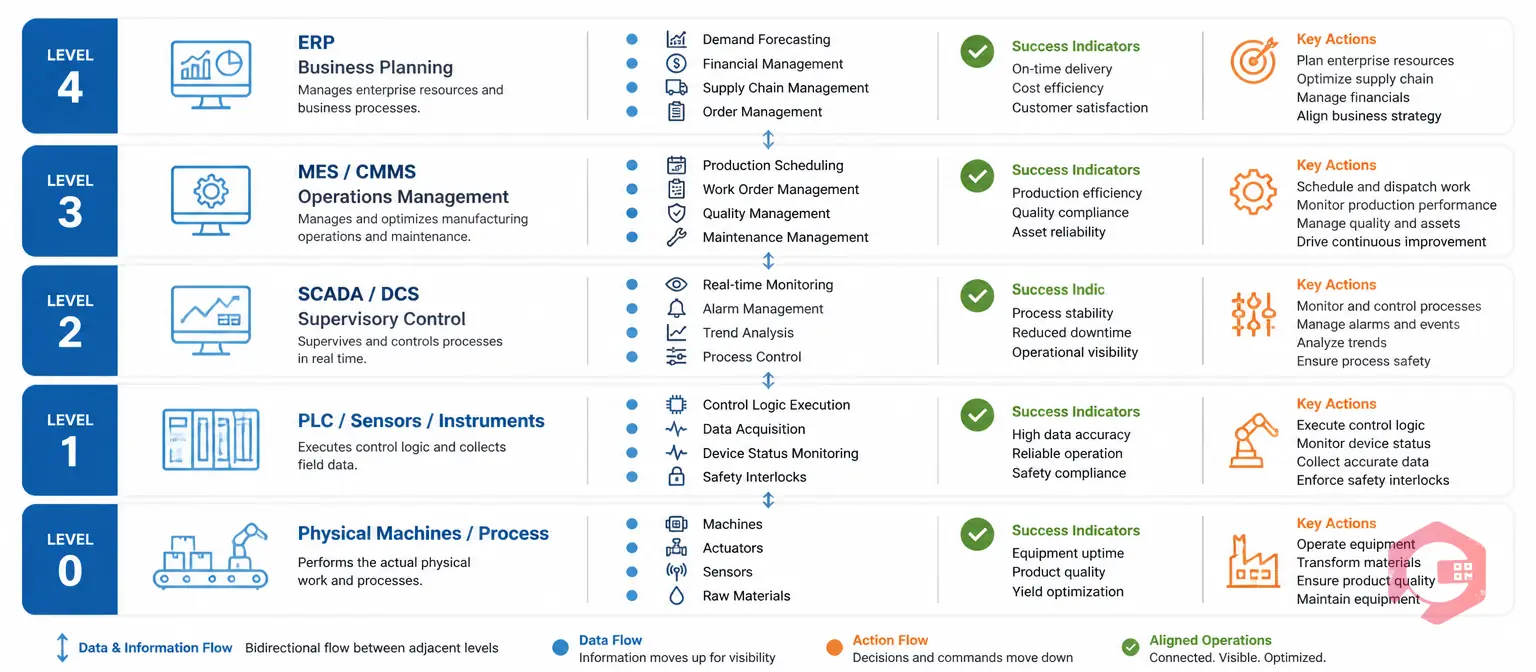
ISA-95 (also known as ANSI/ISA-95 or IEC 62264) is a globally recognised standard developed by the International Society of Automation. It defines the interface between enterprise systems — like ERP — and manufacturing operations systems — like MES and CMMS. The standard breaks a manufacturing facility into a five-level hierarchy, making it easier to define what data each system owns and how that data should move between layers.
Before ISA-95, each vendor built their own integration approach. The result was expensive custom interfaces, fragile connections, and inconsistent data. ISA-95 gave the industry a common language — a shared model for production scheduling, resource management, and maintenance operations that every compliant system can speak.
ISA-95 organises manufacturing systems into five levels, from physical equipment up to business planning:
CMMS sits firmly at Level 3. It receives equipment status from Level 2, translates that into work orders and maintenance schedules, and sends resource and cost data up to Level 4. That positioning is not incidental — it reflects the standard's view that maintenance operations are a core manufacturing function, not an administrative afterthought.
In an ISA-95 compliant environment, a CMMS does more than store work orders. It becomes the system of record for maintenance-related activities at the operations layer, with defined data flows going both up and down the hierarchy.
Your ERP pushes the following types of data into the CMMS at Level 3:
Condition data from sensors and SCADA systems feeds the CMMS to drive condition-based and predictive maintenance:
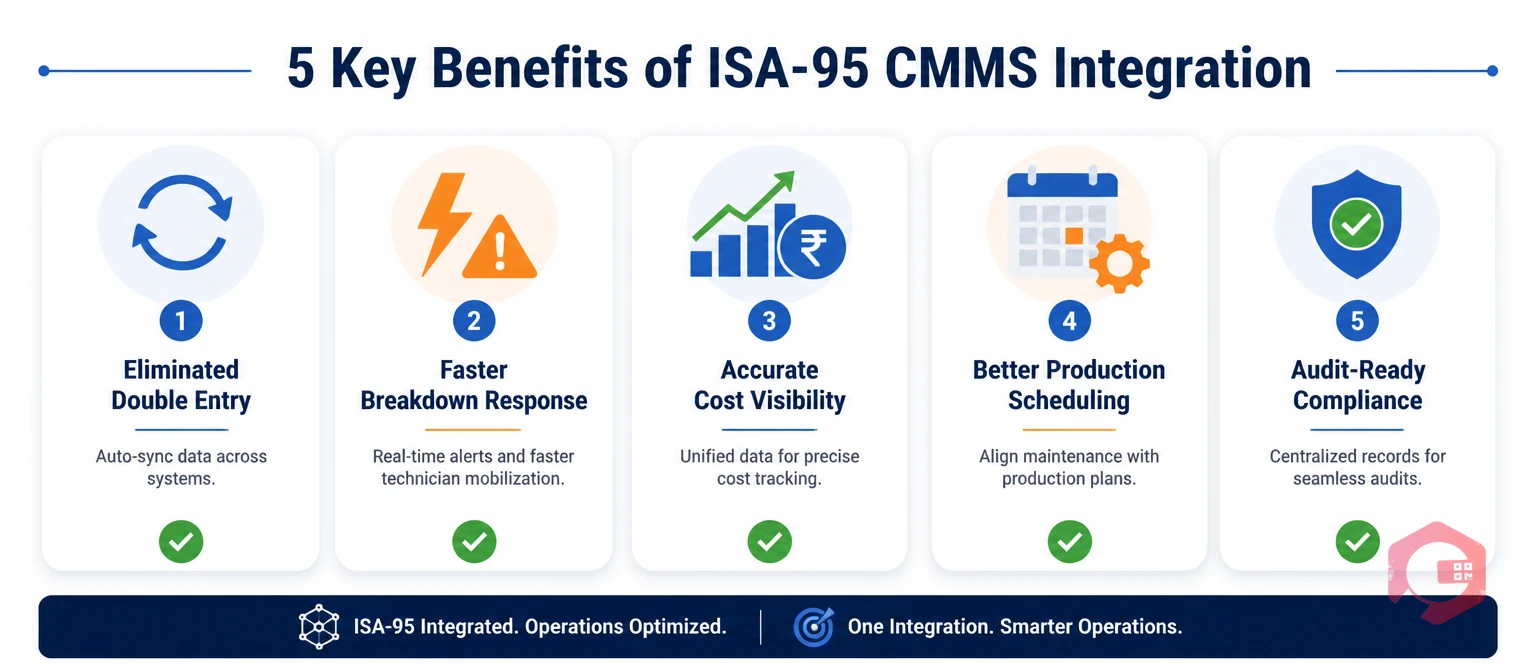
Connecting your CMMS to an ISA-95 architecture delivers measurable benefits across maintenance, production, and finance. Here is what teams consistently report after completing this integrati
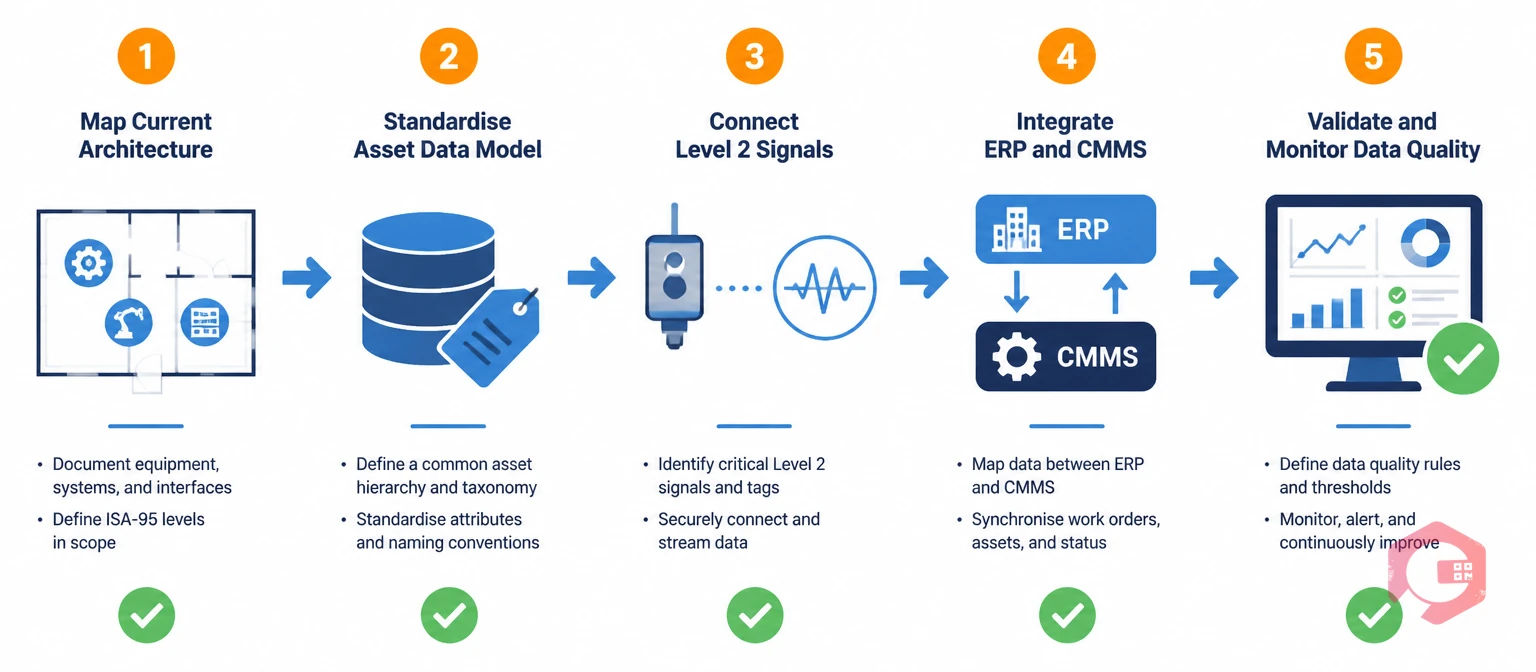
Implementing ISA-95 integration is not a single project — it's a phased alignment of your systems, data models, and processes. Here is a practical sequence that works for most manufacturing environments:
Before touching any software, document which systems you have at each ISA-95 level. Identify where data originates, who owns it, and where it currently gets duplicated or re-entered manually. This map will show you exactly where integration gaps exist and which connections to prioritise first.
ISA-95 integration fails when ERP and CMMS use different asset identifiers. Before connecting systems, agree on a single asset naming convention, unique equipment IDs, and a shared asset hierarchy structure. This is the foundation everything else depends on.
Work with your controls team to define which sensor thresholds and SCADA alarms should create work orders in the CMMS. Start with high-value, high-failure-risk assets. Configure the CMMS to receive those signals and auto-generate work orders with the right priority, asset reference, and technician assignment rules.
Set up the bi-directional data exchange between your ERP and CMMS using the ISA-95 object models for maintenance work, personnel, and materials. Cryotos supports direct ERP integration with SAP and Microsoft Dynamics 365, covering the core Level 3 to Level 4 data flows defined in the standard.
After go-live, track data completeness and accuracy across system boundaries. Set up dashboards that flag missing asset references, unmatched cost codes, or stale sensor data. ISA-95 integration improves over time — data quality reviews in the first 90 days catch most of the edge cases that were not visible during configuration.
Here is a quick reference showing which system type operates at each ISA-95 level and what data it owns:
Not all CMMS platforms are designed with ISA-95 in mind. A CMMS that works well in an integrated manufacturing environment needs to handle real-time data from lower levels, communicate with ERP at the top, and give maintenance teams a clear operational view in between. When evaluating options, look for these capabilities:
Cryotos manufacturing maintenance software is built to operate at ISA-95 Level 3, with live IoT connectivity, ERP integration, automated work order workflows, and reporting that spans asset, department, and facility levels. If your team is ready to align your maintenance operations with your wider manufacturing architecture, Cryotos can get you there faster than a custom build.
ISA-95 stands for the ANSI/ISA-95 standard, also known as IEC 62264 internationally. It was developed by the International Society of Automation to define the interface between enterprise resource planning (ERP) systems and manufacturing operations systems. The "95" refers to the year the standard development effort began.
No, but they complement each other. ISA-95 is a data and integration standard that defines how manufacturing systems communicate. Industry 4.0 is a broader concept covering digitalisation, IoT, AI, and cyber-physical systems in manufacturing. ISA-95 provides the architectural framework that many Industry 4.0 implementations use to connect new technologies to existing systems.
No formal certification exists for ISA-95 compliance. What matters is whether the CMMS supports the data models and interfaces described in the standard. A CMMS that offers native ERP connectors, supports asset hierarchy structures aligned to the standard, and can receive real-time equipment data is effectively operating within the ISA-95 framework, regardless of certification labels.
ISA-88 (the batch control standard) and ISA-95 are related but different. ISA-88 defines how batch processes are structured and controlled at the equipment level, while ISA-95 focuses on the interface between manufacturing operations and enterprise systems. Many process manufacturers use both standards together — ISA-88 for batch recipe management and ISA-95 for integrating that execution layer with ERP and CMMS.
A basic ERP-to-CMMS integration covering asset data and work order costs typically takes four to eight weeks with a CMMS that has pre-built ERP connectors. Full ISA-95 integration — including real-time IoT connectivity from Level 2 and bi-directional data flows — can take three to six months depending on the complexity of your plant architecture and the number of systems involved.




Cryotos AI predicts failures, automates work orders, and simplifies maintenance—before problems slow you down.



