

Campus central plant maintenance is the planned inspection and repair that keeps shared heating, cooling, and power systems running. It also covers the utility distribution network that carries those services to every building.
One chilled water break can shut down labs, dorms, and clinics at once. It often happens when outage windows are hardest to find. This guide covers assets, schedules, inspections, safety rules, and the software that keeps the program on track.
Key Takeaways
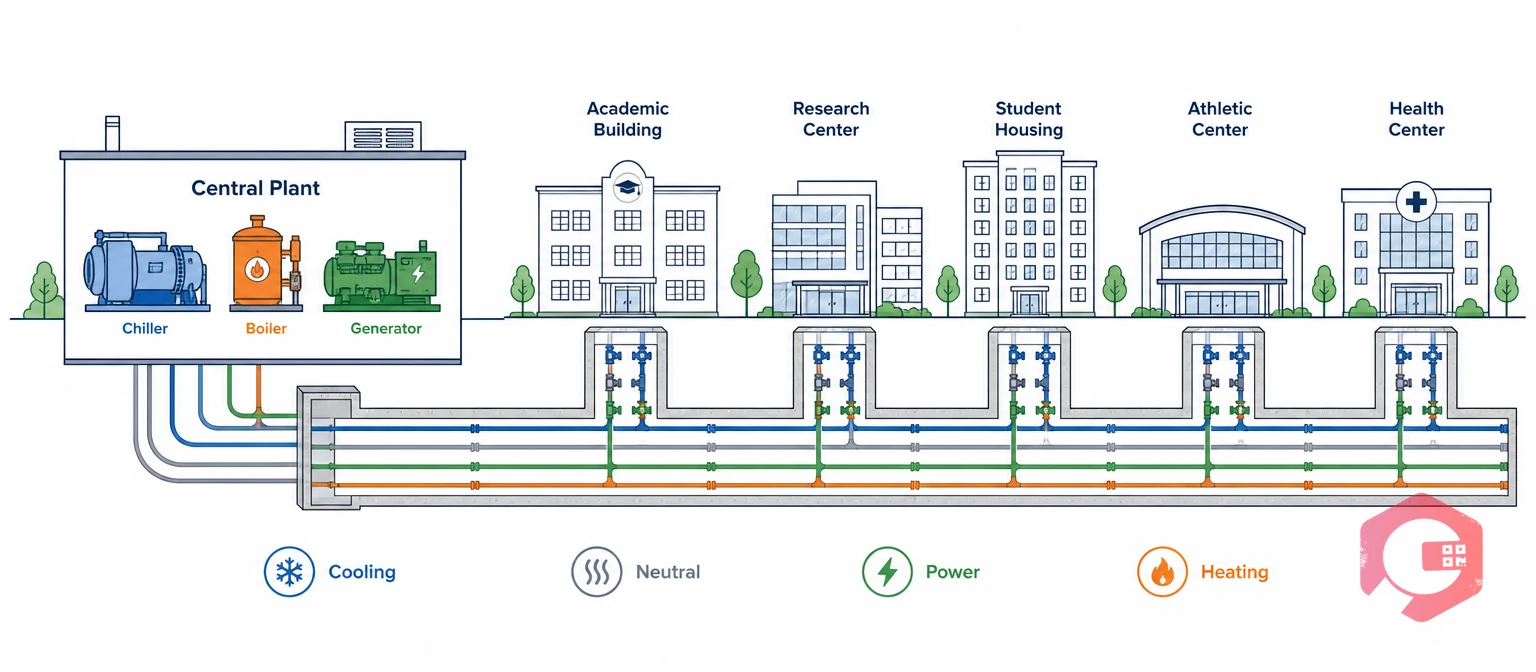
A campus central plant is a shared facility that makes heating, cooling, and often electricity for many buildings. Think of it as a small district energy system owned by one institution.
A distribution network is the piping, valves, and feeders that carry utilities from the plant to each building. It runs through tunnels, trenches, and ductbanks, and it ends at energy transfer stations and substations.
Most campus facilities teams manage chilled water, hot water or steam, medium-voltage power, gas, and compressed air together. OSHA treats many tunnels and vaults as permit-required confined spaces, so access planning is part of maintenance from day one.
Plant equipment fails from wear and fouling, while distribution assets fail from corrosion, leaks, and stuck valves. The table shows the main failure modes and the maintenance focus for each group.
| Asset group | Common failures | Maintenance focus |
|---|---|---|
| Chillers and cooling towers | Tube fouling, refrigerant leaks, scaling, bearing wear | Water treatment, tube cleaning, vibration and oil analysis |
| Boilers and steam plant | Tube corrosion, burner drift, safety device faults | Combustion tuning, water chemistry, statutory inspections |
| Steam and hot water piping | Corrosion under insulation, failed traps, water hammer | Trap surveys, insulation repair, leak detection |
| Chilled water piping | Joint leaks, stuck valves, low delta-T | Valve exercising, delta-T trending, meter calibration |
| Electrical feeders and switchgear | Insulation breakdown, loose connections, relay faults | Infrared scans, electrical testing, relay checks |
| Controls and meters | Sensor drift, lost communication | Calibration, alarm review, data checks |
Rank every row by consequence of failure, not by age. A 40-year-old valve on a spare loop matters less than a newer pump that feeds a research building.
Put a number on outages first: the Cryotos unplanned downtime calculator shows what a failed plant day costs your campus.
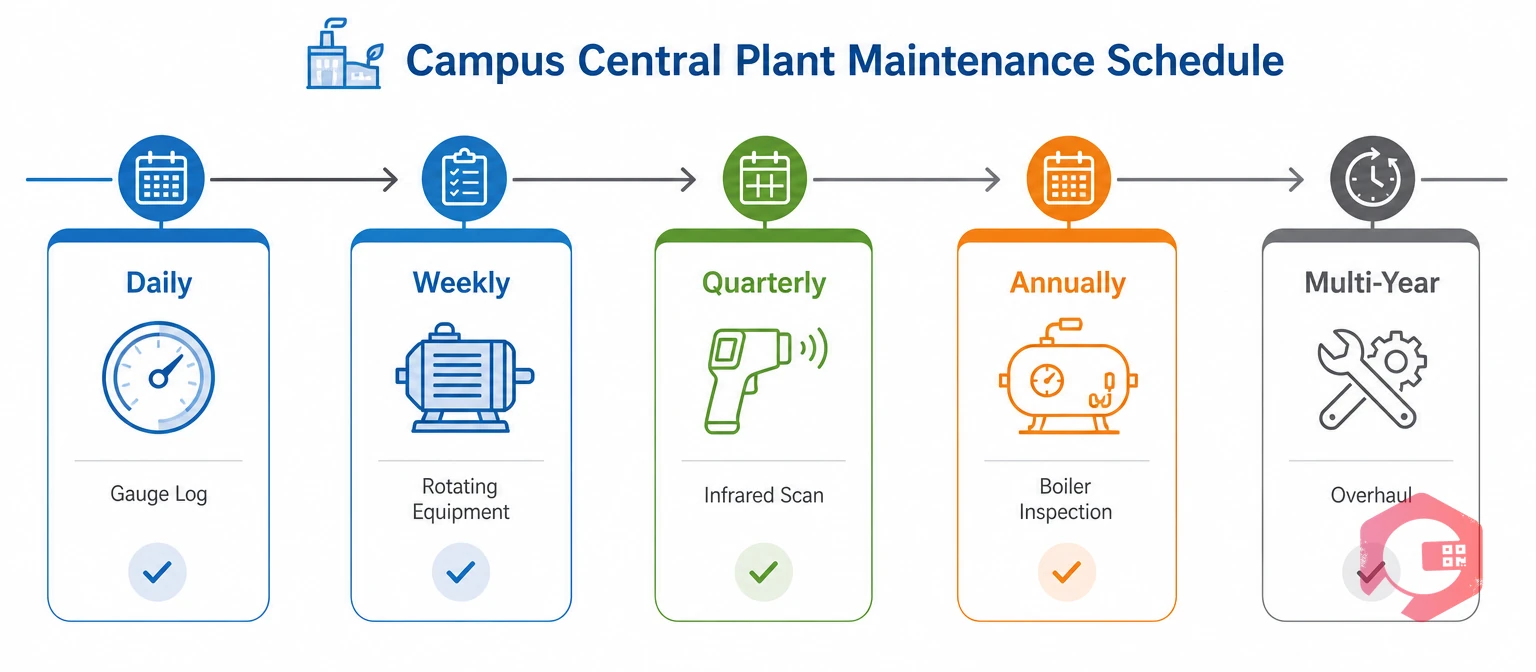
A workable campus central plant maintenance schedule layers daily rounds, quarterly testing, and annual shutdown work, and the manufacturer manual and local code set the final intervals.
| Cadence | Key tasks | What it catches | Who does it |
|---|---|---|---|
| Daily | Log temperatures, pressures, amps, and alarms; check for leaks and noise | Early drift in plant performance | Plant operator |
| Weekly or monthly | Rotate standby equipment, test interlocks, check steam traps, walk key tunnels | Dead standby units and new leaks | Technician |
| Quarterly | Scan switchgear with infrared, read vibration on large motors, exercise network valves, calibrate meters | Hot spots, bearing wear, stuck valves | Technician |
| Annually | Inspect boilers and vessels, clean chiller tubes, test relief valves and protection, load-test generators | Code gaps and lost efficiency | Technician or contractor |
| Every few years | Overhaul switchgear, test cables, rebuild major chillers, assess buried pipe | Aging equipment before it fails | Contractor |
Add a spring and fall changeover task group so cooling and heating plants start each season tested, not hopeful.
The strongest programs map criticality first, then spend effort where an outage hurts most. Most facilities that cut emergency callouts begin by tracking the same few signals every day.
The Criticality-First Reliability Framework:
With IoT meter reading from SCADA or edge devices, a drifting delta-T or rising run-hour count can open a work order before the equipment trips.
Distribution maintenance finds problems that no operator can see from the control room. It depends on set inspection routes and good records.
Plan outage work against the academic calendar a year ahead. Summer shutdowns are the only window for many tie-ins. Teams that finish valve exercising before the break avoid finding a stuck valve in the middle of a repair.
Tunnels and vaults carry real hazards. Crews need a permit-required confined space program under OSHA 29 CFR 1910.146 before any entry.
Auditors and insurers ask for proof of each step. Link every permit to its job with permit-to-work software so the safety record and the repair record stay together.
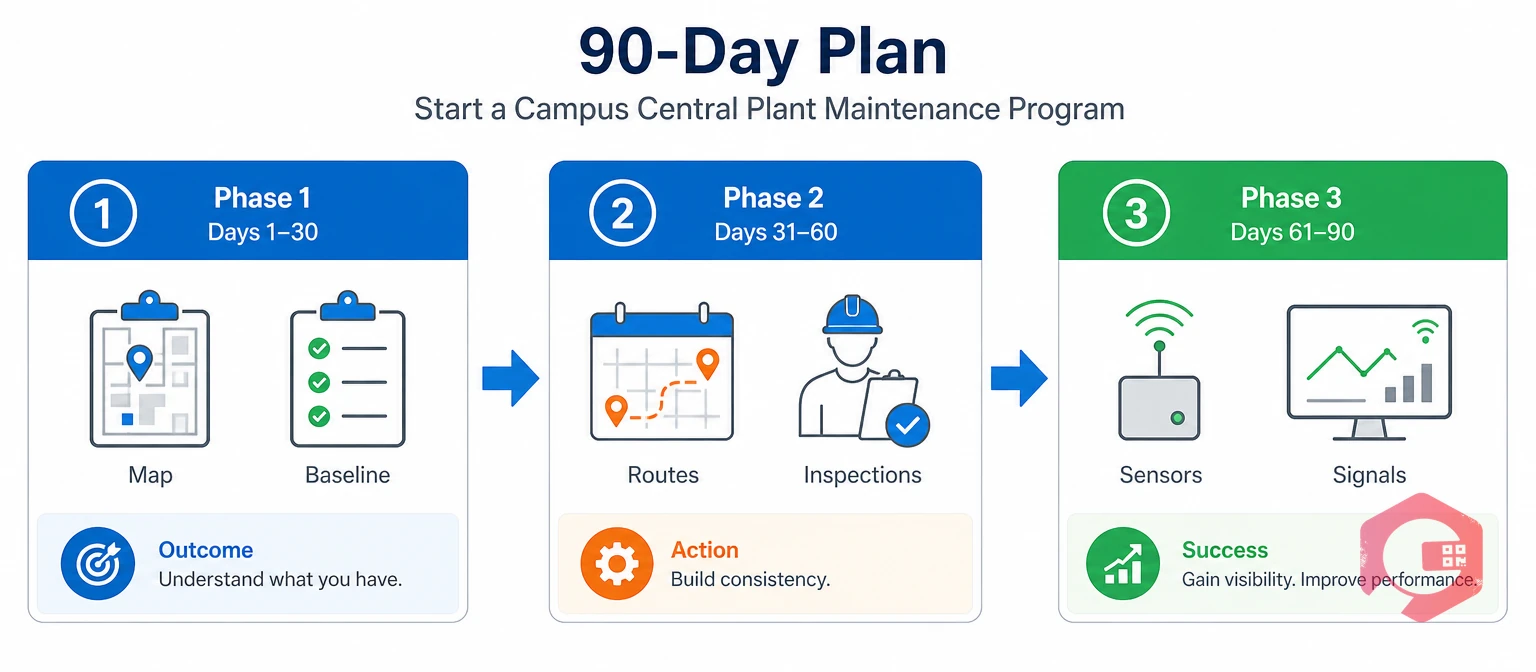
A 90-day start keeps the first phase small enough to finish. Each phase gives the team a clear win.
Short phases give leaders early proof and give crews time to trust the new routine.
A Computerized Maintenance Management System (CMMS) gives every plant and network asset one record, one schedule, and one history. Cryotos also offers maintenance software for schools and universities.
Maintenance teams using Cryotos have reported up to 30% reduction in unplanned downtime and 25% faster repair turnaround. Most campuses start with their most critical plant assets, then add the distribution network.
Operators log rounds every shift, technicians test monthly and quarterly, and inspectors cover boilers and vessels each year. Follow the manufacturer manuals and your jurisdiction's rules, which may require more.
Leaks from corrosion, failed steam traps, and stuck isolation valves are among the most common. Buried piping hides problems until they grow, so routine surveys matter.
Most campuses use summer or winter breaks, when loads are lowest. Plan the work a year ahead and sequence tie-ins by risk.
Not when the tunnel is a permit-required confined space. Entry then needs air testing, ventilation, an attendant, and a rescue plan.
Software turns each task into a scheduled, tracked work order with a checklist and sign-off. It also keeps asset history, spare parts, and permits in one searchable record.
Reliable utilities start with a plan that crews can follow in every building. Schedule a free demo to see how Cryotos turns your campus central plant maintenance schedule into tracked, auditable work.

Cryotos AI predicts failures, automates work orders, and simplifies maintenance—before problems slow you down.



