

Roof asset management means treating every roof section as a tracked asset, with its own condition history, inspection schedule, and maintenance budget. The fastest way to start is to make leak prevention a fixed line item in your preventive maintenance (PM) plan. Give it set tasks, set frequencies, and set dollars.
Most roof leaks don't start as sudden failures. They begin as a clogged drain, a cracked sealant bead, or a lifted flashing that nobody logged. When leak prevention has its own line, your team finds and fixes those small defects on schedule, not after a ceiling tile stains. This guide walks through six steps to build that line item, from asset registration to budget and KPIs.
Key Takeaways
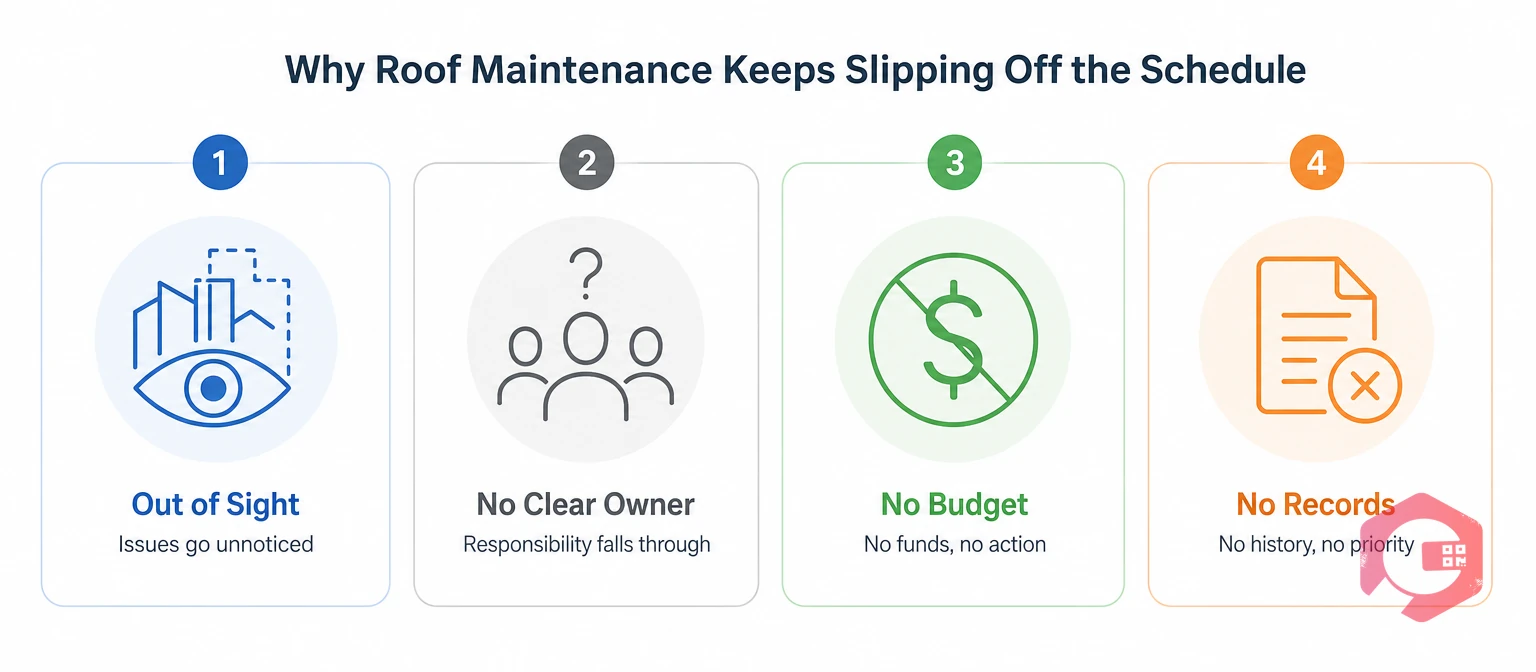
Roof asset management needs its own PM line item because the roof protects every other asset in the building, yet it rarely gets scheduled attention. Equipment, inventory, finishes, and electrical systems all sit below it. One undetected leak can damage all of them at once.
Roof asset management is the practice of treating each roof as a tracked asset with its own history, PM plan, and budget. It follows the same logic as ISO 55000, the international standard for asset management. That standard asks owners to balance cost, risk, and performance across an asset's full life.
A roof PM line item is a dedicated, recurring budget and work order entry for leak prevention tasks. Once it exists in your facility management software, roof care competes on equal terms with HVAC, fire, and electrical work. If the roof has no line, it has no plan.
The first step in roof asset management is to register each roof section as its own asset record. A large building rarely has just one roof. It may have three or four sections with different membranes, ages, and warranties, and each one wears at its own pace.
Most commercial buildings use a low-slope or flat roof, which the National Roofing Contractors Association defines as a slope of 3 in 12 or less. These roofs hold water longer, so drainage deserves extra weight in your risk scoring.
Store every record in a Computerized Maintenance Management System (CMMS) so each work order, photo, and invoice links back to the right roof section. A roof you can't find in your asset list is a roof you can't maintain.

A leak risk zone is any roof area where water collects, changes direction, or crosses a seam. Leaks rarely start in the open field of the membrane. They start where the roof is interrupted, so mapping these zones tells your team where to look first on every visit.
The DRIP Leak Prevention Framework:
Mark each DRIP zone on a roof plan and tag it in the asset record. Use a facility inspection checklist as a starting point, then add the zones specific to each section. When every inspector checks the same four zones in the same order, findings become comparable from one visit to the next. That shared map is the backbone of roof asset management across a multi-site portfolio.
Want to know what reactive roof repairs cost you today? Run your numbers through the Mean Maintenance Cost Calculator before you set your roof PM budget.
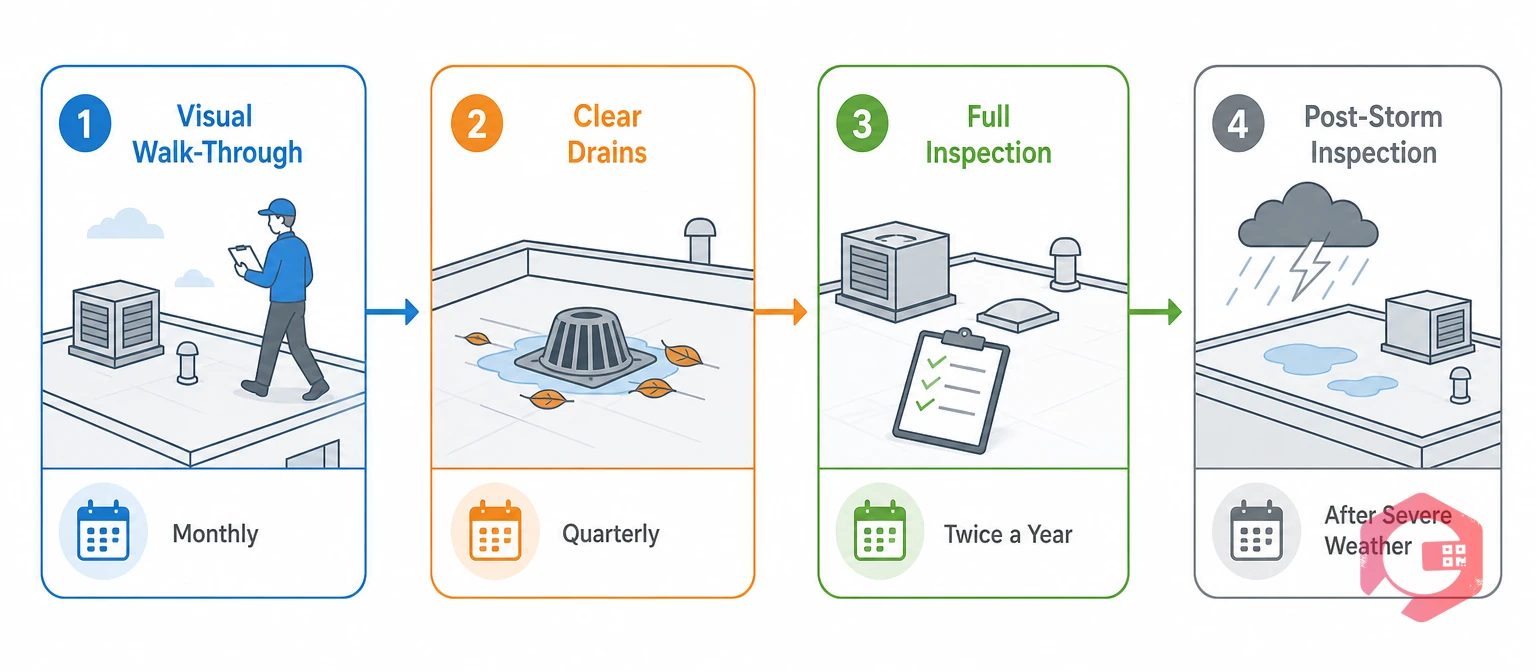
A roof PM schedule sets how often each leak prevention task happens and what triggers extra checks. Most roofing contractors recommend a full inspection at least twice a year, in spring and fall, plus a check after any severe storm. Use the schedule below as a baseline and adjust it for your climate and roof age.
| PM Task | Frequency | DRIP Zone | Trigger | Typical Owner |
|---|---|---|---|---|
| Visual walk-through | Monthly | All | Calendar | In-house technician |
| Clear drains, gutters, and scuppers | Quarterly; monthly in fall | D | Leaf season, after storms | In-house technician |
| Full condition inspection with photos | Twice a year (spring and fall) | All | Calendar | Roofing contractor |
| Post-storm inspection | Within 48 hours of the event | All | Hail, high wind, or heavy rain | In-house or contractor |
| Check penetrations after rooftop service | After every equipment visit | R | Closed HVAC work order | In-house technician |
| Reseal flashing, pitch pockets, and joints | Yearly or as found | P, R | Inspection finding | Roofing contractor |
| Infrared or moisture survey | Every 3 to 5 years | I | Roof age, suspected wet insulation | Specialist contractor |
| Warranty inspection | Per warranty terms | All | Warranty calendar | Approved contractor |
The post-service row matters more than most teams expect. HVAC technicians can damage the membrane while working on rooftop units. Link a roof check to every closed HVAC job to catch that damage the same week.
Preventive maintenance software can create these follow-up tasks automatically from calendar dates, meter readings, or completed work orders. A schedule only works when every task has a frequency, a trigger, and a named owner.
A leak prevention checklist turns a roof walk into a repeatable, auditable task. Without one, two inspectors on the same roof will report different things, and nobody can compare results over time. Checklists are where roof asset management meets daily field work.
Require a photo for every failed item and a pass or fail answer for every line. Digital maintenance checklists make this easy to enforce, because the technician can't close the work order until every field is complete.
Roof work is fall-risk work. OSHA fall protection rules require protection at four feet in general industry. Attach the required safety steps, such as guardrails, harnesses, or warning lines, to the checklist itself. A safe checklist is a checklist that gets completed.
Budgeting leak prevention as a PM line item means you fund roof care from the operating budget every year. The money stops coming from emergency or capital reserves after a failure. It gives the roof a predictable cost that finance teams can plan around.
Maintenance teams that win budget approval usually lead with that last point. Interior cleanup, damaged inventory, lost operating hours, and mold work rarely show up under "roofing." Pull them from past work orders and present them next to the PM line.
IFMA's FMJ article on roof longevity makes the same case: planned upkeep spreads costs evenly and avoids the strain of unplanned spending. The line item is far easier to defend when the cost of doing nothing sits on the same page.
Reactive leak repair costs more than planned roof PM. The bill covers everything the water touched, not just the roof. The table below compares the two approaches on the factors that matter most to facility and finance teams.
| Factor | Reactive Leak Repair | Planned Roof PM |
|---|---|---|
| When work happens | After water enters the building | On a fixed schedule, before leaks form |
| Typical scope | Emergency patch, interior cleanup, damaged goods | Drain clearing, resealing, minor repairs |
| Budget source | Emergency or capital funds | Operating budget line item |
| Cost predictability | Low, with spikes after storms | High, set once a year |
| Warranty status | At risk without inspection records | Protected by dated inspection records |
| Roof service life | Shortened by wet insulation and deck damage | Extended through early defect repair |
| Operational impact | Closed areas, lost stock, slip hazards | Planned work with little disruption |
The pattern holds across most portfolios: reactive work trades a small, planned cost for a large, unplanned one. That trade is the core argument for roof asset management as a budgeted PM line.
Tracking roof asset management KPIs proves the line item works and shows where to spend next year. Start with a small set of measures and review them after every spring and fall inspection.
A roof condition index is a 0 to 100 score that rates the remaining service life of a roof section. Recalculate it after each full inspection and compare it with the expected life in the asset record. Purpose-built facility maintenance software plots these scores across your portfolio. You can then see which roofs need a capital plan and which only need routine care.
The gains reach beyond the roof. Maintenance teams using Cryotos have reported up to 30% reduction in unplanned downtime and 25% faster repair turnaround. Work orders, photos, and asset history all live in one place.
Roof asset management is a planned approach that tracks each roof section's condition, schedule, and budget over its full life. Roof repair fixes damage after it appears. Asset management aims to prevent most repairs by catching small defects during scheduled PM.
Most roofing professionals recommend a full inspection twice a year, in spring and fall, and after any severe storm. Add monthly walk-throughs and a quick check after every rooftop equipment service visit. Your warranty may also require yearly inspections by an approved contractor.
Keep drains, gutters, and scuppers clear so water never ponds. Then inspect penetrations, seams, and perimeter flashing on a fixed schedule and reseal at the first sign of cracking. Most flat-roof leaks start at these details, not in the open membrane.
Build the number from your own tasks: in-house labor hours, contractor inspections, a minor-repair allowance, and the yearly share of periodic surveys. Then compare it with your last three years of reactive leak and interior damage costs. Most teams find the planned line is the smaller figure.
Yes. A CMMS stores dated inspection records, photos, and repair work orders against each roof section, which is the proof most manufacturers ask for during a claim. It can also schedule warranty inspections automatically, so none are missed.
Roof asset management works when the roof has its own PM line, schedule, and history. Schedule a free demo to see how one platform turns roof inspections, leak prevention tasks, and warranty records into one trackable PM program.



Cryotos AI predicts failures, automates work orders, and simplifies maintenance—before problems slow you down.



