

A cement plant equipment maintenance checklist is a structured list of inspection and servicing tasks for every major piece of equipment in a cement manufacturing facility - from rotary kilns and raw mills to coolers, crushers, and bag filters. Without one, maintenance teams react to breakdowns instead of preventing them, and in an industry where a single kiln stoppage can cost tens of thousands of dollars per hour, that is a risk no plant manager can afford.
Cement plants are among the most demanding industrial environments in the world. Extreme heat, heavy dust loads, continuous 24/7 operations, and enormous rotating equipment create conditions that accelerate wear on every component. Plants that implement a disciplined, documented maintenance checklist consistently outperform those that rely on experience and intuition alone - achieving up to 30% less unplanned downtime and significantly longer asset lifespans.
This guide provides a comprehensive, equipment-by-equipment maintenance checklist for cement plants, explains how to organize tasks by frequency, and shows how a modern CMMS like Cryotos can automate the entire process so nothing falls through the cracks.
Cement production is a continuous, capital-intensive process. The raw material journey - from limestone quarrying through crushing, grinding, preheating, clinkerization, and final grinding - passes through a chain of large, interdependent machines. A failure at any single point can stop production entirely.
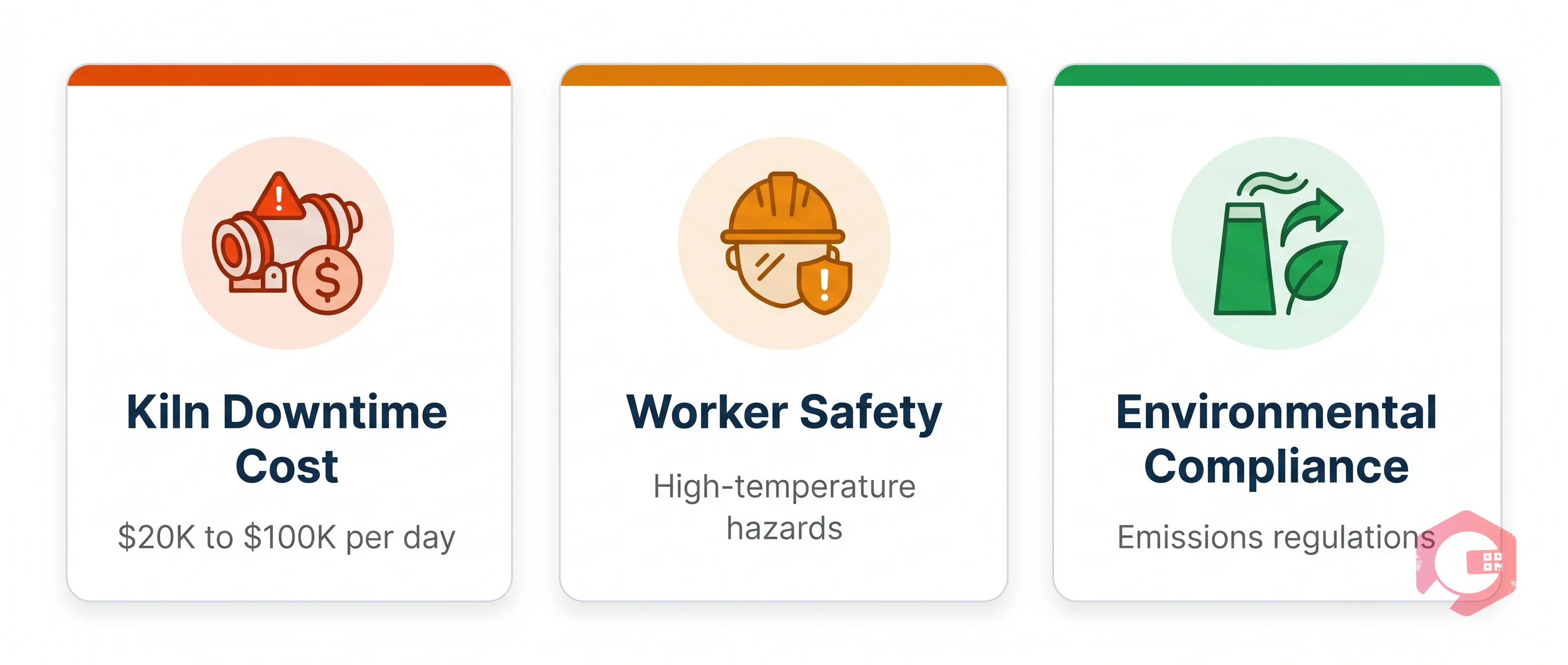
The numbers are sobering. A rotary kiln shutdown can cost a plant anywhere from $20,000 to $100,000 per day in lost production, plus the cost of emergency repairs, refractory replacement, and restart fuel consumption. Unplanned failures also create safety hazards for workers operating near high-temperature zones and heavy rotating equipment.
Beyond the financial impact, cement plants face strict environmental compliance requirements. Dust emissions, NOx, and SO2 levels are regulated tightly. Equipment failure - particularly in filtration and emission control systems - can trigger regulatory violations that carry their own financial and reputational consequences.
A well-structured maintenance checklist addresses all of these risks. It ensures that every piece of equipment receives the right attention at the right intervals, keeps detailed records for compliance audits, and gives maintenance managers the visibility they need to plan resources effectively.
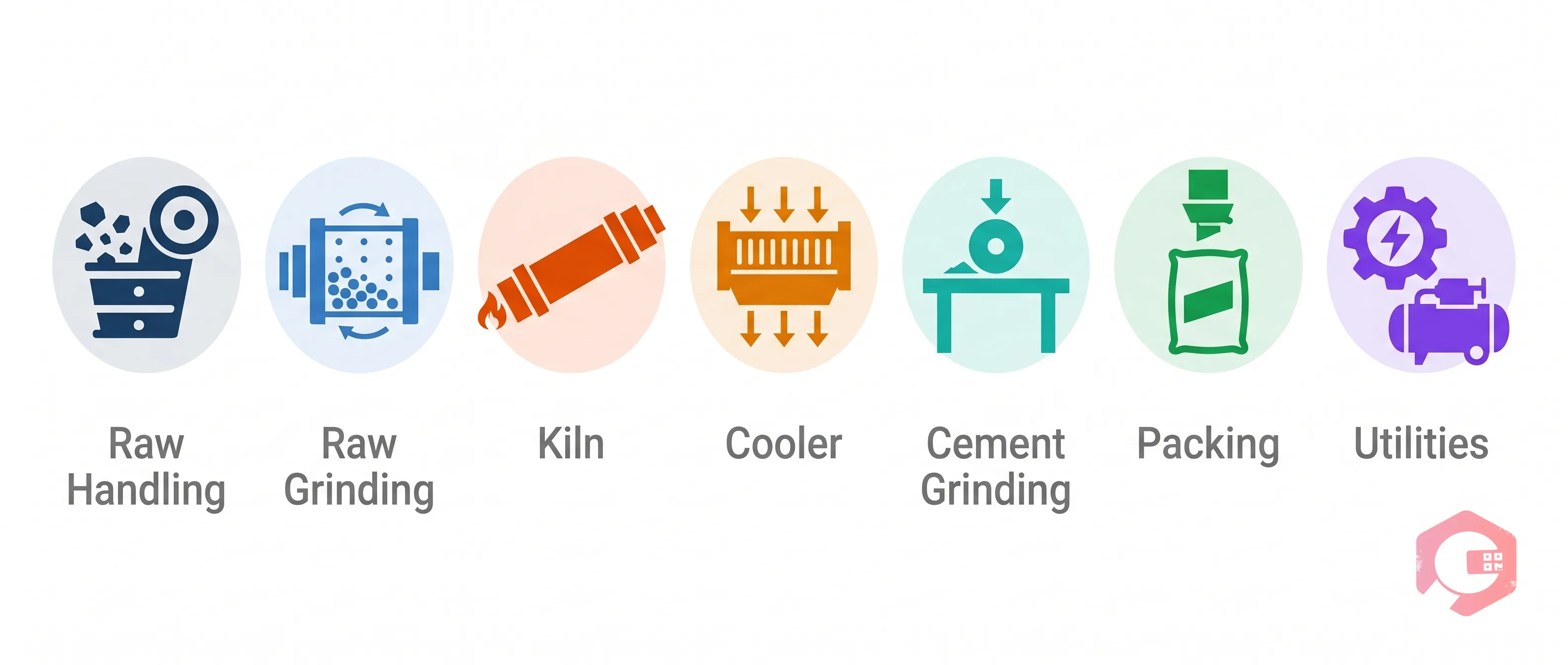
Before building a checklist, it helps to understand the major equipment groups in a typical cement plant. Each category has distinct maintenance needs based on its operating conditions, criticality, and wear mechanisms.
This includes jaw crushers, impact crushers, hammer mills, and apron feeders. These handle abrasive limestone and other raw materials, making wear on liners, hammers, and conveyor components a constant concern.
Ball mills, vertical roller mills (VRMs), and roller presses grind raw materials to fine powder. Grinding media wear, separator efficiency, and mill bearing temperatures are the primary maintenance focus areas.
The rotary kiln, preheater cyclones, calciner, and kiln burner are the heart of the plant. Refractory lining wear, kiln shell deformation, tire and riding ring wear, and bearing temperatures require close, frequent monitoring.
Grate coolers and satellite coolers must handle clinker at temperatures exceeding 1,200°C. Grate plate wear, cooler fan efficiency, and clinker hammer wear are key inspection points.
Ball mills or VRMs grind clinker with gypsum and additives. Similar to raw grinding, but also includes separator performance and product quality control.
Silos, bucket elevators, packing machines, and loading equipment. Silo aeration, elevator belt tension, and packer nozzle condition are typical maintenance tasks.
Air compressors, cooling water systems, lubrication systems, electrical transformers, and dust collection (bag filters, ESP systems). These support the entire plant and failures here can cascade across multiple production areas.
Daily checks are the first line of defense against equipment failure. These are typically performed by operators and shift technicians at the start of each shift or during running hours. The goal is to catch anomalies early - unusual sounds, temperatures, vibrations, or leaks - before they develop into failures.
| Area | Daily Check | What to Look For |
|---|---|---|
| Rotary Kiln | Monitor kiln shell temperature readings from shell scanner | Flag any hotspots above the alarm threshold for immediate investigation. |
| Rotary Kiln | Check tire and riding ring lubrication | Confirm grease injection is active and lubricant is reaching contact surfaces on all three roller stations. |
| Rotary Kiln | Inspect kiln inlet and outlet seals | Look for air infiltration, seal rope condition, and excessive dust blowback; report any gaps or missing seal segments. |
| Rotary Kiln | Record kiln drive motor current draw, bearing temperature, and gearbox oil pressure | Compare against baseline values and note deviations. |
| Rotary Kiln | Verify kiln float position and thrust roller contact | Confirm correct contact on the right station; abnormal float can indicate refractory or tire issues. |
| Raw Mill / Cement Mill | Check main and auxiliary bearing temperatures | Confirm lubrication oil pressure is within design range for all mill bearings. |
| Raw Mill / Cement Mill | Monitor mill differential pressure and feed rate from DCS | Deviations can indicate grinding efficiency changes, blockages, or separator problems. |
| Raw Mill / Cement Mill | Inspect mill inlet and outlet seals | Look for material spillage and dust leakage; check expansion joints for cracks or separation. |
| Raw Mill / Cement Mill | Record separator motor current, separator bearing temperature, and classifier speed | Abnormal readings can indicate blade wear or product quality issues. |
| Raw Mill / Cement Mill | Verify main gearbox oil level and oil pressure | Listen for unusual noise or vibration from the main drive train and document abnormalities. |
| Cooler | Monitor clinker inlet temperature and cooler outlet temperature | Check grate compartment pressure drops and compare against the normal operating range. |
| Cooler | Inspect all cooler fans | Verify suction and discharge pressure readings and confirm all fans are running at design speed without vibration. |
| Cooler | Check clinker crusher operation at the cooler exit | Confirm hammer rotation, listen for abnormal impact sounds, and verify crushed clinker size at discharge. |
| Bag Filter / ESP | Check differential pressure across all filter compartments | High ΔP indicates filter bag blinding; abnormally low ΔP may indicate bag failure or bypass. |
| Bag Filter / ESP | Verify pulse jet cleaning cycle | Check pulse controller status and confirm regular pulsing audible at each solenoid valve. |
| Bag Filter / ESP | Inspect dust discharge system | Look for blockages, material build-up, or abnormal motor current on discharge equipment. |
| General Plant | Inspect all lubrication systems | Check oil levels in reservoirs, confirm system pressure at each distribution point, and note visible leaks. |
| General Plant | Walk all major conveyor systems | Check belt tracking, idler rotation and condition, material spillage at transfer points, and emergency pull-cord accessibility. |
| General Plant | Verify compressed air system header pressure | Check key consumer connections for audible air leaks, including bag filter pulse jets, pneumatic gates, and instrument air. |
Weekly maintenance tasks go deeper than daily observations. They typically involve hands-on inspection, minor adjustments, and lubrication services that keep equipment performing within design parameters.
| Checklist Item | What to Check | Action / Verification |
|---|---|---|
| Kiln tire and riding ring lubrication | Apply lime-based lubricant | Confirm application rate is correct and lubricant is distributed evenly across the full tire contact width. |
| Conveyor belt splices | Joint separation, edge fraying, cover damage | Inspect all splices and re-track any belt that has wandered outside the idler contact zone. |
| Bucket elevator belts and cups | Cups, fasteners, belt tension, take-up counterweights | Check for cracked or missing cups, loose fasteners, and correct belt tension. |
| Emergency stop circuits | E-stop and pull-cord functions | Verify that e-stop engagement cuts power and that resets require deliberate manual action. |
| Gearbox and main drive oil | Lubricating oil condition | Draw oil samples and inspect visually for contamination, discolouration, and water content. |
| Mill separator components | Guide vanes and rotor blades | Inspect for wear and measure blade clearances against OEM tolerances; record for trend tracking. |
| Clinker silo system | Silo level instrumentation and outlet gate operation | Confirm gates open and close smoothly without sticking or jamming under load. |
| Dust collection system | Hoppers, rotary airlock valves, ductwork | Inspect hoppers, confirm rotary airlocks operate correctly, and check ductwork for leakage at flanged joints. |
| Process instrumentation | Temperature, pressure, and level sensors | Test against secondary measurements and cross-check for drift or offset. |
| Hydraulic systems | Oil level, accumulator pre-charge pressure, hoses, fittings | Verify oil level and pressure, and inspect hoses and fittings for condition. |
Monthly checks are planned maintenance activities that often require a brief shutdown window or careful coordination with production to minimize production impact. They address wear rates, alignments, and equipment performance that cannot be assessed from daily or weekly walk-downs alone.
| Checklist Item | Action | Verification / Output |
|---|---|---|
| Kiln tire migration rate | Measure and document kiln tire migration rate | Compare to allowable limits in the OEM specification and adjust lubricant application if migration is accelerating. |
| Critical rotating equipment | Conduct vibration analysis | Inspect kiln roller station bearings, mill main drive train, high-load process fans, and separator top bearings. |
| Gearbox oil samples | Send oil samples to laboratory | Review kiln main gearbox, raw mill gearbox, and cement mill gearbox results for metallic particles, viscosity, and water ingress. |
| Grinding media | Inspect grinding media | Measure filling ratio, check grinding ball size distribution, and add media to maintain the design charge level. |
| HV electrical assets | Perform thermographic survey | Inspect switchgear panels, motor terminal boxes, busbar connections, and transformer radiators; document and address hotspots. |
| Bag filters | Inspect bags by compartment pressure differential mapping | Replace bags in any compartment showing persistent abnormal pressure drop indicating blinding or bag failure. |
| Compressed air system | Conduct compressed air system audit | Replace dryer filter cartridges, verify dew point on instrument air lines, and repair air leaks from the weekly walk-down list. |
| Kiln burner nozzle | Inspect burner nozzle for wear and thermal damage | Verify primary air swirl and axial channel distribution; adjust burner momentum according to clinker quality feedback. |
| Shaft couplings | Check all major shaft couplings | Inspect flexible element condition, check alignment with dial gauge or laser tool, and re-align if deviation exceeds OEM tolerance. |
| CMMS downtime records | Review monthly downtime records | Identify the three most repeated failure causes and adjust PM task frequencies or procedures to address root causes. |
Annual overhauls and major planned shutdowns are the most critical maintenance events in the cement plant calendar. These shutdowns - typically lasting 7 to 21 days - are the opportunity to address accumulated wear, replace major components, and carry out tasks that cannot safely or practically be done during operation.
Planning for an annual overhaul should begin 3 to 6 months in advance. A well-planned shutdown requires a detailed scope of work, pre-ordered critical spares, contractor coordination, and a shutdown schedule that minimizes the window to the absolute minimum.
| Area | Overhaul Task | Inspection / Action Details |
|---|---|---|
| Kiln | Full refractory inspection and replacement | Inspect the burning zone, transition zones, and preheater cyclone lower cones; use profile measurement to determine thickness before final replacement scope is set. |
| Kiln | Kiln tire and riding ring surface measurement | Check for oval wear, longitudinal groove development, and surface roughness; plan regrinding if surface irregularities exceed OEM tolerance. |
| Kiln | Main kiln gearbox major inspection | Check gear tooth wear, all bearing clearances, oil seal condition, housing alignment, and confirm backlash is within specification. |
| Kiln | Full replacement of kiln inlet and outlet seals | Inspect seal housing for wear and replace all rope sections, metal sectors, and spring-loaded contact components. |
| Kiln | Thrust roller replacement and axial load balance reset | Replace worn thrust roller surfaces, check roller bearing clearances, and reset load balance per OEM specification to normalize kiln float behavior. |
| Cooler | Replace all grate plates in high-temperature inlet zones | Inspect grate supporting frame for thermal fatigue cracks, repair by welding, and check grate alignment before re-installation. |
| Cooler | Full cooler fan overhaul | Remove and inspect all fan blades for erosion and cracking, replace worn blades, balance fan rotor, and replace fan shaft bearings as required. |
| Cooler | Replace clinker crusher hammer heads | Check crusher rotor balance, shaft bearings, and side plates for wear; realign crusher with drive motor after reassembly. |
| Mill | Full grinding media charge replacement or major replenishment | Inspect all mill liners (trunnion, shell, intermediate partition, and outlet) and replace worn segments. |
| Mill | Main drive gearbox overhaul | Disassemble, inspect all gear tooth surfaces, replace worn bearings, check shaft seals, re-assemble, flush system, and refill with new oil. |
| Mill | Separator rotor and stator inspection and refurbishment | Replace worn cage rotor blades, set guide vane clearances to specification, and balance rotor before reinstallation. |
| Mill | Trunnion and trunnion bearing inspection | Check trunnion surface for erosion and cracking, inspect bearing white metal or rolling element condition, and relevel mill shell if trunnion wear has caused misalignment. |
| General Plant | High-voltage switchgear full maintenance | Clean, tighten all busbar connections, inspect contact wear, test and calibrate protection relays, and perform earth fault system tests to regulatory requirements. |
| General Plant | Full bag filter and ESP overhaul | Replace all bags in high-wear compartments, check and repair cage frames, clean electrode plates in ESP sections, and verify electrode alignment and spacing. |
| General Plant | Major silo inspection | Enter and inspect all cement and clinker silos for structural cracking, aeration pad condition, and outlet gate and valve operation; repair as required before refilling. |
| General Plant | Safety system certification | Test and certify all fire detection systems, explosion suppression systems, safety interlocks, and emergency shutdown circuits; document results for regulatory compliance records. |
The rotary kiln is unquestionably the most critical and most expensive single piece of equipment in any cement plant. A kiln failure carries the highest financial and operational consequence, which is why kiln maintenance deserves special attention beyond a standard checklist item.
The most valuable monitoring tool for a modern cement kiln is a continuous shell scanner - a laser or infrared scanning system that maps kiln shell temperatures across all rotations in real time. Shell scanners can detect hotspots caused by refractory thinning before a red-spot event occurs, allowing planned refractory repair during a brief stop rather than an emergency shutdown lasting days or weeks.
Tire migration is another common and critical kiln issue. As the kiln shell expands and contracts with temperature cycles, the tire can migrate axially relative to the shell. Too much migration abrades the pad welds and the shell surface underneath. Monitoring migration rate during operation and setting migration alarms allows maintenance teams to intervene with corrective lubrication and adjustment before pad damage occurs.
Kiln thrust bearing management is equally important. The kiln runs on a slight slope and is designed to move slowly in both axial directions, controlled by the thrust rollers. Incorrect thrust management causes uneven refractory wear and accelerates tire and riding ring wear. Documenting kiln float behavior and adjusting thrust roller angles is a specialized but essential maintenance task.

A well-executed preventive maintenance checklist is an enormous step forward from reactive, run-to-failure maintenance. But the most advanced cement plants are moving a step further - toward predictive and condition-based maintenance, where sensors and data analytics replace calendar-based schedules with real-time, need-based interventions.
In practice, this means equipping critical rotating equipment - kiln tire rollers, mill main drives, fan bearings, and crusher shafts - with continuous vibration sensors. These sensors feed real-time data into an analytics platform that establishes baseline behavior for each machine and raises alerts when deviations are detected. Instead of servicing a bearing every three months based on calendar schedule, the system tells you that this specific bearing is beginning to show fatigue and should be inspected within the next two weeks.
The benefits are substantial: fewer unnecessary maintenance interventions on healthy equipment (reducing maintenance cost), and earlier warning of developing failures (reducing unplanned downtime). Leading cement producers who have adopted IoT-based condition monitoring report reductions in unplanned kiln stoppages of 40-60% after full implementation.
Integrating condition monitoring sensors with a CMMS like Cryotos is the key to making predictive maintenance actionable. Raw sensor data becomes useless unless it automatically generates work orders, notifies the right technicians, and creates a traceable maintenance record. That is the bridge a modern CMMS provides.
Managing a comprehensive cement plant maintenance checklist manually - through paper forms, spreadsheets, and WhatsApp groups - is a recipe for inconsistency, missed tasks, and poor traceability. Cryotos CMMS replaces that fragmented approach with a single, centralized platform built for the demands of heavy industrial maintenance.
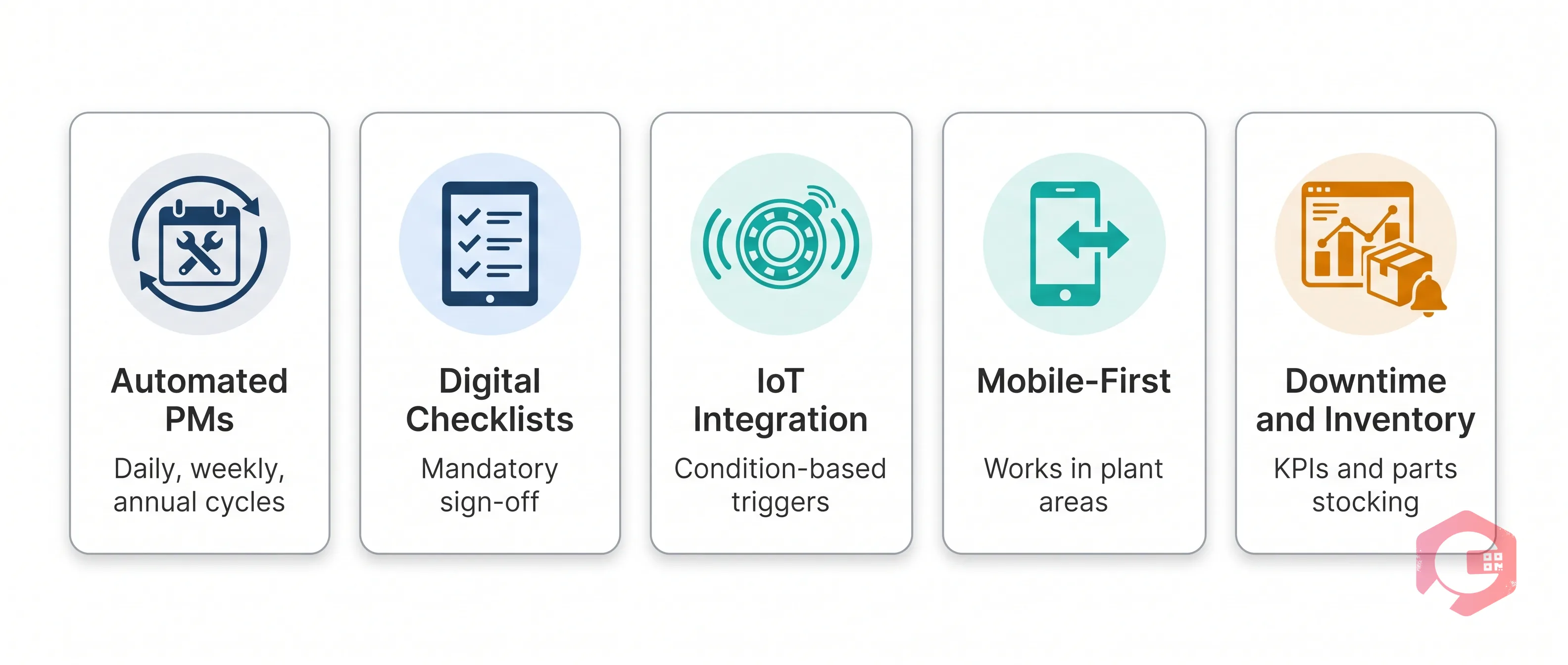
With Cryotos, you can configure your entire cement plant maintenance checklist as automated PM schedules - daily, weekly, monthly, and annual tasks triggered automatically by the calendar or by meter readings (kiln running hours, mill tonnage). When a task is due, Cryotos creates the work order, assigns it to the correct technician or team, and sends notifications through the mobile app or WhatsApp. Nothing gets missed because no one forgot to check a spreadsheet.
Every work order in Cryotos can include the specific checklist for that equipment and task. Technicians cannot close a kiln inspection work order without checking off every item on the shell temperature, tire lubrication, and seal inspection checklist. This enforces consistent, complete inspections across all shifts and removes the ambiguity of "I think we checked it."
Cryotos integrates directly with IoT sensors, SCADA systems, and PLC data feeds. When a vibration sensor on a mill bearing detects readings outside the defined threshold, Cryotos automatically creates a high-priority work order and notifies the on-call technician - without any human intervention. This is condition-based maintenance in practice, enabled by seamless sensor integration.
Cement plants are large, and technicians spend most of their time away from a desk - on the kiln platform, inside the mill building, or in the cooler area. Cryotos's mobile app works fully offline, allowing technicians to receive work orders, complete checklists, attach photos of equipment conditions, and close tasks from anywhere in the plant. Data syncs automatically when connectivity is restored.
Cryotos includes a dedicated downtime management module that tracks every unplanned stoppage - by equipment, department, and cause. Over time, this data reveals your most problematic assets, most common failure modes, and actual MTBF figures for each piece of critical equipment. With this information, maintenance managers can make data-driven decisions about PM frequency, spare parts stocking, and capital investment priorities.
Nothing delays a cement plant maintenance shutdown like discovering that a critical spare part - a kiln tire pad, a roller press hydraulic seal, or a bag filter cage - is out of stock. Cryotos links your maintenance tasks directly to your spare parts inventory. Critical stock thresholds trigger automatic alerts, and high-consumption items can be flagged for pre-ordering ahead of planned shutdowns. Your annual overhaul scope can be used to generate a spare parts requirement list automatically from the planned work orders.
For cement plant managers who are still operating with paper checklists and shared spreadsheets, the shift to a CMMS like Cryotos typically delivers measurable results within the first three to six months - reduced unplanned downtime, higher PM compliance rates, and significantly better visibility into maintenance costs and asset health. Cryotos CMMS is built to handle the complexity and scale of industrial operations like cement manufacturing, with features like automated preventive maintenance scheduling, comprehensive asset management, and real-time inventory control.
The rotary kiln is universally considered the most critical piece of equipment in a cement plant. A kiln failure stops all clinker production and directly halts cement output. Close behind are the main raw mill and cement mill, which feed and finish the core production process. Maintenance programs should prioritize these assets with the highest inspection frequency and the most thorough overhaul scopes.
Refractory campaign life varies widely depending on raw materials, fuel type, clinker quality targets, and kiln operating parameters. A typical burning zone refractory campaign in a well-managed plant lasts 9 to 18 months. Plants burning alternative fuels or producing specialty clinkers often see shorter campaigns. Shell scanner monitoring is the most reliable tool for tracking remaining refractory thickness and planning replacement before a hotspot event occurs.
Preventive maintenance is performed on a fixed schedule - for example, lubricating the kiln tire every week, regardless of the tire's actual condition. Predictive maintenance is triggered by real-time condition data - for example, an IoT vibration sensor detects abnormal bearing behavior and triggers an inspection work order. Predictive maintenance is more efficient because it services equipment exactly when needed, avoiding both under-maintenance (leading to failure) and over-maintenance (wasting labor and parts). Most cement plants use both approaches: preventive for standard tasks and predictive for monitoring critical rotating equipment.
Yes. A modern CMMS like Cryotos allows you to pre-configure all annual overhaul tasks as planned work orders with defined scopes, resource requirements, and sequencing. When planning a kiln shutdown, the system can generate the full work order list, flag the spare parts needed from inventory, assign tasks to contractors or internal teams, and provide a real-time dashboard to track shutdown progress against the plan. This replaces manual Excel-based shutdown planning with a dynamic, centralized tool that all stakeholders can access.
Cement plants operating under environmental, safety, and quality management regulations typically need to maintain records of all planned and corrective maintenance activities, equipment inspection results, calibration certificates for measurement instruments, safety system test records (fire detection, e-stop circuits), emission monitoring equipment maintenance, and any incidents or near-misses related to equipment failure. A CMMS automatically generates and stores all of these records with timestamps and technician sign-offs, making compliance audits significantly simpler and less time-consuming.



Cryotos AI predicts failures, automates work orders, and simplifies maintenance—before problems slow you down.



