

A practical cement plant maintenance checklist with daily, weekly, monthly, and annual tasks for kilns, ball mills, crushers, conveyors, preheaters, and coolers. Built for plant managers and maintenance teams.
A cement plant runs hot, dusty, and around the clock. One missed inspection on a kiln or a primary crusher can shut a 5,000 TPD line for 12 hours. So a strong cement plant maintenance checklist is not a nice-to-have. It is the spine of the plant.
Industry studies put the cost of unplanned cement plant downtime at $50,000 to $150,000 per hour once you add lost clinker, energy waste, overtime, and air-freight spares. Yet many plants still run on paper checklists that get smudged, lost, or skipped during busy shifts. This guide gives you a clean, ready-to-use checklist by frequency, equipment, and trigger, plus a quick view of how a CMMS like Cryotos turns the checklist into daily habit.
Key Takeaways

A cement plant maintenance checklist is a list of inspection, lubrication, calibration, and repair tasks tied to a specific asset and a fixed frequency. It does three jobs at once. It tells the technician exactly what to check. It creates a record for the auditor. It feeds data into the CMMS so the planner can spot patterns over time.
Cement plants need a sharper checklist than a generic factory because the conditions are tougher: 1,450°C inside the kiln, abrasive limestone in the crushers, kilometers of conveyors moving fine dust, and equipment that almost never gets a full rest. The four equipment groups that drive most of the risk are the rotary kiln, the ball mill, the primary crusher, and the bucket elevators that feed the kiln.
Daily checks are short, fast, and run by the operator or shift technician. They catch the early signals: heat, sound, smell, vibration, and leaks. Each task below should be logged with a time stamp, the asset ID, and any observation.
| Equipment | Daily Check | Action Trigger |
|---|---|---|
| Rotary kiln | Walk full shell with thermal camera and eyes | New hot spot above 300°C → escalate |
| Kiln tyres and riding rings | Check auto-lubrication flow and oil level | Unusual axial movement → stop and inspect |
| Ball mill | Read inlet and outlet bearing temperatures | Above 80°C or +10°C jump → escalate |
| Ball mill lube system | Check oil pressure, oil flow, and seal leaks | Loss of pressure → trip and inspect |
| Crusher | Visual on jaw, hammer, or blow bar wear | Cracking or chipping → flag for weekly |
| Conveyors | Walk belts; check tracking, splices, idlers | Seized idler → replace at once (fire risk) |
| Bucket elevators | Check boot for build-up; inspect bolts | Material build-up → clean before next shift |
| Preheater cyclones | Read cone temperatures; note pressure delta | Cold cyclone → blockage check |
| Clinker cooler | Confirm fan speed; record inlet/outlet temp | Off-spec temp → adjust grate speed |
| Compressed air system | Check pressure and condensate dryer | Drop in pressure → leak hunt |
| Electrical MCC | Visual scan for alarms, smell, heat | Burnt smell → isolate and inspect |
| Dust collectors | Read differential pressure on bagfilters | ΔP outside band → clean or inspect |
Weekly checks go deeper. They need a brief stoppage, a permit, or a qualified technician working safely around running gear. Weekly tasks pick up the medium-term failure signals.
| Equipment | Weekly Check | Action Trigger |
|---|---|---|
| Rotary kiln | Measure axial float against baseline | Float above spec → tyre/ring wear check |
| Kiln drive gear | Inspect girth gear–pinion backlash and lube | Out of tolerance → re-align |
| Ball mill liners | Spot ultrasonic thickness checks | Plan replacement before next shutdown |
| Ball mill seals | Check inlet/outlet trunnion seal contact | Material bypass → repair on weekend |
| Raw mill | Visual on grinding table and roller segments | Cracking or chipping → schedule change |
| Crusher wear parts | Profile jaws, hammers, blow bars | Match wear vs. tonnage; order spares |
| Critical conveyors | Measure belt tension; check tracking | Off-spec → adjust take-up or training idlers |
| Conveyor pulleys | Inspect lagging and counterweight | Worn lagging → rebuild or replace |
| Preheater seals | Check kiln inlet seal and labyrinth | Air leakage → repair on next stop |
| Clinker cooler grate | Inspect accessible plates for cracks | Cracked plates → replace next shutdown |
| Bearing oil sampling | Sample kiln main and mill trunnion oil | Iron/copper trend up → schedule inspection |
| Critical motors | Vibration on all motors above 75 kW | Trend up → schedule alignment / bearing |
| Process instruments | Compare critical loops vs. reference | Drift → calibrate and log |
Monthly tasks need planning, permits, and tighter coordination with production. ISO 55000 recommends a monthly review for production-critical assets where failure consequences are high.
| Equipment | Monthly Task | Acceptance / Trigger |
|---|---|---|
| Rotary kiln | Full shell thermal scan and refractory map | Brick worn to <60% → plan repair |
| Kiln drive train | Confirm full gear contact pattern | Patch contact → realign, re-grease |
| Ball mill bearings | Inspect during planned stoppage with LOTO | Surface scoring → rebuild plan |
| Ball mill girth gear | Contact compound check on stationary mill | Uneven contact → re-align |
| Crusher | Confirm wear-part replacement plan | Order long-lead parts now |
| Conveyor splices | Inspect all critical splices, photo-log | >20% deterioration → replace splice |
| Conveyor idlers | Thermal scan idler bearings | >+20°C above ambient → replace roller |
| Preheater fan | Vibration check on full speed range | >4.5 mm/s RMS → clean and balance |
| Clinker cooler grate drive | Inspect cranks, rods, frames | Cracks or wear → repair on weekend |
| Electrical panels | Infrared thermography on MCC and bus bars | >+10°C above adjacent → re-tighten |
| Critical motors | Insulation resistance test (megger) | <1 MΩ → plan rewind |
| Compressed air system | Ultrasonic leak audit | Leaks > 5% of output → fix |
| Safety systems | Functional test on all process E-stops | Failed E-stop → fix before next shift |
Annual or semi-annual shutdowns are the longest planned events on the cement plant calendar. Most plants run a 7 to 21 day major shutdown each year. CMMS-driven shutdowns finish about 25% faster than paper-driven ones, according to Deloitte studies on heavy industry.
| Equipment | Annual Shutdown Task | Why It Matters |
|---|---|---|
| Rotary kiln | Reline refractory, repair shell distortion | Restores heat profile and tube life |
| Kiln tyres / rings | Profile, machine, or replace | Prevents shell cracking and ovality |
| Kiln drive train | Strip and inspect gear, pinion, bearings | Avoids drive failure mid-run |
| Ball mill liners | Replace shell, head, and diaphragm liners | Restores grinding efficiency |
| Ball mill bearings | Strip, inspect, and rebuild trunnion bearings | Avoids catastrophic seizure |
| Crusher | Replace jaws, plates, wedges; inspect frame | Restores throughput; avoids frame cracks |
| Raw mill | Replace table segments and roller wear elements | Holds product fineness |
| Conveyors | Belt replacement assessment, structural check | Avoids mid-run belt failure |
| Preheater cyclones | Confined space inspection of refractory | Prevents wall thinning and breach |
| Clinker cooler | Replace grate plates, repair sidewall refractory | Stops air bypass and clinker spillage |
| Motors and transformers | Power factor, stator resistance, oil quality test | Prevents cascade trips |
| DCS / PLC | Hardware inspection, full backup, interlock test | Confirms safety and process logic |
| Bagfilters | Replace bags at design service life | Holds emissions and ID fan health |
| Pre-startup safety review | Close permits, remove LOTO, restore guards | Required before authorizing startup |
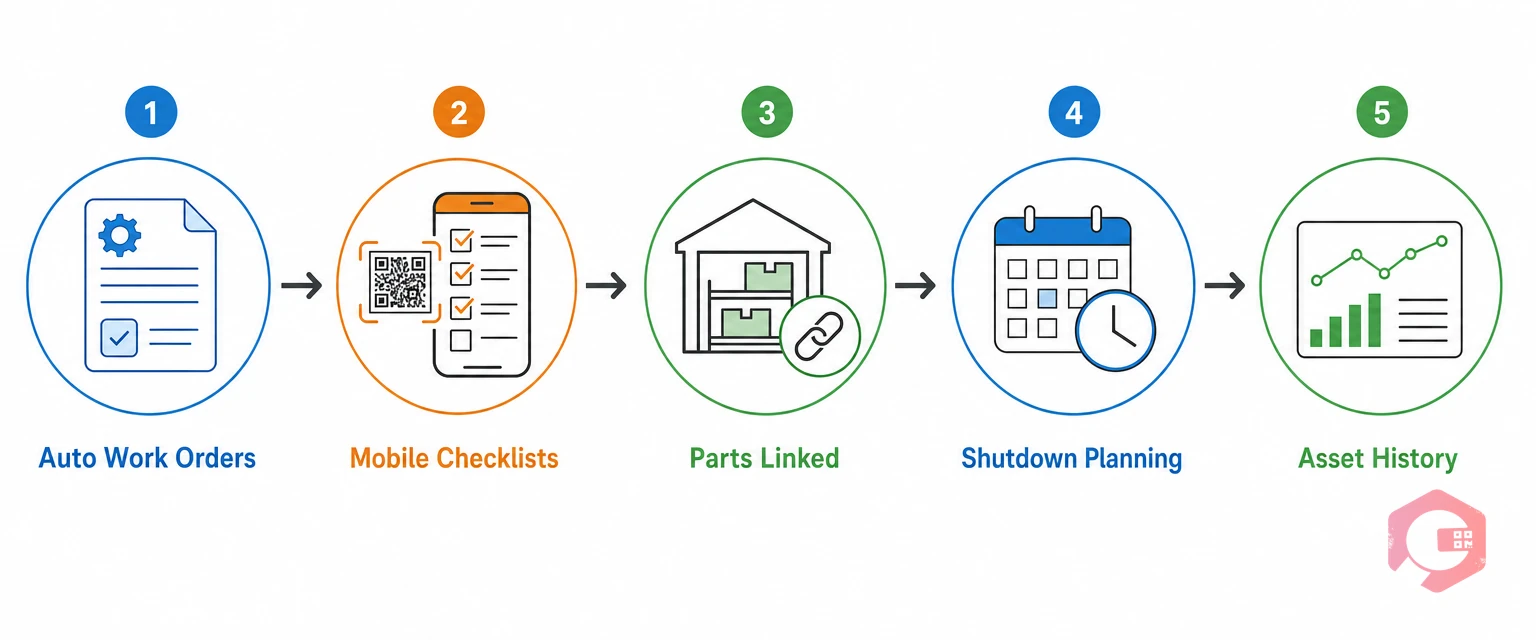
A printed checklist on the wall does little. A checklist that lives inside the CMMS does the work for you. Cryotos handles five jobs that cement plant teams used to do by hand.
For more on the bigger picture, read our guides on CMMS for cement industry and predictive maintenance in cement industry.

The checklist should cover the full process chain: kiln, ball mills, crushers, conveyors, bucket elevators, preheater, clinker cooler, electricals, and dust collection. Each task should name the asset, the exact step, the acceptance reading, and the action if the reading is out of spec. Tasks must run on four cycles: daily, weekly, monthly, and annual.
Walk the kiln shell every shift for hot spots. Measure axial float and drive gear backlash weekly. Run a full thermal shell scan once a month. Open the kiln for refractory and tyre inspection at every annual shutdown. Many modern plants now run continuous shell scanners that flag hot spots in real time.
Cement plants combine all four. Corrective maintenance fixes things after failure. Preventive maintenance follows the schedule in this guide. Predictive maintenance uses vibration, oil, and thermal data to act before failure. Reliability-centered maintenance (RCM) sets the strategy for each asset based on its risk and failure modes.
A CMMS schedules every task, opens the work order, pushes it to a phone, links the spares, captures the readings, and stores the history. It also runs the audit trail for ISO 55000 and local pollution control rules. Cryotos plants typically cut unplanned downtime by 30% in the first year.
Most integrated plants run one major shutdown per year plus one or two short shutdowns for the kiln. The exact pattern depends on production load, fuel mix, and refractory life. CMMS data on wear rates helps the planner shift the cycle from fixed dates to condition-based windows.
Cement plant maintenance comes down to one habit: do the right check on the right asset on the right day, and write it down. The checklists in this guide give you the structure. A CMMS like Cryotos gives you the system that keeps the structure alive after week three.
Plants that follow this discipline run longer, spend less, and pass audits without panic. The plants that do not, end up writing the case study about the day the kiln tripped.
Want to load these checklists into your plant in under 30 days? Book a free Cryotos demo and we will set up your kiln, mill, crusher, and conveyor PMs with you.



Cryotos AI predicts failures, automates work orders, and simplifies maintenance—before problems slow you down.



