CIP cycle tracking is the process of recording, validating, and storing the parameters of every Clean-In-Place cleaning run — time, temperature, flow rate, and chemical concentration — to prove that sanitation meets regulatory and food-safety standards. In beverage manufacturing, a failed or incomplete CIP cycle is not just an equipment problem; it is a compliance risk that can trigger FDA citations, product recalls, and lost certifications under FSMA and SQF standards.
Yet most beverage plants still track CIP cycles manually — operators log run times on paper sheets, supervisors verify by spot check, and audit evidence lives in binders that take hours to compile. A CMMS (Computerized Maintenance Management System) changes this completely. It automates CIP scheduling, captures validation data against pass/fail thresholds, builds a tamper-evident audit trail, and cuts the cleaning downtime that eats into production shifts. A mid-sized soft drink plant that moved CIP tracking into their CMMS reduced average CIP turnaround time by 22% and eliminated two manual re-cleans per week by catching parameter deviations in real time.
This guide explains how beverage plants use CMMS to validate CIP compliance and get cleaning downtime under control.
Clean-In-Place (CIP) is the automated cleaning of processing equipment — tanks, pipelines, heat exchangers, filling machines — without disassembly. A standard CIP sequence runs through pre-rinse, caustic wash, intermediate rinse, acid wash, and final sanitizing rinse steps. Each step has defined parameters: temperature ranges, chemical concentration targets, contact time minimums, and flow velocity requirements.
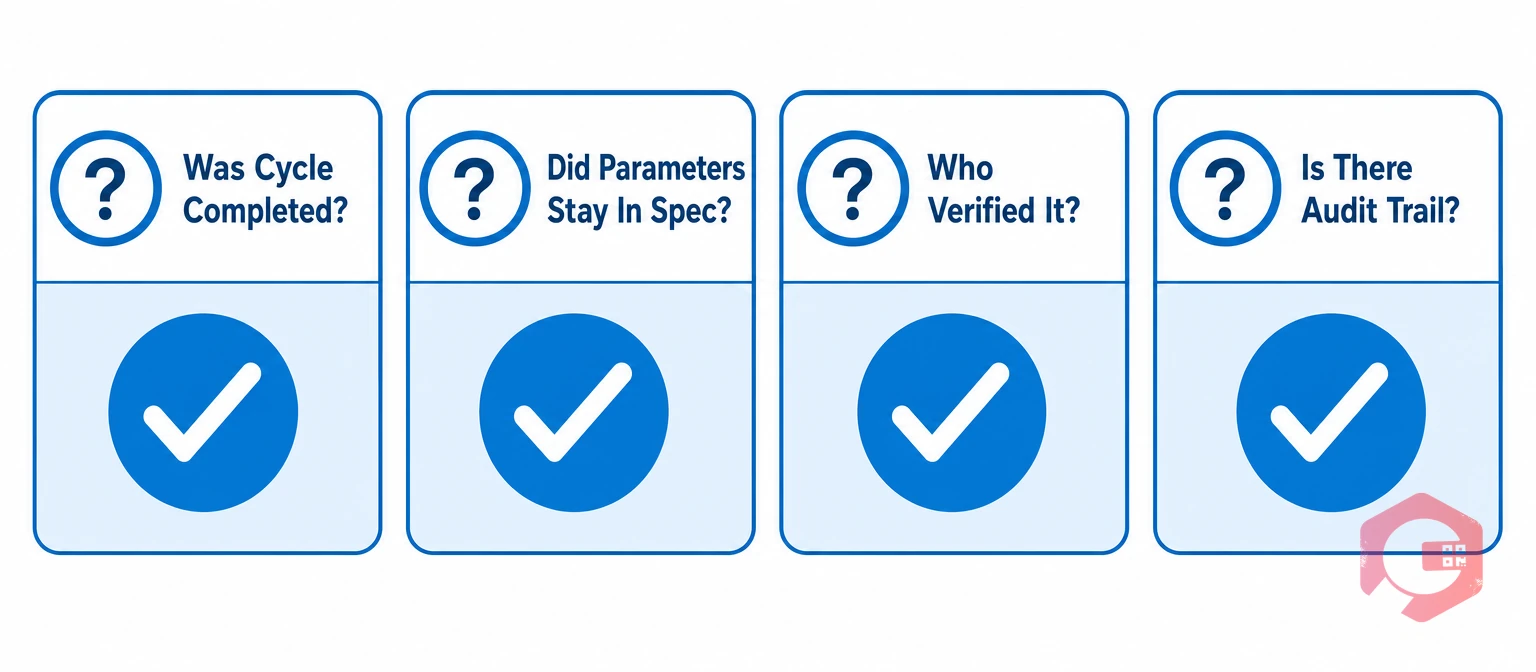
CIP cycle tracking is the systematic capture and validation of those parameters for every cleaning run on every asset. It answers four questions that regulators and food safety auditors always ask:
When CIP tracking lives on paper, the answer to at least one of these questions is almost always “sort of.” When it runs through a CMMS, every question has a documented, retrievable answer.
The FDA’s FSMA Preventive Controls for Human Food rule (21 CFR Part 117) requires food and beverage manufacturers to validate and monitor sanitation controls as part of their Food Safety Plan. Under SQF and BRCGS audit frameworks, CIP records must demonstrate that every cleaning step met its validated parameters — and those records must be immediately retrievable during an unannounced audit.
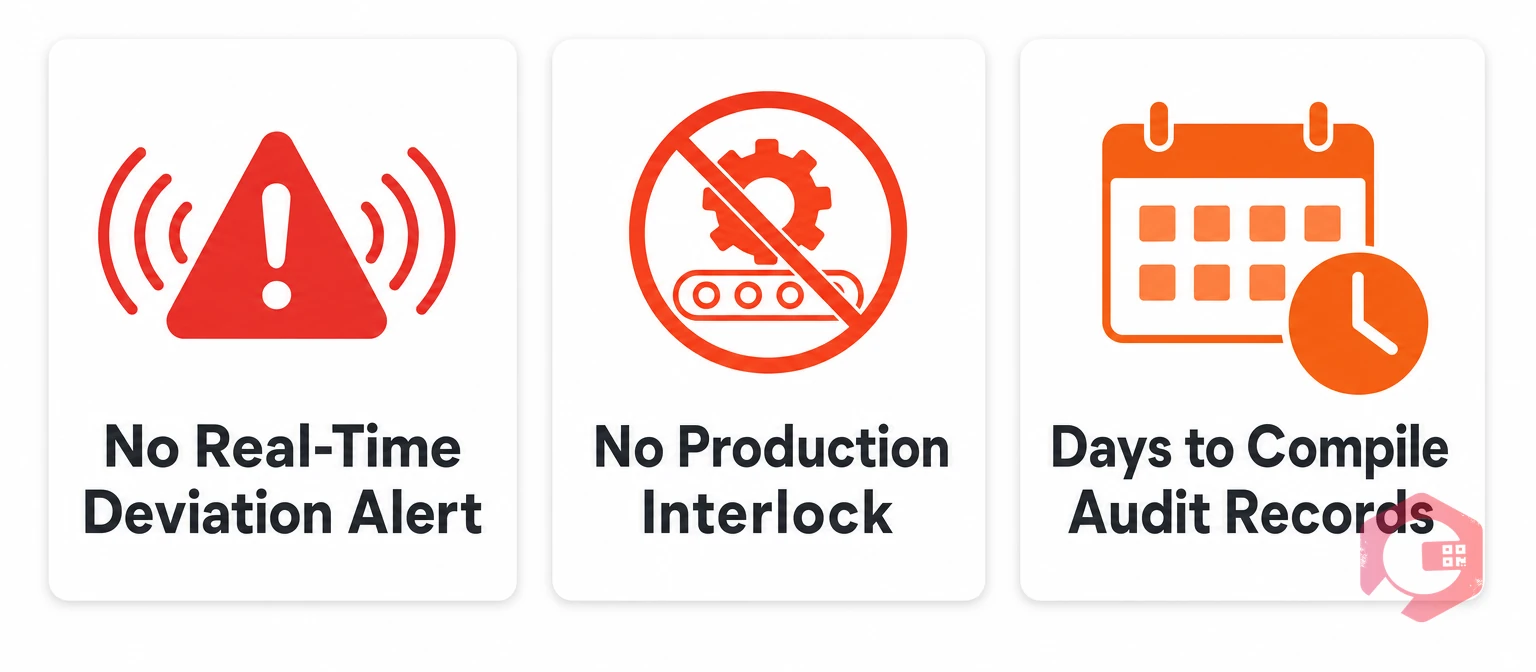
Three specific failures make paper-based CIP tracking a compliance liability:
According to the SQF Institute, sanitation program documentation deficiencies are consistently among the top five findings in SQF food safety audits. A CMMS is the most direct way to close that gap.
A CMMS tracks CIP cycles through a combination of scheduled work orders, digital checklists, parameter capture fields, and automated pass/fail logic. Here is how each piece works in practice.
Each CIP run in Cryotos CMMS starts as a scheduled work order tied to a specific asset — Tank 3, Filling Line B, Pasteurizer Unit 2. The work order template carries the full CIP procedure: step names, target parameters for each step, and the operator sign-off fields. When the cycle runs, the operator completes each step digitally on mobile, entering actual readings for temperature, conductivity, time, and flow rate directly into the work order.
Cryotos maintenance checklists support numeric value fields with defined acceptable ranges. If the operator enters a caustic wash temperature below the validated minimum, the system flags the reading as out of spec before the checklist can be submitted. The operator must either correct the condition and recheck, or escalate with a documented reason. Nothing can be silently skipped.
Every completed CIP work order stores the submitting operator’s identity, the submission timestamp, all parameter readings, and any flags or comments — as an immutable record. No editing after submission. When an auditor requests CIP records, the CMMS BI Dashboard filters by asset, date range, and cycle type and exports the full record set in minutes.
For plants with instrumented CIP skids, Cryotos integrates with sensors and SCADA systems through its IoT meter reading module. Temperature sensors, conductivity probes, and flow meters push live data directly into the work order as it runs. The system compares incoming readings against the validated process window continuously — no manual entry required for instrumented assets. A threshold breach automatically flags the cycle as non-conforming and notifies the supervisor.
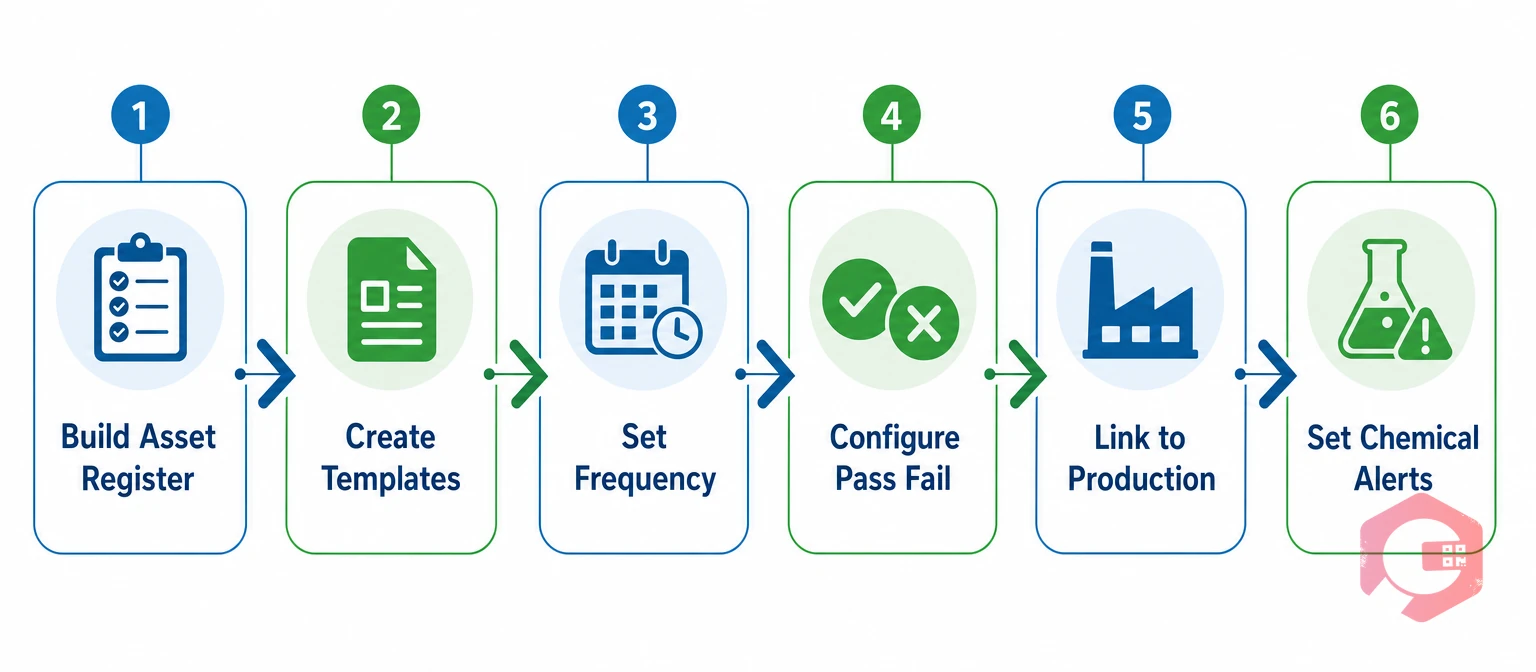
Getting CIP cycle tracking running in a CMMS takes a structured setup that most beverage plants can complete in a few weeks. The core steps are:

Once CIP data flows through a CMMS, the reporting layer turns compliance records into operational intelligence. These are the KPIs that matter most for beverage sanitation programs.
According to the 3-A Sanitary Standards organization, which sets design and practice guidelines for dairy and beverage equipment, documented CIP validation records are a prerequisite for third-party sanitary equipment certification. Plants that track these KPIs through a CMMS build the evidence base that certification auditors and food safety regulators need to see.
CIP is necessary — but the time it consumes is not fixed. Most beverage plants have meaningful room to reduce total CIP downtime without compromising sanitation standards. A CMSS creates four specific opportunities to do this.
When CIP triggers fire based on fixed clock times rather than production status, cleaning often interrupts active runs or starts before equipment is ready. Cryotos preventive maintenance scheduling lets you set CIP work orders to trigger relative to production batch completions, shift handovers, or throughput counters — not arbitrary times. Aligning CIP to natural production breaks reduces the frequency of mid-run interruptions and the dead time between cleaning completion and restart.
A CIP cycle that fails its final rinse conductivity check and requires a full repeat run costs double the time. Real-time parameter monitoring — either through operator digital input or IoT sensor feed — catches deviations at the step level rather than at the end. Correcting a low-temperature caustic step during the cycle takes 5–10 minutes. Running the entire sequence twice takes 45–90 minutes.
Variation in how operators execute CIP steps — how long they soak, how they verify rinse completion, when they call a cycle done — is one of the biggest sources of unnecessary CIP downtime. Cryotos digital checklists lock the procedure: every operator follows the same steps in the same order with the same documented verification points. When the procedure is identical every time, cycle durations become predictable and schedulable.
Over time, CIP records in a CMMS build an evidence base that sanitation teams can use to optimize validated parameters with regulatory confidence. If 12 months of records show that your pasteurizer CIP consistently achieves its microbiological validation at 68°C when the procedure specifies 72°C, you have the data to support a validation study that could reduce chemical usage and energy consumption per cycle. You cannot make that case without the history.
Plants using Cryotos for food and beverage sanitation management report 30% reductions in unplanned downtime and 25% faster turnaround on maintenance and cleaning activities. The beverage industry’s need to meet both production targets and food safety requirements makes CMMS-driven CIP tracking one of the highest-ROI applications in the whole plant.
A CMMS suitable for CIP tracking needs: asset-specific work order templates with parameter capture fields, numeric pass/fail validation logic in digital checklists, time-based and usage-based PM scheduling, IoT or sensor integration for real-time data capture, tamper-evident audit trail storage, and reporting that can filter CIP records by asset, date range, and cycle outcome. Cryotos covers all of these within a single platform.
FSMA’s Preventive Controls rule requires documented monitoring and verification of sanitation controls. SQF requires retrievable records demonstrating CIP parameters met validated specifications. A CMMS automatically creates those records at the point of execution, stores them as immutable audit-ready entries, and generates compliance reports on demand — eliminating the manual record-keeping that most audit findings relate to.
Yes. If your CIP skid has instrumentation — temperature sensors, conductivity probes, flow meters — Cryotos can receive real-time data from SCADA systems, PLCs, or edge devices via its IoT integration. Parameter readings populate directly into the CIP work order as the cycle runs, with no manual entry required and no risk of transcription error.
Most beverage plants see 15–30% reduction in total CIP downtime within the first six months of CMMS-managed scheduling. The biggest gains come from eliminating repeat cleans caused by undetected parameter deviations and from aligning CIP triggers to production windows rather than fixed clock times.
Cryotos links chemical inventory to CIP work orders. When a work order closes, actual chemical usage is logged against the relevant inventory item. Minimum stock thresholds trigger automatic reorder alerts before chemicals run out. Expiration reminder features track chemical shelf life and flag nearing-expiry items before they affect a scheduled CIP run.
CIP cycle tracking is one of the most compliance-critical and downtime-intensive activities in a beverage plant — and it is one where moving from paper to CMMS delivers fast, measurable results. Every parameter deviation that gets caught mid-cycle instead of at the final check saves a full repeat run. Every audit that takes minutes instead of days saves a compliance team significant time. Every CIP work order that automatically interlinks with the production schedule prevents a premature product release from an insufficiently cleaned line.
If your beverage plant is still relying on manual logs to demonstrate CIP compliance, the next food safety audit is a risk you don’t need to take. Cryotos CMMS for food and beverage is built for exactly this challenge. Book a free demo today and see how CMMS-driven CIP tracking can validate your sanitation compliance and cut cleaning downtime on your most critical lines.


Cryotos AI predicts failures, automates work orders, and simplifies maintenance—before problems slow you down.