

Managing contractor access without a workflow module is a food safety risk because it removes the documented gates — certification checks, hygiene inductions, area authorisations, and permit-to-work confirmations — that prevent an unqualified or improperly briefed contractor from entering a production or processing zone and creating a contamination event, a safety incident, or an audit failure.
Most food manufacturers have contractor access procedures on paper. The problem is that "on paper" is exactly where they stay. A visitor log at the front desk, an emailed hygiene certificate that nobody checked against an expiry date, a verbal safety briefing that the contractor acknowledged with a nod — none of this constitutes a controlled access process. And when something goes wrong, or when an auditor asks for documentation, the paper trail either doesn't exist or doesn't prove what it needs to prove.
According to the BRC Global Standard for Food Safety Issue 9, sites must maintain documented procedures for managing contractors, including verification of competency, site rules communication, and supervision requirements. A workflow module in your CMMS enforces all of this automatically — before the contractor sets foot in the plant, not after an incident forces a review.
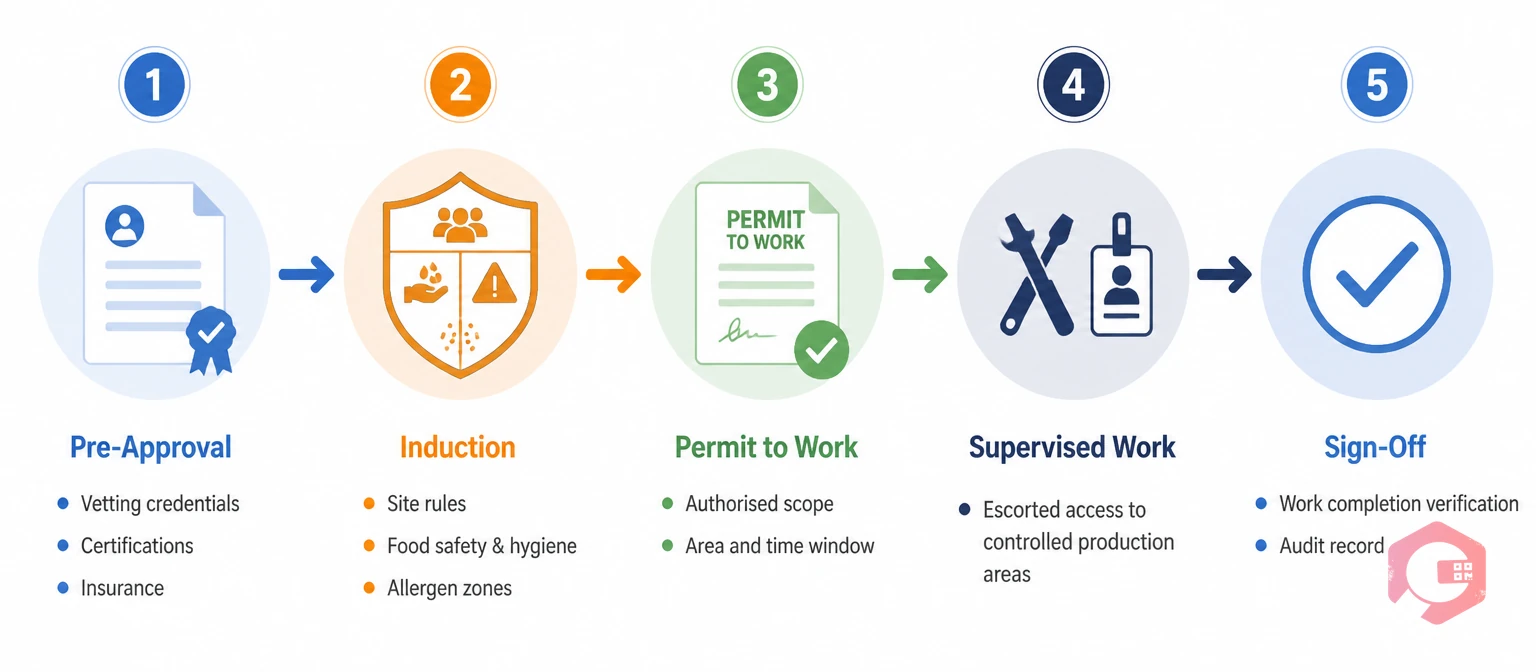
Contractor access management in a food manufacturing environment is not the same as signing a visitor into a lobby. It is a structured process that verifies a contractor's right to enter a specific area of your facility, confirms their competency to perform the work safely, documents their acknowledgement of your site's food safety and hygiene rules, and creates a retrievable audit record of every visit and every task performed.
The stakes are higher in food manufacturing than in most other industries. A contractor entering a high-care or high-risk zone without proper hygiene induction can introduce allergens, pathogens, or foreign body contamination that reaches finished product. A maintenance contractor bypassing lockout/tagout procedures on food contact equipment creates both a safety risk and a contamination route. A contractor using tools or equipment that hasn't been checked for compatibility with your food safety standards introduces a foreign material risk that your HACCP plan is built to prevent.
The gap that most food plants have is not a lack of awareness about these risks. It is the absence of a system that enforces the controls at the point of entry, every time, for every contractor, without relying on someone remembering to ask the right questions. That is what a workflow automation module provides.

When contractor access is managed through informal processes — email confirmations, paper sign-in sheets, verbal briefings — five specific food safety failure modes appear consistently. Each one is preventable with a workflow-enforced access system.
Food manufacturers typically require contractors to hold current food hygiene training certificates before entering production areas. In practice, these certificates are collected once, filed somewhere, and never reviewed again until an auditor asks for them. A contractor whose Level 2 Food Hygiene certificate expired eight months ago is still being admitted because nobody's system flagged the expiry.
A workflow module changes this by requiring a valid, non-expired certificate upload as a mandatory step before an access request is approved. The system checks the expiry date automatically. If the certificate has lapsed, the workflow stops — the access request cannot proceed until the contractor provides a current certificate. No manual check required, no human memory required, no gaps.
Food plants operate with defined hygiene zones — often tiered from low-risk ambient areas through to high-care and high-risk zones requiring full PPE changes, footbaths, and dedicated tools. Without a workflow-controlled access system, there's no reliable mechanism to restrict a contractor to the zone they were authorised to enter, or to record which zones they actually accessed during their visit.
When a contamination incident is investigated and the food safety team asks "was anyone in the high-care area that day who shouldn't have been?", the answer from an unmanaged access system is: "we don't know." That answer is a food safety failure and a BRC non-conformance. A workflow module logs every zone authorisation and access event with a timestamp and a named person — giving the investigation team a complete record to work from.
Contractors performing maintenance on food contact equipment — cleaning a CIP circuit, replacing a gasket on a filler, servicing a conveyor — must complete lockout/tagout and permit-to-work procedures before work starts. According to OSHA's control of hazardous energy standard, lockout/tagout procedures must be followed any time maintenance is performed on equipment that could unexpectedly release stored energy — a requirement that applies fully to food processing machinery. In a facility where these are managed verbally or through paper forms, a busy supervisor under production pressure can sign off a permit without confirming that all isolation steps were completed. The contractor starts work. The equipment is not fully isolated. The risk is real.
A workflow module makes it impossible to proceed to the "work start" stage without digital confirmation that every LOTO step has been completed and signed off by the named authorised person. The permit-to-work system enforces the sequence — not because someone remembered to check, but because the system won't advance to the next step until the previous one is confirmed. For food contact equipment specifically, this is the difference between a managed risk and an uncontrolled one.
Contractor tools and equipment entering food production areas must be food-safe — no rust, no loose parts, no lubricants incompatible with food contact standards, no wooden handles in high-care zones. In most facilities, this check happens informally: the contractor carries a bag of tools through the door and the site operative who lets them in may or may not check its contents.
A workflow access system can include a mandatory equipment declaration step — the contractor lists the tools and equipment they intend to bring on-site, and a responsible person approves the list before the access request is confirmed. Any equipment not on the approved list requires a separate authorisation. This creates a documented check that the tools entering your production area were reviewed and accepted — which is exactly the kind of evidence that food safety auditors look for when reviewing contractor management procedures.
When a food safety auditor reviews your contractor management process, they want documentary evidence of three things: that contractors were assessed as competent before being admitted; that they received and acknowledged your site's food safety rules; and that their work was supervised and verified as compliant. A sign-in book and a folder of emailed certificates satisfies none of these requirements reliably.
A workflow module produces this evidence automatically. Every access request creates a record: the contractor's name, the date, the zones authorised, the certificates checked, the safety briefing acknowledged, the work performed, and the sign-off obtained. That record is stored against the contractor's profile in the CMMS, retrievable in seconds for an audit. According to the SQF Institute guidance on contractor management, documented access control records are a core expectation of any third-party food safety audit programme.
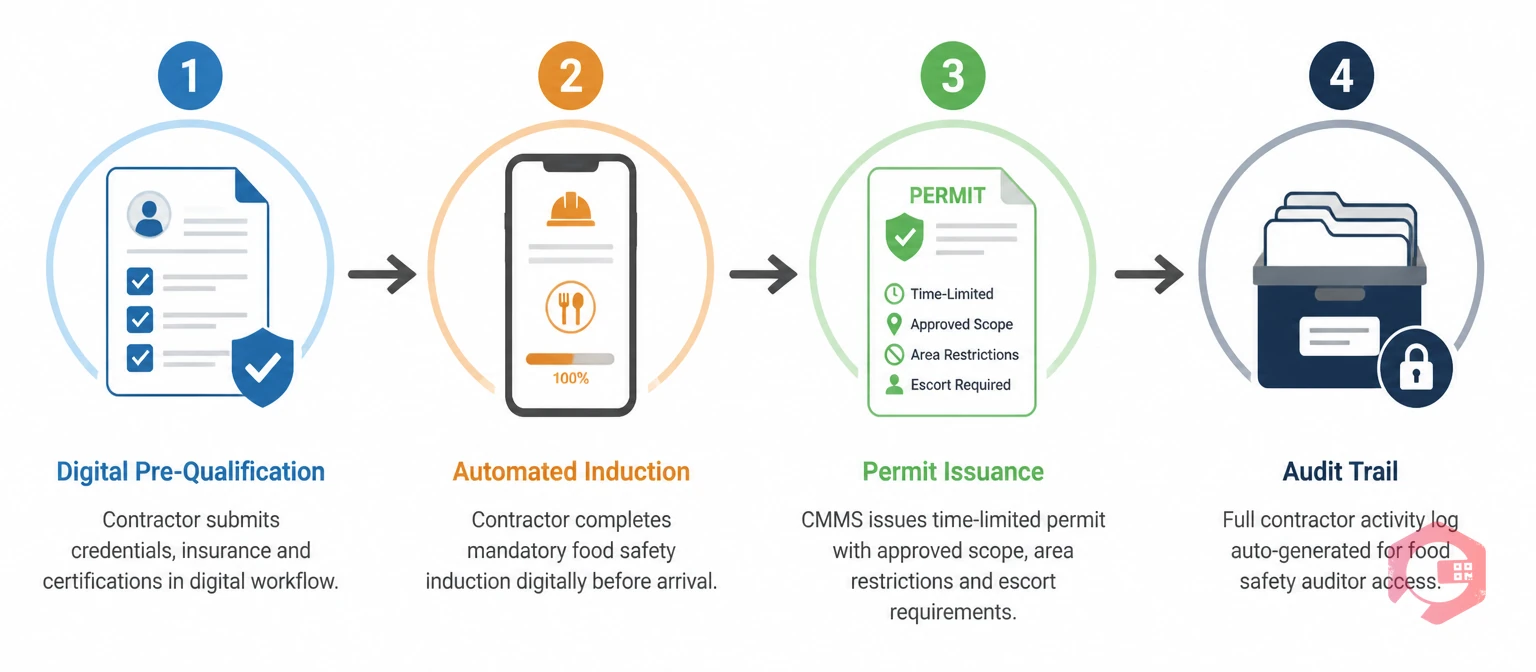
A properly configured contractor access workflow in a food plant CMMS operates as a digital gate that every contractor must pass through before work begins. Here is what each step enforces:
Each of these steps produces a document. Together, they produce a complete contractor visit record that satisfies BRC, SQF, FSSC 22000, and GMP audit requirements without anyone needing to compile a folder of paperwork the night before the audit.
Food safety audit standards have become increasingly specific about contractor management requirements. The evidence bar has risen: auditors are no longer satisfied with a policy document and a sign-in sheet. They want to see operational records that demonstrate the policy is being followed in practice, every time.
Specifically, auditors expect to verify:
The ISO 22000:2018 food safety management standard requires that all activities affecting food safety — including those performed by external parties — are controlled, monitored, and documented. A workflow module in your CMMS is the operational mechanism that makes this control real rather than theoretical.
Cryotos CMMS gives food manufacturers the workflow infrastructure to control contractor access from request to sign-off, with a complete audit trail built automatically at every step. The platform's workflow automation engine supports conditional access logic — a contractor requesting entry to a high-care zone triggers a different, more stringent set of requirements than one entering a low-risk utility area — so the system scales the control level to the food safety risk without adding administrative burden.
Key capabilities for contractor access management in Cryotos:
Food manufacturers running contractor-heavy maintenance programmes — refrigeration contractors, specialist cleaning crews, packaging equipment engineers — consistently identify contractor access control as one of the highest-value use cases for CMMS workflow automation. The risk is real, the audit exposure is real, and the fix is a system configuration, not a culture change programme. If your contractor access process still relies on a folder of emailed certificates and a supervisor's memory, Cryotos CMMS gives your food safety and maintenance teams the infrastructure to close that gap today.
The five main food safety risks of unmanaged contractor access are: expired hygiene certifications going undetected; contamination zone breaches with no audit trail; LOTO and permit-to-work steps being skipped under production pressure; unverified contractor equipment entering food contact areas; and the absence of documented evidence for BRC, SQF, or FSSC 22000 auditors. Each of these risks is preventable with a workflow-enforced access system that gates each step before allowing the next to proceed.
BRC Issue 9 and SQF require documented evidence that contractors were verified as competent before admission, received and acknowledged site-specific food safety rules, and that their work was supervised and recorded. Auditors want to see records that cover the entire audit period — not just a current certificate on file, but timestamped proof that the certificate was valid at the time of each visit. A CMMS workflow module generates this documentation automatically at each access event.
A workflow module enforces contractor access by making each required step a mandatory gate before the next step can proceed. Certificate verification, induction acknowledgement, PTW confirmation, and work sign-off are all embedded in the workflow sequence. The system will not advance to the next stage until the current one is completed and recorded — removing the reliance on human memory or supervisor discretion to enforce the controls.
Yes. A CMMS with an expiration reminder feature stores each contractor's certificate records with their expiry dates and fires automatic alerts before they lapse — to the contractor, the site contact, or both. When a new access request is submitted, the system checks whether all required certificates are current. If any have expired, the access request is placed on hold until a valid certificate is provided. This eliminates the most common contractor access failure: the lapsed certificate that nobody checked.
No — the food safety risk from unmanaged contractor access exists at any site scale. A small bakery with a refrigeration contractor visiting monthly faces the same HACCP exposure as a large processing plant if that contractor enters without verified hygiene induction, uses non-food-safe tools, or bypasses a LOTO step on a food contact chiller. The workflow complexity scales to your operation size, but the compliance requirement and the contamination risk do not disappear because the facility is small.
The contractors who service your refrigeration systems, maintain your filling lines, and clean your CIP circuits are not employees. They don't have the same ongoing training record, the same daily supervisor oversight, or the same institutional familiarity with your hygiene zones and food safety protocols. Every time one of them enters your plant, the food safety controls that normally operate automatically — because your trained staff know the rules — need to be explicitly triggered, verified, and documented.
Without a workflow module to enforce that process, you are relying on the right questions being asked at the right moment by the right person, every single time. That is not a food safety management system. That is a hope. And when it fails — when the certificate was expired, when the LOTO step was skipped, when the tool that should have stayed outside was carried into the high-care zone — the failure is documented nowhere, traced to nobody, and invisible to the auditor who asks for your contractor access records next month.
A workflow module makes the controls automatic, the record complete, and the risk managed. Book a free Cryotos demo to see how the contractor access workflow operates in a real food manufacturing environment — and what your current process looks like when placed next to it.



Cryotos AI predicts failures, automates work orders, and simplifies maintenance—before problems slow you down.



