
A supermarket chain operating 300 stores carries approximately 300 compressor rooms, 900 walk-in coolers and freezers, 6,000 multi-deck refrigerated display cases, and 1,500 standalone chest freezers — all requiring scheduled preventive maintenance, reactive fault response, temperature compliance logging, and refrigerant gas records. When a compressor bank at Store 247 loses efficiency at 2 a.m. on a Tuesday, the cost is not just an emergency service call — it is the spoilage risk for thousands of pounds of chilled product, a potential food safety audit exposure, and an F-gas compliance gap if the refrigerant top-up isn't logged against the system's equipment record. According to the USDA, refrigeration failures are a leading cause of food waste in retail operations — and at the scale of a national grocery chain, the aggregate cost of unmanaged refrigeration maintenance runs into millions of pounds annually.
A CMMS gives supermarket chains the multi-store visibility, automated compliance logging, and contractor coordination infrastructure to manage that estate systematically. This guide covers how it works — from asset inventory to temperature breach work orders to refrigerant gas records — across hundreds of geographically dispersed locations.
Refrigeration is not a peripheral system in a supermarket — it is the primary asset class. Between 40% and 60% of a typical grocery store's total energy consumption goes to refrigeration, and refrigeration equipment represents the largest single category of maintenance spend in most grocery retail operations. At the estate level, a chain of 200–400 stores is managing a refrigeration portfolio that rivals the complexity of a dedicated cold storage logistics business — with the additional constraint that every store operates during retail trading hours when equipment cannot be taken offline without customer impact and food safety risk.
Refrigeration maintenance in a supermarket estate covers a more diverse asset range than most facilities operations teams realise until they attempt to inventory it. The asset categories include: multi-deck open refrigerated display cases (produce, dairy, deli, and fresh meat sections); closed refrigerated display cases (beverages, desserts); remote compressor packs serving multiple display case circuits simultaneously; walk-in coolers (back-of-house storage, typically 2–4 per store); walk-in freezers; chest freezers and upright freezer display units; refrigerated service counters (deli, bakery, seafood); and condenser units — typically roof-mounted — that serve the compressor pack circuits.
Each asset type has its own PM requirements, failure modes, service frequency, and compliance documentation obligation. A chest freezer PM is a 30-minute task involving condenser coil cleaning, door seal inspection, and temperature log verification. A remote compressor pack service is a 4–6 hour job requiring refrigeration engineering credentials, F-gas certification, and refrigerant quantity documentation. Managing both in the same CMMS, under the same work order and compliance framework, is what multi-store refrigeration estate management requires.
A facilities manager at a single supermarket can know their refrigeration estate intuitively — they know which compressor pack runs warm in summer, which display case seal has been deteriorating, which walk-in cooler door is slow to close. Across 300 stores, that intuitive knowledge is impossible. A regional maintenance manager responsible for 60 stores cannot hold the equipment condition of 60 refrigeration estates in their head — and they cannot act on information they never receive.
Without a CMMS, a refrigeration failure at Store 247 becomes known when someone at Store 247 calls the maintenance helpdesk. With a CMMS, it becomes known when the temperature sensor triggers an alert, the system creates a work order, and the regional manager receives a notification — before anyone at the store has noticed that the display case temperature is climbing. The difference between those two information flows, at 300 stores, is the difference between managed refrigeration maintenance and reactive crisis management.

Supermarket chains managing refrigeration estates across hundreds of locations face four recurring operational challenges that single-store approaches cannot address and that a properly configured CMMS resolves systematically.
The central visibility problem in multi-store refrigeration management is that failures are distributed across geography. A regional manager responsible for 60 stores cannot visit them; they rely on information flows. In the absence of a CMMS, those information flows are reactive and manual — store staff notice a problem and call, or a temperature log sheet catches an exceedance at the next manual check. In both cases, the problem has already been developing for hours before it reaches the attention of someone who can coordinate a response.
A CMMS with IoT temperature sensor integration changes this fundamentally. Temperature sensors on display cases, walk-in coolers, and freezer units transmit readings continuously to the CMMS. When a reading crosses the defined threshold for that asset type — for example, a display case rising above 5°C for a chilled product zone — the CMMS creates a corrective work order automatically, assigns it based on the contractor coverage for that store's location, and sends an alert to the store manager, the regional maintenance manager, and the contractor simultaneously. The failure is responded to within minutes of detection, not hours after a manual check.
Retail food businesses are legally required to maintain temperature records that demonstrate chilled and frozen products were stored within safe temperature ranges. In the UK, this obligation derives from the Food Safety (Temperature Control) Regulations and the general due diligence requirements of the Food Safety Act. In the EU, EC Regulation 853/2004 sets specific temperature requirements for different food categories with documentation obligations. In practice, environmental health officers and food safety auditors request temperature log records during inspections — and the burden of proof is on the retailer to demonstrate compliance.
Manual temperature log books — the paper sheets completed by store staff twice daily — are the traditional approach. They have two fundamental weaknesses at supermarket chain scale: they are not real-time (a failure between readings is invisible until the next check), and they are not centralised (a head office audit of 300 stores' temperature records requires physical or scanned copies from each location). A CMMS with sensor integration creates a continuous, centralised, auditable temperature record for every asset across every store — exportable for any date range, any store, and any asset within minutes of an audit request.
Commercial refrigeration systems in the UK and EU are subject to the F-Gas Regulations, which require operators of systems containing more than 5 tonnes CO2-equivalent of F-gas refrigerant to maintain records of the refrigerant type, quantity charged, quantities added and removed at each service, and the credentials of the engineer who performed the work. For a 300-store estate where compressor packs at each store may contain 20–60 kg of refrigerant, the aggregate record-keeping obligation is substantial.
A CMMS stores these records against the asset — not against the service engineer's job sheet or a central spreadsheet that requires manual population after each visit. When a compressor pack at Store 183 receives a refrigerant top-up during a reactive repair, the engineer records the quantity added and the refrigerant type against the CMMS work order at point of completion. The system updates the cumulative charge record for that asset, flags if the annual leak rate is approaching the regulatory threshold for mandatory leak testing, and creates an alert if no leak detection check has been completed within the required interval. F-gas compliance becomes a CMMS output rather than a manual administrative burden.
No single refrigeration contractor covers a 300-store national estate. Supermarket chains typically work with 8–20 regional refrigeration contractors, each holding coverage for a geographic zone. Coordinating this contractor matrix — ensuring the right contractor receives the right work order for the right store, tracking their response time and completion quality, and holding them to the SLA terms in their contracts — is one of the most operationally demanding aspects of multi-store refrigeration management.
A CMMS automates contractor routing: when a work order is created for Store 247, the system knows which contractor holds coverage for that store's location and assigns the work order automatically. The contractor receives the work order on mobile, completes the service checklist, and closes the work order with the required documentation — all within the CMMS. The chain's maintenance team sees contractor SLA performance across every location from a single dashboard, with no manual coordination required for routine work orders.
The following asset-to-task mapping provides a reference for configuring refrigeration PM schedules in a supermarket chain CMMS. These are representative maintenance intervals — actual intervals should be calibrated to manufacturer specifications and site conditions:
| Refrigeration Asset | CMMS PM Task | Frequency | Compliance Record Generated |
|---|---|---|---|
| Remote compressor pack | Oil level, pressure checks, filter inspection, leak test, refrigerant log | Quarterly (F-gas >5 tCO2e systems: 6-monthly leak check minimum) | F-gas service record; refrigerant quantity log; engineer certification record |
| Multi-deck display cases | Coil cleaning, door gasket inspection, fan motor check, temperature verification | Every 3 months | PM completion record with temperature readings; defect log |
| Walk-in cooler / freezer | Evaporator defrost cycle verification, door seal check, temperature calibration, drainage inspection | Every 6 months (door seals: quarterly) | Temperature calibration record; defect and repair log |
| Condenser units (roof) | Coil cleaning, fan blade inspection, refrigerant pressure check | Twice yearly (pre-summer and post-summer) | PM completion with pressure readings; coil condition photograph |
| Chest freezer display units | Condenser coil clean, temperature check, door seal inspection | Every 3 months | PM completion record; temperature log entry |
| Refrigerated service counters | Glass cleaning, temperature verification, drain pan inspection, seal check | Monthly (temperature log: continuous via sensor) | Monthly completion record; continuous temperature compliance log |
Each row in this table is a configured PM task template in the CMMS — created once at the portfolio level and deployed to every store in the estate. The PM task auto-generates at the correct interval for every asset at every store, assigns to the relevant contractor, and produces the compliance documentation at completion without any additional administrative effort from the central maintenance team.
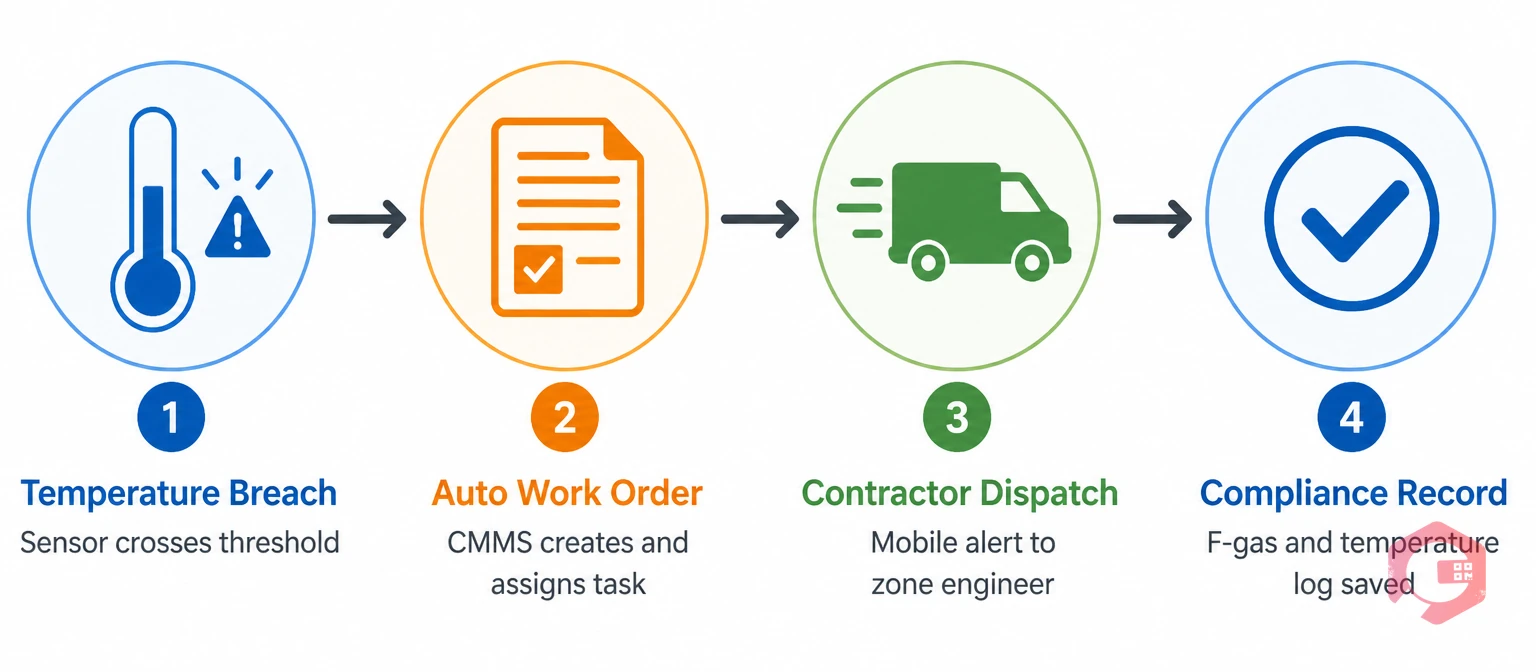
The most operationally critical CMMS configuration for supermarket refrigeration is the temperature breach to work order workflow. This is the mechanism that converts a passive monitoring system (temperature sensors recording data) into an active maintenance response system (technicians dispatched before product spoilage occurs).
The workflow operates in four steps. When a temperature sensor on a monitored asset crosses the configured threshold — for example, a display case temperature rising above 5°C for more than 15 minutes — the alert transmits to the CMMS via the IoT integration. The CMMS creates a corrective work order with the asset ID, location, current temperature, and threshold breach duration pre-populated. The work order is assigned to the contractor covering that store's zone, who receives a mobile notification within seconds of the breach occurring. The store manager and the regional maintenance manager receive simultaneous alerts — the store manager to initiate food safety protocols (temperature logging, product assessment) while the contractor is in transit; the regional manager to monitor contractor response time against the SLA.
The workflow automation software configures this trigger-to-response chain once and it operates automatically across every monitored asset at every store. The maintenance team does not manage 6,000 sensor alert feeds; they manage the exception — the work orders that have not been acknowledged within the SLA window, the stores where sensor data has dropped out, the contractors whose response times are falling below the contracted threshold.
F-gas compliance for a supermarket chain operating HFC refrigerant systems is a significant ongoing obligation. Under UK F-Gas Regulation 517/2014 (as retained in UK law), systems containing 5 tonnes CO2-equivalent or more must be leak tested at prescribed intervals, and records of all refrigerant additions and removals must be maintained with the equipment for a minimum of five years. Across a 300-store estate, each store potentially carrying 4–8 refrigerant circuits of varying charge sizes, the compliance record-keeping requirement is substantial.
The CMMS stores F-gas records at the asset level — not at the contractor level or the service event level. The compressor pack at Store 183 has an asset record in the CMMS that carries: the refrigerant type and initial charge quantity, every addition and removal at every service event with the work order reference, the engineer's F-gas certification number, the last leak test date and result, and the next required leak test date calculated automatically from the regulatory interval for that system's charge size. When the next leak test is due, the CMMS generates a PM task automatically — the regulatory obligation becomes a scheduled maintenance task rather than a compliance calendar entry that someone has to remember.
For estate-level compliance reporting — which supermarket chains must be able to produce for regulatory inspections and ESG sustainability reporting — the Report Builder generates refrigerant consumption summaries by store, by refrigerant type, and by period. The total F-gas leakage across the estate, by store and by system, is a reportable sustainability metric for large retailers with scope 1 emission obligations. A CMMS that holds this data systematically makes the report a scheduled output rather than a manual aggregation exercise.
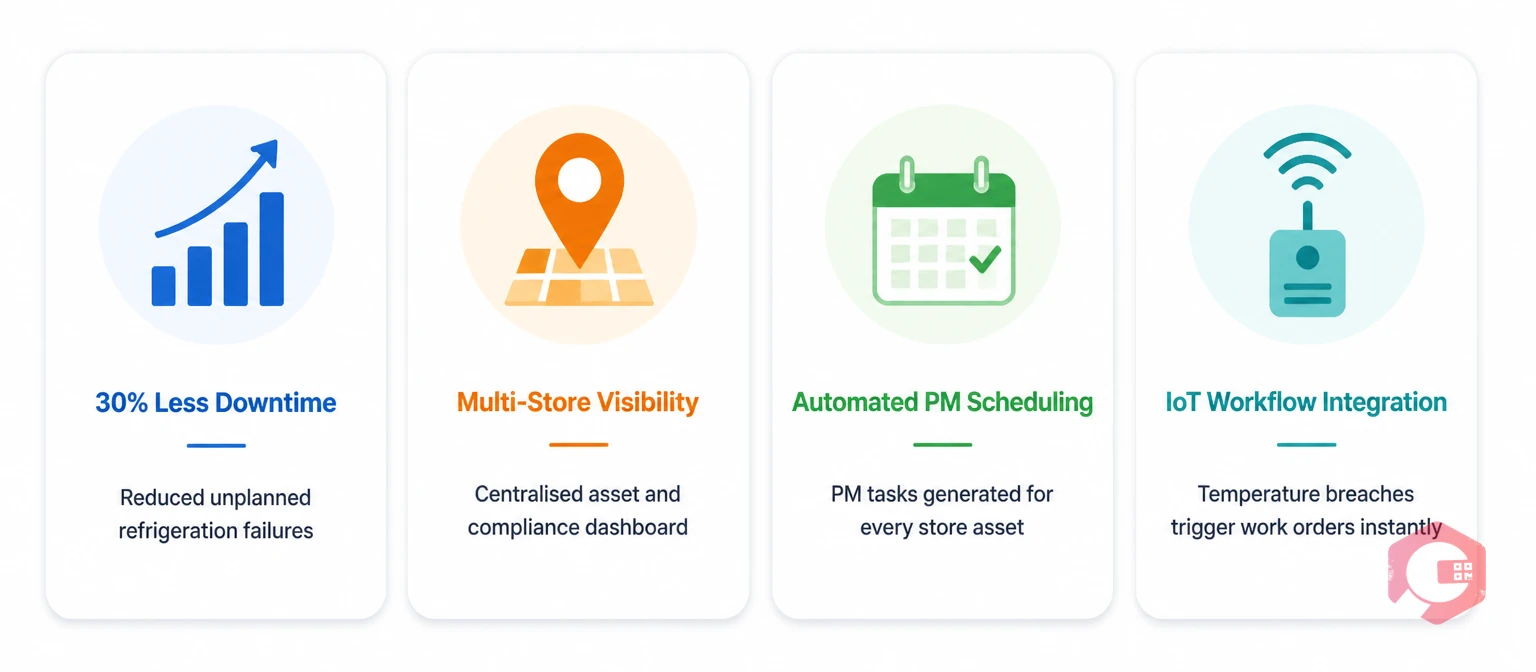
Cryotos CMMS is built for the operational complexity of multi-store refrigeration estate management. The asset management software module maintains a complete refrigeration asset register across all stores — each asset tagged to its location, carrying its PM schedule, service history, temperature monitoring configuration, and refrigerant charge record. The central maintenance team manages the asset data model once; the store-level data populates automatically through work order completion and sensor integration.
The preventive maintenance software module generates PM tasks for every refrigeration asset at every store, assigns them to the correct contractor based on store location and asset type, and tracks completion against schedule. PM compliance rates by store, by contractor, and by asset category are visible on the BI Dashboard in real time — the regional maintenance manager can see at a glance which stores are behind on compressor pack services, which contractors are completing assignments on time, and which asset categories are generating the most reactive work orders across the estate.
For stores where IoT sensor integration is configured, Cryotos connects refrigeration temperature data to the work order workflow through the workflow automation software — temperature threshold breaches create corrective work orders automatically, with contractor assignment, SLA clock, and stakeholder notifications firing within seconds of the alert. The store's continuous temperature record is stored in the CMMS against the asset, creating the food safety compliance log that regulators and auditors require from the same system that manages the maintenance response.
For estate-level reporting, the Report Builder generates the refrigerant gas consumption records, PM completion summaries, contractor SLA performance data, and reactive work order trend analysis that supermarket chain operations directors and sustainability teams need — formatted for internal review meetings, regulatory submissions, or ESG disclosures without manual data compilation. Teams using Cryotos report a 30% reduction in unplanned downtime, with multi-store refrigeration operations consistently citing centralised visibility and automated temperature breach response as the primary contributors to reduced food spoilage and improved food safety audit outcomes.
A supermarket CMMS manages the full refrigeration estate: remote compressor packs (the central refrigeration plant serving multiple display case circuits), multi-deck open and closed refrigerated display cases, walk-in coolers and freezers, chest freezer and upright freezer display units, refrigerated service counters, and roof-mounted condenser units. For each asset type, the CMMS holds the PM schedule, service history, temperature monitoring configuration, and any refrigerant charge records where applicable. The asset register is structured by store and by asset category, enabling both store-level management and estate-level portfolio analysis from the same data model.
CMMS supports food safety temperature compliance through two mechanisms. First, IoT sensor integration provides continuous, automated temperature logging against each monitored refrigeration asset — replacing manual twice-daily log sheets with a permanent, centralised, audit-ready record that captures every temperature reading throughout the day. Second, temperature threshold breach alerts create corrective work orders automatically, ensuring that exceedances generate a maintenance response record in addition to the temperature event record. For food safety audits, the CMMS provides a complete temperature history for any asset at any store across any date range, exportable within minutes. This is the evidence standard that environmental health officers and food safety auditors require — and that manual log sheets cannot consistently provide at supermarket chain scale.
Yes — through IoT sensor integration and workflow automation configuration. When a refrigeration asset's temperature sensor transmits a reading that crosses the defined threshold for that asset type (for example, a display case rising above 5°C for chilled products), the CMMS creates a corrective work order automatically with the asset details, current temperature, threshold breach duration, and store location pre-populated. The work order is assigned to the contractor covering that store's zone, and simultaneous alerts are sent to the store manager and regional maintenance manager. This automated response chain operates 24 hours a day, 7 days a week — including overnight when store staff are not present and when refrigeration failures have the longest time before detection in a manual-monitoring model.
The CMMS stores refrigerant gas records at the asset level — each compressor pack and each refrigeration circuit carries a charge record within its asset profile that includes refrigerant type, initial charge quantity, and every addition and removal from every service event, referenced to the work order. When an engineer performs a refrigerant top-up, the quantity and refrigerant type are recorded as mandatory fields in the CMMS work order at task completion. The CMMS calculates cumulative charge totals, flags when annual leak rates approach regulatory reporting thresholds, and generates the leak test schedule automatically based on the charge size and applicable F-gas regulatory interval. Estate-level refrigerant consumption reports — total by store, by refrigerant type, by period — are generated from the Report Builder for ESG and regulatory reporting without manual aggregation.
Refrigeration maintenance at supermarket chain scale is not a facilities management challenge — it is a portfolio management challenge. Hundreds of stores, thousands of assets, multiple refrigerant circuits, dozens of contractors, and a food safety compliance obligation that runs continuously across every asset, every day. The maintenance team that tries to manage this estate with store-level spreadsheets, manual temperature logs, and reactive contractor coordination will always be behind the problem. The team that manages it through a CMMS with centralised asset data, automated PM scheduling, sensor-triggered work orders, and F-gas compliance logging built into the work order workflow is ahead of the problem — catching failures before they become spoilage events, producing compliance records before auditors request them, and giving the whole estate the visibility that good management requires.
For supermarket chains and food retail operators ready to bring their refrigeration estate under systematic CMMS management, Cryotos CMMS provides the asset register, multi-store PM scheduling, IoT workflow integration, and compliance reporting infrastructure to make it practical at any scale. Book a free demo today and see what your refrigeration estate looks like when every store, every asset, and every compliance record is in one system.




Cryotos AI predicts failures, automates work orders, and simplifies maintenance—before problems slow you down.