

A CMMS for car dealerships gives service managers, facility teams, and parts coordinators one system to manage every maintenance task — from workshop equipment servicing and lift inspections to facility HVAC, electrical compliance, and spare parts inventory — so nothing gets missed, no contractor goes untracked, and no compliance deadline slips past unnoticed. Dealerships that run maintenance on spreadsheets, phone calls, and memory consistently overspend on emergency repairs and underspend on the preventive work that keeps equipment running through peak sales periods. According to NADA Dealership Operations data, facility and equipment downtime is one of the top five controllable cost drivers in franchise dealership operations — and most of it is preventable with structured maintenance management.
This complete guide covers what a dealership CMMS manages, which features matter most for your operating model, and how to implement it without disrupting workshop operations or service bay throughput.

A car dealership is a more complex maintenance environment than it looks from the outside. A typical franchise dealership runs a vehicle workshop with 10 to 30 service bays, a parts department with significant inventory, a showroom and customer lounge, a pre-delivery inspection area, a car wash facility, and back-of-house infrastructure including HVAC, electrical distribution, compressed air systems, and oil/water separators. Each of these areas has equipment that needs regular servicing, inspection, and compliance documentation.
Without a CMMS, maintenance runs on whoever notices the problem first. A workshop lift that starts making noise gets reported to the service manager, who tells someone to call the lift contractor, who may or may not show up this week. A compressor that drops pressure gets adjusted manually and the underlying fault doesn't get investigated. An HVAC unit in the showroom runs warm during a heatwave because the quarterly service was missed when the maintenance spreadsheet wasn't updated after the last contractor visit.
The consequences stack. A lift breakdown mid-service takes a bay out of operation, delays customer vehicles, and costs emergency contractor rates on top of the lost throughput revenue. A compressor fault that progresses to failure takes down air tools across the workshop simultaneously — potentially stopping multiple service bays for hours. An HVAC failure in a premium vehicle showroom during summer is a customer experience problem that no amount of apology recovers fully.
Compliance adds a layer that memory-based maintenance management can't reliably handle. Vehicle lifts require annual thorough examination under LOLER (or equivalent jurisdiction-specific regulations). Electrical installations require periodic inspection. Compressed air vessels require pressure system examinations. Oil separators require servicing records for environmental compliance. A missed inspection discovered during a manufacturer audit or insurance review creates both a compliance gap and a liability exposure that a CMMS-managed schedule prevents entirely.
Multi-site dealer groups compound every one of these problems. A group running 5, 10, or 20 dealerships has no practical way to monitor maintenance compliance, equipment health, and contractor performance across the estate without a centralised system. Regional operations managers are flying blind without visibility — relying on site managers to report problems that the site managers themselves may not be tracking systematically.
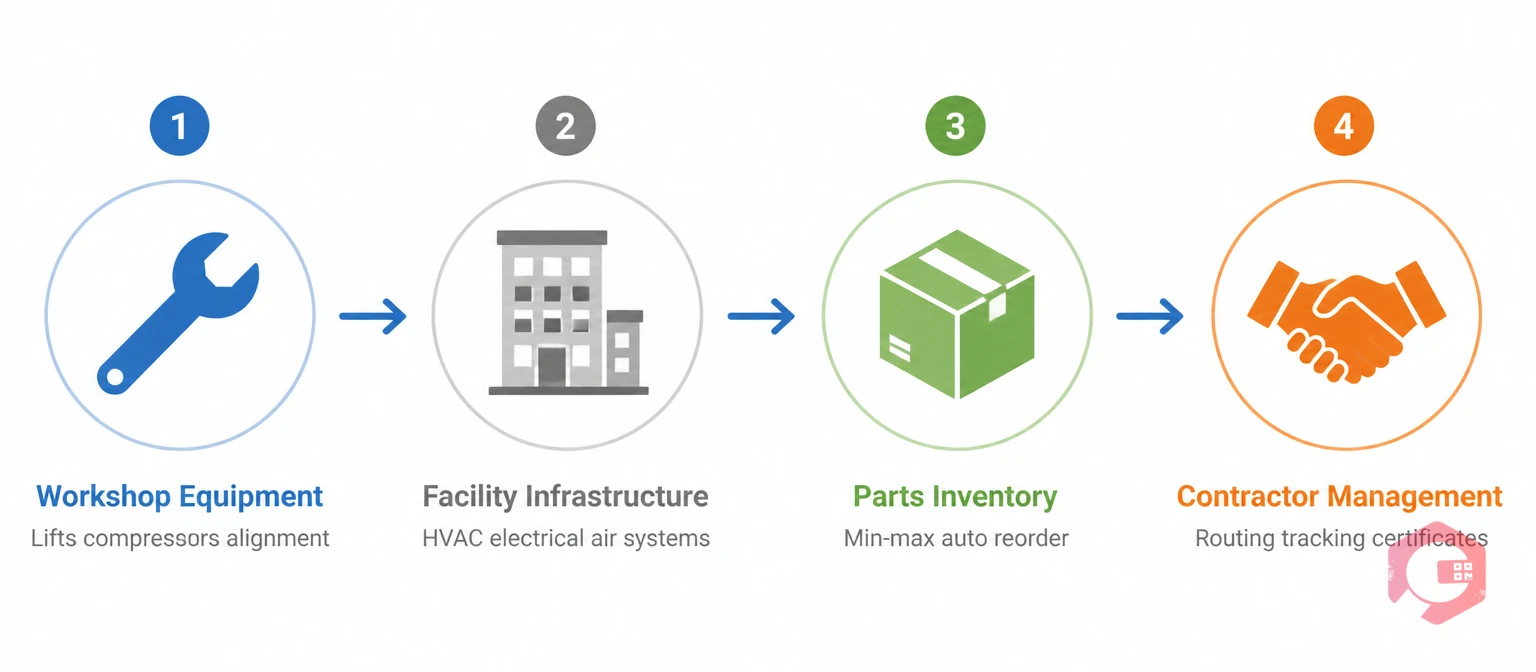
A dealership CMMS manages maintenance across four distinct asset categories, each with its own maintenance rhythm, compliance requirements, and failure consequences.
Workshop equipment is the highest-criticality category in terms of revenue impact. Vehicle lifts, wheel alignment systems, brake testers, diagnostic equipment, tyre fitting machines, nitrogen inflation units, and wheel balancers all need scheduled servicing, calibration, and statutory examination. A lift failure during a service appointment costs the revenue from that bay for the duration of the repair — plus emergency contractor rates. A mis-calibrated brake tester creates both a safety liability and a quality control failure. CMMS preventive maintenance schedules for workshop equipment ensure every piece of equipment gets serviced on time, with the right contractor, carrying the right certification, and producing a service record that satisfies both manufacturer audit and statutory requirements.
Facility infrastructure covers the building systems that keep the dealership operating: HVAC in the showroom, customer lounge, and parts department; compressed air supply to the workshop; electrical distribution including distribution boards and RCDs; lighting throughout the facility; car wash equipment; and the drainage and oil/water separation systems that sit under environmental compliance obligations. Facility infrastructure failures are less immediately visible than workshop equipment failures but accumulate into significant cost and compliance exposure when maintenance is unmanaged.
Spare parts and consumables inventory connects directly to maintenance execution. A CMMS with integrated spare parts inventory tracks the consumables and replacement parts used in maintenance — workshop equipment filters, lift hydraulic fluid, compressor belts, HVAC filters — with min-max reorder thresholds that generate purchase requisitions automatically when stock drops below the configured minimum. Parts required for a scheduled PM visit are reserved against the work order before the contractor arrives, eliminating the delay and emergency procurement costs of discovering a required part isn't in stock on the day of the service.
Contractor management is where most dealership maintenance programs leak most visibly. When third-party contractors handle lift examinations, HVAC servicing, electrical inspections, and compressor maintenance, tracking their visit schedules, work completion, certificate submission, and invoice reconciliation across multiple sites without a CMMS is administratively intensive and inherently unreliable. A CMMS routes work orders directly to contractors, tracks completion status, captures completion documentation against the relevant asset record, and surfaces overdue contractor visits before the compliance gap becomes a problem.

Not every CMMS feature delivers equal value in a dealership context. These are the capabilities that move the needle most directly on maintenance cost, equipment availability, and compliance.
Preventive maintenance scheduling is the foundation. Every asset in the dealership — from a 4-post lift to a showroom air handling unit — gets a PM schedule in the CMMS configured at the right interval: weekly, monthly, quarterly, annually, or usage-based. Cryotos's preventive maintenance software generates work orders automatically at the configured interval, assigns them to the right technician or contractor, and tracks completion. PM work orders that aren't completed on time escalate automatically — no chasing required.
Mobile work orders let technicians receive, complete, and close work orders from a smartphone on the workshop floor or in the car wash bay — without going back to a desktop terminal. Cryotos's mobile app supports QR code scanning to pull up asset records, photo capture for condition documentation, checklist completion with mandatory sign-off fields, and parts issue logging against the work order. A technician who completes a lift service logs the work, uploads the completion photos, and issues the parts used — all from the phone before leaving the asset.
Asset register with service history gives every maintainable asset a complete, searchable record: make, model, serial number, installation date, warranty status, last service date, next service due, and the full history of every work order ever raised against it. When a lift manufacturer's representative asks for the service history during an audit, the answer is three clicks in the CMMS — not a search through filing cabinets.
Compliance document management stores inspection certificates, statutory examination reports, insurance documentation, and contractor accreditations against the relevant asset records in Cryotos's document management module. Compliance documents are retrievable by asset, by date, and by document type — making manufacturer audits, insurance renewals, and regulatory inspections a document retrieval exercise rather than a document hunt.
Multi-site visibility gives dealer group operations managers a live view of maintenance status across every site — open work orders, overdue PMs, upcoming compliance deadlines, and contractor performance metrics — from a single dashboard. The BI Dashboard in Cryotos surfaces these KPIs without requiring manual reporting from site managers, giving regional leadership the data to prioritise visits, escalate non-performing contractors, and identify sites where deferred maintenance is accumulating before it becomes a failure event.
The operational difference between managing dealership maintenance without a CMMS and with one shows up at every level — from the technician doing a lift service to the group operations director reviewing compliance across 15 sites. The comparison below covers the dimensions that matter most in a dealership environment.
| Dimension | Without CMMS | With CMMS |
|---|---|---|
| Workshop equipment PM | Tracked on spreadsheet or memory; frequently late or missed | Auto-generated work orders at correct intervals; completion tracked |
| Lift and equipment compliance | Certificates in filing cabinet; due dates tracked manually if at all | Certificates stored in CMMS against asset; due date alerts fire ahead of deadline |
| Contractor management | Phone/email bookings; no systematic completion tracking | Work orders routed to contractor; completion and documentation tracked in system |
| Emergency repairs | Reactive — fault discovered when equipment fails during operation | Proactive — PM catches wear before failure; fewer emergency call-outs |
| Parts availability | Parts checked on day of service; emergency orders common | Parts reserved against work order before contractor arrives; min-max auto-reorder |
| Multi-site oversight | Site managers report problems upward; no systematic visibility | Live dashboard shows maintenance status, overdue PMs, compliance gaps across all sites |
| Audit preparation | Hours assembling records from multiple sources | Records retrievable from asset record in seconds |
CMMS implementation in a dealership environment works best when it follows a sequenced approach that avoids the two most common failure modes: trying to configure everything at once before going live, and going live with insufficient asset data to generate meaningful PM schedules.
Cryotos is built for multi-asset, multi-site maintenance operations — which maps directly to the dealership operating model whether you're running a single franchise point or a group of 20 locations. The platform handles the full maintenance workflow for a car dealership without requiring a dedicated IT implementation team or a long configuration runway.
For workshop equipment, Cryotos's work order management module handles the complete PM and corrective maintenance cycle. Lift service work orders generate automatically on the configured schedule, route to the approved contractor, carry the full checklist for that service type, and close with the service certificate uploaded against the lift's asset record. The service manager sees completion status in real time without chasing the contractor — and the next service due date updates automatically when the job closes.
For facility maintenance, the IoT meter reading integration connects to energy sub-meters and building sensors, so an HVAC unit drawing elevated current triggers a maintenance alert before it fails during a summer heatwave. WhatsApp notifications via Cryotos WhatsApp integration keep the service manager informed when a facility work order is raised, assigned, and completed — without requiring them to log into the system between appointments.
For dealer groups, the multi-site dashboard gives operations directors the cross-estate visibility that was previously impossible without manual reporting from site managers. Open work orders by site, overdue PM compliance rate by location, contractor performance across the group, and upcoming statutory inspection deadlines across all assets — all visible from a single screen, updated in real time.
Dealership maintenance teams using Cryotos report a 30% reduction in downtime and 25% faster repair times — outcomes that translate directly to more service bays available for customer vehicles, fewer emergency contractor call-outs at premium rates, and compliance records that satisfy manufacturer and regulatory audits without preparation effort. The CMMS for automobile dealers page covers the full feature set and dealer-specific use cases in detail.
If your dealership is managing workshop equipment compliance from a spreadsheet, tracking contractor visits through email threads, and discovering facility faults when they fail during trading, Cryotos CMMS gives you the system to run it properly — PM schedules, work orders, compliance documents, parts inventory, and multi-site visibility in one platform built for your operating environment. Book a demo at cryotos.com to see how the dealership maintenance workflow operates from asset register to audit-ready compliance record.
A CMMS for a car dealership manages all maintenance activity — workshop equipment servicing, facility maintenance, contractor scheduling, compliance tracking, and parts inventory — in one system. It generates preventive maintenance work orders automatically on the correct schedule for every asset, routes them to the right technician or contractor, tracks completion, stores compliance documentation against asset records, and gives managers a live view of maintenance status across the entire facility or dealer group. The result is fewer equipment failures during trading hours, lower emergency repair costs, and compliance records that are audit-ready at any point without preparation effort.
Prioritise equipment whose failure directly stops service bay operation: vehicle lifts first, then the compressed air system, then wheel alignment and brake testing equipment. These assets have both the highest revenue impact on failure and statutory compliance requirements that make regular scheduled examination non-negotiable. After these, configure PM schedules for tyre fitting machines, wheel balancers, diagnostic equipment, and car wash systems. Facility infrastructure — HVAC, electrical panels, oil separators — should be configured in parallel, as these carry both operational and environmental compliance obligations.
A CMMS manages lift compliance by scheduling the required thorough examinations automatically, routing work orders to the approved inspection contractor, and storing the examination certificate against the lift's asset record when the inspection completes. Alert notifications fire ahead of the examination due date — giving enough lead time to book the inspector rather than discovering an overdue certificate during an audit. The certificate storage means the service manager can produce the current examination certificate for any lift in seconds, from any device, without searching physical files.
Yes — multi-site management is a core capability of Cryotos. All locations in a dealer group operate under a single account with role-based access controls: site technicians and service managers see their own location's assets and work orders, while group operations managers and directors see a consolidated view across all sites. The BI Dashboard shows maintenance KPIs — open work orders, PM compliance rates, overdue inspections, contractor performance — by site and in aggregate, giving regional leadership the visibility to manage the estate proactively rather than reactively.
A single dealership can complete CMMS implementation — asset register, PM schedule configuration, contractor setup, and team training — in 2 to 4 weeks when the process follows a structured sequence. The longest step is the asset register walk, which typically takes 1 to 2 days for a single site. PM schedule configuration follows from OEM documentation and statutory requirements, which are usually already known by the service manager or facilities team. Team training for mobile app use runs in under an hour per group. Multi-site dealer group implementations typically phase by location, with each site going live 1 to 2 weeks apart.



Cryotos AI predicts failures, automates work orders, and simplifies maintenance—before problems slow you down.



