A CMMS (Computerised Maintenance Management System) helps organisations hit energy and ESG targets by giving maintenance teams the data, automation, and process control they need to reduce energy waste, cut emissions, and prove compliance to auditors and investors. According to the International Energy Agency's Energy Efficiency 2023 report, poorly maintained industrial equipment wastes up to 30% more energy than well-maintained equivalents — making maintenance operations one of the highest-impact levers for ESG performance.
If your sustainability team is setting carbon reduction targets but your maintenance team is still running on spreadsheets and reactive work orders, there is a gap. This post explains exactly how a modern CMMS bridges it — from energy monitoring and preventive maintenance scheduling to ESG reporting and audit readiness.
Most ESG frameworks — including the GRI Standards and the Task Force on Climate-related Financial Disclosures (TCFD) — require organisations to report on energy consumption, Scope 1 and Scope 2 emissions, and operational efficiency. Every one of those metrics is directly influenced by how well your physical assets are maintained.
A leaking compressed air system wastes energy continuously. An HVAC unit running on a degraded compressor draws 15 to 25% more power than a well-maintained one. A boiler with dirty heat exchanger surfaces loses thermal efficiency and burns more fuel to reach the same output temperature. These are maintenance failures — and they show up directly in your energy bill and your carbon footprint.

The most direct path from CMMS to energy savings runs through preventive maintenance. When PM schedules are enforced consistently — not skipped, deferred, or forgotten — equipment stays close to its peak efficiency operating point.
Consider a cooling tower serving an industrial facility. Properly maintained at scheduled intervals (cleaning the fill media, calibrating the basin controls, checking fan blade pitch), it consumes a known and predictable amount of electricity per tonne of cooling delivered. Let maintenance slip for six months and that same unit may draw 20 to 30% more power for the same output — a direct energy waste that a CMMS-enforced PM schedule prevents.
Beyond time-based intervals, a CMMS like Cryotos supports meter-based and condition-based PM triggers. This means you can schedule maintenance when an asset reaches a defined run-hour threshold or when a connected sensor reports a parameter outside its energy-efficient operating band — not just on a calendar date. This approach catches efficiency degradation earlier and ties maintenance directly to measured energy performance rather than elapsed time.
Two of the highest-impact PM tasks for energy efficiency are lubrication and filter replacement — and both are routinely missed when maintenance teams rely on manual systems. A dry or contaminated bearing forces a motor to work harder. A clogged air filter drops compressor output efficiency. A CMMS with automated PM reminders and checklist enforcement makes sure neither task gets overlooked. Cryotos's maintenance checklists can be configured to capture before-and-after condition readings at each PM visit, creating the performance data trail your energy audits require.
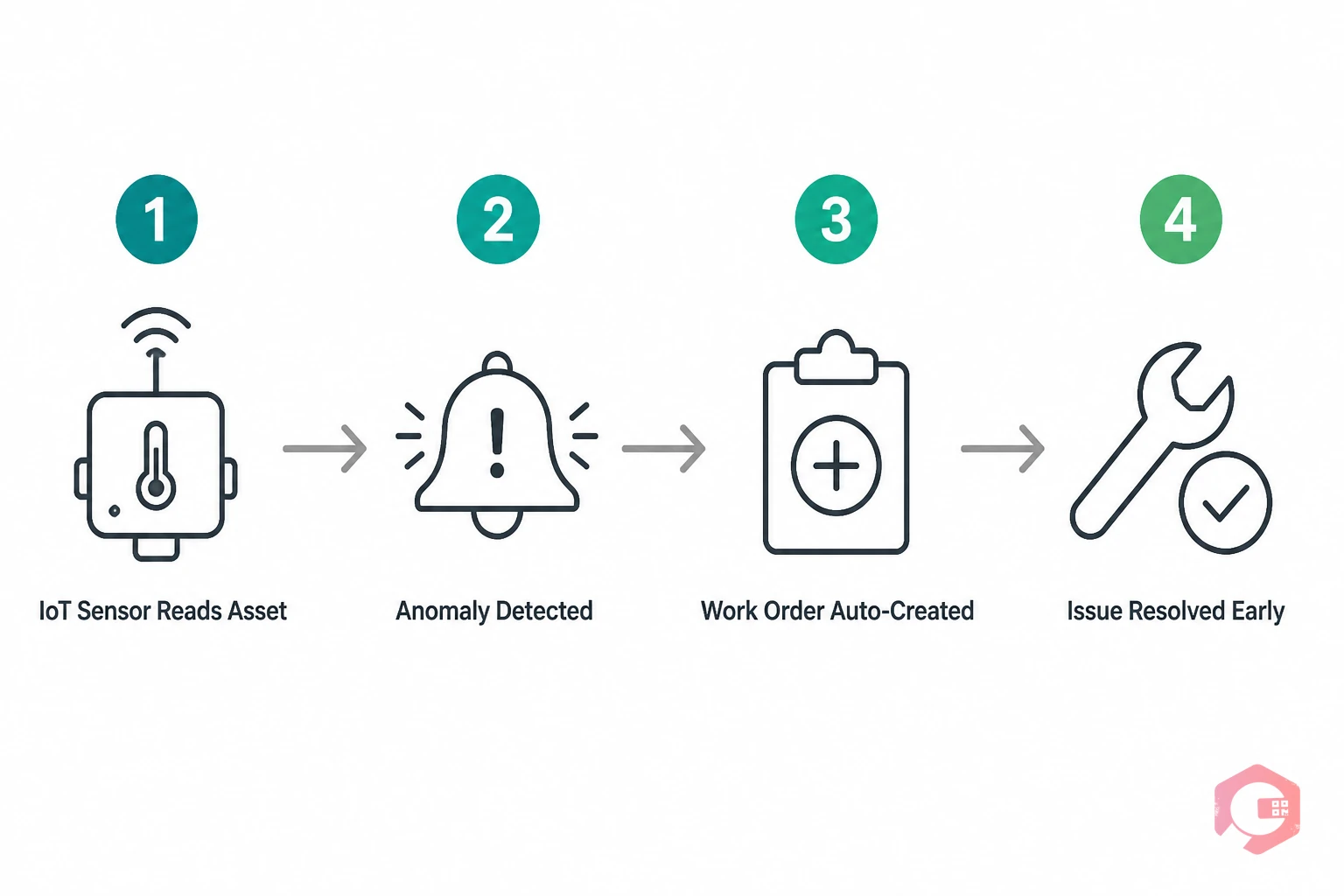
A CMMS connected to IoT sensors takes energy management from reactive to proactive. Rather than discovering that a chiller has been running inefficiently for three months when the electricity bill arrives, your maintenance team gets an alert the moment current draw or temperature differential moves outside the normal operating envelope.
Cryotos integrates with IoT meter reading devices and SCADA systems, pulling real-time energy and process data directly into the maintenance workflow. When a sensor detects abnormal energy consumption on a monitored asset, it can automatically trigger a work order — so the problem is investigated and resolved before it inflates your quarterly energy report. This kind of IoT meter reading integration closes the loop between energy data and maintenance action.
According to a McKinsey analysis of sustainable operations, industrial companies that combine predictive maintenance with real-time energy monitoring achieve energy savings of 10 to 20% compared to organisations using time-based PM alone. The difference is the speed of response — catching degradation early rather than correcting large efficiency losses after the fact.

Reporting ESG performance is not just about having good data — it is about being able to prove it. Investors, sustainability auditors, and regulatory bodies increasingly require evidence that reported figures are backed by documented processes and verifiable records. A CMMS is, at its core, a record-keeping system, and that makes it a natural foundation for ESG audit readiness.
Every work order completed in Cryotos creates a timestamped record: who performed the work, what was done, what condition the asset was found in, what parts were used, and what the post-maintenance state was. Over time, this builds a complete maintenance history for every asset in your facility — the kind of documented evidence that gives sustainability auditors confidence that your energy and emissions data reflects real operational conditions, not estimates.
Connecting maintenance data to ESG reporting is simpler when your CMMS captures the right data fields. In Cryotos, work orders can be tagged by asset type, energy system, and ESG-relevant category (for example, "cooling efficiency," "combustion tuning," or "refrigerant leak check"). Your BI dashboard can then aggregate these tags into reports that map directly to the ESG metric categories your framework requires — whether that is energy intensity per unit of production, planned versus reactive maintenance ratio, or asset availability percentage.
Beyond voluntary ESG reporting, many industries face mandatory energy and environmental compliance requirements. Facilities operating under ISO 50001 (energy management) or ISO 14001 (environmental management) must demonstrate that their management systems include documented maintenance procedures and performance monitoring. A CMMS provides both — and Cryotos's document management capability keeps equipment manuals, inspection certificates, and compliance records attached directly to the relevant assets, so nothing gets lost when you need it most.
Scope 1 emissions come directly from assets you operate — combustion equipment, refrigerant systems, process heaters. Scope 2 emissions come from the electricity you purchase. A CMMS helps reduce both.
For Scope 1, the maintenance lever is combustion efficiency and refrigerant management. Boilers, furnaces, and engines that are regularly tuned and operating within specification emit less CO₂ per unit of useful output. Refrigeration and air conditioning systems that are checked for leaks on a scheduled basis release less refrigerant (which is often a high global warming potential substance) to atmosphere. Your CMMS enforces both of these maintenance disciplines through scheduled work orders and checklist completion requirements.
For Scope 2, the lever is electricity consumption — which is where preventive maintenance on electrical equipment and HVAC systems pays off most directly. Every kilowatt-hour saved through better-maintained motors, compressors, and chillers is a kilowatt-hour not purchased from the grid, reducing your Scope 2 footprint. You can track this progress through Cryotos's downtime tracking and energy-tagged work order history, building a quarterly picture of efficiency improvement that translates directly into your ESG report.
For facilities working toward net-zero or science-based targets, the Science Based Targets initiative (SBTi) Corporate Manual recommends starting with operational efficiency improvements before investing in offsets — and maintenance-driven energy reduction is exactly the type of operational efficiency improvement that counts toward verified Scope 1 and 2 reductions.
ESG performance is not just about how you operate assets — it is also about when you replace them. Ageing, inefficient equipment is often both an energy drain and a reliability risk. But the business case for replacement is hard to make without data showing the true cost of keeping an asset in service versus investing in a newer, more efficient alternative.
A CMMS builds that case automatically. By tracking cumulative repair costs, energy-tagged work order frequency, and asset availability over time, Cryotos's asset maintenance management capability gives facilities managers the data to identify which assets are becoming net energy and cost liabilities — and to time replacements so that capital investment in more efficient equipment delivers the maximum ESG benefit.
This is particularly relevant for HVAC equipment, motors, and compressed air systems, which together typically account for 50 to 70% of a manufacturing facility's electricity consumption according to the US Department of Energy's Advanced Manufacturing Office. Knowing exactly which units are underperforming — and by how much — turns ESG strategy from a reporting exercise into an operational improvement programme.
Yes — indirectly but meaningfully. A CMMS reduces energy waste by keeping equipment running at peak efficiency through consistent preventive maintenance. It also enables faster response to energy anomalies through IoT integration. Both effects reduce the energy consumed per unit of output, which directly lowers Scope 1 and Scope 2 carbon emissions. The IEA estimates that maintenance-driven efficiency improvements in industry can reduce energy use by 10 to 30% depending on the sector.
A CMMS creates verified, timestamped records of every maintenance activity performed on every asset. This evidence base supports ESG reporting by documenting that energy management procedures are in place and followed, that emissions-relevant equipment (boilers, refrigeration, generators) is maintained to specification, and that efficiency improvements are real rather than estimated. Many ESG frameworks — including GRI, TCFD, and ISO 50001 — specifically require documented maintenance management as part of their operational performance evidence requirements.
CMMS maintenance records are directly relevant to GRI 302 (Energy), GRI 305 (Emissions), ISO 50001 (Energy Management Systems), ISO 14001 (Environmental Management), and TCFD operational resilience disclosures. The specific data points most commonly drawn from a CMMS include energy intensity per production unit, maintenance-to-failure ratio, asset availability, and PM compliance rate.
Most facilities see measurable energy efficiency improvements within three to six months of consistent PM compliance, as the first round of deferred maintenance is completed and equipment returns closer to its design efficiency point. Facilities with IoT integration and automated energy anomaly alerts often see faster gains — because problems are caught and resolved weeks or months earlier than in organisations relying on manual monitoring.
If your organisation is building toward ESG targets and your maintenance operations are not yet part of that strategy, there is a straightforward place to start. Cryotos CMMS connects your maintenance team's daily work directly to your organisation's energy and sustainability goals — through automated PM schedules, IoT-triggered work orders, ESG-relevant reporting, and a complete asset history that gives auditors and investors the evidence they need. The organisations that hit their ESG targets fastest are the ones that treat maintenance excellence and sustainability as the same objective — because they are.



Cryotos AI predicts failures, automates work orders, and simplifies maintenance—before problems slow you down.