

A Computerized Maintenance Management System (CMMS) for EPC firms tracks every asset from the day it's ordered through installation, commissioning, and final handover to the owner. Most CMMS tools are built for a plant or building that's already running. A CMMS for EPC firms has to do more. It has to follow assets that don't exist yet, then hand over a clean, verified record once the project closes. This guide breaks down what makes EPC maintenance different, which modules matter most, and how to choose the right system for your project. It also covers the common rollout mistakes worth avoiding.
Key Takeaways

A CMMS for EPC firms is asset software that starts tracking equipment at procurement and ends with a verified handover to the owner. It logs each asset as it's ordered. It follows that asset through installation and testing. Then it produces the asset register the owner needs at handover.
Most teams think of a CMMS as a tool for a site that's already running. EPC firms need something broader. That's why Cryotos built a dedicated CMMS software for engineering and procurement instead of repurposing a plain facilities tool. On an EPC project, the "assets" are often still being built and tested. They aren't reconciled against design records until close to handover.
Standard CMMS platforms assume a stable asset in a fixed location. EPC projects don't work that way. ISO 55001 is the international standard for asset management systems. It requires organizations to control an asset's performance, risk, and cost across its full life, not just while it's operating, according to the ISO 55001 asset management standard.
EPC projects create three gaps a generic system can't close:

The EPC Asset Lifecycle Ladder:
Most teams only plan for the last rung of this ladder. Getting the first three right is what makes handover fast instead of a scramble.
See how downtime and repair-time metrics carry through commissioning with the MTTR calculator.
A punch list is the running list of defects found during construction that must be fixed before an asset goes into service. On an EPC project, punch-list items live on the same work order system as everyday maintenance, so nothing gets tracked twice or lost between spreadsheets.
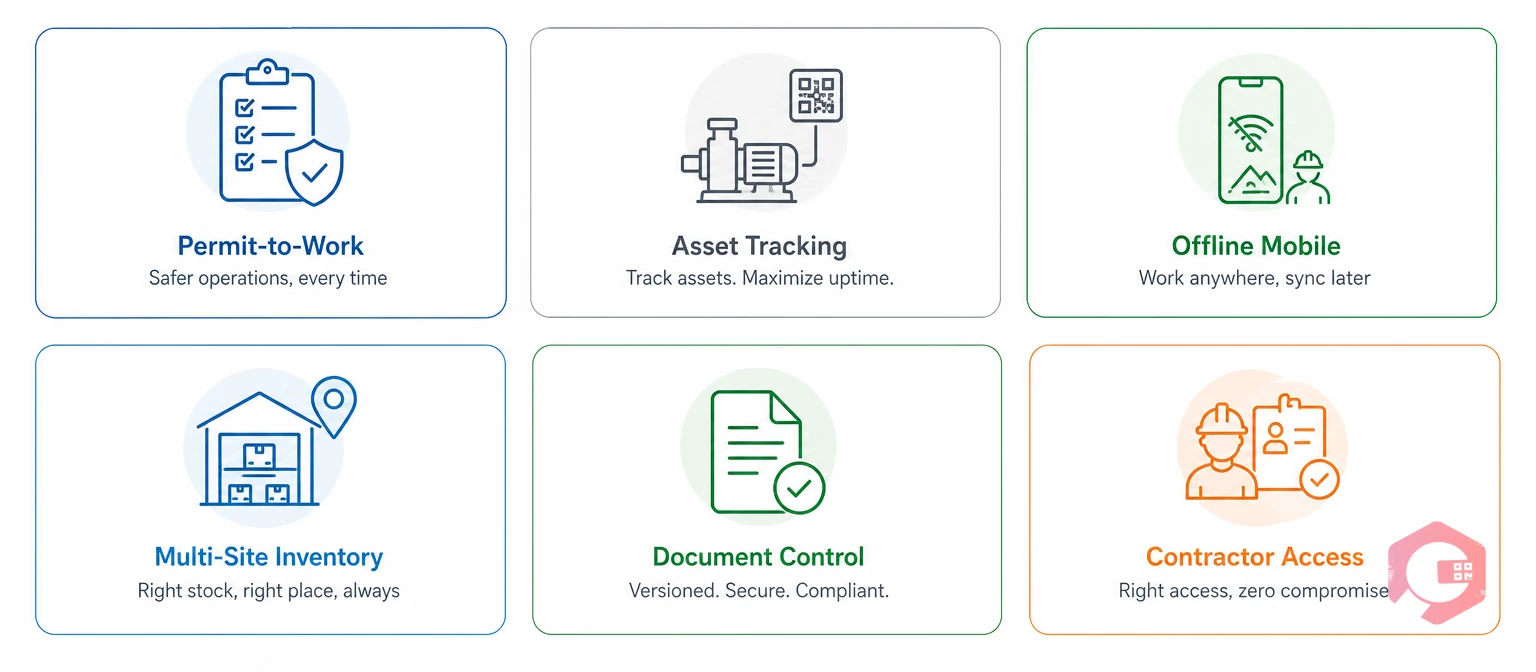
An EPC project needs more than work orders and preventive maintenance schedules. These modules cover the gaps a generic CMMS leaves open:
The clearest way to see the gap is side by side. Generic CMMS platforms are built for steady-state facilities. EPC projects need a system that also covers construction and handover.
| Capability | Generic CMMS | CMMS for EPC Firms |
|---|---|---|
| Asset creation point | When equipment goes into service | At procurement, before installation |
| Work order scope | Breakdowns and routine PM | Punch-list, commissioning, and PM |
| High-risk work | Occasional permit forms | Daily permit-to-work with audit trail |
| Connectivity assumption | Stable office or plant network | Offline-first for remote sites |
| End goal | Ongoing maintenance record | Verified handover package |
The right column is what an EPC firm needs from day one of procurement through the final signature at handover.
Running one system from procurement through handover changes how a project closes out. It doesn't just help with day-to-day maintenance.
Maintenance teams using Cryotos have reported up to 30% reduction in unplanned downtime and 25% faster repair turnaround once assets are tracked in one system. Operations that carry this discipline into the construction phase tend to see the same gains show up earlier, during commissioning rather than after handover.
Not every CMMS for EPC firms on the market covers the same ground. Match the system to how your project actually runs, not just its feature list. Check these points before you commit:
Asset reconciliation is the check that confirms an installed asset matches what was ordered and designed. Most operations that get handover right start evaluating a CMMS during procurement, not after construction is already underway.
Even the right CMMS for EPC firms runs into friction on a live project. Knowing the common snags ahead of time makes rollout smoother. Most of these issues are easy to avoid once a project team knows to expect them.
Subcontractors often resist a new system mid-project, especially if their own firm already has a tool they prefer. The fix is usually simple: give them scoped mobile access tied only to their own work orders and permits, so there's nothing extra to learn.
Asset records are only as good as what gets entered when equipment is ordered. Most operations assign one person per project to own procurement-stage data entry. A missing serial number or warranty date is much harder to fix once the equipment is buried inside a finished structure.
Greenfield and offshore sites often have no signal for weeks at a time. An offline-first mobile app avoids blocked work orders. Teams sync everything the next time they're in range, so nobody loses a day's work waiting for a network bar to appear.
EPC projects change scope constantly, and every change order can add, remove, or swap equipment. If the asset register only updates at handover, these changes pile up and become hard to trace. Tying every scope change to a work order or asset update as it happens keeps the register accurate. It avoids a separate reconciliation project at the end.
The best CMMS for EPC firms tracks assets from procurement through handover, not just during operation. Look for permit-to-work, offline mobile access, and asset reconciliation reporting as the deciding features.
An EPC firm needs a CMMS during construction, since punch-list tracking, permits, and calibration all happen before handover. Waiting until after handover means rebuilding asset records from scratch.
Asset reconciliation checks that installed equipment matches the original design and procurement records, including location and spec checks. A regular asset register just lists what exists without that verification step.
Yes, subcontractors can use the same CMMS through role-based access that limits them to their own trade's work orders and permits. This avoids paying for full licenses while keeping one system of record.
The verified asset register, documents, and maintenance history export to the owner as the O&M handover package. Some EPC firms also keep using the same system into ongoing operations if the owner retains it.
Most EPC firms can set up core work orders, asset registers, and permit workflows within a few days. Legacy enterprise systems often take months instead. The bigger time cost is training subcontractors and building good data entry habits early, not the software setup itself.
An EPC project's maintenance data is only as useful as the system tracking it from day one. Schedule a free demo to see how Cryotos follows your assets from procurement through handover.



Cryotos AI predicts failures, automates work orders, and simplifies maintenance—before problems slow you down.



