

CMMS software helps food and beverage companies meet HACCP requirements by automating preventive maintenance on critical control point equipment, generating tamper-evident digital records of every inspection and corrective action, and producing the audit-ready documentation that regulators, certification bodies, and retail customers demand. When your CMMS is aligned to your HACCP plan, compliance stops being a paperwork burden and becomes an automatic output of daily maintenance operations.
According to the FDA's HACCP Principles and Application Guidelines, documented corrective actions, monitoring records, and verification procedures are non-negotiable requirements of any HACCP plan. A modern CMMS produces all of this documentation automatically — timestamped, attributable, and immediately retrievable during an inspection.
Key Takeaways

Hazard Analysis and Critical Control Points (HACCP) is the globally recognized, science-based food safety system that identifies biological, chemical, and physical hazards in food production and establishes specific control measures to prevent them from reaching the consumer. Originally developed for NASA's space food program in the 1960s, HACCP is now a legal requirement in most major markets and the foundation of virtually every food safety certification scheme, from SQF and BRCGS to FSSC 22000 and ISO 22000.
For food and beverage manufacturers, the stakes are concrete. The FDA's Food Safety Modernization Act (FSMA) requires that food facilities identify hazards and implement preventive controls — and it explicitly names equipment maintenance and calibration as recognized preventive controls when equipment failure could result in a food safety hazard. The USDA mandates HACCP plans for all meat and poultry processors. Missing a preventive maintenance task on a pasteurizer or letting a metal detector's calibration lapse is not just an operations failure — it's a documented regulatory non-conformance that can trigger FDA warning letters, consent decrees, or product recall.
Where maintenance intersects with HACCP is often underappreciated until an audit or an incident. A pasteurizer running 2°C below its validated kill temperature, a metal detector whose sensitivity hasn't been verified since the last production run, a cold store compressor with a missed quarterly inspection — these are not just maintenance backlogs. They are potential HACCP Critical Control Point failures. This is why food safety managers increasingly treat their CMMS as a compliance tool, not just a work order system.
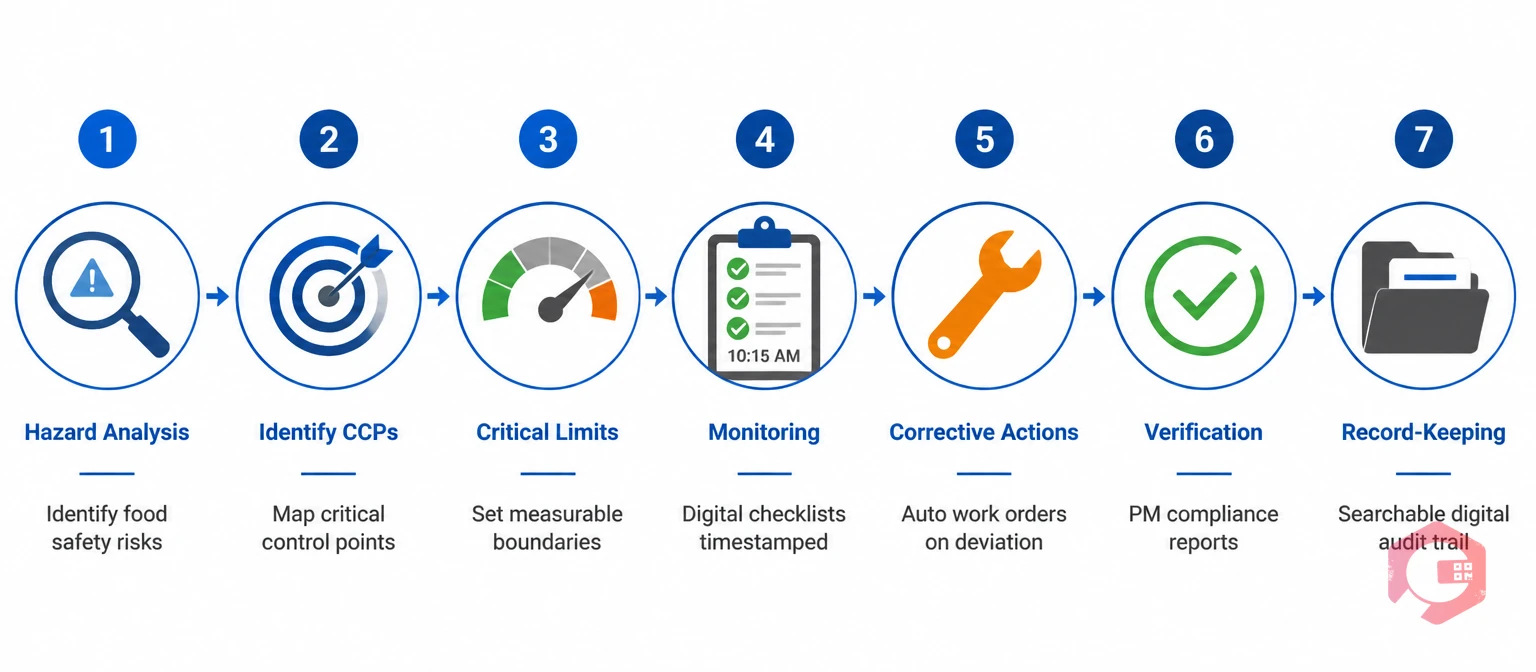
HACCP is built on seven principles, each with specific documentation and operational requirements. A CMMS configured to your HACCP plan provides direct support for all seven — here's exactly how:
The hazard analysis identifies which production steps pose a significant food safety risk, and equipment condition is a direct input. A worn gasket on a filling machine can harbour pathogens; a miscalibrated temperature probe at a cooking step can allow Listeria or Salmonella to survive. A CMMS stores the complete maintenance and calibration history for every asset — the factual record that supports an accurate hazard analysis. When a new hazard is identified, the CMMS is updated immediately to add the required monitoring and maintenance requirements for that asset, ensuring the hazard analysis stays current.
CCPs are the production steps where control is essential to prevent or eliminate a food safety hazard — cooking temperatures, metal detection, pasteurization, chilling rates, and allergen separation are common examples. In a CMMS, each CCP maps directly to a specific asset: the pasteurizer on Line 2, the metal detector at the end of Line 4, the cold store compressor in Building C. CCP-designated assets receive their own maintenance and calibration schedules that cannot be skipped or rescheduled without an escalation. Work orders on CCP equipment carry critical priority flags, ensuring they complete before production resumes after any maintenance event.
Critical limits are the measurable boundaries — temperature, pH, pressure, time — that must be met at each CCP. A CMMS supports critical limits by storing the validated operating parameters for every CCP asset and triggering alerts when calibration readings or equipment faults suggest those limits may not be achievable. When integrated with IoT sensors — temperature probes, pressure gauges, flow meters — the CMMS can monitor CCP parameters continuously and generate corrective maintenance work orders the moment a reading drifts toward a critical limit boundary, before a production supervisor needs to catch the deviation manually.
HACCP monitoring procedures define exactly how, when, and by whom each CCP will be observed or measured. CMMS digital checklists replicate these procedures precisely. Technicians complete each checklist item and authenticate their sign-off — the timestamp is applied automatically by the system, not written in by hand. Unlike paper logs that can be backdated or filled in retrospectively at end of shift, CMMS monitoring records are tamper-evident and immediately retrievable, timestamped to the second.
When monitoring reveals a deviation from a critical limit, a defined corrective action must be taken and documented. This is where CMMS work order management becomes a direct HACCP compliance tool. When a CCP deviation is identified — a temperature reading below the validated limit, a metal detector failing its sensitivity check — the CMMS generates a corrective action work order automatically, capturing the asset details, the deviation observed, the required action, and the technician assigned. Every corrective action is logged with a timestamp and digital sign-off, producing exactly the documentation that HACCP auditors need to see.
Verification confirms that the HACCP system is working as intended — that critical limits are scientifically valid, monitoring is being executed correctly, and corrective actions are effective. CMMS reporting tools provide the documented verification evidence auditors and inspectors review: PM compliance reports showing whether all CCP maintenance tasks are completing on schedule, calibration status reports showing whether all monitoring instruments are within their calibration intervals, and corrective action closure reports confirming that HACCP deviations are being resolved fully and on time.
Record-keeping is the HACCP principle that maps most directly to CMMS functionality. HACCP requires documented records of hazard analysis, CCP monitoring, corrective actions, equipment calibration, and verification activities. A CMMS stores all of this in a searchable, timestamped digital record that is immediately accessible during an inspection or audit. When a food safety auditor asks for the maintenance and calibration history on the pasteurizer over the past 12 months, the CMMS produces that report in minutes — not the hours it would take to compile paper binders or email threads.
Not all equipment carries the same HACCP risk. The assets below represent the most common CCPs in food and beverage manufacturing, and each one requires a documented, regularly executed maintenance and calibration schedule that a CMMS is built to manage:

When evaluating a CMMS for food manufacturing, these are the capabilities that matter most for HACCP compliance — and the ones your configuration should prioritise:
HACCP monitoring procedures require that each check is performed by a specific person at a specific time. Maintenance checklists in a CMMS enforce this by requiring technician authentication before a checklist item can be marked complete. Timestamps apply automatically. This eliminates the end-of-shift log reconstruction that makes paper monitoring records unreliable — and unacceptable to increasingly rigorous food safety auditors.
The preventive maintenance software module handles the scheduling, work order generation, assignment, and escalation for all CCP-linked assets. When a pasteurizer's quarterly seal inspection is due, the CMMS creates the work order, assigns it, and sends a notification. If it isn't completed before the deadline, the system escalates to the maintenance manager — no CCP maintenance task falls through the cracks because someone forgot to create a work order.
Temperature probes, pH meters, pressure gauges, and metal detection challenge kits all require regular calibration at frequencies defined in your HACCP plan. The CMMS tracks calibration due dates for every instrument, generates calibration work orders automatically, stores calibration certificates against the instrument's asset record, and alerts the maintenance manager when a calibration is approaching expiry. When an auditor asks for the calibration certificate on the retort's temperature recorder, it's retrieved in seconds — not from a filing cabinet.
When a CCP deviation occurs — a temperature out of range, a metal detector failing its challenge test — the CMMS generates a corrective action work order immediately. The work order captures the deviation identified, the corrective action taken, parts used, and the technician's digital signature confirming the equipment has been restored to compliance. This produces the corrective action documentation that HACCP Principle 5 requires, without any separate reporting effort from the maintenance team.
Every CCP-designated asset has a permanent digital record in the CMMS covering every inspection, repair, calibration, and corrective action it has ever received. This history is searchable and filterable by date, technician, work order type, and part replaced. Regulatory inspectors and certification auditors who request equipment histories get an organised, timestamped record immediately — not a request to return next week while the team pulls binders together.
For manufacturers moving toward continuous CCP monitoring — as FSMA's preventive controls framework increasingly implies — CMMS integration with IoT sensors, SCADA systems, and PLC edge devices enables real-time data capture from CCP assets. When a sensor reading at a cooking step drifts below the critical limit, the CMMS creates a high-priority corrective action work order automatically, before anyone has to notice the deviation on a paper chart or a disconnected monitoring system.
FSMA's preventive controls rule is explicit: equipment maintenance and calibration are required preventive controls when equipment failure could result in a food safety hazard. This means a missed PM on a pasteurizer or a lapsed metal detector calibration is a documented regulatory non-conformance, not a maintenance backlog item to reschedule. The CMMS eliminates the operational conditions that allow these failures to occur.
Here's what the workflow looks like in a properly configured food manufacturing environment:
Every CCP-linked asset — pasteurizers, retorts, metal detectors, X-ray systems, chilling units, cold stores, allergen-separation equipment — is registered in the CMMS as a distinct asset with its own profile. The profile carries the CCP designation, critical limits, the maintenance schedule required by the HACCP plan, and the calibration frequency for any associated monitoring instruments.
For each CCP asset, the CMMS generates PM schedules based on calendar intervals, production hours, or both. A pasteurizer might require a seal inspection every 30 days and a full service every 500 production hours — the CMMS tracks both triggers simultaneously. When a PM is due, a work order generates automatically, pre-loaded with the task list, safety requirements, and the digital checklist the technician must complete before the work order can be closed.
Technicians receive work orders on their mobile devices and complete maintenance tasks directly at the CCP equipment. They fill in the digital checklist in real time, attach photos if required (a replaced seal, a calibration certificate), and sign off with their credentials. Every action is timestamped automatically. If a technician finds a defect during a routine PM, they log a corrective action work order directly from the mobile app — no paper, no office, no delay.
At any time — weekly review, pre-audit preparation, or during an unannounced inspection — the CMMS generates PM compliance reports showing which CCP maintenance tasks were completed on time, which were overdue, and what corrective actions resulted from maintenance findings. This report becomes the verification evidence for HACCP Principle 6 and the record-keeping output for Principle 7, produced automatically without any additional effort from the food safety team.
HACCP audits — by the FDA, a state food safety agency, a retail supplier approval team, or a certification body like SQF, BRCGS, or FSSC 22000 — require comprehensive, organised, and immediately retrievable documentation. A CMMS eliminates the most common audit preparation failure: spending days assembling records that should have been continuously and automatically captured. Here's what audit-ready HACCP documentation looks like in a CMMS-managed environment:
Every work order completion, checklist sign-off, and corrective action creates a permanent, timestamped record the moment it's saved. There's no end-of-shift data entry, no paper-to-digital transcription, and no opportunity to reconstruct records after the fact. When an auditor arrives — announced or not — every maintenance and monitoring record is immediately available in the CMMS, searchable by date, asset, technician, or work order type.
Paper maintenance logs can be backdated, altered, or lost. CMMS records are tamper-evident: each entry carries an automatic timestamp and is attributed to the authenticated user who created it. Any modification to a closed work order creates a new audit trail entry, preserving the original record. This documentation integrity is increasingly required by major food safety certification schemes and retail supplier approval programmes. Your regulatory compliance checklist becomes a live, always-current document rather than an annual exercise.
Calibration certificates for temperature probes, pressure gauges, and metal detection challenge test kits can be scanned and attached directly to the relevant instrument's asset record in the CMMS. Expiry dates automatically feed the calibration alert system. When an auditor asks for the calibration certificate on Line 3's metal detector, the maintenance manager retrieves it in seconds — not from a filing cabinet, not from an email archive.
Every HACCP deviation that triggers a corrective maintenance work order is logged automatically with full details: what the deviation was, when it was identified, who identified it, what corrective action was taken, and when the equipment was returned to compliance. This log is the HACCP corrective action record that Principle 5 requires — produced automatically by the CMMS without any additional documentation effort from the maintenance or quality team.
Cryotos is built for the maintenance complexity of asset-intensive industries, and its feature set maps directly to the HACCP compliance requirements that food and beverage manufacturers face. Our food and beverage CMMS software is used by food manufacturers to embed HACCP compliance into daily maintenance operations — not to manage it as a separate, parallel documentation burden.
Cryotos supports a complete asset hierarchy — plant, line, equipment, component — so CCP equipment is tagged and managed distinctly from general facility assets. Every CCP-designated asset carries its full maintenance history, calibration records, and open work orders, all accessible via QR code scan from the production floor. A technician standing next to the pasteurizer on Line 2 scans its code and immediately sees when it was last serviced, what the next PM is, and whether any corrective actions are pending — without leaving the production floor to check a desktop system.
Cryotos's preventive maintenance engine supports both calendar-based and meter-based triggers — essential for food manufacturing, where a pasteurizer may require maintenance after a defined number of production hours rather than a fixed calendar interval. Once your HACCP-driven PM schedules are loaded into Cryotos, the system generates work orders automatically, assigns them to the right technician, and escalates overdue tasks before they become non-conformances. PM compliance rates for CCP equipment are tracked and reportable at any time.
Every HACCP monitoring procedure can be replicated as a digital checklist in Cryotos. Checklists are embedded in work orders, and technicians must complete every item and provide their digital signature before the work order closes. Checklists can include pass/fail criteria, numeric readings with acceptable ranges, and mandatory photo attachments — all of which become part of the permanent work order record. This produces the Principle 4 monitoring records with the timestamp precision and technician attribution that paper checklists cannot provide.
Cryotos integrates with IoT sensors, SCADA systems, and PLC edge devices to pull real-time data from CCP equipment directly into the maintenance platform. When a temperature probe at a cooking step reads below the critical limit, Cryotos generates a high-priority corrective action work order automatically — before a production supervisor notices the deviation on a chart. This continuous monitoring capability moves beyond the manual shift-end checks that most HACCP plans still rely on.
Cryotos's mobile app operates in full offline mode — critical for food manufacturing environments where cellular coverage is limited near production equipment. Technicians complete work orders, checklists, and corrective actions directly at the CCP equipment, not at a desktop hours later. Data syncs automatically when connectivity is restored. HACCP monitoring records reflect what happened, at the time it happened, at the location where it happened.
Cryotos's report builder and BI Dashboard let food safety managers generate HACCP-specific compliance reports on demand — PM completion rates for CCP equipment, calibration status by instrument, corrective action closure rates, and downtime events on critical assets. When an SQF auditor or FDA inspector arrives, the food safety team produces a complete HACCP documentation package in minutes. Facilities using Cryotos consistently report that audit preparation time drops by more than half after full CMMS implementation across their CCP equipment portfolio.
A CMMS supports HACCP compliance by automating preventive maintenance on CCP equipment, generating tamper-evident digital records of every maintenance activity, tracking calibration due dates for monitoring instruments, and producing corrective action documentation and verification reports automatically. It transforms HACCP record-keeping from a manual, paper-based burden into an always-current digital system that is continuously audit-ready.
Yes. Equipment maintenance is a recognized preventive control under both HACCP and FSMA. The FDA's preventive controls rule explicitly states that equipment maintenance and calibration are required preventive controls when equipment failure could result in a food safety hazard. Missed maintenance on a pasteurizer, metal detector, or temperature-controlled storage unit constitutes a HACCP non-conformance and can trigger regulatory action.
A CMMS supports food safety audits by maintaining a complete, timestamped, tamper-evident digital record of all maintenance activities, calibration events, and corrective actions for every CCP asset. When auditors from the FDA, SQF, BRCGS, or a major retail customer request maintenance documentation, the CMMS produces complete records for any asset, for any date range, in minutes. This is far faster and more reliable than assembling paper records or searching email archives.
Yes. FSMA's preventive controls for human food rule specifically identifies equipment maintenance and calibration as preventive controls that must be documented. A CMMS provides the automated scheduling, digital record-keeping, corrective action tracking, and compliance reporting that FSMA requires — creating the documented evidence that food facilities must produce during FDA inspections and routine verification activities.
The most critical CMMS features for HACCP compliance are: digital checklists with mandatory sign-off and automatic timestamping; automated PM scheduling with escalation for overdue tasks on CCP equipment; calibration tracking and certificate storage per instrument; corrective action work order generation with full technician attribution; IoT integration for real-time CCP parameter monitoring; and on-demand compliance reporting. Together, these produce the monitoring, corrective action, and verification records that HACCP and FSMA require without any separate documentation effort.
Food and beverage companies that still manage HACCP maintenance records on paper or in disconnected spreadsheets carry preventable compliance risk — every missed PM, every undocumented corrective action, and every calibration that expires unnoticed is a potential audit finding or, worse, a food safety incident. Schedule a free demo and see how Cryotos embeds HACCP compliance into your daily maintenance operations — automatically, completely, and always audit-ready.




Cryotos AI predicts failures, automates work orders, and simplifies maintenance—before problems slow you down.



