
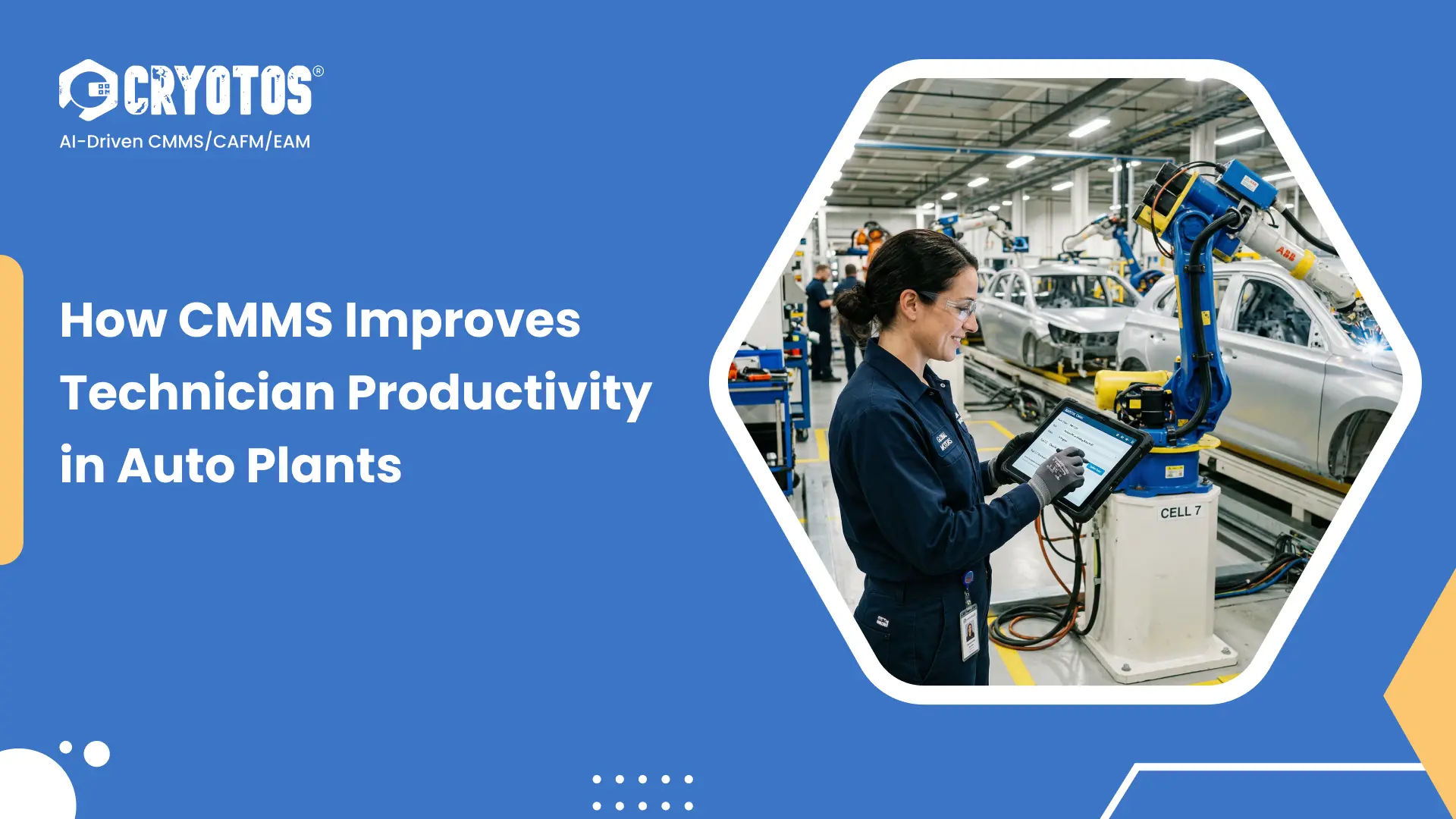
CMMS (Computerized Maintenance Management System) improves technician productivity in automotive plants by centralizing assigned activities, raised work requests, and digital checklists into a single platform — giving maintenance managers real-time visibility into who is doing what, how fast, and how well. In automotive manufacturing, where unplanned downtime costs an average of $22,000 per minute on the production line, having every technician's activity tracked and optimized isn't a nice-to-have — it's survival. Cryotos CMMS gives automotive maintenance teams the tools to eliminate guesswork, reduce idle time, and close the loop on every task from raise to resolution.
Employee efficiency tracking in a CMMS means measuring how effectively each technician completes maintenance tasks — covering speed, accuracy, SLA adherence, and task completion rates. It goes far beyond simple timesheets. A modern CMMS logs every action a technician takes: when they accept an assigned task, when they start work, how long each step takes, what checklist items they complete, and when they close the job.
In an automotive plant, this level of visibility is critical. You might have 20 technicians across three shifts maintaining assembly robots, conveyor systems, CNC machines, and paint booth equipment simultaneously. Without a CMMS tracking assigned and raised activities, your maintenance manager is flying blind — relying on verbal check-ins and paper logs that are already outdated by the time they're reviewed.
Cryotos CMMS captures three core activity types that together paint a complete picture of technician productivity: assigned activities (tasks pushed to a technician by a supervisor), raised activities (work requests initiated by the technician or anyone on the floor), and checklists (structured task sequences that ensure quality and compliance). Each feeds into dashboards that give managers live efficiency metrics for every individual on the team.
Assigned activities are work orders or preventive maintenance tasks that a supervisor or system scheduler pushes directly to a specific technician. In Cryotos, every assigned activity carries a clear owner, a due date, a priority level, and a checklist of steps to complete. The moment it lands in a technician's queue — on their mobile app — the clock starts, and the system starts tracking.
When an activity is assigned in Cryotos, the system captures the full lifecycle of that task:
In an automotive plant running three shifts, this matters enormously. If a robot arm on an assembly line is scheduled for weekly lubrication and one technician consistently completes the task in 25 minutes while another takes 55 minutes, the CMMS flags the discrepancy. Managers can investigate — is it a skill gap, a parts availability issue, or an understaffed shift? The data tells the story so the manager doesn't have to guess.
Cryotos goes one step further by enabling planning and scheduling based on both asset location and technician location. In a large automotive plant spread across multiple floors and bays, assigning the closest available technician to a breakdown reduces response time significantly. The system also considers each technician's current workload before assigning new tasks — preventing one team member from being overloaded while others have capacity.
Raised activities — also called raised work requests — are maintenance tasks that originate from anyone on the production floor, not just scheduled from a management dashboard. A machine operator who notices an unusual vibration in a CNC spindle can raise a work request on the spot, via the Cryotos mobile app or by scanning a QR code on the asset. That request enters the CMMS queue immediately, gets assigned to the appropriate technician, and is tracked through to resolution.
This bottom-up reporting loop is one of the most powerful — and most overlooked — efficiency drivers in automotive maintenance. Here's why it matters for technician productivity:
In Cryotos, the flow from raised request to completed assignment works like this: a request is raised (by an operator, technician, or automated IoT alert) → it's reviewed and assigned by a supervisor with a priority level → the assigned technician receives a mobile notification and accepts the task → they work through the checklist → they close the task with photo or video evidence → the supervisor reviews and approves. Every step in this loop is timestamped, creating an unbroken audit trail of technician efficiency from first alert to final sign-off.
In automotive manufacturing, consistency is everything. A preventive maintenance task on a robotic welding arm has to be done the same way every time — every bolt torqued, every sensor calibrated, every safety guard replaced. Paper checklists get skipped, lost, or filled in after the fact. Digital checklists in Cryotos enforce the right process in real time, at the point of work.
Cryotos checklists are embedded directly into work orders, meaning technicians can't close a task without completing every required step. Key features that drive quality in automotive settings include:
When checklists are embedded in the work order flow, technician efficiency improves in two ways. First, technicians spend less time figuring out what to do — the checklist tells them step by step, including what parts to bring and what safety certifications to check. Second, managers spend less time auditing completeness — the system shows instantly which checklists were fully completed, which were partially done, and which were skipped, without manually reviewing paper records.
For automotive plants with ISO/TS or IATF 16949 compliance requirements, digital checklists in Cryotos become audit-ready records automatically — no separate documentation step required.
Let's put these three pillars — assigned activities, raised activities, and checklists — into the context of real automotive maintenance scenarios:
A 6-axis welding robot requires weekly PM: lubrication, cable inspection, wrist calibration, and safety sensor testing. In Cryotos, this is a recurring assigned activity with a 22-item checklist. The system assigns it to the most available technician on the day shift, sends a mobile notification, and tracks completion. If the technician skips the cable inspection step, they cannot close the work order. The 30-day completion rate for this asset's PM is visible in the dashboard, showing whether the team is hitting 100% or slipping.
A production operator notices a conveyor belt slowing and raising irregular noise during a shift. They scan the asset's QR code with their phone and raise a work request in 30 seconds, attaching a short video of the noise. The request hits the maintenance supervisor's dashboard immediately. They assign it to the nearest available technician with a priority level of "Urgent." The technician resolves the issue, completes the fault checklist including root cause notes, and closes the work order with photo evidence — all within 45 minutes of the original raise.
End-of-line vehicle inspection in an automotive plant requires 40+ checkpoints across chassis, electrical, and fluid systems. With paper checklists, inspectors sometimes skip items under production pressure. With Cryotos, every checkpoint is logged, timestamped, and tied to the inspector's ID. Supervisors can pull a report showing which inspectors consistently complete 100% of checkpoints and which routinely skip items — informing coaching and compliance action.
Torque wrenches and measuring instruments used on automotive assembly lines require regular calibration to maintain quality standards. Cryotos' tool management module tracks each tool's calibration schedule, automatically generating assigned activities for the metrology technician when calibration is due. The technician completes the calibration checklist, logs the results, and signs off digitally — creating a calibration record tied directly to the tool's asset history.
A CMMS is only as useful as the metrics it surfaces. Here are the key KPIs that Cryotos tracks to measure technician productivity in automotive plants:
Cryotos' BI Dashboard surfaces all of these KPIs in real time, with drill-down from org level to individual technician level. Managers can schedule automated daily or weekly KPI reports delivered directly to their email — no manual data pulls required.
Many automotive plants still rely on spreadsheets, whiteboards, and paper work orders to manage technician activities. Here's what that looks like compared to CMMS-based tracking:
Cryotos CMMS is built for the operational complexity of industrial manufacturing. For automotive plants specifically, the platform's approach to employee efficiency tracking is built around three interconnected capabilities:
Technicians can create work orders in Cryotos using voice commands or by photographing a fault and letting the AI analyze and annotate it. This means work requests get raised faster and with better documentation from the moment the fault is spotted — improving the quality of the entire activity tracking chain from its starting point.
When a technician closes a corrective work order, Cryotos prompts them to complete a built-in 5 Whys root cause analysis. This creates two efficiency benefits: it forces the technician to think about the underlying cause (reducing repeat repairs) and it builds a knowledge base of failure patterns across the plant that managers can mine for systemic improvements.
Cryotos' BI Dashboard gives maintenance managers a live view of every active assigned activity, every pending raised request, and every in-progress checklist across the entire plant. Drill-down capability means a manager can move from plant-wide OEE to a single technician's work order completion rate in three clicks. Combined with scheduled reporting, this creates a continuous performance management loop that paper systems simply cannot replicate.
Automotive plant floors are not desk environments. Cryotos' mobile app gives technicians full access to their assigned activities, raised requests, and checklists from any location in the plant — including offline mode with sync for areas with poor connectivity. QR code scanning on assets gives technicians instant access to maintenance history, specs, and the relevant checklist without needing to look anything up. Every action on mobile is tracked and synced to the central platform in real time.
Plants using Cryotos have reported a 30% reduction in equipment downtime and 25% faster repair times — results driven directly by tighter activity tracking, faster response to raised requests, and digital checklist enforcement across every technician on every shift.
If you're ready to bring that level of visibility and accountability to your automotive maintenance team, explore how Cryotos CMMS can be configured for your plant's specific workflow — from assembly line PM to fleet maintenance and everything in between.
CMMS improves technician productivity by centralizing assigned activities, raised work requests, and digital checklists in one platform. It gives every technician a clear task queue with priority levels, SLA deadlines, and step-by-step checklists — eliminating the time lost to unclear instructions, verbal handovers, and paper-based processes. Real-time dashboards let managers see productivity gaps the moment they appear, not after a weekly meeting.
Assigned activities are work orders pushed to a technician by a supervisor or automated scheduler — they represent planned or reactive maintenance that management has decided needs to happen. Raised activities are work requests that originate from anyone on the floor (an operator, technician, or IoT sensor alert) that enter the system as a new request and then get reviewed and assigned by a supervisor. Both are tracked end-to-end in Cryotos with full timestamps and checklist requirements.
Automotive plants operate under strict quality standards including IATF 16949. Digital checklists in Cryotos enforce compliance at the point of work — technicians cannot close a task without completing mandatory checklist steps, and every completion is logged with a timestamp and the technician's digital signature. This creates audit-ready records automatically, without any separate documentation effort.
Cryotos tracks key technician productivity KPIs including Work Order Completion Rate, Mean Time to Acknowledge (MTTA), Mean Time to Repair (MTTR), Checklist Completion Rate, Wrench Time Percentage, SLA Adherence Rate, and Repeat Repair Rate. All KPIs are visible in real-time dashboards and can be filtered by technician, shift, asset type, or time period.
Yes. Cryotos handles both planned (scheduled preventive maintenance) and unplanned (reactive/emergency) work orders in the same platform. Scheduled PMs are automatically generated and assigned based on calendar intervals or usage triggers (hours, mileage, cycles). Emergency repairs enter the system as raised work requests with an "Urgent" priority level and are tracked with the same rigor as planned work — including checklist completion and root cause analysis.
Cryotos tracks technician activity across all shifts simultaneously. Each shift's technicians see only their assigned tasks in the mobile app, but supervisors and managers have a cross-shift view of all activities in the central dashboard. Shift handover notes can be captured digitally within work orders, ensuring the incoming shift team has full context on in-progress tasks, pending raised requests, and any safety flags from the previous shift.



Cryotos AI predicts failures, automates work orders, and simplifies maintenance—before problems slow you down.



