
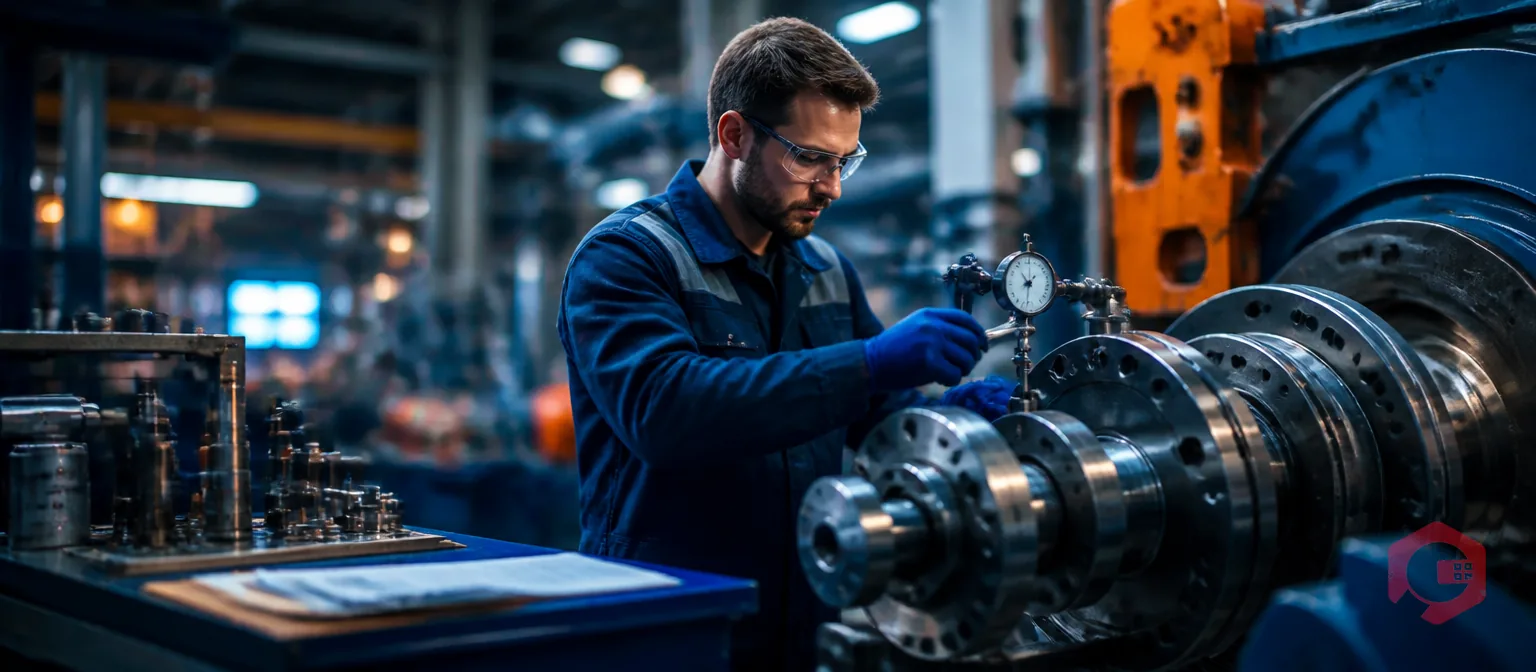
Measurement practices for the mechanical maintenance team are the backbone of any high-performing maintenance operation. Without the right metrics tracked consistently, maintenance teams work blind — reacting to failures instead of preventing them, and guessing at performance instead of proving it. According to a Plant Engineering maintenance survey, facilities with structured measurement programs reduce unplanned downtime by up to 45% compared to those running on intuition alone.
This guide covers the essential measurements every mechanical maintenance team should track, how to collect them accurately, and how to act on the data to drive real improvements.

Mechanical equipment — pumps, compressors, conveyors, gearboxes, motors — degrades in predictable ways. Vibration increases before a bearing fails. Temperature rises before a seal gives out. Oil viscosity drops before a gearbox seizes. The problem is that without a disciplined measurement practice, these early warning signals go unnoticed until the machine stops.
Teams that measure consistently catch failures weeks before they happen. They also build a historical dataset that allows them to move from time-based maintenance schedules to condition-based ones — which the ISO 55000 asset management standard identifies as a key driver of lifecycle cost reduction. Measurement is not just a performance reporting exercise. It is the foundation of proactive maintenance.

Before getting into measurement techniques, let's cover the KPIs that give context to everything you measure in the field. These are the numbers your maintenance manager and plant leadership will ask about.
Machine availability starts with MTBF. It tells you the average operating time between breakdowns for a given asset. A rising MTBF means your maintenance program is working. A falling MTBF is an early signal of increasing wear, poor lubrication, or incorrect operating conditions. Calculate it by dividing total uptime hours by the number of failures in a period.
MTTR measures how fast your team diagnoses and fixes a problem. A high MTTR points to one of three issues: technicians are struggling to find root causes, spare parts are not on hand, or the repair process is not documented. Tracking MTTR by asset type and by technician gives you a clear picture of where to focus training and spare parts investment.
Overall Equipment Effectiveness combines availability, performance, and quality into a single score. World-class OEE sits at 85% for discrete manufacturing. Most plants run closer to 60%. Even a 5-point OEE improvement on a critical asset translates directly into production output. Maintenance teams that track OEE have a much stronger case when requesting capital for equipment replacement.
PMP measures what percentage of your total maintenance hours are planned versus reactive. A healthy maintenance program targets 85% planned work. If your team is below 70%, you're spending most of your time firefighting — which drives up costs, increases injury risk, and accelerates equipment wear.

For any mechanical team managing motors, pumps, fans, compressors, or gearboxes, vibration analysis is the most important condition monitoring technique available. It detects imbalance, misalignment, bearing wear, looseness, and resonance — all before they cause a breakdown.
Set up measurement routes where technicians take readings from fixed points on each machine — typically the drive end and non-drive end bearings — on a scheduled basis (weekly, monthly, or quarterly depending on criticality). Use a handheld vibration meter or an online vibration sensor and record overall velocity (mm/s or in/s RMS) and envelope acceleration (gE) for bearing health.
ISO 10816 provides the internationally recognised severity thresholds for different machine classes. A machine crossing from Zone B (acceptable for long-term operation) into Zone C (only short-term operation permitted) requires immediate investigation. Your team should have these thresholds clearly defined in their inspection forms so there's no ambiguity on what to escalate.
A single vibration reading means little without context. Trending — comparing today's reading against the baseline and against recent readings — is what reveals the rate of deterioration. A bearing that measures 4.5 mm/s today but was 2.1 mm/s six months ago is degrading fast, even if it hasn't crossed the alarm threshold yet. This is why logging every reading into a preventive maintenance software platform is essential: you need the history to make the call.
Abnormal heat is one of the most reliable signs of mechanical distress. Bearing failures, lubrication breakdown, electrical faults, belt slippage, and blockages all generate excess heat before they cause visible damage.
Infrared thermometers and thermal imaging cameras allow technicians to take temperatures without touching live equipment — critical for safety on energized machinery. Infrared thermography scans are particularly useful for electrical panels, motor windings, steam traps, and heat exchangers. A thermal image captures temperature distribution across the entire component, making it far more informative than a single contact measurement.
For bearing housings and gear cases, a contact thermometer or thermocouple gives the most accurate absolute temperature. Set alert thresholds based on the manufacturer's specifications — most standard rolling element bearings have a maximum operating temperature of 80–90°C. A delta-T approach (measuring the rise above ambient) is often more reliable than absolute limits because it accounts for seasonal ambient variation.
Temperature data only generates value if it's recorded and acted on. Log each reading against the asset and date. When a reading crosses your alert threshold, generate a work order immediately — don't wait for the next scheduled inspection. Teams using a downtime tracking module can correlate temperature spikes with subsequent failures, building a case for where to focus condition monitoring resources.

Oil analysis is one of the most underused measurement tools in mechanical maintenance, yet it delivers a detailed picture of both lubricant condition and internal component wear. According to Machinery Lubrication research, facilities that run proactive oil analysis programs extend oil drain intervals by 30–50% and reduce gearbox and bearing failures significantly.
Collect samples from the same sampling point, at the same machine operating temperature, every time — consistency in sampling technique is what makes the trend data reliable.
Hydraulic and pneumatic systems are pressure-dependent. A pump that's generating 15% less pressure than its rated specification is showing early signs of internal wear — even if it's not yet failing. Pressure and flow measurements give your team the data to catch this before the machine trips.
Install permanent pressure gauges at key points in the circuit: pump outlet, system relief valve, cylinder ports, and filter differential pressure. Record readings as part of your daily or weekly inspection route. A filter differential pressure gauge that's reading high means the filter is loaded and needs changing — a simple, fast correction that prevents contaminated oil from circulating through the system.
For pressure sensor data integrated directly into your maintenance platform, IoT-enabled gauges can send real-time alerts when readings fall outside set limits — removing the need for manual rounds on high-criticality systems.
Flow measurement is particularly important for cooling systems, lubrication circuits, and hydraulic circuits where inadequate flow leads to thermal damage. A pump delivering 80% of its rated flow is showing wear. Measure flow periodically using a clamp-on ultrasonic flow meter — no pipe cutting required — and trend the results over time.
Misalignment is responsible for a significant percentage of premature bearing and coupling failures in rotating equipment. Reliable Plant data suggests that up to 50% of rotating equipment failures are alignment-related, yet alignment checks are frequently skipped after equipment installation or following maintenance work.
Use a laser shaft alignment tool after every coupling replacement, bearing replacement, or any maintenance work that requires removing and reinstalling connected machinery. Dial indicator alignment is acceptable but laser systems are faster, more accurate, and easier to document. Most modern laser systems store the alignment readings digitally and generate a pass/fail report that can be attached to the work order.
Acceptable alignment tolerances vary by shaft speed. At 3,000 RPM, angular and offset tolerances are in the range of 0.05–0.10 mm, depending on coupling type. Exceeding these limits puts immediate stress on bearings and seals, shortening their service life dramatically. Track alignment results in your maintenance checklists to build a record of which machines trend out of tolerance and need more frequent checks.

Collecting measurements is only half the job. The other half is storing them in a way that makes them searchable, trendable, and actionable. A clipboard-and-spreadsheet approach works for a small operation, but it breaks down at scale — readings get missed, trends go unnoticed, and follow-up work orders fall through the cracks.
A maintenance management software platform centralizes all measurement data against each asset. Technicians record readings on mobile, the system flags values outside limits automatically, and the maintenance planner can see at a glance which assets are trending toward failure. Cryotos CMMS, for example, includes IoT meter reading capabilities that pull live sensor data directly into the asset record — so pressure, temperature, and vibration readings update in real time without requiring manual data entry.
When a reading crosses an alert threshold, Cryotos automatically generates a work order, assigns it to the right technician, and sends a notification via mobile or WhatsApp. That closed loop — from measurement to action — is what separates teams that prevent failures from teams that just react to them. You can explore the full BI dashboard to see how measurement data feeds directly into maintenance KPI reporting.
The best measurement program in the world fails if technicians don't buy into it. Here's how to build a team culture where measuring is a habit, not a chore.
The most important measurements are vibration (for rotating equipment), temperature (for bearings, motors, and electrical components), oil analysis (for lubricated systems), and pressure/flow (for hydraulic and pneumatic circuits). Alongside these field measurements, teams should track KPIs like MTBF, MTTR, OEE, and Planned Maintenance Percentage to monitor overall program performance.
Frequency depends on asset criticality and the rate of degradation. Critical assets — those whose failure would stop production — should be measured weekly or even daily for vibration and temperature. Lower-criticality assets can be measured monthly or quarterly. Oil analysis intervals depend on operating conditions but typically run every 500–1,000 operating hours for high-stress gearboxes and hydraulic systems.
The core toolkit includes a handheld vibration meter (or access to online sensors), an infrared thermometer or thermal camera, a contact thermometer for bearing housings, a pressure gauge set, an oil sampling kit, and a laser shaft alignment tool. For teams building a digital measurement program, a mobile CMMS app that logs readings against assets is essential.
CMMS software stores all measurement readings against each asset, trends them over time, and automatically triggers work orders when readings cross alert thresholds. It eliminates paper-based data entry, ensures no readings are missed, and gives managers a real-time view of asset health across the entire facility. IoT-enabled CMMS platforms can pull live sensor data directly, removing the need for manual rounds on high-criticality equipment.
Industry best practice targets 85% planned maintenance and 15% or less reactive maintenance. Below 70% planned work suggests the team is spending most of its time on emergency repairs, which is more expensive, more dangerous, and harder on equipment than scheduled work. Tracking PMP monthly and working to improve it is one of the most direct levers a maintenance manager has for reducing costs.
If your mechanical maintenance team is ready to move from spreadsheets and clipboards to a fully integrated measurement and maintenance management system, Cryotos CMMS gives you the tools to track every measurement, trend every asset, and close the loop from data to action — all from a single platform built for maintenance teams in the field.



Cryotos AI predicts failures, automates work orders, and simplifies maintenance—before problems slow you down.



