The future of maintenance in manufacturing is being shaped by artificial intelligence, connected sensors, and intelligent software that can predict equipment failure before it happens. According to Deloitte, unplanned downtime costs industrial manufacturers an estimated $50 billion per year, with equipment failure responsible for 42% of that loss. The organizations closing that gap are the ones investing in smarter maintenance strategies today.
What Is Maintenance 4.0 and Why Does It Matter?
Maintenance 4.0 is the application of Industry 4.0 technologies — IoT sensors, AI, cloud computing, and digital twins — to maintenance operations. It represents a shift from scheduled or reactive maintenance toward fully data-driven, predictive, and even autonomous maintenance systems.
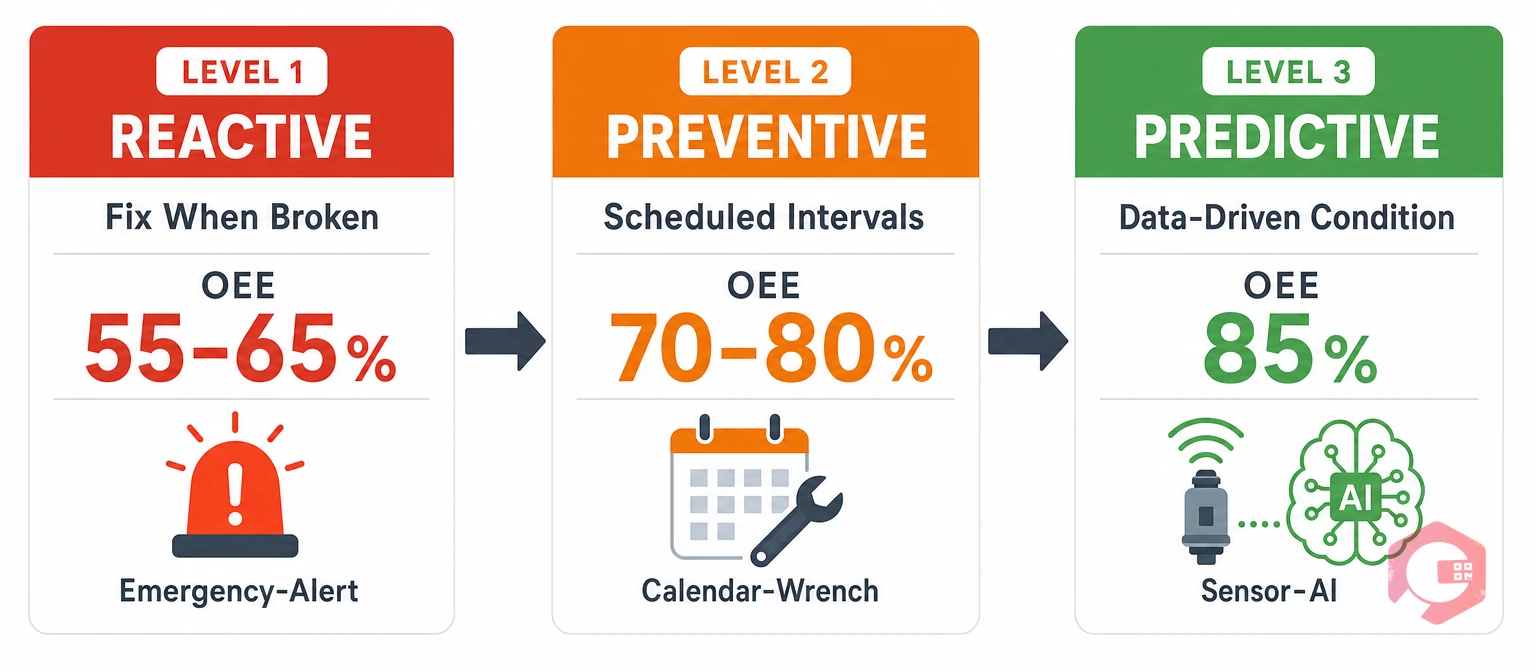
From Reactive to Predictive: The Maintenance Maturity Model
Reactive Maintenance (Level 1): Fix it when it breaks. High unplanned downtime, high emergency repair costs. Typical OEE: 55–65%.
Preventive Maintenance (Level 2): Scheduled maintenance based on time or usage. Reduces failures but can lead to over-maintenance. Typical OEE: 70–80%.
Predictive Maintenance (Level 3): Data-driven maintenance triggered by real asset condition. Maximizes uptime, minimizes unnecessary maintenance. Typical OEE: 85%+.
Most manufacturers are at Level 1 or 2. The future belongs to those who reach Level 3. According to McKinsey, manufacturers that have adopted smart maintenance practices have reduced maintenance costs by 10–25%, cut downtime by 35–45%, and extended equipment life by 20–40%.
Key Trends Shaping the Future of Maintenance in Manufacturing
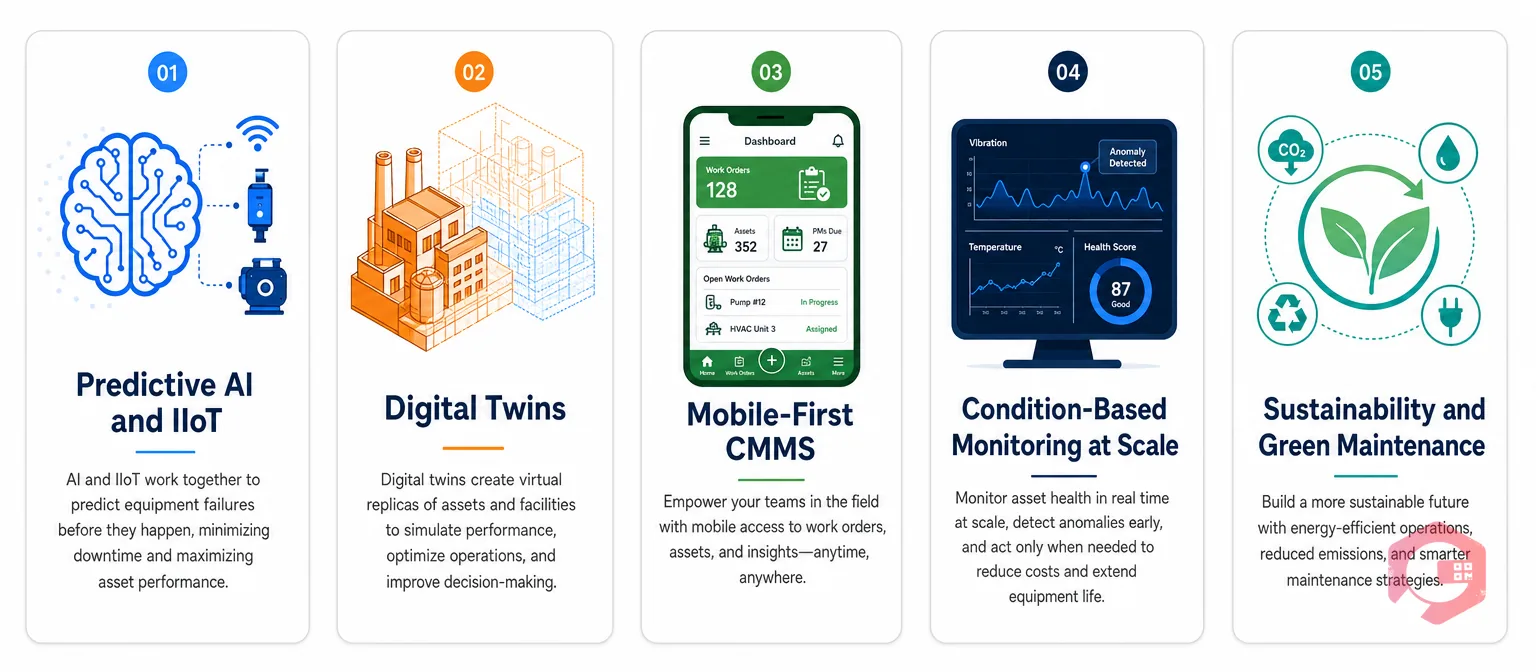
Predictive Maintenance Powered by AI and IIoT:Industrial Internet of Things (IIoT) sensors continuously collect vibration, temperature, pressure, and acoustic data. AI models analyze this data to detect anomalies — often weeks before a visible fault develops. A large automotive supplier reduced compressor-related downtime by 37% after deploying IIoT sensors and a predictive maintenance dashboard.
Digital Twins for Real-Time Asset Simulation: A digital twin is a virtual replica of a physical asset, updated in real time with live sensor data. Gartner reports 75% of organizations implementing IoT will use digital twins by 2027, translating to near-zero unplanned downtime for critical assets.
Mobile-First CMMS and Remote Maintenance Management:Mobile-first CMMS allows technicians to receive work orders, log repairs, scan asset QR codes, and close out tasks from the shop floor in real time.
Condition-Based Monitoring (CBM) at Scale:CBM triggers maintenance actions only when an asset’s actual condition warrants it. Plant Engineering reports CBM programs can reduce maintenance costs by up to 30% compared to fixed-interval schedules.
Sustainability and Green Maintenance Practices: Energy-efficient operations, reduced lubricant waste, minimizing scrap from equipment failures, and extending asset life all fall under green maintenance. Manufacturers are building sustainability KPIs directly into their CMMS.
The Role of CMMS in the Future of Manufacturing Maintenance
A CMMS sits at the center of any modern maintenance strategy — aggregating data from IIoT sensors, generating work orders, managing spare parts inventory, and producing the KPI reports that drive continuous improvement. Organizations using a modern CMMS report an average 28% reduction in unplanned downtime within the first year of adoption.
How to Prepare Your Maintenance Strategy for the Future
Audit your current maintenance maturity: Map your asset portfolio, identify your top five failure-prone assets, and benchmark your current unplanned downtime rate and MTTR.
Implement a CMMS if you haven’t already: A CMMS is the non-negotiable foundation. It brings structure, visibility, and data to maintenance operations before layering on advanced technology.
Digitize PM schedules and work orders: Move off paper and spreadsheets. Digital PM schedules are searchable, auditable, and can be escalated automatically.
Pilot IIoT sensors on critical assets: Start with two or three high-value or high-failure-frequency machines. Use sensor data to validate or improve your PM intervals.
Build a maintenance KPI dashboard: Track OEE, MTBF, MTTR, planned maintenance percentage (PMP), and PM compliance weekly. What gets measured gets improved.
Invest in technician upskilling: Train your team on mobile CMMS use, basic data interpretation, and sensor-based maintenance logic. This is as important as the technology investment.
Frequently Asked Questions
What is the future of maintenance in manufacturing?
The future centers on predictive, data-driven practices powered by AI, IIoT sensors, and CMMS software. Manufacturers are moving from reactive, time-based maintenance to condition-based and predictive models that prevent failures before they occur, reducing downtime and extending asset life.
How is AI changing maintenance in factories?
AI analyzes real-time data from IIoT sensors to detect patterns associated with equipment degradation — often identifying problems weeks before a failure occurs. AI also powers automated work order generation, spare parts forecasting, and maintenance scheduling optimization.
What is Maintenance 4.0?
Maintenance 4.0 is the integration of Industry 4.0 technologies — including IoT, AI, digital twins, and cloud-based CMMS — into maintenance operations. It represents a shift from scheduled or reactive maintenance to autonomous, real-time, data-driven maintenance that maximizes asset reliability.
How does CMMS help with predictive maintenance?
A CMMS integrates with IIoT sensors and analytics platforms to receive condition alerts and automatically generate work orders when asset health metrics cross defined thresholds. Without a CMMS, predictive maintenance data has nowhere actionable to go.
The future of maintenance in manufacturing is already here. Cryotos CMMS is purpose-built for manufacturing environments, offering predictive maintenance integration, mobile work orders, real-time asset health dashboards, and full PM scheduling in a single platform. Book a free demo with Cryotos and see how much downtime you can reclaim.