
A power quality audit is a structured assessment of the electrical supply in a facility — measuring voltage fluctuations, harmonic distortion, power factor, and transient events to identify problems that silently erode uptime and drive up energy costs. Poor power quality is responsible for up to 80% of unplanned equipment failures in industrial environments, according to a study by the Electric Power Research Institute (EPRI). Yet most maintenance teams only investigate power problems after an asset has already failed.
This guide explains exactly what a power quality audit involves, which problems it uncovers, and how to build an audit program that measurably improves uptime and operational efficiency across your plant.
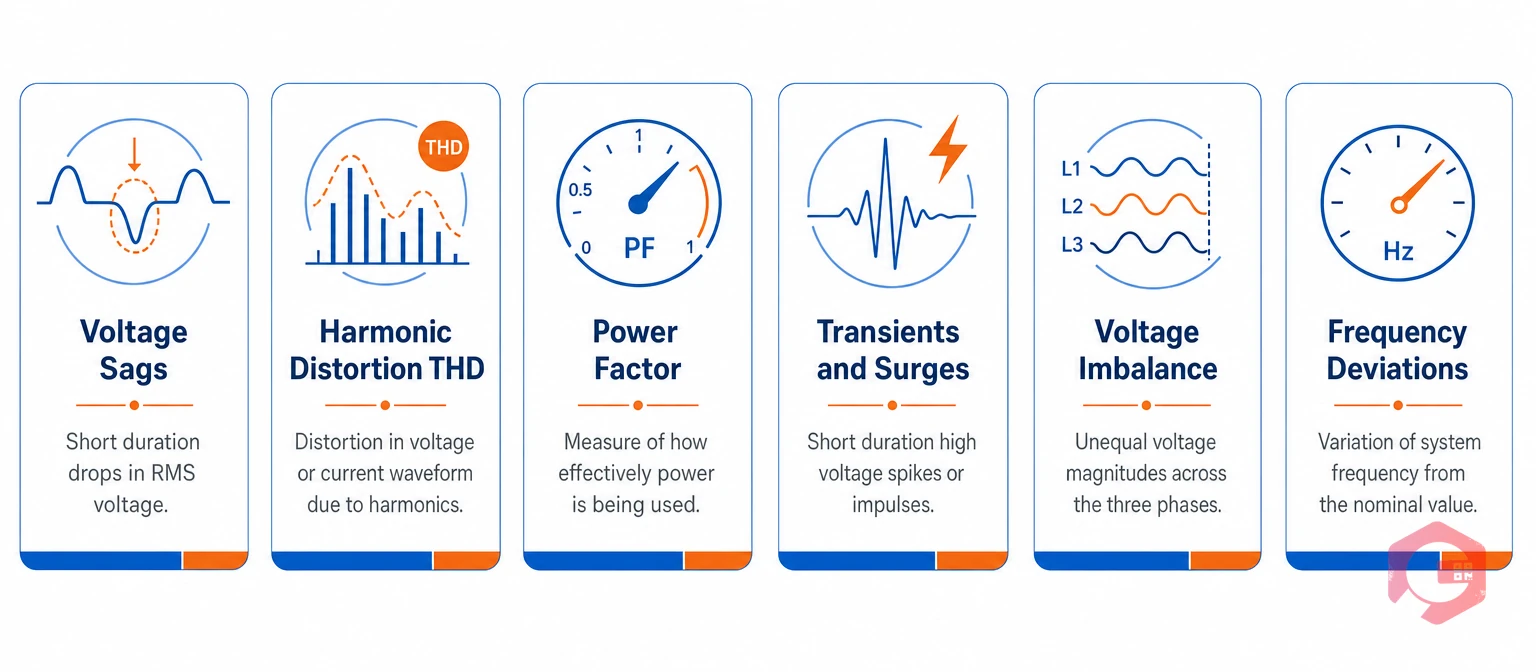
A power quality audit is a systematic evaluation of your facility's electrical system to measure how cleanly and reliably power is being delivered to equipment. Unlike a standard electrical inspection, a power quality audit uses specialized instruments — power analyzers, oscilloscopes, and harmonic analyzers — to capture real-time data on the electrical supply over hours or days.
The audit measures six core parameters:
Understanding these parameters tells you where your electrical system is vulnerable — before the next unplanned shutdown happens.

Most maintenance managers track mechanical failures closely, but power-related failures are harder to diagnose because they rarely leave obvious physical evidence. A motor that burns out due to voltage imbalance looks identical to one that failed from overloading. A PLC that drops out during a voltage sag may return to service immediately, leaving no maintenance record — until it fails permanently three months later.
The real cost shows up across four areas:
Tracking downtime at the asset level is the first step to noticing patterns that suggest a power quality root cause — repeated failures on the same line, clustered downtime events on stormy days, or motors that consistently fail before their rated service life.
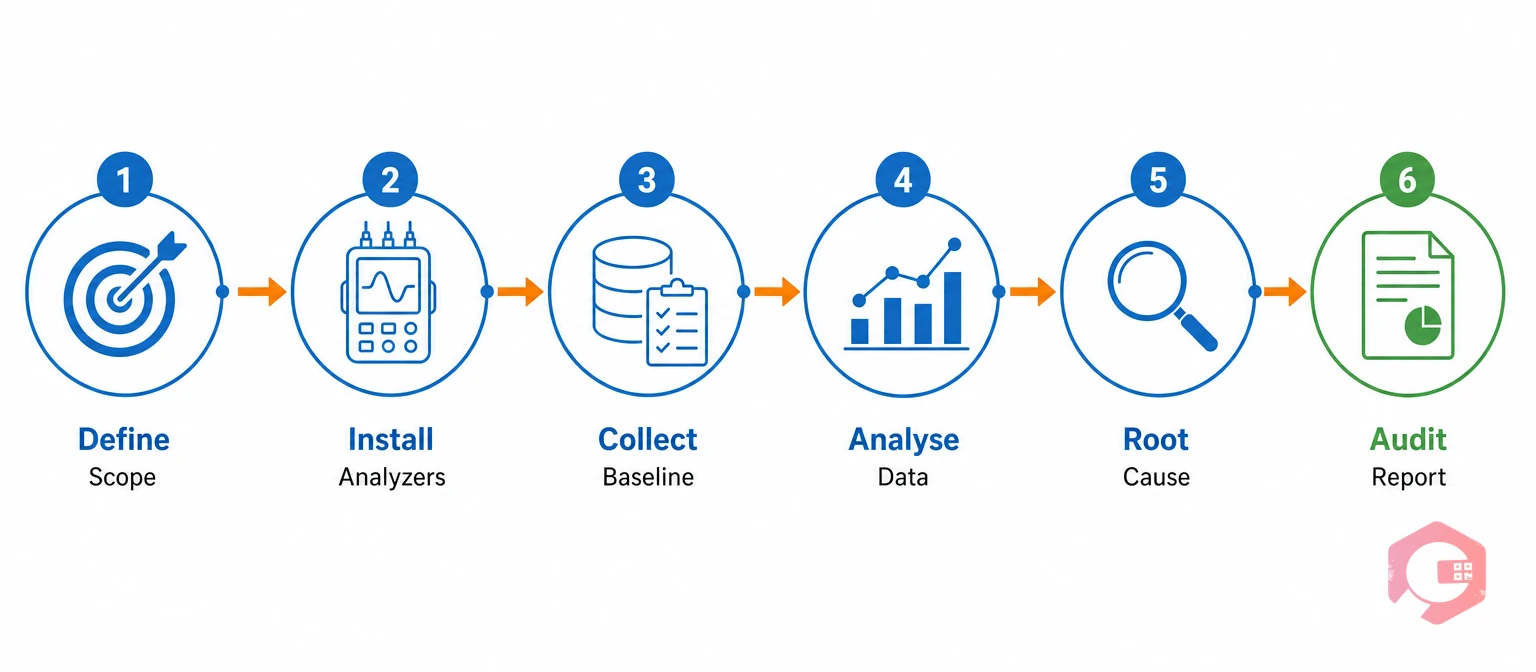
A well-structured audit follows a defined process. Rushing through it produces incomplete data and missed findings.
Start by identifying which parts of the facility to include. Priority areas are those with the highest downtime history, the most sensitive equipment, or the largest energy consumption. A manufacturing plant typically starts at the main distribution board and works downstream to sub-panels, motor control centres (MCCs), and individual critical assets.
Place revenue-grade power quality analyzers at each measurement point for a minimum of seven days. A one-day snapshot misses events tied to shift changes, weekend production modes, or weekly utility switching. The analyzers should log every parameter at one-second intervals and capture waveforms during any event that exceeds a defined threshold.
During the measurement window, gather supporting data: equipment nameplate ratings, historical maintenance records, energy bills for the past 12 months, and any existing single-line diagrams. This context helps you correlate electrical events with real production outcomes. If you use a maintenance management system, pull the downtime log for the same measurement period to cross-reference.
Compare recorded values against international power quality standards — specifically IEEE 519 for harmonic limits and EN 50160 for voltage characteristics in European grids. Flag any parameter that exceeds the standard and note the time, duration, and magnitude of each event.
Every power quality problem has a source. Harmonics typically originate from non-linear loads like VFDs and UPS systems. Voltage sags often trace back to large motor starts or utility-side faults. Transients usually come from capacitor bank switching or arc welding equipment. Knowing the source determines the fix.
The report should rank findings by severity and map each one to a specific corrective action — harmonic filters, power factor correction capacitors, surge protection devices, or network reconfiguration. Include a cost-benefit estimate for each recommendation so maintenance leadership can prioritise spending.

Here are the most frequently found issues in industrial power quality audits, along with proven corrective measures:
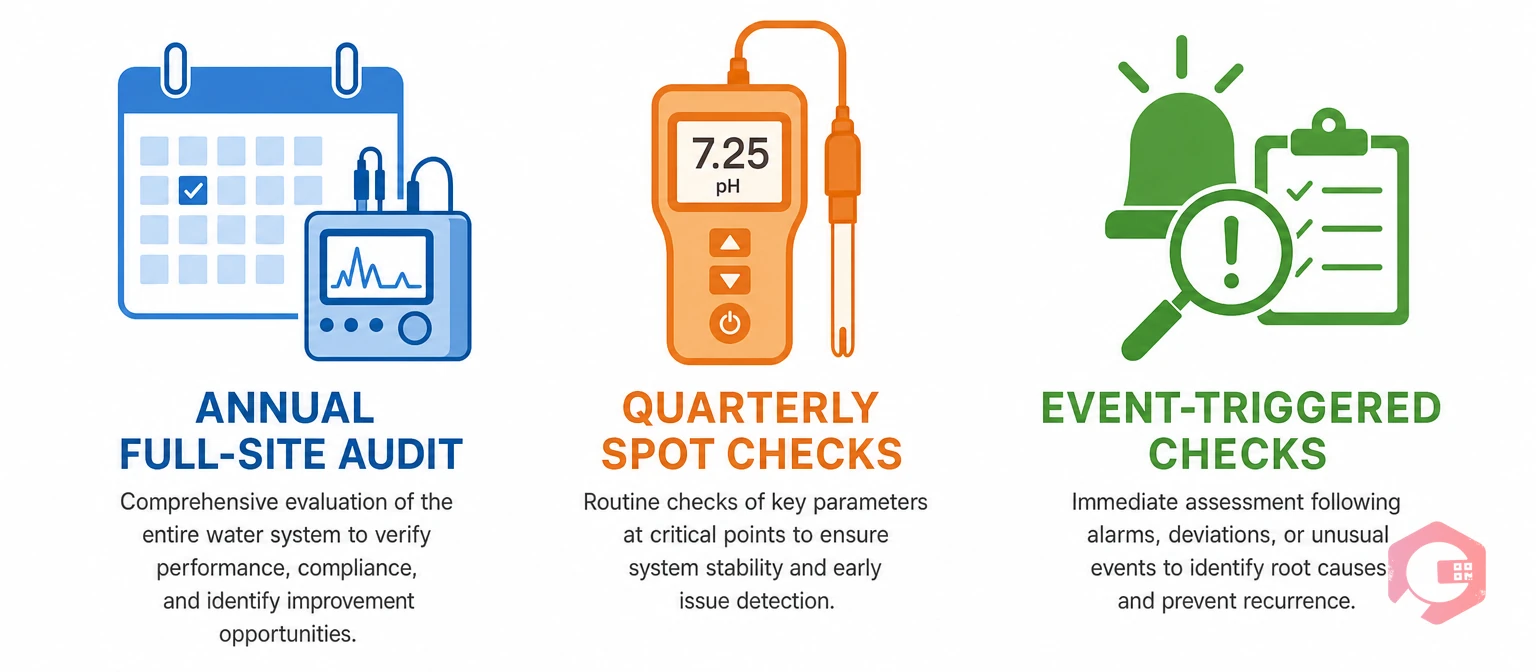
A one-time power quality audit produces value, but embedding power quality checks into your ongoing preventive maintenance program multiplies that value over time. Equipment degradation happens gradually — a transformer that measured 4% THD this year may hit 8% THD next year as new loads are added to the circuit.
A practical schedule looks like this:
Scheduling these activities in your CMMS ensures nothing gets skipped. Cryotos lets you set up calendar-based and IoT meter-triggered maintenance tasks so that power quality checks are automatically assigned, tracked, and documented alongside all other PM work.

Leadership teams want numbers. Here's how to build a straightforward business case for power quality investment.
A food processing facility with 200 motors running at a 0.78 power factor, with a utility demand charge of $12 per kVA, can expect to pay roughly $18,000–$25,000 per year in excess demand charges. Correcting the power factor to 0.95 typically costs $8,000–$12,000 in capacitor equipment and installation — a payback period of six to eight months.
On the reliability side, a plant that reduces motor rewind frequency from once every two years to once every five years on 20 critical motors (at $4,000 per rewind) saves $240,000 over five years. That's a return that's hard to argue against.
Use Cryotos's BI dashboard to track energy consumption trends, motor failure frequency, and Overall Equipment Effectiveness (OEE) before and after power quality improvements. Having that data in one place makes the ROI case self-evident at the next budget review.
Use this checklist when planning or reviewing a power quality audit in your facility. You can also download Cryotos's full maintenance audit checklist as a starting template.
Most industrial facilities benefit from a full audit once a year and targeted spot checks every quarter. Any major change to the electrical system — adding new VFDs, expanding production capacity, or switching utilities — warrants an immediate audit to establish a new baseline.
An energy audit focuses on how much energy a facility consumes and where it can be reduced. A power quality audit focuses on how cleanly power is delivered to equipment and what electrical disturbances are present. The two are complementary — poor power quality often shows up as unexplained energy waste in an energy audit, and the root cause is found in the power quality data.
Yes. Persistent voltage unbalance and high harmonic currents cause overheating in cables, transformers, and motors that can lead to insulation failure and fire risk. Transient overvoltages can damage protective relays and cause control systems to behave unpredictably. A safety compliance checklist should include power quality parameters alongside mechanical and chemical hazards.
For a basic audit at a single facility, a trained internal electrical engineer with access to a portable power quality analyzer can collect the data. Interpretation and reporting often benefit from a specialist — particularly for complex sites with multiple VFDs, generators, or co-generation systems where harmonic interactions are harder to diagnose.
A CMMS helps in three ways: scheduling recurring power quality measurements as preventive maintenance tasks, logging findings and corrective actions in a searchable audit trail, and tracking asset reliability KPIs — like MTBF and unplanned downtime — that reveal whether power quality improvements are translating into real reliability gains. Cryotos connects directly with IoT sensors to flag abnormal readings in real time, so your team knows about a developing power quality issue before it becomes a failure.
Power quality audits are one of the highest-ROI activities available to maintenance and reliability teams. They surface hidden problems that standard inspections miss, extend asset life, cut energy costs, and give you defensible data for capital investment decisions. The facilities that treat power quality as an ongoing discipline — not a one-off exercise — consistently outperform peers on uptime and cost per unit produced.
If you want to bring power quality data into the same system where you manage work orders, preventive maintenance schedules, and asset history, Cryotos CMMS gives your team a single platform to track every audit finding, schedule every follow-up task, and measure every improvement over time. Book a demo to see how it works in a facility like yours.




Cryotos AI predicts failures, automates work orders, and simplifies maintenance—before problems slow you down.