
Cold room compressor PM scheduling for food retail chains is the structured practice of planning, triggering, and tracking preventive maintenance tasks across every refrigeration compressor in a multi-store network — from a single CMMS dashboard. For a chain managing 50 or more stores, this is not a luxury. It is the operational difference between catching a refrigerant charge drop before a compressor seizes and discovering the failure through a product loss claim on a Saturday night.
Food retail chains face a maintenance coordination problem that does not exist in single-site operations. A chain with 60 stores and three cold rooms per store has 180 compressors generating PM events, fault alerts, and contractor work orders simultaneously. Managing that from spreadsheets and WhatsApp groups is not a maintenance programme — it is reactive firefighting dressed up as a schedule. This guide covers exactly how to structure PM scheduling, what the dashboard view looks like, and how to run contractor AMC work orders across 50+ stores without losing compliance evidence.
Key Takeaways

Food retail refrigeration operates under conditions that food manufacturing refrigeration typically does not. A cold room compressor in a controlled manufacturing environment runs at stable load, in a clean plant with a dedicated maintenance technician on site. A supermarket compressor runs in a customer-facing back room with frequent door openings, variable ambient temperatures, fluctuating stock volumes, and no dedicated technician within 20 km.
Three failure patterns account for the majority of cold room compressor breakdowns in food retail:
According to the FDA Food Code, retail food establishments must maintain refrigerated storage at or below 41°F (5°C) at all times. A compressor failure that allows temperatures to drift above this threshold for more than 4 hours can trigger a full cold room discard event — product loss, regulatory reporting, and potential inspection. The PM programme is not just a maintenance activity. It is a food safety control.
Use Cryotos's maintenance checklists to build compressor-specific PM templates that capture every check — condenser condition, pressures, superheat and subcooling readings, refrigerant status, electrical supply, oil level, and abnormal vibration — as mandatory fields before the work order closes.
A food retail chain with 60 stores and three cold rooms per store has 180 cold room compressors in its asset register. Quarterly PM across the network means 720 PM events per year — roughly 60 per month — distributed across 60 locations and executed by a mix of in-house technicians and external AMC contractors.
Coordinating that in spreadsheets means maintaining 60 store tabs, tracking PM completion manually, chasing contractor confirmations, and identifying overdue stores from a document that is out of date the moment it is updated. There is no automated alert when a PM is missed. There is no consolidated fault frequency view across the network. There is no way to see — from a single screen — which compressors across all stores are due for replacement this quarter.
The coordination failure surfaces most visibly at two moments. The first is when a compressor fails and no one can retrieve its service history quickly enough to inform the repair decision. The second is when a food safety audit requests evidence that every cold room in the network has been maintained on schedule. Both moments produce the same outcome: hours of manual record-hunting that a CMMS query would resolve in under 10 minutes.
The food and beverage CMMS approach solves the coordination problem at the structural level — not by adding more spreadsheet columns, but by replacing the spreadsheet entirely with a location-aware asset register that auto-generates PM work orders and tracks completion in real time.
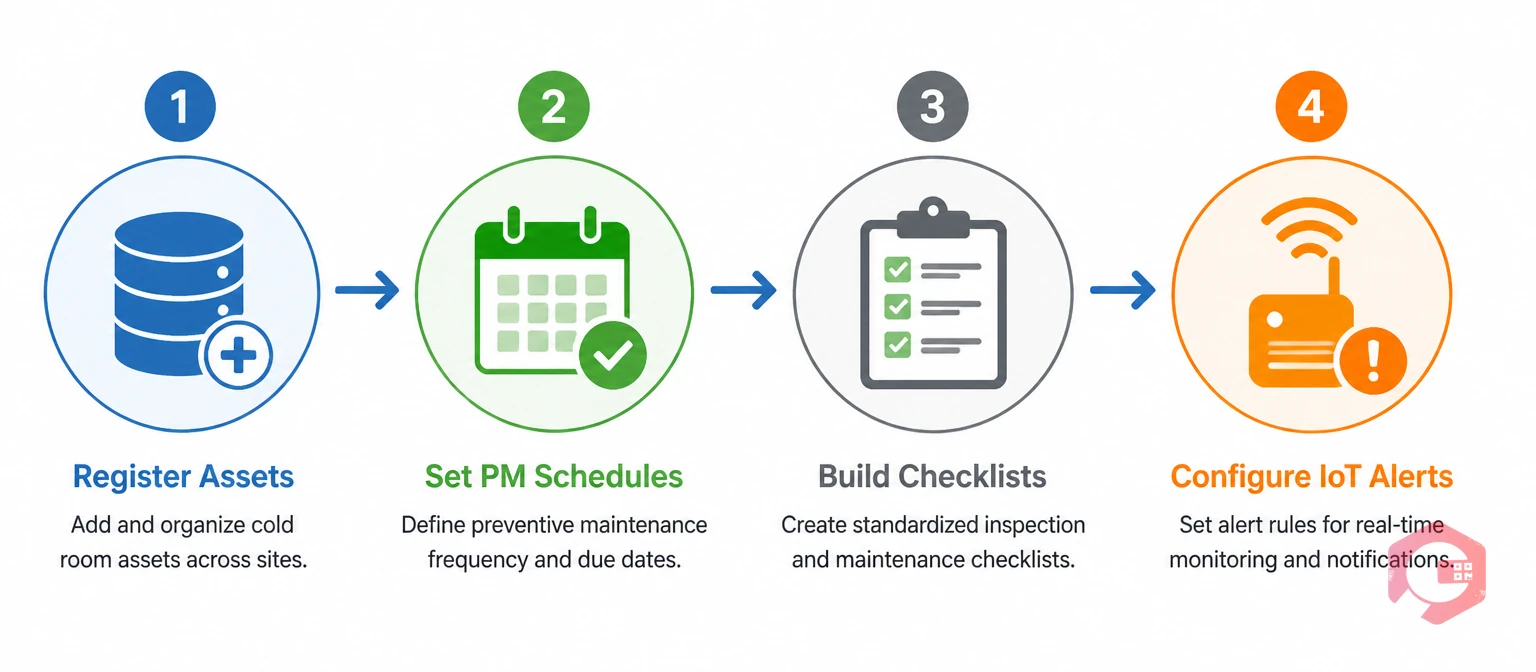
The foundation of multi-site cold room management in a CMMS is the location hierarchy. Every asset is tagged to a store, every store to a region, and every region to the network. A cold room compressor at Store 47 in Chennai is a specific asset with its own service history — and it is also visible as one of 180 compressors in a network-level dashboard the regional maintenance manager sees every morning.
Setting up the asset register for a food retail chain follows four steps:
According to ASHRAE Refrigeration Handbook guidance, quarterly inspection intervals are the minimum recommended frequency for commercial refrigeration compressors in food retail environments. Higher-criticality units serving perishable categories — meat, fish, dairy — should be inspected monthly. Your CMMS makes it possible to apply different intervals to different assets within the same network without manual calendar management.
A PM checklist is only as effective as the data it captures. Generic checklists with yes/no fields produce sign-off records, not maintenance intelligence. The following table shows the minimum data points that every cold room compressor PM should record — and why each one matters for failure prevention.
| Check Item | Data to Record | Failure Mode It Catches | Interval |
|---|---|---|---|
| Condenser coil condition | Clean / Partial fouling / Blocked — with photo | Condenser fouling → high discharge pressure → motor overload | Monthly |
| Suction pressure (psig) | Actual reading vs. rated suction pressure | Low refrigerant charge → compressor overheating | Every PM |
| Discharge pressure (psig) | Actual reading vs. rated discharge pressure | Condenser fouling / refrigerant overcharge | Every PM |
| Superheat (°C/°F) | Calculated from suction temp and saturation temp | Liquid slugging → valve plate damage | Every PM |
| Subcooling (°C/°F) | Calculated from liquid line temp and saturation temp | Flash gas → reduced cooling capacity and efficiency | Every PM |
| Compressor current draw (A) | Actual vs. rated full-load amps | Motor stress from voltage variation | Every PM |
| Supply voltage (V) | Measured at compressor terminals — all phases | Under/over-voltage → winding insulation degradation | Every PM |
| Oil level and condition | Level on sight glass; colour and clarity | Oil degradation → bearing failure | Quarterly |
| Abnormal noise or vibration | None / Present — describe type and location | Bearing wear / loose mountings | Every PM |
| Cold room temperature | Actual vs. set point — logged at start and end of PM | Overall system performance verification | Every PM |
In Cryotos, each of these fields is configured as a required entry on the PM work order template. A technician cannot mark the work order complete until every field has a recorded value. This produces a structured data record — not a paper signature — that supports audit responses, warranty claims, and capital planning decisions.

From the BI Dashboard, the regional maintenance manager sees a live view of the entire cold room compressor estate — filterable by store, region, compressor type, PM status, or fault frequency.
The most operationally useful views are:
Most food retail chains do not employ enough in-house refrigeration technicians to cover 50+ stores. The model is typically a combination of a small central maintenance team and regional AMC contractors who handle scheduled PMs and first-response corrective work at the store level.
In Cryotos, work order management for contractors operates with the same mandatory checklist and sign-off structure as in-house work orders. The contractor's technician closes the work order on the Cryotos mobile app, completes every required checklist field, attaches photos, and submits. The work order cannot be marked complete without the required data — which means the maintenance record is complete regardless of which contractor executed the work.
When a contractor fails to complete a scheduled PM on time, Cryotos flags it as overdue and begins automatic escalation. The notification goes first to the contractor, then to the internal maintenance manager, then to the regional operations head if the PM remains uncompleted beyond a further defined window. No one needs to chase manually.
For food retail chains operating across multiple states or regions with different contractor partners, the same CMMS platform manages all contractor work orders, all service histories, and all SLA compliance records from a single system. The head of maintenance does not need to log into four different contractor portals or reconcile four different Excel reports to understand whether the refrigeration maintenance programme is on track. According to Safe Quality Food (SQF) Edition 9 guidance, food retailers are required to maintain documented records of all equipment maintenance activities — including contractor-performed work — as part of a compliant food safety plan. Cryotos produces that audit trail automatically, per asset, per store, per contractor, without any additional record-keeping effort from the maintenance team.
Cryotos's mobile app operates in full offline mode for stores with unreliable connectivity. Technicians download their assigned work orders before entering the store, complete every checklist field and record all readings offline, and the data syncs to the central system the moment connectivity is restored. The work order record is timestamped at completion — not at sync — so offline completion is captured accurately for audit purposes.
Yes. Each refrigerant top-up is recorded as a work order against the specific compressor asset, with the quantity added, refrigerant type, technician name, and date. A compressor requiring top-ups at every PM cycle is flagged by the pattern in its work order history — giving the maintenance team documented evidence to justify a full leak detection inspection before the next compressor burnout.
Every compressor asset record in Cryotos includes warranty start date, warranty end date, and warranty terms. When a compressor fails, the work order is created against the asset record and the warranty status is visible before any repair decision is made. The full maintenance history — every PM, every refrigerant top-up, every corrective work order — provides the documentation warranty claims require: proof of regular maintenance and a timestamped record of every service event since installation.
Cryotos's BI Dashboard generates exportable reports on PM compliance rate by store and region, mean time between failures by asset type, corrective work order frequency and cost by store, contractor SLA performance, and assets approaching end of life. Reports can be scheduled to export automatically on a weekly or monthly basis and sent to defined recipients — no manual compilation required. For food safety audits, the complete per-asset service history is available as a filtered report within minutes of the audit request.
Cryotos routes after-hours alerts through the same escalation logic as any other corrective work order. When a cold room temperature breach triggers a fault alert — via IoT sensor or manual report — Cryotos creates the corrective work order and sends push notifications, SMS, and WhatsApp alerts to the on-call technician and duty manager simultaneously. If acknowledgment does not occur within the configured window, the alert escalates automatically to the next person in the chain. There is no gap in coverage because of shift changes or weekend rosters.
Managing cold room compressor PM across 50+ stores does not require more people — it requires better structure. Schedule a free demo to see how Cryotos manages multi-site cold room PM scheduling, contractor AMC work orders, and food safety compliance records for food retail chains at your scale.




Cryotos AI predicts failures, automates work orders, and simplifies maintenance—before problems slow you down.



