
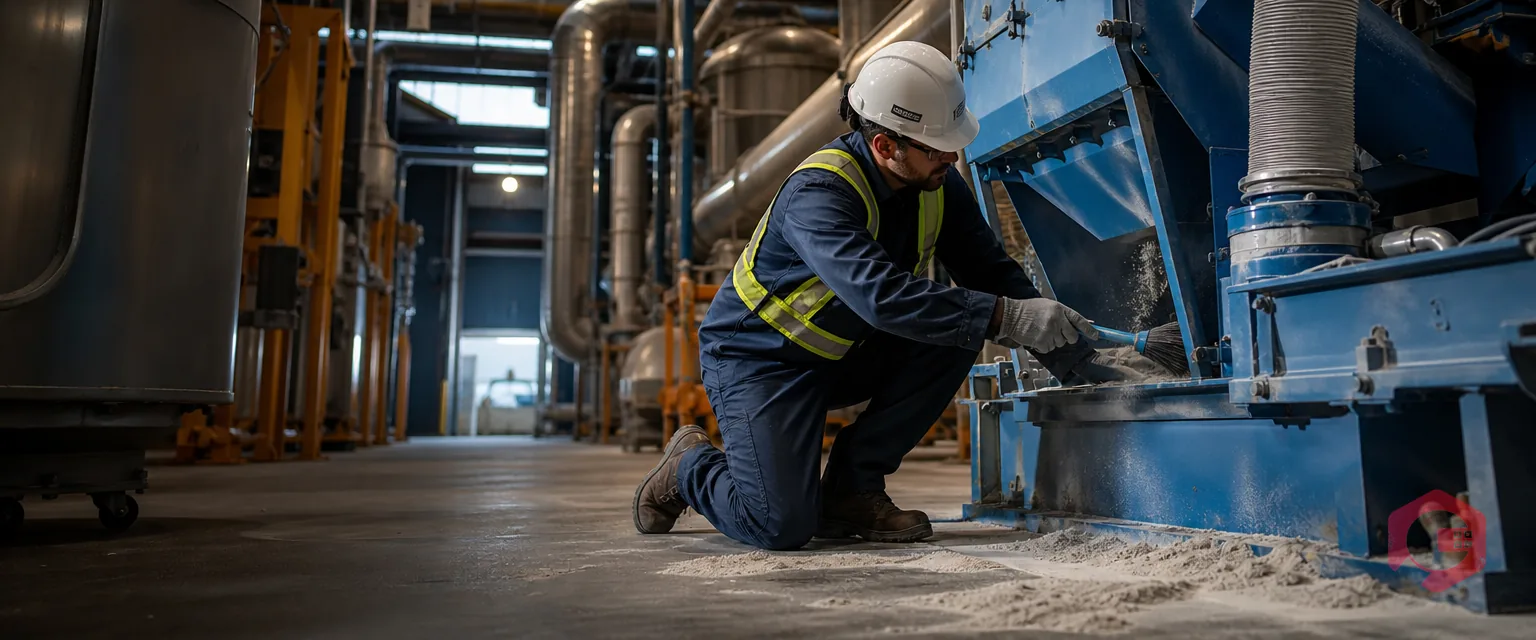
Combustible dust prevention is the practice of controlling fuel, ignition sources, and containment so fine dust never reaches an explosive concentration. In practice, it depends on maintenance: scheduled cleaning, equipment inspection, ignition control, and records that prove the work happened.
This guide gives you a practical combustible dust prevention program, a frequency register, and a way to turn a dust hazard analysis into scheduled work.
Key Takeaways
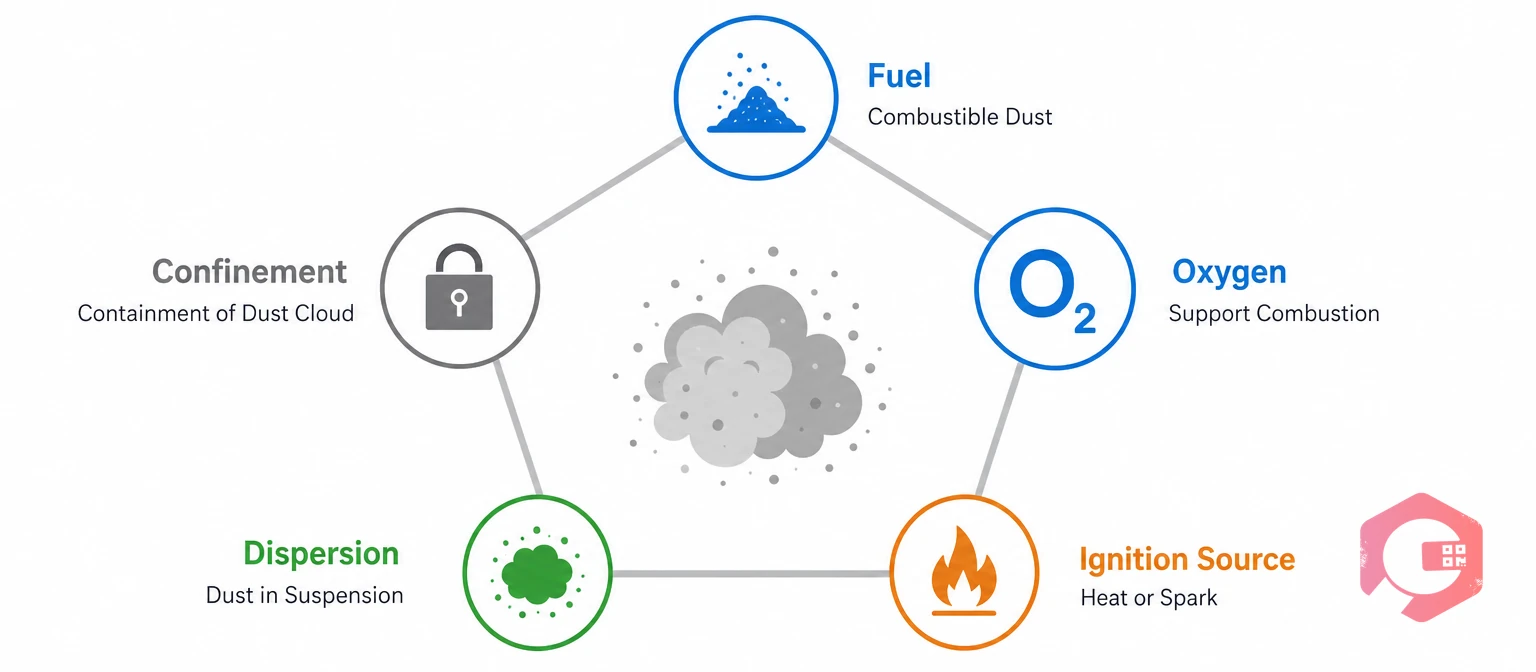
Combustible dust is any finely divided solid that can burn or explode when it is dispersed in air. Food, wood, plastic, chemical, and metal powders all qualify. Even aluminum and iron, which will not burn as lumps, can explode as dust, according to OSHA.
A dust explosion needs five elements, known as the explosion pentagon: fuel, oxygen, an ignition source, dispersion of the dust into a cloud, and confinement. Remove any single element and the explosion cannot happen. Maintenance teams can break the chain at fuel, ignition, and dispersion every shift.
A small primary explosion shakes loose dust sitting on beams, ducts, and ledges. That dust ignites in a larger secondary blast, which is why overhead accumulation matters as much as dust inside equipment.
For standards, NFPA 660 is the current benchmark. Its 2025 edition combines NFPA 61, 484, 652, 654, 655, and 664, and it carries forward the dust hazard analysis (DHA) requirement from NFPA 652.
Dust becomes an explosion risk only when five conditions meet, so maintenance can break the chain at several points.
Combustible dust collects in places routine cleaning misses: overhead beams, duct runs, equipment housings, cable trays, and the tops of motors and enclosures.
Most facilities find that combustible dust prevention is a maintenance condition, not a process mystery: dust escapes from worn equipment and builds up where nobody looks.
Digital maintenance checklists make overhead and hidden-space inspections repeatable, with photo proof for every round.
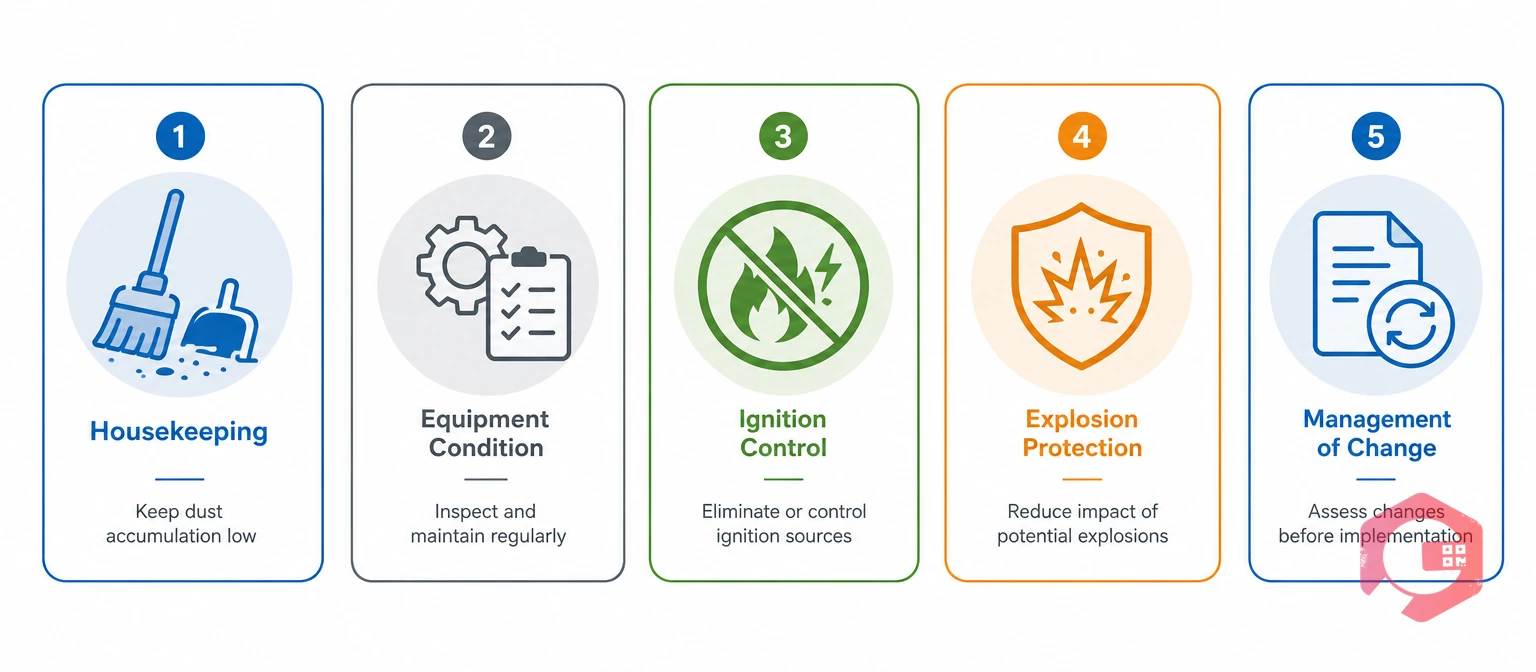
Effective combustible dust prevention rests on five maintenance controls: housekeeping, equipment condition, ignition control, explosion protection, and management of change.
Set cleaning frequencies by area and dust type, not by habit. Use vacuums approved for combustible dust, and avoid compressed air blow-down because it throws dust into a cloud.
Inspect ducts, seals, and transfer points for wear and leaks, and log dust collector differential pressure daily. A rising reading points to failing filters or cleaning, and a sudden drop can signal a breach. Apply lockout and tagout before opening any duct or hopper.
Check bearings, belts, and motors on dust-handling equipment for heat, and verify grounding and bonding. Control hot work through permit-to-work software that confirms dust has been cleared first.
Vents, isolation devices, and suppression systems only work if they are intact. Test them at the intervals set by the manufacturer and your DHA, and record each result.
A new product, a new dryer, or a rerouted duct can change where dust goes. Review every process change against the DHA before startup, and update the schedule to match.
Together these five controls cover fuel, ignition, and containment, the three elements your team can influence directly.
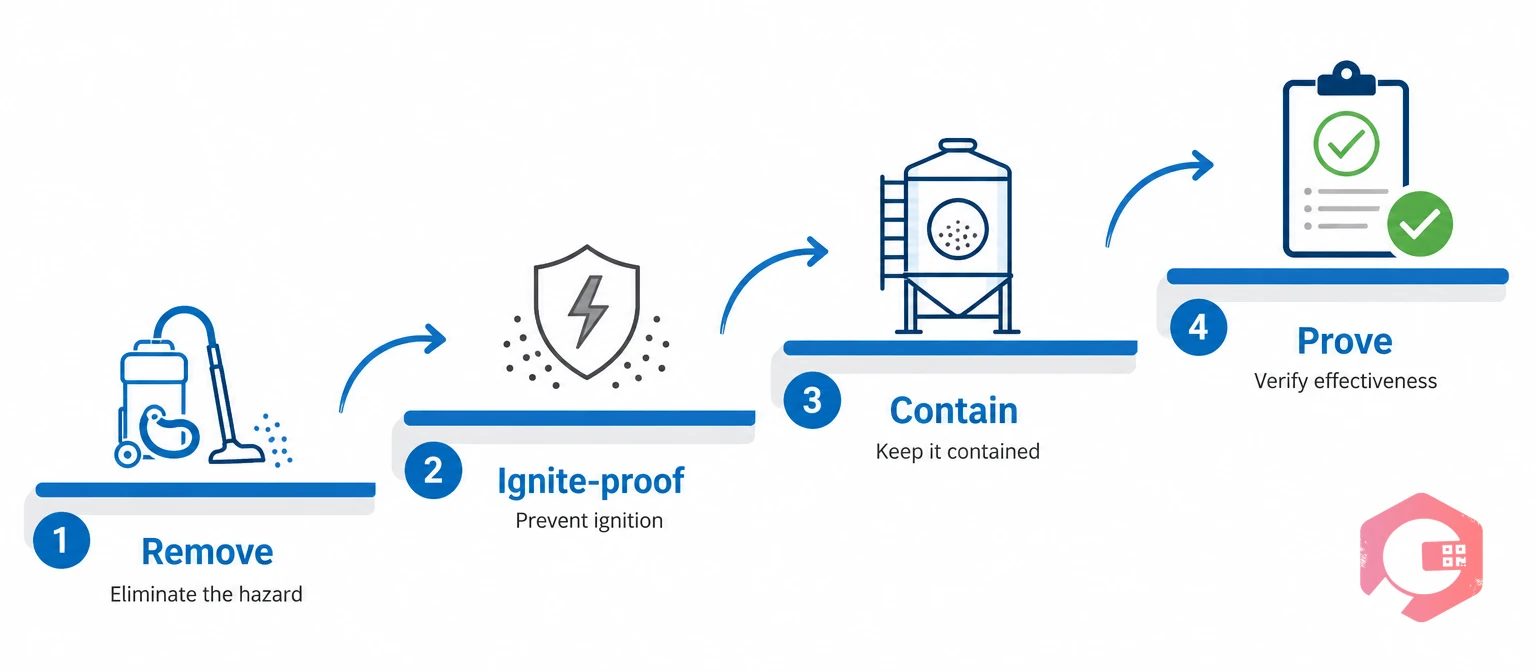
The Dust Control Ladder is a four-rung priority order, from removing fuel to proving controls work. Start at the bottom rung and do not skip upward.
The Dust Control Ladder:
Most maintenance teams invest in rungs 2 and 3 and neglect rung 4. A control without a record is a control that an auditor, insurer, or investigator cannot verify.
A combustible dust prevention schedule assigns each control a frequency, an owner, and the evidence to capture.
Use this register as a starting point, then set final intervals from your DHA and manufacturer guidance.
| Control Task | Frequency | Owner | Evidence to Capture |
|---|---|---|---|
| Clean floors, ledges, beams, and overhead surfaces | Every shift in high-dust areas | Operators | Signed checklist with photos. |
| Read dust collector differential pressure; check hoppers | Daily | Operators | Logged reading; work request if out of range. |
| Check bearings, belts, and motors for heat | Weekly | Maintenance technician | Temperature reading and work order. |
| Inspect ducts for buildup, wear, and leaks | Monthly | Maintenance technician | Inspection record with photos. |
| Test explosion vents, isolation devices, and suppression | Per manufacturer and DHA | Qualified technician | Test report on asset record. |
| Verify grounding, bonding, and electrical ratings | Per DHA interval | Electrician | Test record. |
| Approve hot work after dust clearance check | Every job | Permit issuer | Approved permit. |
| Review DHA; update schedule after process changes | Annually and at every change | EHS and maintenance lead | Revised DHA and task list. |
Assign every row to an asset and a named owner, so overdue items surface automatically instead of at audit time.
The most common challenge we hear from maintenance teams is a combustible dust prevention program that exists on paper but not in the schedule.
The facility has a DHA, a housekeeping policy, and a binder of procedures. Cleaning rounds slip on busy shifts. Nobody can show when ducts were last inspected. Hot work permits live in a separate system, and DHA actions never become recurring work.
A Computerized Maintenance Management System (CMMS) closes that gap by turning the register above into assigned, tracked work. Cryotos does this in five ways:
Maintenance teams using Cryotos have reported up to 30% reduction in unplanned downtime and 25% faster repair turnaround. That matters on dust collectors, fans, and conveyors, where a breakdown can leave dust uncontrolled.
The strongest approach is to break the explosion pentagon at several points at once. Remove dust through scheduled housekeeping, control ignition sources, keep explosion protection devices working, and document every task. No single control is enough on its own.
Cleaning frequency depends on how fast dust accumulates in each area, so your dust hazard analysis should set it. Many facilities clean high-generation areas every shift and inspect overhead and hidden spaces monthly. Adjust intervals based on what inspections find.
NFPA 660 consolidates NFPA 61, 484, 652, 654, 655, and 664 into a single standard, and its current edition is 2025. Check with your authority having jurisdiction and update your written program to reference NFPA 660.
A CMMS turns your dust hazard analysis into scheduled work orders, mobile checklists, permits, and records. It also shows overdue tasks in one dashboard, so gaps appear before an audit or an incident.
Combustible dust prevention works when every control is scheduled, assigned, and recorded. Schedule a free demo to see how Cryotos turns your dust hazard analysis into tracked maintenance work.


Cryotos AI predicts failures, automates work orders, and simplifies maintenance—before problems slow you down.



