You manage fatigue risk during long shutdowns and 12-hour shifts by limiting hours, protecting sleep, moving high-risk tasks away from fatigue peaks and checking crews for warning signs every shift. Fatigue is a hazard like heat or pressure. It needs limits, controls and records, not just a reminder to rest.
Shutdowns make fatigue harder to control. Crews work long days for weeks, night shifts stack up, and overtime feels normal when the schedule slips. This guide explains why the risk grows and how 8-hour and 12-hour shifts compare. It then gives six practical steps any maintenance team can put in place before the next outage.
Key Takeaways

Fatigue risk is the chance that tiredness causes a worker to make an error or get hurt. Tiredness slows reaction time and weakens judgment. In shutdown work, those errors happen during isolations, lifts, hot work and line breaks, where one mistake can hurt people.
Research published in Occupational and Environmental Medicine found that staying awake for 17 to 19 hours can impair performance about as much as a blood alcohol level of 0.05%. A long shift plus a long commute can reach that point easily.
OSHA lists long work hours and worker fatigue as a workplace hazard that employers should manage. In refining, API Recommended Practice 755 sets guidance for fatigue risk management systems, including hours-of-service limits for normal operations and outages.
That guidance followed the 2005 Texas City refinery explosion, which killed 15 people. Investigators found that a key operator had worked 12-hour shifts for 29 days in a row. Fatigue was named as a contributing factor.
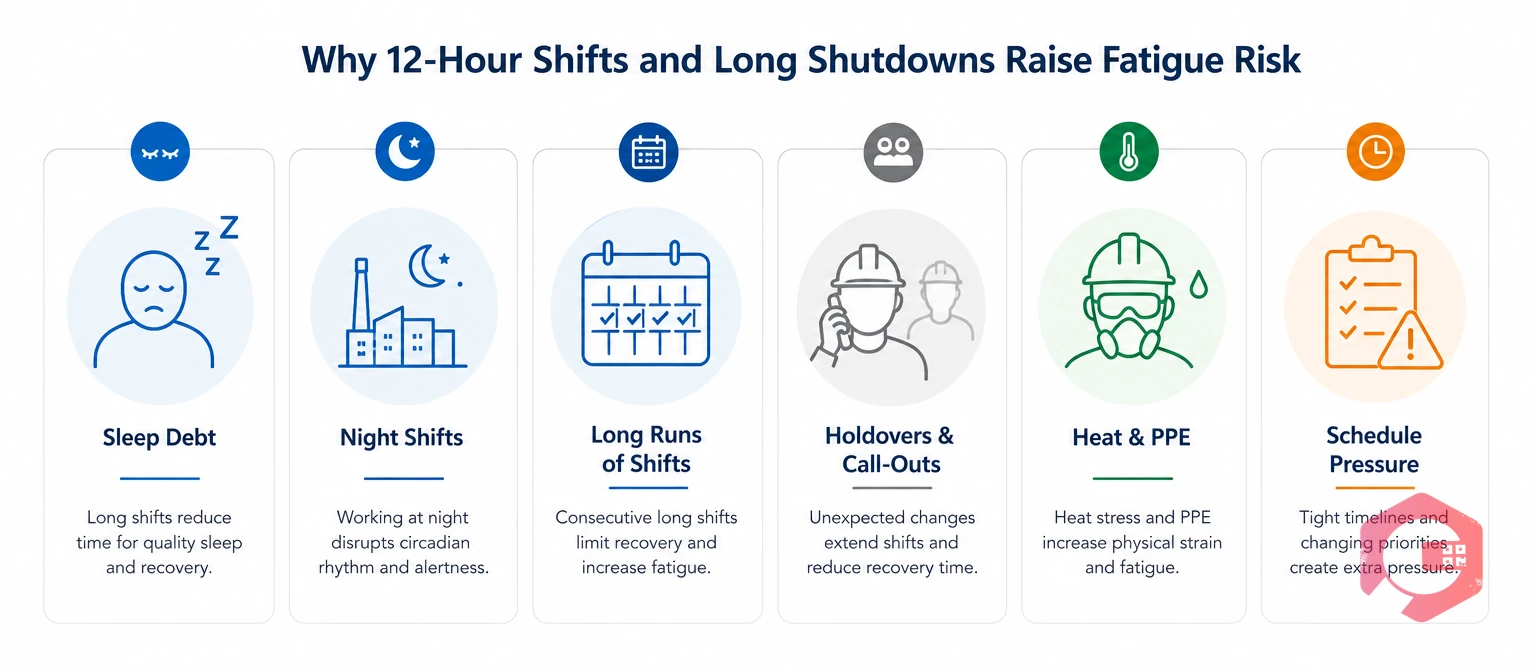
Long shutdowns raise fatigue risk because hours, night work and pressure all peak at the same time. Each one adds to the others.
Sleep debt is the gap between the sleep a person needs and the sleep they actually get. It builds quietly across a long outage and does not clear after one good night.
Contractors face extra risk. Many travel long distances, stay in temporary housing and move from one shutdown to the next with little rest in between.
No shift work pattern is safe or unsafe by itself. The table shows where each one tends to help or hurt during a shutdown.
| Factor | 8-Hour Shifts | 12-Hour Shifts |
|---|---|---|
| Fatigue within the shift | Lower, because work ends before the riskiest late hours | Higher in the last four hours, when error rates tend to climb |
| Handovers per day | Three, so more chances for information to be lost | Two, so fewer handover gaps |
| Recovery time | Shorter days off, but more sleep between shifts | More days off in a normal roster, but less sleep between shifts |
| Effect of overtime | A 4-hour holdover makes a 12-hour day | A 4-hour holdover makes a 16-hour day |
| Best fit | Heavy physical work, hot areas and long night runs | Planned work with strict limits on holdovers and consecutive nights |
Studies of shift-work accidents by Folkard and colleagues found that risk around the twelfth hour of work is roughly double the risk in the first eight hours. Twelve-hour shifts can work well, but only when holdovers are controlled and rest days are protected.
Before the next outage, review your site controls with our safety compliance checklist.
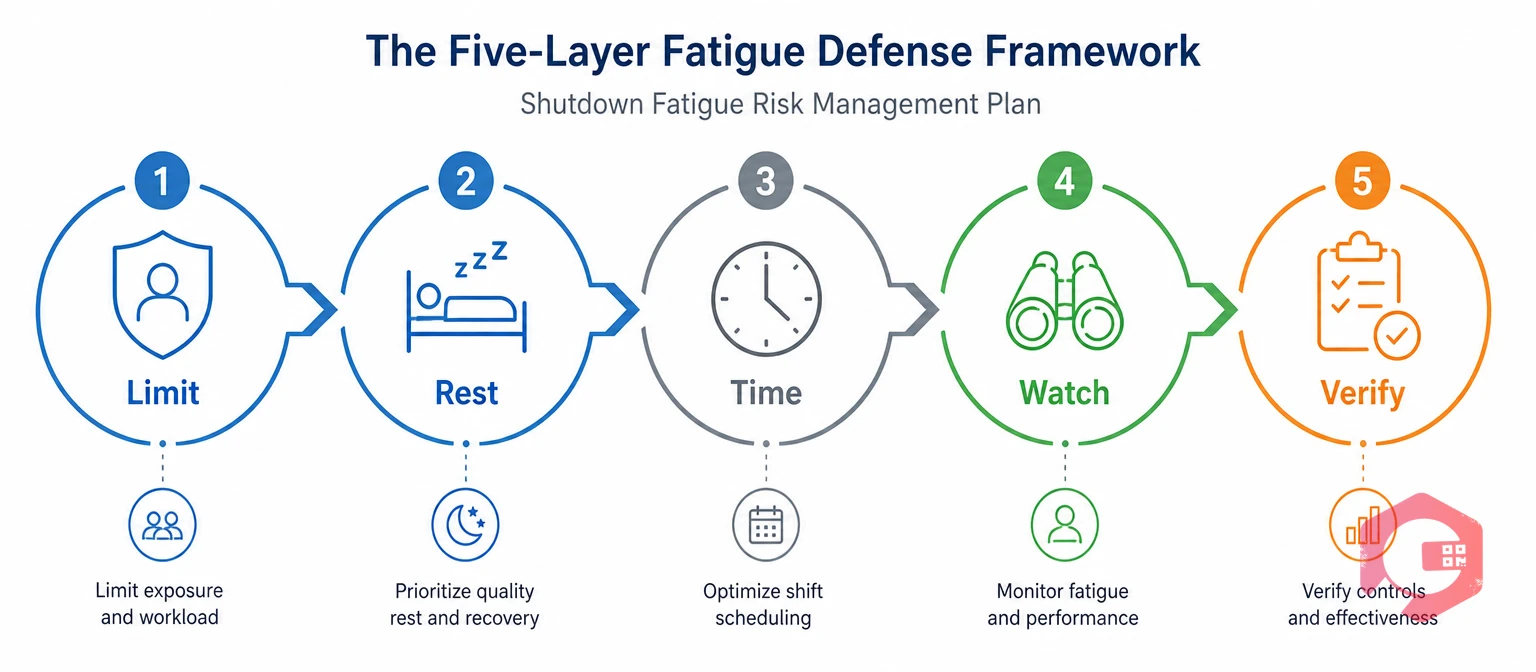
A fatigue risk management plan is a written set of limits, controls and checks for tired workers. It keeps tiredness from turning into incidents. It works best when it is built into the shutdown plan from the start, not added in week two.
The Five-Layer Fatigue Defense Framework:
Each layer catches what the one before it misses. The six steps below put these layers into practice.
Hours-of-service limits must be agreed and signed off before the first crew arrives. Once the outage starts, schedule pressure makes it hard to say no to overtime.
Write the limits into contracts and the shutdown plan, and record every approved exception with a reason. Limits that live only in a policy binder are not limits.
A good roster protects sleep first and then plans the work around it. Most fatigue problems start with a roster that looked fine on paper but left no time for rest.
Plan short breaks every two to three hours, with water and food available close to the work area. Breaks lower fatigue only if supervisors make sure crews actually take them.
The best time for high-risk work is early in the shift and outside the nighttime low. Shutdown planners can control this through the work sequence.
Tie these timing rules to your permits. Permit-to-work software can record who approved the work and when it started, so supervisors see when a high-risk job falls inside a fatigue window.
Supervisors and crew members should check for fatigue at the start of every shift and keep watching during it. People are poor judges of their own tiredness, so a short structured check works better than asking "are you OK?"
Make it safe to speak up. Workers must be able to report fatigue without being punished. Without that, nobody reports it until something goes wrong.
Overtime is the most common way fatigue limits get broken during a shutdown. Each extra hour feels small, but they add up across a long outage.
Most facilities that control fatigue well treat a holdover as a planning failure to fix, not a normal part of shutdown life.
Handovers and second checks catch the mistakes tired workers make. They are the last layer of defense before an error reaches the plant.
Use our regulatory compliance checklist to confirm the records an auditor may ask for after a shutdown.
A Computerized Maintenance Management System helps you manage fatigue by showing who is working, on which jobs and for how long. It does not measure tiredness, but it puts the data behind your limits in one place.
Better planning also cuts the breakdowns that cause emergency overtime. Maintenance teams using Cryotos have reported up to 30% reduction in unplanned downtime and 25% faster repair turnaround, which means fewer surprise call-outs for tired crews.
They can be, if you control them. Set hard caps on holdovers, limit runs of consecutive night shifts and protect rest days. Without those controls, accident risk rises sharply in the last hours of each shift.
There is no single number for every site. Industry guidance such as API RP 755 sets limits on consecutive shifts during outages, with tighter limits for nights. Check the guidance for your industry and set your limits in the shutdown plan.
Look for yawning, slow reactions, irritability, missed steps and repeated mistakes. Ask how much sleep each person got in the last 24 hours. Less than five hours is a clear warning sign.
It should include hours-of-service limits, roster rules, timing rules for high-risk tasks, fatigue checks and a clear way to report fatigue. It should also name who approves exceptions and how records are kept.
No. Maintenance software does not measure how tired someone is. It tracks hours, shifts, permits and checks, so you can see when a crew is close to its limit and act before an incident happens.
Shutdowns go better when tired people are never the last line of defense. Schedule a free demo to see how Cryotos tracks labor hours, digital permits and shift handovers so you can keep fatigue risk under control during your next outage.


Cryotos AI predicts failures, automates work orders, and simplifies maintenance—before problems slow you down.