

A hazardous substances register is a live list of every hazardous chemical on site, with its location, quantity and safety data sheet. In chemical and pharma facilities, it is the base document for risk assessments, storage rules, training and emergency plans.
This guide explains what to record, which rules drive it and how to build one in four parts. It also shows how a Computerized Maintenance Management System (CMMS) keeps the register honest, using a real Cryotos chemical-plant client.
Key Takeaways

A hazardous substances register is the controlled record of which hazardous chemicals a site holds, where they sit and how they are managed. Sites also call it a chemical inventory or hazardous chemicals register.
The legal basis depends on where you operate. In the US, OSHA’s Hazard Communication standard requires a written program that includes a list of hazardous chemicals. Employees must also be able to reach SDSs during every shift. Australia’s model WHS Regulations require a register of hazardous chemicals with current SDSs. The UK’s COSHH rules require risk assessment, and a register is the practical way to show it. This guide is general information, not legal advice.
Chemical and pharma sites hold many hazard types in many places. The register must cover far more than the main storage tank.
A safety data sheet (SDS) is a supplier document covering a chemical’s hazards, handling, storage and emergency steps. It follows the 16-section format from the Globally Harmonized System, and every register entry should point to the current one. Most facilities find that small containers, not bulk tanks, cause the surprises.
Check your current records against our regulatory compliance checklist before you start.

At minimum, record the product name, hazard class, location, maximum quantity, SDS status and key controls for each chemical. Add the supplier, CAS number and emergency contact where you can.
| Substance (example) | Hazard class | Location | Key controls | SDS and review |
|---|---|---|---|---|
| Isopropyl alcohol | Flammable liquid | Flameproof solvent cabinet | Hot work permit, earthing, spill kit | Current SDS; review on supplier update |
| Sulfuric acid, concentrated | Corrosive | Bunded acid bay | Keep apart from bases; eyewash and shower checks | Current SDS; review each cycle |
| Peracetic acid cleaner | Oxidizer, corrosive | Cleaning chemical store | Keep apart from organics; ventilation and PPE checks | Current SDS; review each cycle |
| Potent API powder (banded OEB 4) | Toxic | Contained suite | Containment checks, restricted access, trained staff | Current SDS; review on process change |
These rows are illustrations only. Classify your own products from the supplier’s current SDS, and check local rules for required fields.
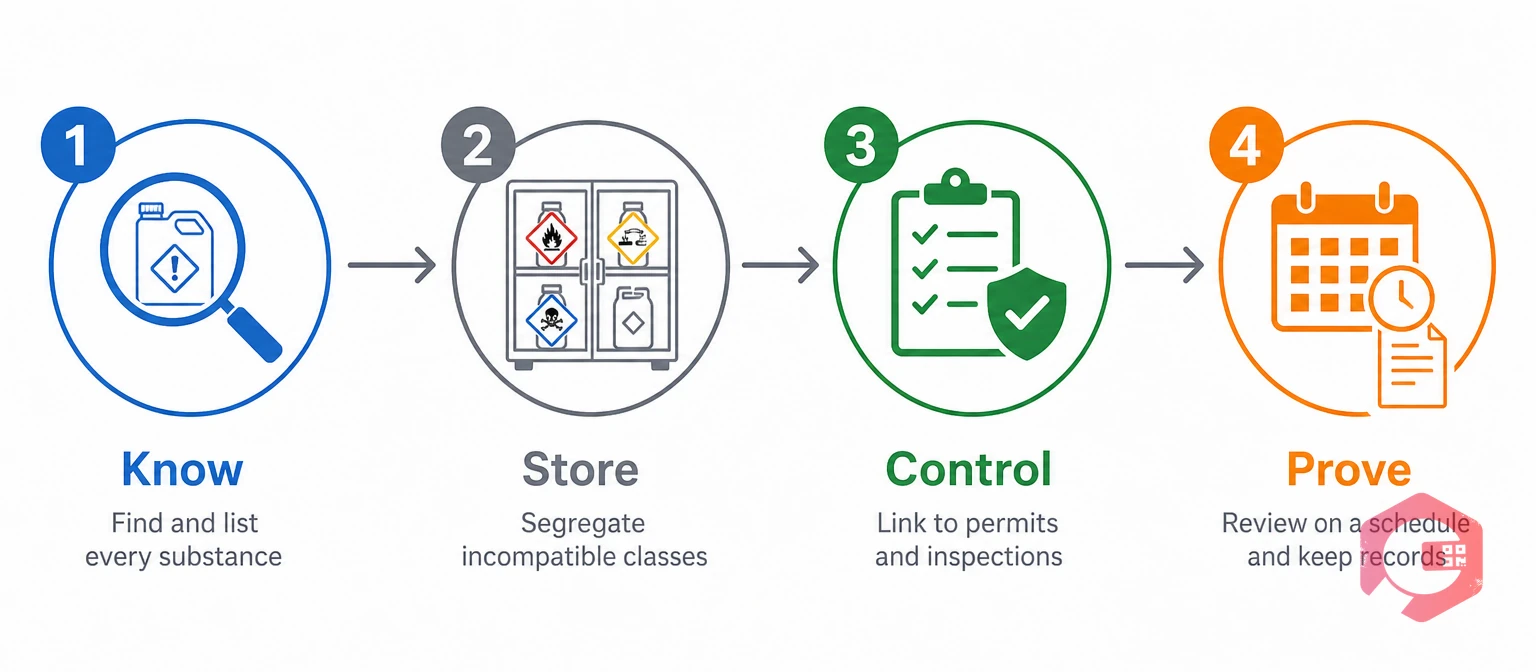
You build a register by finding every chemical, storing it safely, linking it to the work and proving it stays current. This four-part framework keeps the effort repeatable.
The Know-Store-Control-Prove Framework:
Walk every store, lab, production area and waste point with a checklist. Pull the current SDS for each product, and ask contractors to declare what they bring.
Segregation is storing incompatible chemicals apart so a spill or leak cannot trigger a reaction. Keep oxidizers away from flammables and acids away from bases, using the storage section of each SDS.
Attach each substance to the assets and jobs that touch it. Route hot work and confined space entry through permit-to-work software, and apply lockout and tagout before opening any line.
Set review triggers: a new product, a changed storage area, an SDS update and a fixed annual date. Record who reviewed it, what changed and which actions followed.
Most registers fail in the same few places. A common mistake is to treat the register as a one-time compliance project instead of a record that changes every week.
Track a few simple measures each month and report them to the EHS lead. They show whether the register matches the real site.
Resil Chemical runs reactors, scrubbers and an effluent treatment plant (ETP). Its Cryotos case study covers daily control, not a chemical register. It still shows why a hazardous substances register depends on reliable maintenance records.
Resil’s core problem was late detection. Manual meter reading was slow and hard. The team set acceptable limits too wide, so equipment problems went unnoticed until they became failures.
Safety showers and eyewash stations are the emergency equipment that a register entry for a corrosive often points to. Resil’s scheduled checks show how that equipment stays ready.
Resil reports faster issue resolution, tighter control and more reliable equipment. The case study does not describe a register or publish downtime figures, so this guide invents neither.
Across the wider Cryotos base, maintenance teams using Cryotos have reported up to 30% reduction in unplanned downtime and 25% faster repair turnaround. Results vary by site, and those figures are not chemical-safety measures.
A CMMS manages the work around the register, not the chemical data itself. Cryotos supports these jobs:
Cryotos does not classify chemicals or write SDSs. It also does not replace dedicated chemical inventory software. Keep the register in your EHS tool or a controlled document, and use Cryotos to run and prove the maintenance behind it.
You do not need a new program to start. You need a small, dated plan that EHS and maintenance share.
Small, repeatable steps beat a large plan that nobody follows.
It depends on where you operate. Australia’s model WHS Regulations require one where adopted. OSHA requires a list of hazardous chemicals in the written hazard communication program. Confirm the rules with your safety lead.
Update it whenever a product, quantity, storage location or SDS changes. Then review the whole register on a fixed schedule, such as annually, set from your risk assessment and local rules.
EHS usually owns the register, and each area owner keeps their section current. Maintenance owns the inspection jobs, and procurement flags new products before purchase.
No. The folder holds supplier documents. The register lists what is on site, where it sits, how much there is and which controls apply. It also points to the SDS.
A CMMS can schedule the inspections, permits and repairs around the register and keep the records. It is not built to classify chemicals or write SDSs, so keep that data in a dedicated tool.
A hazardous substances register protects people only while the work behind it gets done. Schedule a free demo to see how Cryotos schedules storage inspections, controls permits and records every repair.


Cryotos AI predicts failures, automates work orders, and simplifies maintenance—before problems slow you down.



