The key safety rules for drilling operations in mines are to assess the ground before the rig moves, inspect the rig every shift, keep people clear of moving parts, never drill into explosives, control dust and noise, and lock out the rig before any repair. Follow those rules, and you close off the main ways drilling hurts people: falls, entanglement, rig rollovers, power line contact, misfires and dust disease.
This guide covers drilling safety on surface benches and in underground headings. It gives eight rules, a pre-start inspection matrix and a five-gate framework any crew can use. Binding limits come from your regulator and your site procedures, so treat this as a practical checklist, not legal advice.
Key Takeaways

Drilling safety in mines is the set of rules and checks that protect crews while holes are drilled. It needs its own rules because a drill rig combines heavy mobile equipment, high-pressure hydraulics, rotating steel and unstable ground, often close to explosives. Eight hazards show up again and again:
Regulators treat drilling that way. In the United States, the Mine Safety and Health Administration (MSHA), not OSHA, enforces mine rules, including 30 CFR Part 56 for surface metal and nonmetal mines and Part 57 for underground metal and nonmetal mines. Coal mines follow separate parts. In India, the Mines Act, 1952 and the regulations made under it, enforced by the Directorate General of Mines Safety (DGMS), set the baseline, and many sites also run an ISO 45001 safety management system.
Good drilling safety turns each hazard into a rule with an owner, a check and a record.
Before any rig moves onto a bench or into a heading, a competent person must assess the ground, mark the hazards and approve a drill plan. Many drilling hazards can be found before the first hole starts, so this check is the first line of defense in drilling safety.
Permit-to-work software can keep approvals, conditions and sign-offs in one record, so the next shift sees what was approved and by whom. A drill plan built on today's ground checks beats a plan built on last week's conditions.
The operator must inspect the rig at the start of every shift and take any rig with a safety defect out of service until it is repaired. Pre-start checks are the base of drilling safety, because they catch worn hoses, weak brakes and missing guards before they injure anyone.
A signed pre-start sheet proves the check happened, and any defect it finds should go straight to a work order. A rig with an unfixed safety defect should not drill.
Put your pre-start sheet on a phone with maintenance checklists that work offline and capture digital signatures.
Position the rig on stable, level ground, set back from the crest and well clear of overhead lines, before raising the mast. Rig tip-overs and edge failures are among the most serious drilling events, and the cause often comes down to where the rig stands.
If a rig does touch a power line, the operator should stay in the cab, warn others to keep clear and wait for the line to be de-energized. Leave only if fire forces an exit, and jump clear with both feet together, so no part of the body bridges ground and rig. Your site emergency plan sets the exact steps.
Drilling safety starts with where the rig stands, so choose the spot before the mast goes up.
Nobody should stand near rotating drill steel, an open hole or a moving rig unless the job requires it and the machine is stopped or guarded. Rotating parts catch loose clothing, gloves and hair in a fraction of a second, so the safe position is always away from them.
Personal protective equipment (PPE) is the last layer, not the first: a hard hat, safety glasses, hearing protection, safety boots and high-visibility clothing. In drilling safety, distance and guarding protect better than any PPE.
Never drill, deepen or collar a hole into or next to a hole that may contain explosives, and keep drilling work separate from loading and blasting. A drill bit striking explosive material can set it off, so working beside charged holes is off limits.
The blasting supervisor owns these steps, and the drill crew must know them. Explosives rules are strict and local, so build them into your drilling safety plan and follow your regulator and your site blast plan. For background, read this overview of the drill and blast method. If you cannot prove a hole is empty, do not drill near it.
Respirable crystalline silica is fine dust from drilling quartz-bearing rock that can cause silicosis. Silicosis is an incurable lung disease, and drilling is a major dust source, so dust control is a core drilling safety rule, not a comfort measure.
MSHA's 2024 silica rule lowered the exposure limit to 50 micrograms per cubic meter over an eight-hour shift. Compliance dates have been revised, so confirm current requirements with your regulator. Dust that is never made cannot be breathed in, so control it at the drill.
Lock out, tag out and test the rig before anyone repairs, cleans or adjusts it, and release all stored energy first. A drill rig holds more than engine power: hydraulic pressure, a raised mast and a heavy drill string can all move or fall when nobody expects it.
Review the basics of lockout and tagout, then write the exact steps for each rig model on your site. No lock, no repair: that one habit in drilling safety can prevent some of the worst injuries on a drill rig.
Only trained and authorized operators should run a drill rig, and crews should rehearse emergency steps before they are needed. Rules on paper protect nobody if the people on the rig are untrained or exhausted.
Most operations that manage drilling safety well treat near misses as free lessons. They log each one, find the cause and share the fix with every crew.
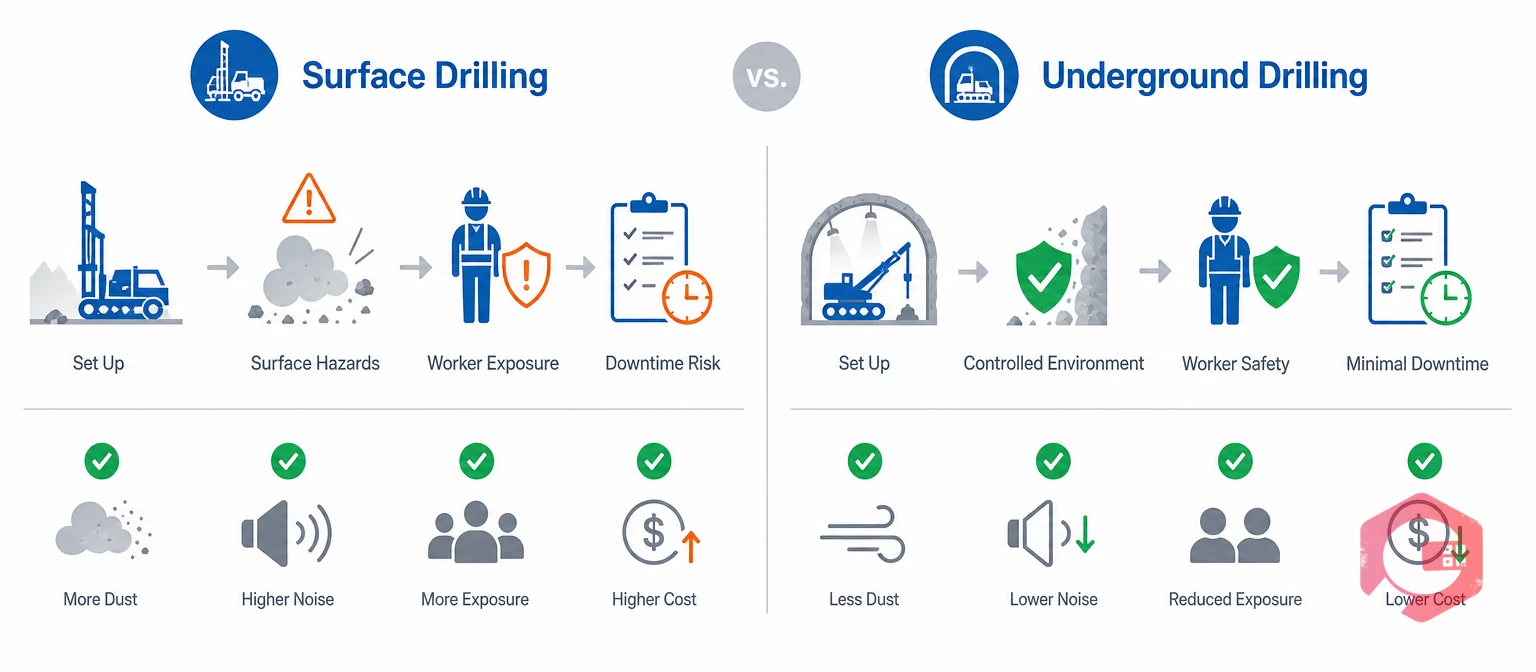
The eight drilling safety rules apply in both settings, but the main hazards and controls shift. The table shows where.
| Factor | Surface Drilling | Underground Drilling |
|---|---|---|
| Main hazards | Crest and highwall edges, rig tip-over, power lines and weather. | Unsupported ground, rockfall, poor air, tight spaces and rig collisions. |
| Ground control | Check benches, crest cracks and highwalls, and keep setbacks and berms. | Scale loose rock and install ground support before drilling, and stay under supported ground. |
| Dust and air | Wet drilling, dust collectors and filtered cabs; wind helps and hurts. | Wet drilling plus ventilation checks and gas testing; dust lingers in headings. |
| Rig type | Large blasthole rigs and track-mounted rigs. | Drill jumbos, long-hole rigs and bolting rigs in tight headings. |
| Explosives risk | Misfires and bootlegs in old blast patterns. | Misfires at the face; examine and scale after every blast. |
| Emergency planning | Clear rescue routes and edge rescue plans. | Marked escape routes, refuge options and a record of who is underground. |
| Inspection focus | Crest, berms, ground under the rig and overhead lines. | Back, ribs, ventilation, gas readings and boom clearance. |
Both settings share one truth: ground and explosives risks are known before drilling starts, so check them first.
Use this matrix as a starting point for drilling safety checks on the rig and the bench. Your manufacturer manual, regulator and site risk assessment set the real checks and intervals.
| Area | What to Check | Sign of Trouble | Suggested Rhythm |
|---|---|---|---|
| Brakes, steering and tracks | Service and park brakes, track or tire condition, backup alarm. | Long stopping distance; silent alarm. | Every shift. |
| Mast, feed and drill string | Cracks, loose pins, worn cables, locking devices. | Visible cracks; play in pins. | Every shift; full inspection per PM. |
| Hydraulic hoses and fittings | Leaks, chafing, bulges, loose fittings. | Wet fittings; bulging hose. | Every shift. |
| Guards and emergency stops | Guards fitted; each stop button works. | Missing guard; stop fails. | Every shift. |
| Fire protection | Extinguishers, suppression system, engine bay cleanliness. | Low gauge; oily residue. | Every shift; service per schedule. |
| Dust control | Water supply, dust collector, hoses, cab filters. | Visible dust cloud at the collar. | Every shift. |
| Bench or heading | Crest, berms, ground, power lines, open holes, ground support. | New cracks; wet ground; missing berm. | Every shift and after rain or blasting. |
| Lockout equipment | Locks, tags and isolators. | Missing or damaged locks. | Weekly. |
Build these rows into preventive maintenance software, so each check becomes a scheduled work order with a signed checklist.
For a wider site review, use the safety compliance checklist.

A simple way to remember drilling safety is to pass five gates in order. A crew does not move to the next gate until the current one is clear.
The Five-Gate Drilling Safety Framework:
Here is an illustrative example. A crew arrives at a bench after heavy rain. At Gate 1 the supervisor sees fresh cracks behind the crest, so the team moves the pattern back and re-marks the setback before the rig moves. The delay costs an hour and removes the risk of an edge failure under the rig.
On many sites, Gate 1 and Gate 5 are the ones skipped when production pressure rises. Start with the gate your site misses most often.
A Computerized Maintenance Management System (CMMS) supports drilling safety by scheduling rig inspections, recording signed checks and tracking every defect to a repair. It does not replace your drill plan, your safety management system or your regulator's requirements. Cryotos is a maintenance platform, not a blasting, ground control or gas monitoring system.
Maintenance teams using Cryotos have reported up to 30% reduction in unplanned downtime and 25% faster repair turnaround. On a drill fleet, fewer breakdowns can also mean fewer rushed repairs, and rushed repairs are where inspection and lockout steps tend to slip.
Ground control, blast design and gas monitoring stay in your engineering and safety systems. Ask any software vendor how its records connect to them.
Assess the ground and hazards first, inspect the rig every shift and position it on stable ground away from edges and power lines. Keep people clear of rotating parts, never drill into explosives, control dust and noise, and lock out before any repair. Train crews and manage fatigue, so the rules hold on every shift.
Most sites require a hard hat, safety glasses, hearing protection, safety boots and high-visibility clothing. Respiratory protection is added when dust controls are not enough. PPE is the last layer of drilling safety, and your site risk assessment sets the exact list.
Drilling quartz-bearing rock releases fine silica dust that can reach deep into the lungs. Over time, it can cause silicosis, which has no cure. Wet drilling, dust collectors and filtered cabs are the main controls.
Stay in the cab, warn others to keep clear and wait for the line to be de-energized. Leave only if fire forces an exit, and jump clear with both feet together. Follow your site emergency plan for the exact steps.
The operator should complete a pre-start inspection at the start of every shift. Planned maintenance inspections then follow the manufacturer manual, run hours and your regulator. Keep a signed record of each check.
Yes, in the maintenance side of safety. It schedules inspections, records signed checks and tracks defects to repair. It does not replace your drill plan, safety management system or regulator requirements.
Safe drilling comes from rules that crews follow every shift and records that prove it. Schedule a free demo to see how Cryotos schedules rig inspections, records signed checks and tracks every defect to a repair.


Cryotos AI predicts failures, automates work orders, and simplifies maintenance—before problems slow you down.