

A fire risk assessment for maintenance operations is a pre-work check that finds what can start a fire, what can burn, and who could be hurt. Done before the job begins, it tells the team which tasks need a permit, a fire watch, or a different method.
Maintenance work changes a site's fire risk every day. A welding job, a solvent clean-up, or a switched-off smoke detector can turn a normal area into a high-risk one in minutes. This guide shows how to complete a fire risk assessment before work starts, how to rate high-risk jobs, and how to record the result.
Key Takeaways
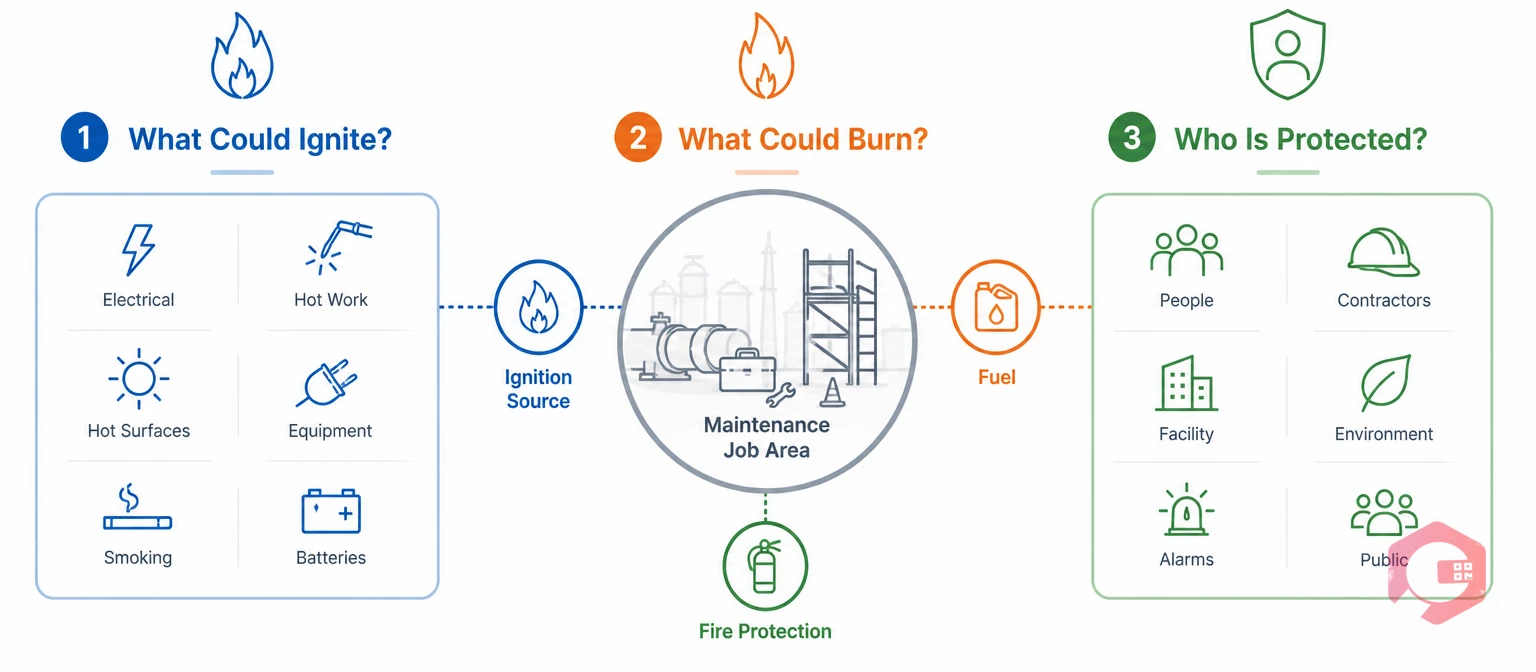
A fire risk assessment for maintenance operations looks at each planned job and asks three questions: what could ignite, what could burn, and what protects people if a fire starts. Rules differ by country. In the UK, fire safety law requires the responsible person to carry out a fire risk assessment for most workplaces.
In the United States, when an OSHA standard requires a fire prevention plan, 29 CFR 1910.39 sets what the plan must cover: the main fire hazards, the ignition sources and how they are controlled, and who is responsible. Check your local fire code and your insurer's rules as well. Most sites run two layers of assessment:
The site-level assessment sets the baseline, but maintenance changes the baseline every shift. The job-level assessment catches that change. For wider background, see this overview of fire safety.
A site assessment shows the normal risk, and a job assessment shows today's risk.
Maintenance work raises fire risk because it brings heat, fuel, and disabled safeguards into the same place at the same time. Normal production keeps ignition sources in known spots, such as ovens and motors. Maintenance moves them, adds new ones like torches and grinders, and often removes protection.
A fire protection impairment is any time a detector, alarm, sprinkler, or extinguisher is out of service. Maintenance causes many impairments, so every assessment should ask what protection the job will switch off.
Most facilities treat hot work as the fire risk and stop there. Maintenance teams that avoid fires also check what sits on the other side of the wall, under the floor grating, and in the duct above. Fire starts where heat meets fuel, and maintenance is often what brings them together.
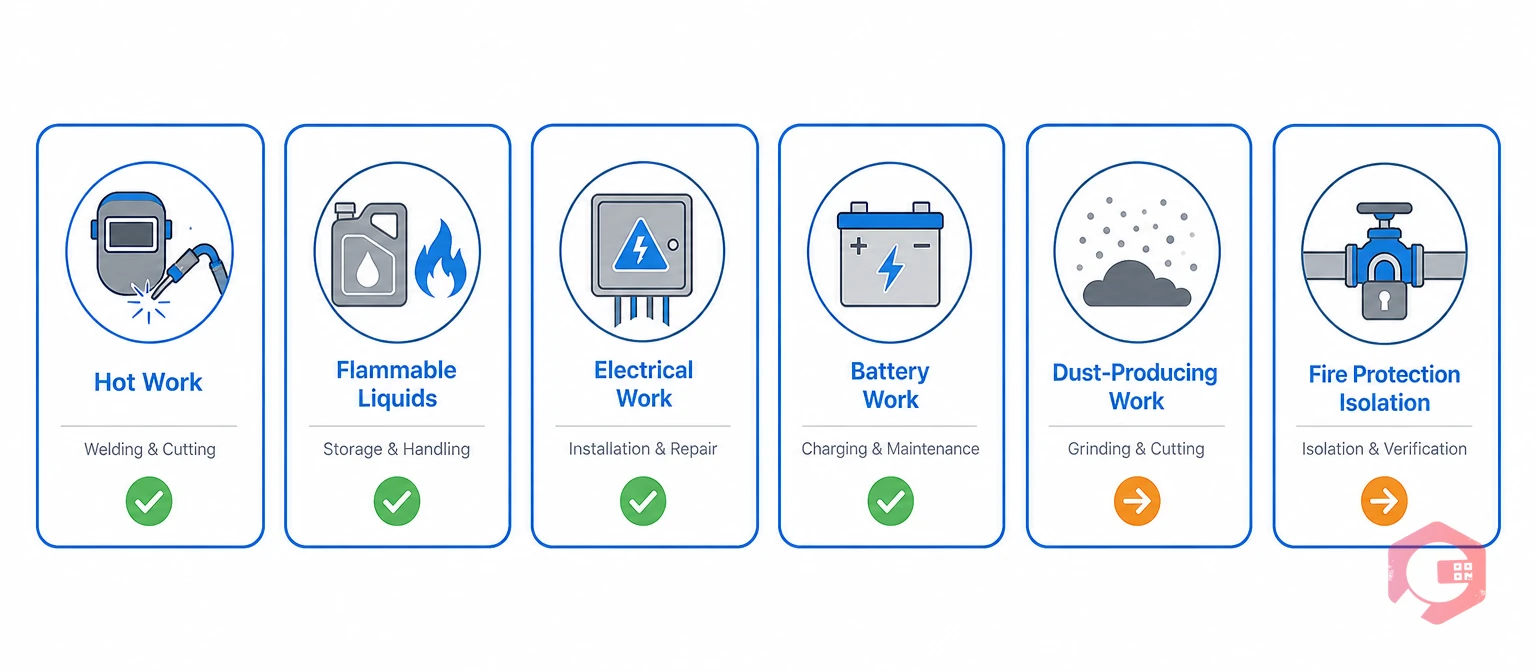
High-risk maintenance work is any job that adds a heat source, a fuel, or a defeated safeguard to the work area. Use this list to flag jobs that need a full job-level assessment:
Many jobs fit more than one group. Cutting a pipe near a solvent line is hot work and a flammable liquid job at once, so it rates higher than either alone. If a job adds heat, adds fuel, or removes protection, treat it as high-risk until the assessment says otherwise.
Turn this list into a repeatable site review with the safety compliance checklist.
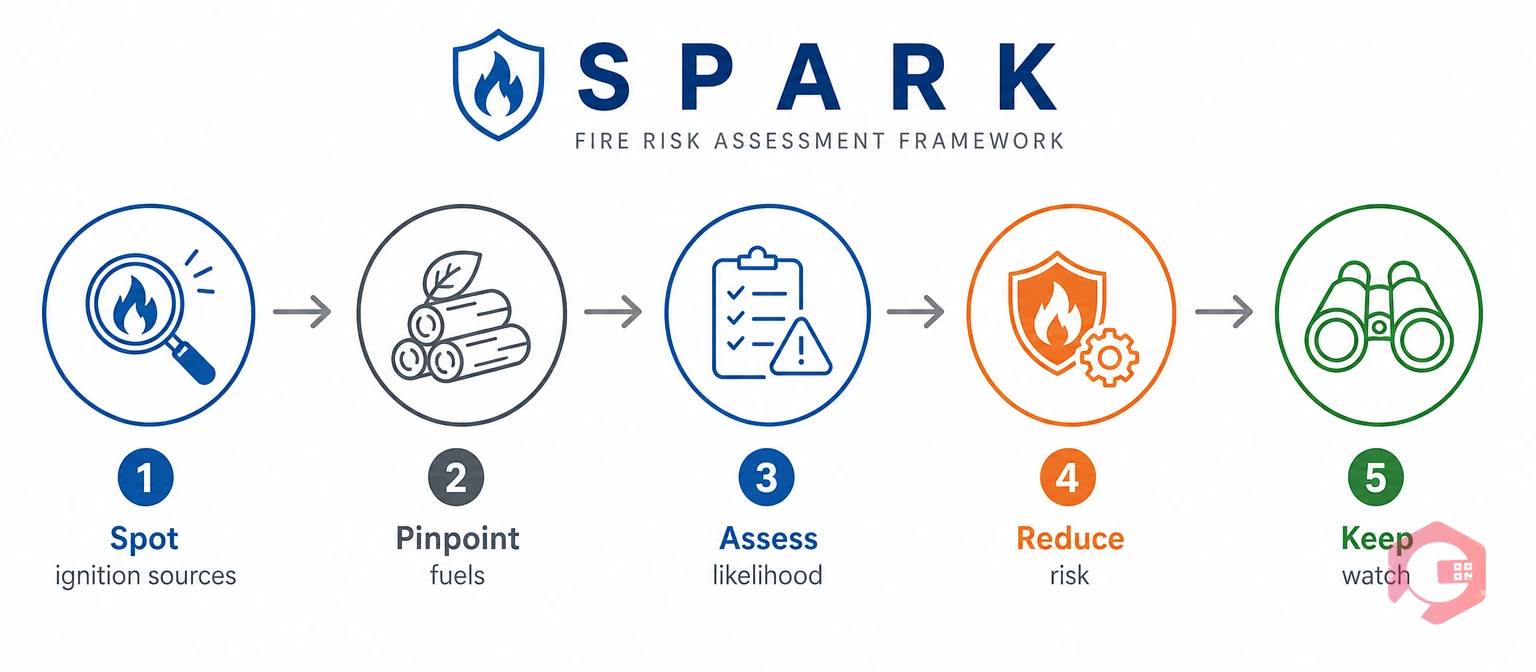
Complete a fire risk assessment before maintenance work starts by walking the job site, listing ignition sources and fuels, rating the risk, choosing controls, and recording the result. The five steps below follow the SPARK Framework, so crews can remember them without a manual.
The SPARK Framework:
List every tool and condition that can create heat, sparks, or flame, including those next to the work area.
Walk a wide circle around the job, and look up, down, and through walls. Sparks can fall through grating, pass through wall openings, and ignite material on another level.
Rate how likely a fire is and how serious it would be if one started. Then combine the two into a simple rating.
Rate the worst credible case, not the usual case. Sites with a formal risk matrix should use it, so the fire rating lines up with other safety ratings.
Start by removing the hazard, then add controls in order of strength. Change the method first, add screens or ventilation second, and add permits, a fire watch, and training third. Match the strength of the controls to the rating.
Assign someone to watch the work, then check the area after the crew leaves. Record the rating, the controls, and the sign-off against the work order.
Here is an illustrative example. A crew plans to cut a bracket on a platform above a packing line. The Step 2 walk-through finds cartons stacked on the floor below. The team moves the cartons, hangs a blanket under the platform, and posts a fire watch. The change takes ten minutes and removes the most likely way a fire could start.
A fire risk matrix links each type of maintenance task to its main ignition source, nearby fuel, key controls, and a starting rating. The ratings are starting points only, because your site conditions, local fire code, insurer rules, and competent assessor set the final rating.
| Maintenance Task | Main Ignition Source | Fuel Nearby | Key Controls | Starting Rating |
|---|---|---|---|---|
| Welding, cutting, brazing, and grinding | Sparks, slag, arcs, and hot metal. | Dust, oil, packaging, wood, and insulation. | Hot work permit; clear or shield fuel; trained fire watch; extinguisher at hand. | High |
| Soldering and heat-gun work | Hot tool tips and hot air. | Cables, plastic, and paper. | Clear the area; use a tool stand; check the area after work. | Medium |
| Draining or transferring flammable liquids | Static sparks and nearby heat. | Fuels, solvents, and vapors. | Bonding and grounding; ventilation; no ignition sources; spill kit. | High |
| Electrical repair and panel work | Arcs, loose terminals, and overloaded circuits. | Cable insulation and dust. | Isolate and lock out; qualified person; thermal check after repair. | Medium to High |
| Battery charging and replacement | Short circuits and overheating cells. | Battery packs and nearby stock. | Charge in a set area; inspect for damage; keep stock clear. | Medium to High |
| Oil changes and hydraulic repair | Hot surfaces and friction. | Oil, grease, and oily rags. | Cool down first; wipe spills; use closed metal bins for rags. | Medium |
| Work on hot equipment such as ovens, dryers, and boilers | Residual heat and hot surfaces. | Dust build-up and product residue. | Allow cool-down time; clean dust first; check temperature. | Medium to High |
| Isolating a detector, alarm, or sprinkler | None, but protection is removed. | Everything in the protected area. | Impairment record; fire watch; notify the fire authority or insurer if required; test when restored. | High |
Raise any rating by one level when the job is in a dusty area, near stored flammables, or during a fire protection impairment.
Build the matrix into your preventive maintenance software, so each recurring high-risk task starts with its assessment. A matrix does not replace judgment, but it makes sure the right questions get asked every time.
The strongest controls remove the fire hazard, and the weakest rely on people remembering to act. The hierarchy of hazard controls ranks them, and it works well for fire risk:
A permit turns the assessment into an authorization. A permit to work system can hold the assessment, the approval, and the sign-offs in one record, so the next shift sees what was approved and by whom.
For hot work, 29 CFR 1910.252 sets basic fire prevention steps, such as moving combustibles, shielding what cannot be moved, and using a fire watch where a fire could develop. NFPA 51B sets out hot work permit and fire watch practice in more detail.
A fire watch is a trained person who looks for fires during and after hot work and can raise the alarm. The watcher needs an extinguisher, a clear view of the work area, and no other task.
When a job also involves energy sources, isolate them first. Review the basics of lockout and tagout, and apply the same discipline to fire risk.
The most common mistake is treating the assessment as a yearly paper exercise instead of a check done before each high-risk job. Most maintenance teams recognize at least two of the mistakes below.
Each fix needs a named owner and a recorded check, not new equipment.
A Computerized Maintenance Management System (CMMS) supports fire risk assessments by attaching the check to the work order, scheduling recurring high-risk tasks, and keeping signed records. It does not detect fires or replace a competent fire risk assessor. Cryotos is a maintenance platform, not a fire alarm, detection, or suppression system.
Maintenance teams using Cryotos have reported up to 30% reduction in unplanned downtime and 25% faster repair turnaround. Fewer rushed repairs can also mean fewer shortcuts on fire checks.
Fire detection, alarm, and suppression systems, and your site's own fire risk assessment, stay in your safety and engineering systems. Ask any software vendor how its records connect to them.
It is a check of one planned job that finds ignition sources, nearby fuel, and any protection the job will switch off. Do it before the work starts, and update it if the plan or the work area changes. Record the result against the work order.
Any job that adds heat, adds fuel, or removes fire protection needs one. Hot work, flammable liquid handling, electrical repairs, battery work, dusty work, and detector or sprinkler isolation are the usual examples. Your site risk assessment sets the final list.
A site assessment reviews the building and its normal conditions, and it is repeated on a schedule or after major changes. A job-level assessment reviews one task in one place on one day. The job-level check catches risks that maintenance creates after the site assessment is done.
The employer or responsible person stays accountable under most fire safety rules. In practice, a competent person such as the supervisor or permit issuer completes the job-level check. Follow your local law and your site procedure for the exact roles.
OSHA's welding and cutting standard sets a minimum of 30 minutes. NFPA 51B sets a longer minimum, and some insurers ask for more. Follow the strictest rule that applies to your site, and let the assessment decide if more time is needed.
Yes, on the maintenance side. It schedules recurring checks, keeps the assessment with the work order, and stores signed records. It does not replace fire detection systems, a competent assessor, or your local fire code.
A fire risk assessment protects people only when it happens before the work starts and the result stays with the job. Schedule a free demo to see how Cryotos links pre-work checks, sign-offs, and records to every work order.


Cryotos AI predicts failures, automates work orders, and simplifies maintenance—before problems slow you down.



