

A well-built preventive maintenance checklist catches eight categories of equipment problems before they become failures: bearing degradation, belt and coupling slippage, electrical connection faults, cooling system breakdown, lubricant contamination, vibration-induced damage, safety guard wear, and compliance documentation gaps. Each shows up as a leading indicator on the checklist weeks or months before it costs you downtime.
This post walks through each category — what the failure looks like, which checklist task catches it, and how much warning time you get. Together they cover most of what a structured PM program is designed to prevent.
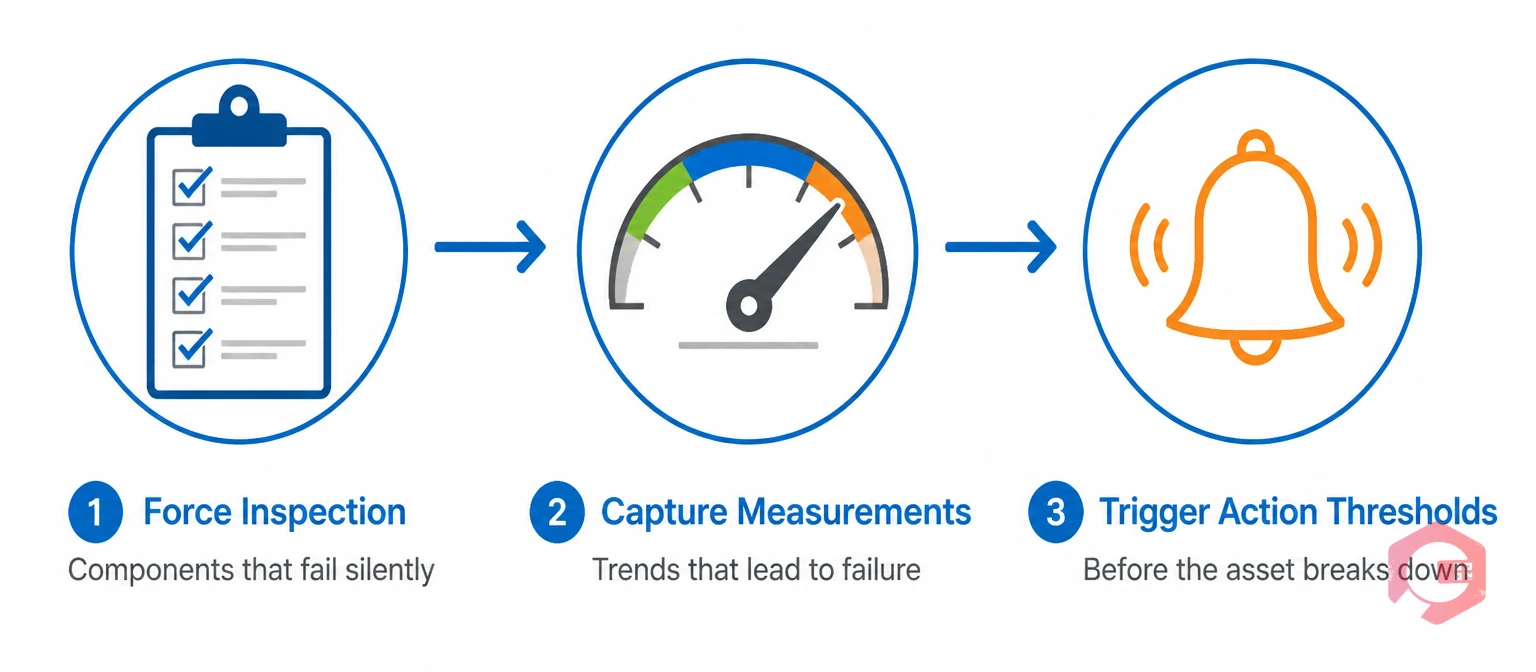
A PM checklist prevents problems three ways: it forces inspection of components that fail silently, it captures measurements that trend toward failure, and it triggers action thresholds before the asset breaks. None of this works without the right structural pieces in place — see our breakdown of the key components of an effective PM checklist for what every checklist must contain.
The eight problems below are the most common targets. Some are mechanical, some electrical, some procedural — but they share a pattern: every one is preventable with the right task on the right schedule, executed by a technician who knows what "passing" actually means.
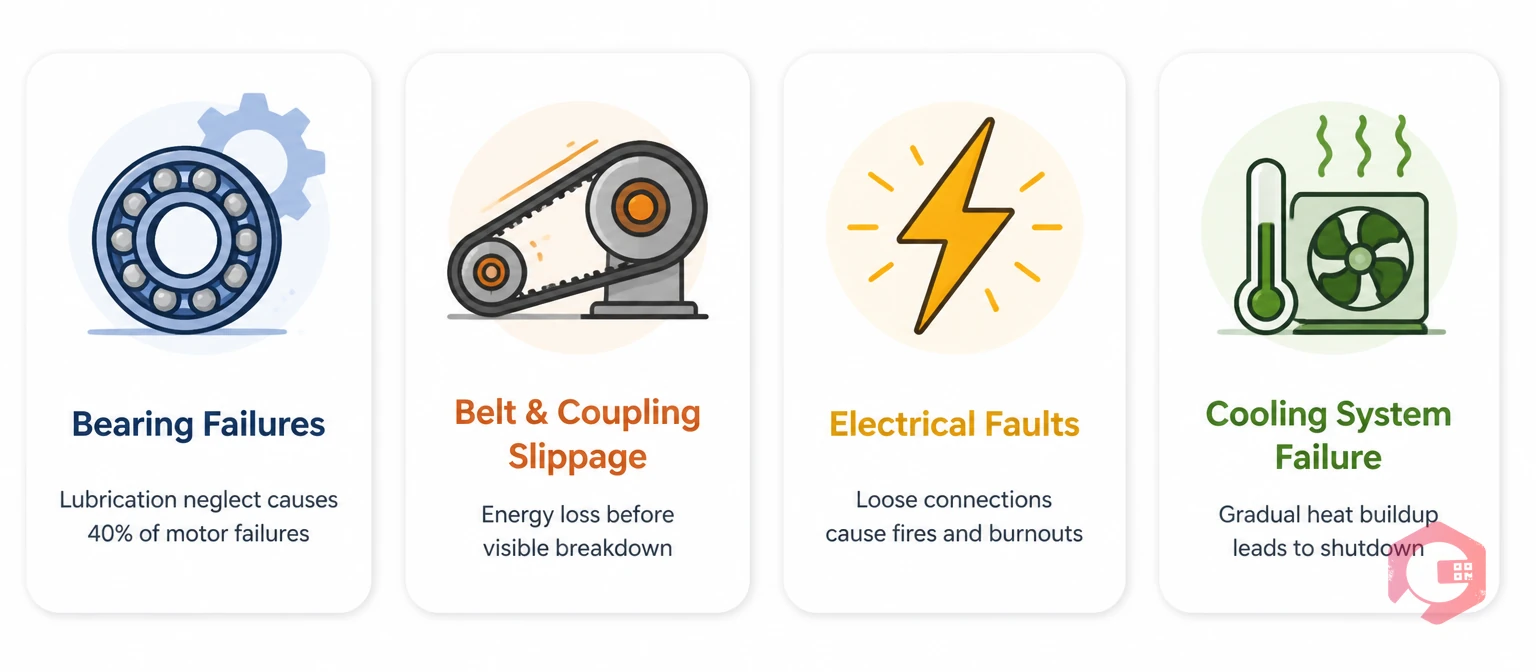
Bearings cause an estimated 40% of unplanned motor failures, and the overwhelming majority of those failures trace back to lubrication issues — wrong grease, too little, too much, or contaminated grease. A 30-second checklist task prevents most of it.
What the checklist catches:
Early warning window: 4 to 12 weeks when temperature and noise are tracked monthly. A $3,000 motor replacement plus 8 hours of downtime becomes a $30 tube of grease and 15 minutes of labor.
Worn belts and misaligned couplings cause energy loss long before they cause breakdown. By the time the belt snaps or the coupling shears, the asset has been running at 60% to 80% efficiency for weeks.
What the checklist catches:
Catching slippage early doesn't just prevent breakdown — it recovers the 5% to 15% energy waste running underneath it. Energy savings alone often justify the PM frequency.
Loose electrical connections are the cause of an enormous share of industrial fires and motor burnouts. They develop silently — a bolt that was torqued correctly at install loosens through 18 months of thermal cycling — and the first symptom is usually smoke.
What the checklist catches:
The OSHA penalty schedule includes electrical safety violations at up to $16,550 each — and those are minor compared to the cost of an actual fire. Thermographic scans during PM catch nearly all of these in time.
Cooling systems fail gradually. The radiator slowly clogs, the fan slowly weakens, the coolant slowly loses additive concentration, and one summer day the asset shuts down on thermal protection. Every step is detectable.
What the checklist catches:
The pattern matters as much as the absolute reading. A motor at 70°C is fine. A motor at 70°C that was at 60°C six months ago is a failure waiting — but only if someone reads the trend.
Oil analysis is one of the most powerful PM tools available — and one of the most under-used. It tells you what's wearing inside the gearbox before you can see or hear anything wrong.
What the checklist catches:
A gearbox showing rising iron and falling viscosity gives you 3 to 6 months of warning before a bearing or gear tooth fails — enough to schedule the rebuild instead of suffering the breakdown.
Vibration is the symptom of almost every mechanical fault — imbalance, misalignment, bearing wear, looseness, resonance. A good PM checklist captures it as a measurable trend, not a gut feel.
What the checklist catches:
Vibration on a single bearing typically rises gradually for 8 to 16 weeks before catastrophic failure. If nobody is measuring, that warning window is wasted.
The most preventable failures of all are safety incidents from missing guards, expired interlocks, or worn safety devices. These aren't equipment problems in the wear sense — they're documentation and discipline problems that PM checklists catch directly.
What the checklist catches:
These items come up first in any OSHA inspection. A documented PM history covering them is often the difference between a citation and a clean walk-through.
The eighth problem isn't on the equipment — it's in the records. ISO 9001, ISO 55001, FDA 21 CFR Part 11, and most insurance audits require documented evidence of inspection. Without a structured checklist, that evidence doesn't exist.
What the checklist catches:
An audit that takes three weeks of frantic record-gathering becomes a 30-minute report export when the PM checklist is structured right from day one.
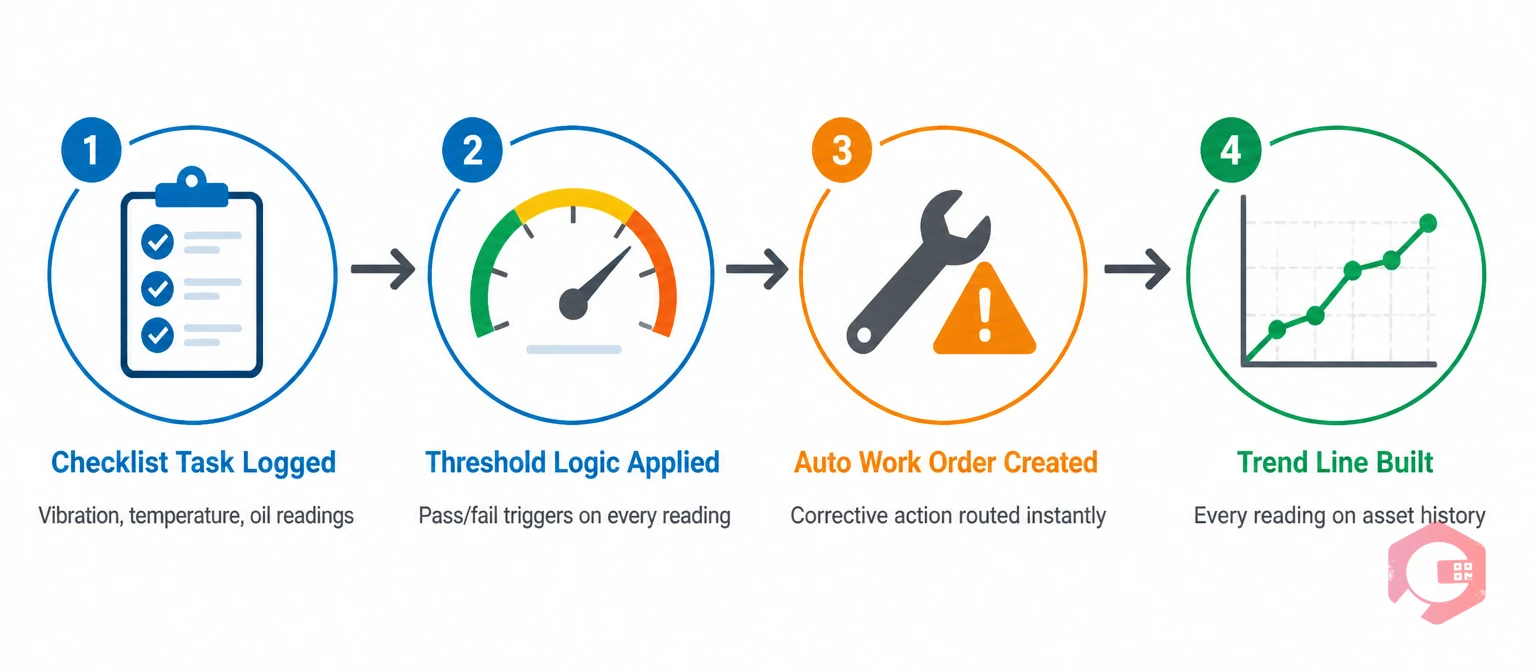
Cryotos is built so each of these eight problems has a place on the checklist with the right trigger and threshold. Vibration, temperature, oil analysis, and electrical readings log with pass/fail logic that auto-creates a corrective work order when a threshold trips. Photo evidence captures with geolocation and timestamp. Maintenance checklists link to asset history so every reading sits on a trend line, not in isolation. Most teams see their first prevented failure within 60 days of go-live.
No — random failures (manufacturing defects, voltage spikes, operator error) sit outside what PMs can catch. Industry research suggests 70% to 80% of mechanical failures are wear-related and preventable with disciplined PM. The remaining 20% to 30% is why even the best plants still need reactive capacity and condition monitoring.
A basic time-based PM with visual inspection and lubrication typically catches Problems #1, #2, #4, and #7. Adding measurements (temperature, vibration, current) brings in #3, #6, and #8. Full coverage requires oil analysis (#5) and thermographic scans (#3) — both pay back fast on critical assets.
Bearing failures (#1) consistently top the list — both because they're frequent and because they take other components down when they seize. Cooling system failures (#4) are usually second, since thermal shutdown of a critical asset can halt a production line for a full shift.
It varies by problem. Lubricant contamination and vibration give 3 to 6 months of warning when tracked monthly. Bearing temperature trends give 4 to 12 weeks. Loose electrical connections detected via thermography give 1 to 6 months. The earlier and more consistently you measure, the longer the planning window.
Every problem on this list is preventable — but only by a checklist that's structured to catch it. Audit your current PM checklists against the eight categories above and you'll quickly see where the gaps are. If you'd like to skip the audit and start with templates that cover all eight, book a demo with Cryotos to see what a problem-anchored PM checklist looks like for your asset base.



Cryotos AI predicts failures, automates work orders, and simplifies maintenance—before problems slow you down.



