
TPM programs fail for the same handful of reasons in almost every plant. Leadership stops following through. Nobody records a baseline. Autonomous maintenance never really sticks. Preventive schedules quietly slide back into firefighting. Total Productive Maintenance is meant to be a company-wide reliability effort, not a maintenance-department checklist, and most breakdowns happen at the handoff between operators, technicians, plant management, and finance. A Computerized Maintenance Management System closes that gap. It captures the data, enforces the routines, and gives every stakeholder the same numbers to work from. Below are the 10 failure points that show up most often when TPM programs fail, and the specific CMMS capability that prevents each one.
Key Takeaways
TPM programs fail early when leadership signs off on the launch and then hands the whole initiative to the maintenance team. TPM only works when operators, supervisors, and plant leadership share ownership of equipment condition. Without visible sponsorship from the top, budget requests get deprioritized fast.
Floor staff read that gap correctly. If leadership isn't checking the numbers, the new routines feel optional. This is one of the most cited reasons TPM programs fail inside the first year.
A live BI dashboard gives plant managers and executives the same OEE, availability, and cost figures the maintenance team sees. Everyone looks at one screen instead of a monthly slide deck. Because leadership can check progress without asking for a meeting, TPM stays visible at the level where funding decisions get made.
Teams often launch TPM with real enthusiasm but no record of where they started. Without a documented baseline for downtime, MTTR, MTBF, or OEE, there's no way to prove the program worked six months later. Early wins go unnoticed because nobody can point to the before-and-after numbers, and this gap is a quiet but common reason TPM programs fail to earn continued budget.
A CMMS builds that baseline automatically through the MTTR calculator and ongoing downtime logs, instead of relying on someone to set the whole thing up by hand from scratch. That distinction between planned downtime and true failure is exactly what manual tracking tends to blur.
A BI dashboard then turns that raw data into MTTR, MTBF, and availability trends a team can present with confidence.
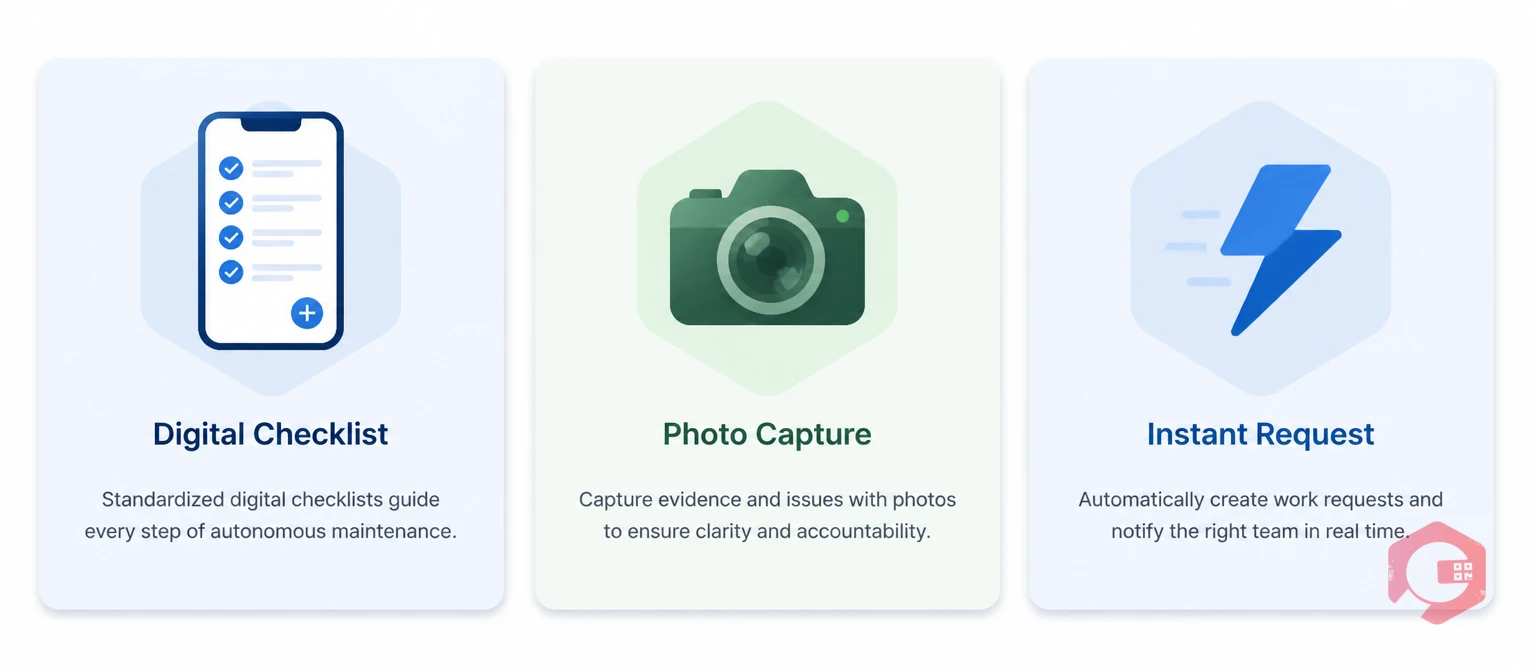
Autonomous maintenance is the pillar where operators handle daily cleaning, inspection, and lubrication. It is also the part of TPM that collapses most often. Autonomous maintenance is operators handling routine equipment care instead of leaving it solely to maintenance staff. Paper checklists get lost or filled in from memory at the end of a shift, which turns the inspection into a formality instead of a real check on equipment condition.
Digital maintenance checklists on a mobile CMMS walk operators through the same steps every time. Photo capture and digital signatures show whether a check happened on the floor or was filled in later from memory. If an operator spots something during a routine check, they can raise a work request from the same screen. That single step stops a small issue from becoming a breakdown. This is also where OSHA's lockout/tagout requirements matter. Operators doing hands-on checks need a documented, repeatable safety procedure, not just a verbal reminder from a supervisor.
See how a CMMS keeps preventive maintenance schedules on track: explore Cryotos maintenance management software.
Work order history, failure notes, and asset records often sit scattered across paper logs and personal spreadsheets. When that happens, nobody has a full picture of an asset's condition. Technicians repeat diagnostic work that was already done last month. Reliability patterns that would show up in a proper history simply go unnoticed. This scattered record-keeping is a quiet reason TPM programs fail to build the institutional memory they need.
Every work order in a CMMS attaches to a specific asset record, so its full repair history, parts used, and technician notes stay in one place. QR code and GPS-based asset tracking mean a technician can scan a machine on the floor and see its complete maintenance timeline right away, instead of digging through old paperwork.
TPM depends on planned maintenance actually happening on schedule. When PM tasks live on a whiteboard or in someone's calendar, they get pushed back the moment a breakdown demands attention. Within a few months the team is fully reactive again, which is the exact failure pattern TPM was meant to fix.
Preventive maintenance is scheduled repair work performed before a failure occurs, not after one. This differs from corrective maintenance, which only starts once equipment has already broken down. A CMMS schedules PM tasks on a calendar that supports both static, date-based PMs and dynamic PMs triggered by hours or mileage. The schedule adjusts on its own. Nobody has to recalculate it by hand every week.
Because overdue and upcoming PMs sit on one screen, supervisors can spot a slipping schedule before it turns into a missed inspection, not after.
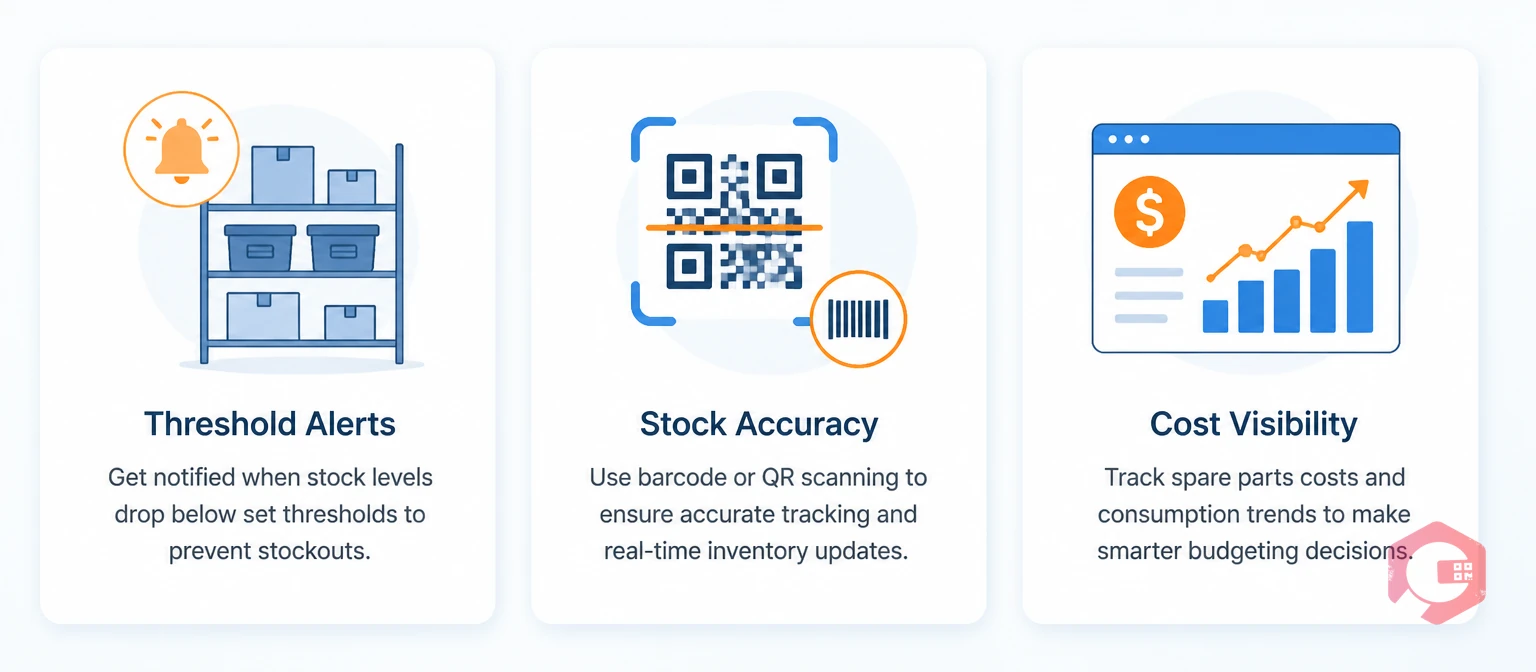
A preventive task that can't be completed because a filter, belt, or bearing isn't in stock does more damage than a missed inspection. Technicians either delay the task, which restarts the slippage problem above. Or they use the wrong part instead. That shortens the life of the very component the PM was meant to protect. Parts shortages are a mundane but frequent reason TPM programs fail to hold their schedule.
Cryotos ties PM tasks directly to the parts they require through its inventory management module, so a shortage shows up on the schedule, not on the work order.
Without a structured way to ask why a failure happened, teams treat the same breakdown as a series of unrelated incidents. Each occurrence gets a quick fix. The underlying cause stays in place, whether it's a bad lubrication interval or a design flaw. The same asset keeps coming back onto the work order list. Skipping root cause work is a well-documented reason why TPM programs fail to reduce repeat failures over time.
Cryotos builds the 5 Whys method directly into the work order closeout, so technicians document root cause at the point of repair instead of in a report nobody reads. That structured data rolls up into reporting, which makes repeat-failure assets easy to spot and prioritize.
TPM needs fast, constant communication. The person who runs the machine, the technician who fixes it, and the manager who allocates resources all need to hear from each other quickly. When that communication depends on phone calls or a shift-change conversation that may or may not happen, issues sit unresolved. Trust in the program erodes over time. Poor communication is consistently named as a reason TPM programs fail even when every pillar activity is technically in place on paper.
Cryotos pushes work order status, PM reminders, and downtime alerts directly to WhatsApp and email. A technician's update reaches a supervisor's phone the moment it happens, not at the next shift meeting. Most operations that successfully sustain TPM past year one credit this kind of real-time visibility over any single pillar activity on its own.
TPM's core promise is reducing the six big losses defined by TPM's founder, Seiichi Nakajima. Those losses are breakdowns, changeovers, idling and minor stops, reduced speed, startup rejects, and running rejects. Most plants never quantify them. Logging every stop reason by hand is tedious enough that operators skip it. Leaving these losses unmeasured is arguably the clearest reason TPM programs fail to show a measurable return on the effort put in.
Overall Equipment Effectiveness is TPM's standard score for how much production capacity a plant actually uses. World-class OEE is generally cited at 85%. That benchmark traces back to Nakajima's original TPM research from the 1970s. Most manufacturing plants today run closer to 60%. More plants score below 45% than above 85%, which shows how wide the gap really is.
Cryotos downtime tracking captures stops in real time by department, plant, and asset, classifying them against MTTR, MTBF, and unplanned maintenance hours automatically. Maintenance teams using Cryotos have reported up to 30% reduction in unplanned downtime and 25% faster repair turnaround once that data becomes visible instead of anecdotal.
Maintenance data often lives in a system that doesn't talk to production scheduling or the ERP. When that happens, TPM initiatives can't align with output targets. They also can't account for maintenance cost at the enterprise level. Finance ends up seeing maintenance as a cost center with no visible link to the uptime it protects. That disconnect is a structural reason TPM programs fail to earn support beyond the plant floor, even when the shop floor results are strong.
Cryotos integrates with SAP and Microsoft Dynamics 365 through its ERP integration, so maintenance costs and parts consumption sync with the systems finance and production already use. IoT and SCADA feeds let dynamic PMs trigger from actual machine usage instead of a fixed calendar guess.
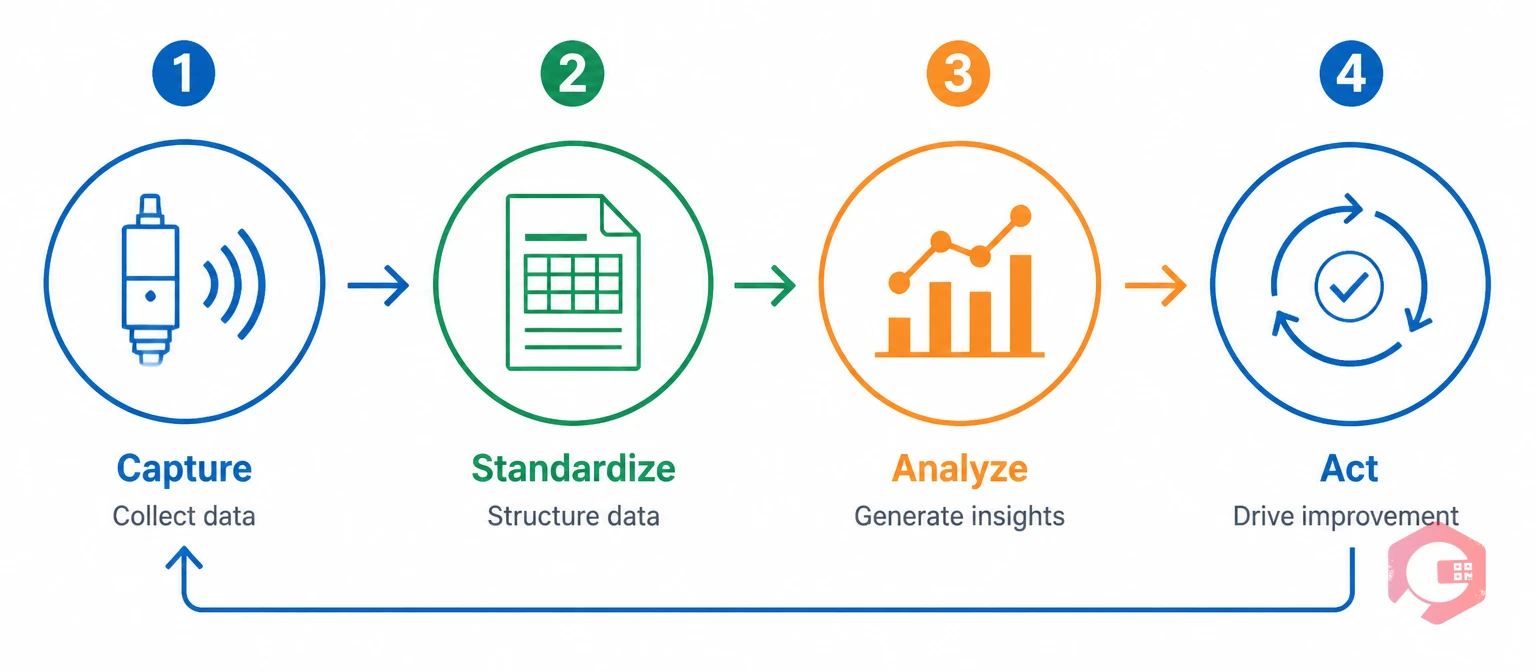
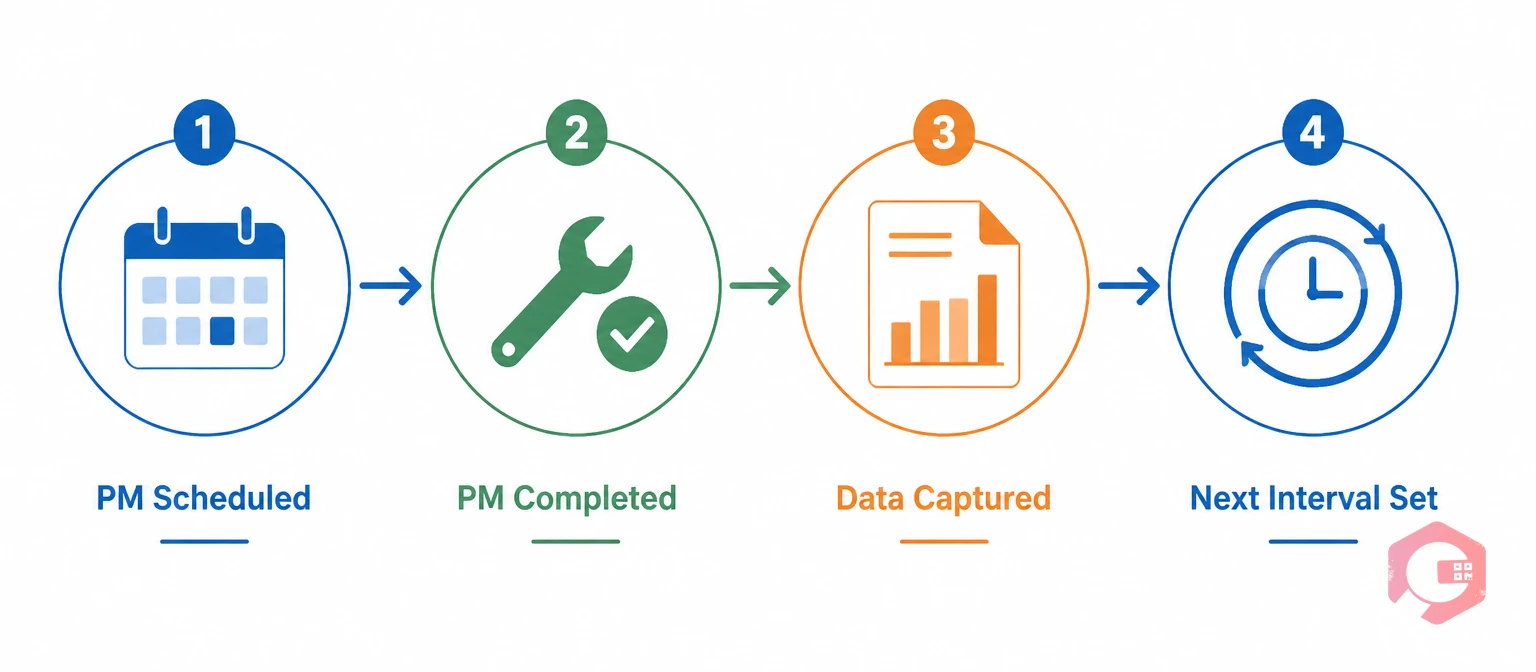
Every failure point above traces back to one of four breakdowns in how data moves through a TPM program. Teams that fix all four tend to avoid the usual pattern of TPM programs fail after a strong first year.
The CMMS-Driven TPM Data Loop:
A Computerized Maintenance Management System exists to run this loop continuously. That ongoing discipline is exactly what most manual TPM programs can't sustain on their own.
Most TPM programs fail because autonomous maintenance never sticks with operators. Paper checklists get filled in from memory instead of during the actual inspection. Once that pillar breaks down, the planned maintenance schedule that depends on early warning signs starts slipping too.
Programs typically show cracks within the first six to twelve months. That's right around the point where launch enthusiasm fades. No one has documented measurable results yet at that stage. Plants without a baseline OEE or downtime figure from day one struggle the most to prove the program is working, which makes it easy for leadership to quietly stop paying attention.
Yes, a CMMS can restart a stalled TPM program by rebuilding the data discipline it was missing the first time. That means PM scheduling, downtime tracking, and root cause documentation, in particular. Most teams relaunch with a narrower pilot area instead of trying to fix everything plant-wide at once, much like how TPM was originally designed to roll out in stages.
TPM began in automotive manufacturing, but the same principles apply anywhere equipment uptime matters. Facilities, healthcare, and food and beverage operations all use versions of it today. Autonomous maintenance, planned maintenance, and data-driven tracking work the same way regardless of industry, even if the specific equipment and compliance rules look different.
A TPM program is only as strong as the data behind it. Most of the reasons why TPM programs fail trace back to information that never made it off a clipboard in the first place. Schedule a free demo to see how Cryotos keeps preventive maintenance, downtime tracking, and root cause data connected in one system, from the first inspection to the next audit.

Cryotos AI predicts failures, automates work orders, and simplifies maintenance—before problems slow you down.



