

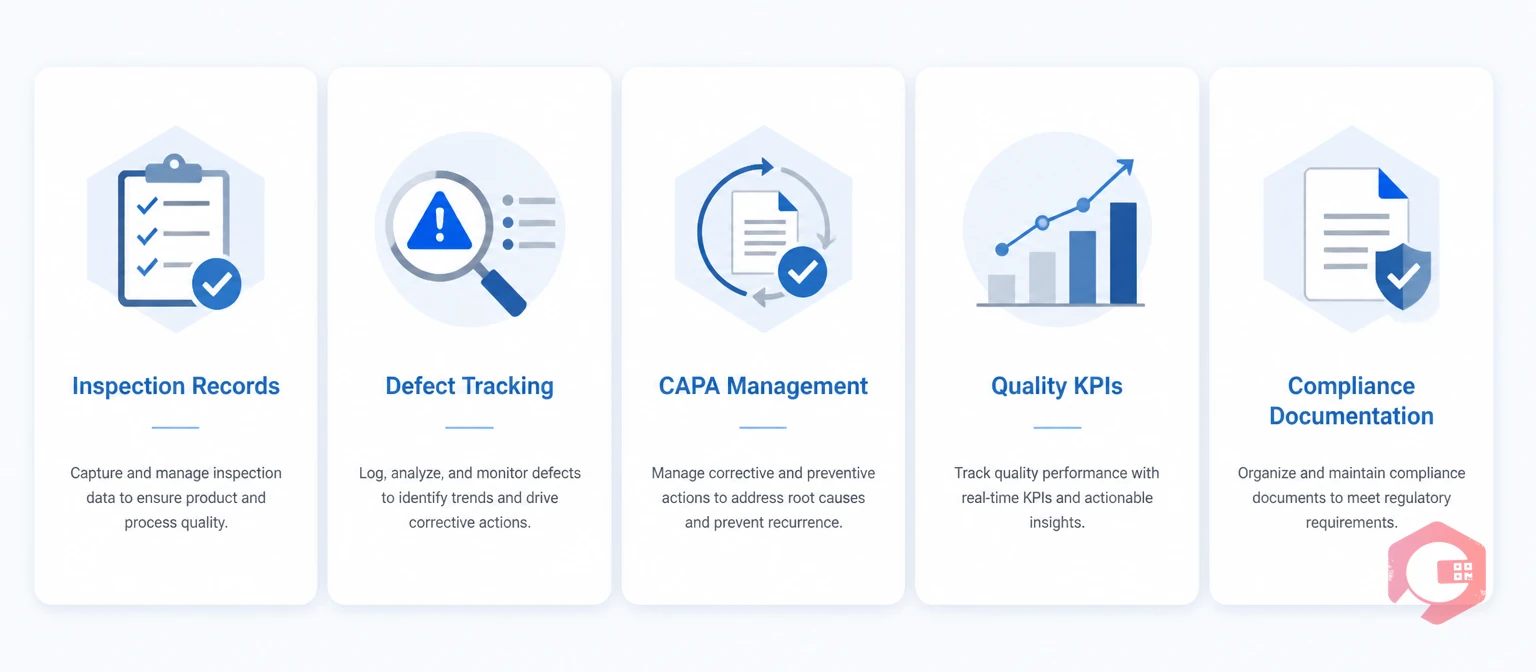
A QM Matrix (Quality Management Matrix) is a structured framework that tracks product and process quality through inspections, defect measurement, and corrective actions. It gives maintenance and quality teams a systematic way to record quality failures, measure compliance against standards, and drive corrective and preventive actions (CAPA) across production or facility operations.
Key Takeaways
| Dimension | QM Matrix | QX Matrix |
|---|---|---|
| Primary Focus | Product and process quality | Quality + operational excellence |
| Approach | Reactive quality improvement | Proactive continuous improvement |
| KPIs Tracked | Defect rates, inspection pass rates, CAPA | OEE, MTTR, MTBF, asset reliability, quality + maintenance KPIs |
| Data Approach | Inspection-based, historical | Real-time, predictive, data-driven |
| Scope | Quality department | Quality, maintenance, operations, leadership |
| Best For | Compliance-driven industries | Asset-intensive operations targeting OEE and reliability |
The QM Matrix originated in quality management disciplines and aligns closely with ISO 9001 quality management standards. It answers the question: "Are we meeting our quality standards?" Organizations in food and beverage, pharmaceuticals, and regulated manufacturing rely on QM Matrix to maintain compliance, manage audit records, and demonstrate quality control to external bodies.
Maintenance teams that lack a structured approach to root cause analysis often find their QM Matrix filling up with repeat defects — because the underlying equipment or process issues are never resolved, only documented.
QM Matrix is most effective in environments where product quality directly determines regulatory compliance or customer acceptance. Pharmaceutical manufacturing, food processing, automotive OEM supply chains, and aerospace component manufacturing all rely on QM Matrix-style frameworks to demonstrate traceability and process control. In these settings, documentation completeness and inspection thoroughness are as important as the quality outcomes themselves.
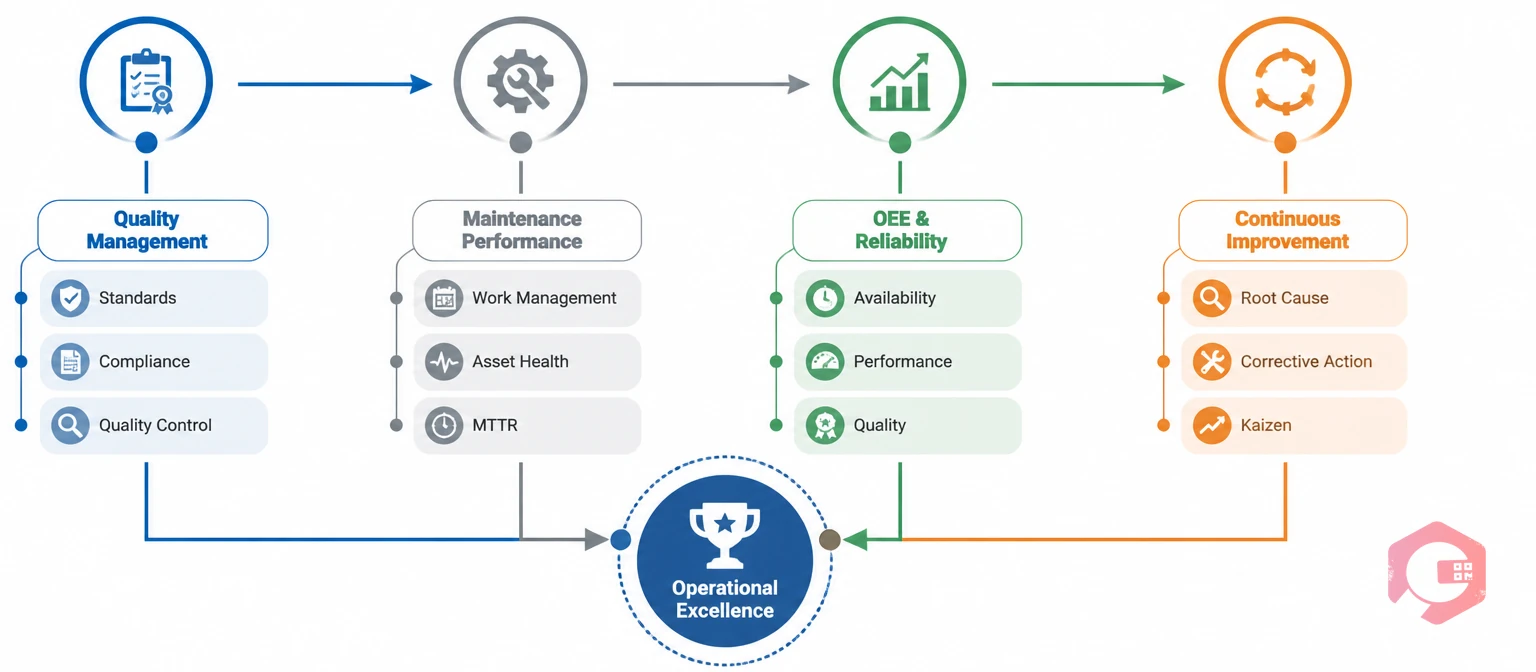
A QX Matrix (Quality Excellence Matrix) is an expanded quality framework that integrates product quality with maintenance performance, asset reliability, operational efficiency, and continuous improvement. Where a QM Matrix asks "Are we meeting quality standards?", a QX Matrix asks "Are we optimizing our entire operation to eliminate the root causes of quality and reliability failures?" It takes quality out of a silo and embeds it into every operational function.
The QX Matrix draws from lean manufacturing, Total Productive Maintenance, and reliability engineering disciplines. According to Total Productive Maintenance principles, equipment reliability and product quality are inseparable — defects produced by deteriorating equipment cannot be solved through inspection alone. The QX Matrix addresses this connection directly.
QX Matrix delivers the highest return in asset-intensive operations where equipment condition directly drives product quality outcomes. Discrete manufacturing, process industries, power generation, and heavy equipment operations all see significant gains when quality and maintenance data are unified. Most maintenance teams that operate in these environments already collect the data needed to build a QX Matrix — they just lack the integration layer that connects it into a coherent performance picture.
The most important distinction between the two frameworks is not what they measure — it is what they can change. A QM Matrix measures quality outcomes and triggers corrective actions within the quality system. A QX Matrix measures the entire operational system that produces those outcomes, including equipment health, maintenance execution, and process efficiency, and drives improvement across all of them simultaneously.
| Category | QM Matrix | QX Matrix |
|---|---|---|
| Definition | Quality Management Matrix — tracks product and process quality through inspections and CAPA | Quality Excellence Matrix — integrates quality, maintenance, reliability, and operational improvement |
| Primary Question | Are we meeting quality standards? | Are we optimizing everything that affects quality? |
| Defect Response | Document, investigate, corrective action | Predict and prevent defects through asset and process optimization |
| Maintenance Role | Maintenance is a support function | Maintenance is a core quality driver |
| Data Frequency | Batch — inspections and audit cycles | Continuous — real-time dashboards and alerts |
| Improvement Cycle | CAPA → verify → close | Continuous improvement (Kaizen, DMAIC, A3) |
| Typical Users | Quality managers, compliance teams | Operations, maintenance, quality, leadership |
| Technology Needed | Quality management system (QMS) | CMMS + QMS + real-time dashboards |
Neither framework is superior — they address different organizational needs. A QM Matrix is the right starting point for any organization building quality discipline. A QX Matrix is the right next step for operations that have quality basics in place and want to drive systematic performance improvement across their entire asset base.
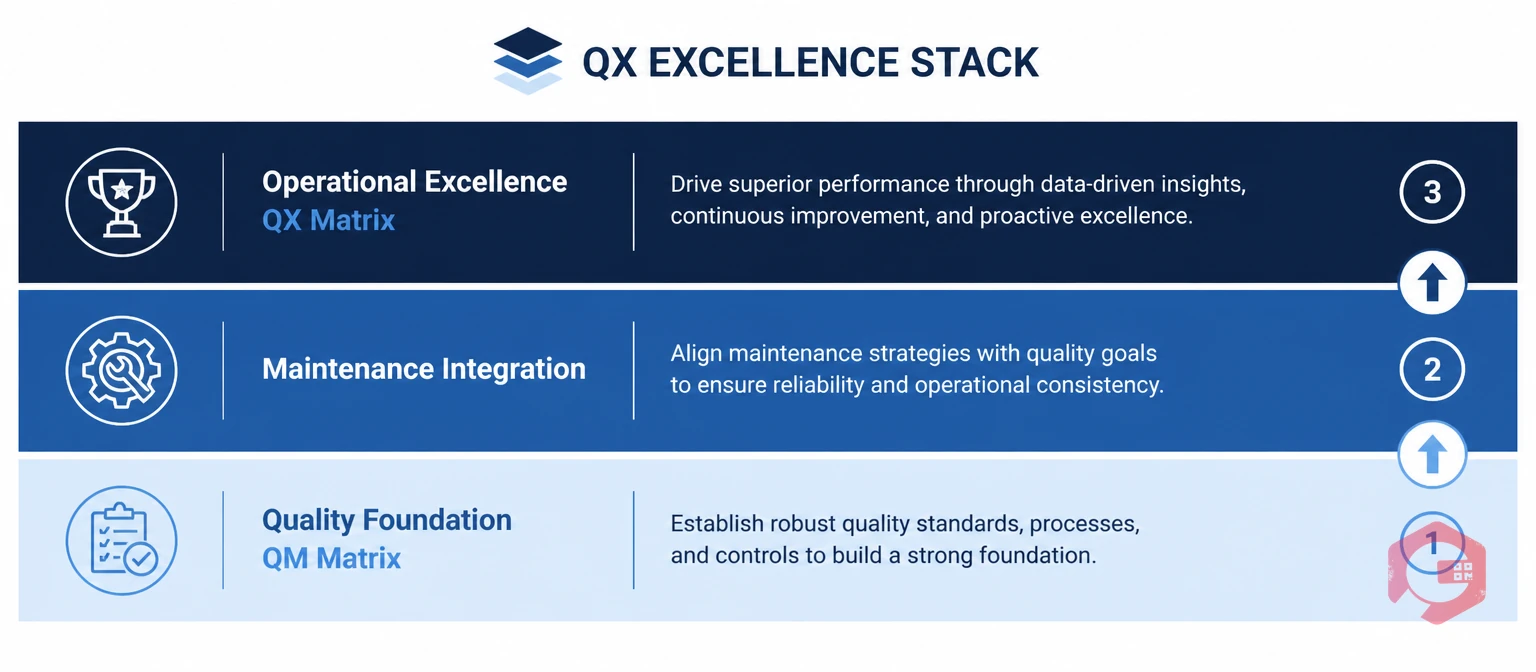
Most organizations that struggle to implement either matrix do so because they treat quality and maintenance as separate systems. The QX Excellence Stack is a layered implementation approach that shows how QM Matrix sits as the foundation, with QX Matrix capabilities building on top of it in three progressive layers.
The QX Excellence Stack Framework:
Organizations that attempt to jump to Layer 3 without Layer 1 in place consistently fail — because excellent dashboards built on incomplete data produce misleading signals. The Stack enforces the right sequence.
In a manufacturing plant, Layer 1 means every production line has a digital inspection checklist, every defect is categorized and tracked, and every CAPA has an owner and a closure date. Layer 2 means the maintenance team's work orders are linked to quality failure records — so when a sealing machine produces out-of-spec welds, the CMMS already knows the machine's last PM was overdue by 12 days. Layer 3 means leadership reviews a single dashboard showing OEE, defect rate, and maintenance completion rate side by side, and improvement projects are prioritized based on which asset is contributing most to quality losses.
Ready to build your quality excellence stack? Use the OEE calculator to benchmark your current equipment effectiveness before designing your QX Matrix program.
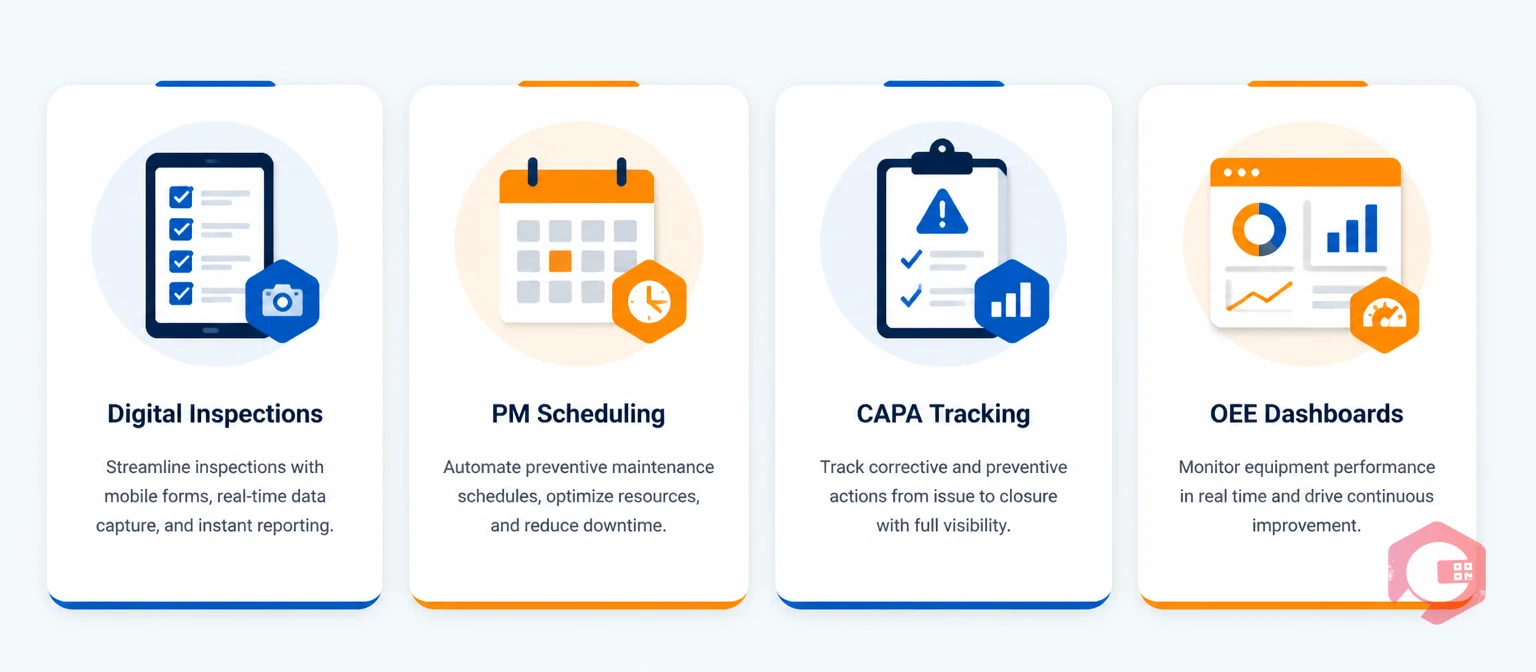
Cryotos is a Computerized Maintenance Management Software built for asset-intensive operations that need to connect maintenance performance with quality and reliability outcomes. It provides the operational infrastructure that both QM Matrix and QX Matrix implementations require — from digital inspection checklists to real-time KPI dashboards and automated preventive maintenance. Cryotos customers report up to a 30% reduction in unplanned downtime and 25% faster repair turnaround, which directly improves the quality output metrics that both frameworks track.
Quality management depends on consistent, auditable data from the shop floor. Cryotos gives quality teams the tools to capture that data without relying on paper forms, spreadsheets, or manual data entry.
QX Matrix requires a deeper integration between quality, maintenance, and operational data. Cryotos delivers this through its analytics and automation capabilities, turning maintenance execution data into strategic quality intelligence.
The choice between QM Matrix and QX Matrix is not an either/or decision — it is a sequencing decision. Every organization needs a functional QM Matrix before a QX Matrix can deliver meaningful results. The question is: which stage are you at, and what is the right next investment?
According to ASQ quality management research, organizations that integrate maintenance and quality management into a unified performance system consistently outperform those that manage them separately — in defect reduction, asset uptime, and overall customer satisfaction. The QX Matrix is the practical structure for achieving that integration.
QM Matrix stands for Quality Management Matrix. In a maintenance context, it refers to a structured framework that tracks equipment-related quality activities — including inspection records, defect reports, preventive maintenance completion, and corrective action workflows. The QM Matrix ensures that maintenance activities are documented, quality outcomes are measured, and compliance requirements are met.
A QM Matrix focuses on managing and measuring product and process quality through inspections, defect tracking, and corrective and preventive actions. A QX Matrix extends this by integrating quality with maintenance performance, asset reliability, OEE, and continuous improvement — it covers not just quality outcomes but the entire operational system that determines those outcomes. QM Matrix is quality management; QX Matrix is quality-driven operational excellence.
Yes — and in most mature operations, both frameworks run simultaneously. The QM Matrix handles compliance, inspection records, and corrective actions at the quality management level. The QX Matrix sits on top of this foundation, using the same quality data alongside maintenance and reliability data to drive strategic improvement. A CMMS like Cryotos supports both layers from a single platform, eliminating the need for separate quality and maintenance systems.
A CMMS supports QM Matrix by digitizing inspection checklists, automating preventive maintenance scheduling, managing corrective work orders from quality failures, and storing audit-ready maintenance records. For QX Matrix, a CMMS adds real-time KPI dashboards, predictive maintenance through IoT integration, root cause analysis tools, and cross-functional reporting that connects maintenance performance to quality outcomes. Together, these capabilities turn maintenance execution data into strategic quality intelligence.
A QX Matrix program typically tracks a combination of quality KPIs and maintenance KPIs in a unified view. Quality KPIs include defect rate, first-pass yield, inspection pass rate, and CAPA closure time. Maintenance KPIs include OEE, MTTR, MTBF, planned maintenance percentage, and work order completion rate. The defining feature of a QX Matrix KPI set is that quality and maintenance metrics are reviewed together — because the relationship between them is where the most improvement opportunity lies.
Moving from a QM Matrix to a full QX Matrix implementation does not require a large-scale transformation — it requires the right platform connecting your quality and maintenance data. Schedule a free demo to see how Cryotos helps operations at every stage build their quality excellence foundation.




Cryotos AI predicts failures, automates work orders, and simplifies maintenance—before problems slow you down.



