

The compliance checklist that most facility managers keep getting wrong isn't a checklist with no items — it's one with all the right items ticked and none of the evidence that an auditor, a regulator, or a court would need to verify those ticks were legitimate. The checklist looks complete. The audit trail is hollow.
Facility managers across commercial property, healthcare, education, and industrial sectors invest significant time in producing compliance checklists for statutory maintenance — fire suppression systems, emergency lighting, water hygiene, HVAC, electrical testing, and lift inspection. The effort is real. But the mistakes embedded in how those checklists are designed, completed, and stored mean they fail at the moment they're needed most: when a regulator asks for evidence, when an insurer investigates a claim, or when an incident triggers a root cause review. According to the Health and Safety Executive's guidance on planned preventive maintenance, a significant proportion of statutory compliance failures in UK workplaces involve documentation that exists but cannot demonstrate that competent persons completed the work, that defects were addressed, or that inspection frequency matched legal requirements. This guide names the seven specific mistakes that cause that failure — and explains how to fix them.
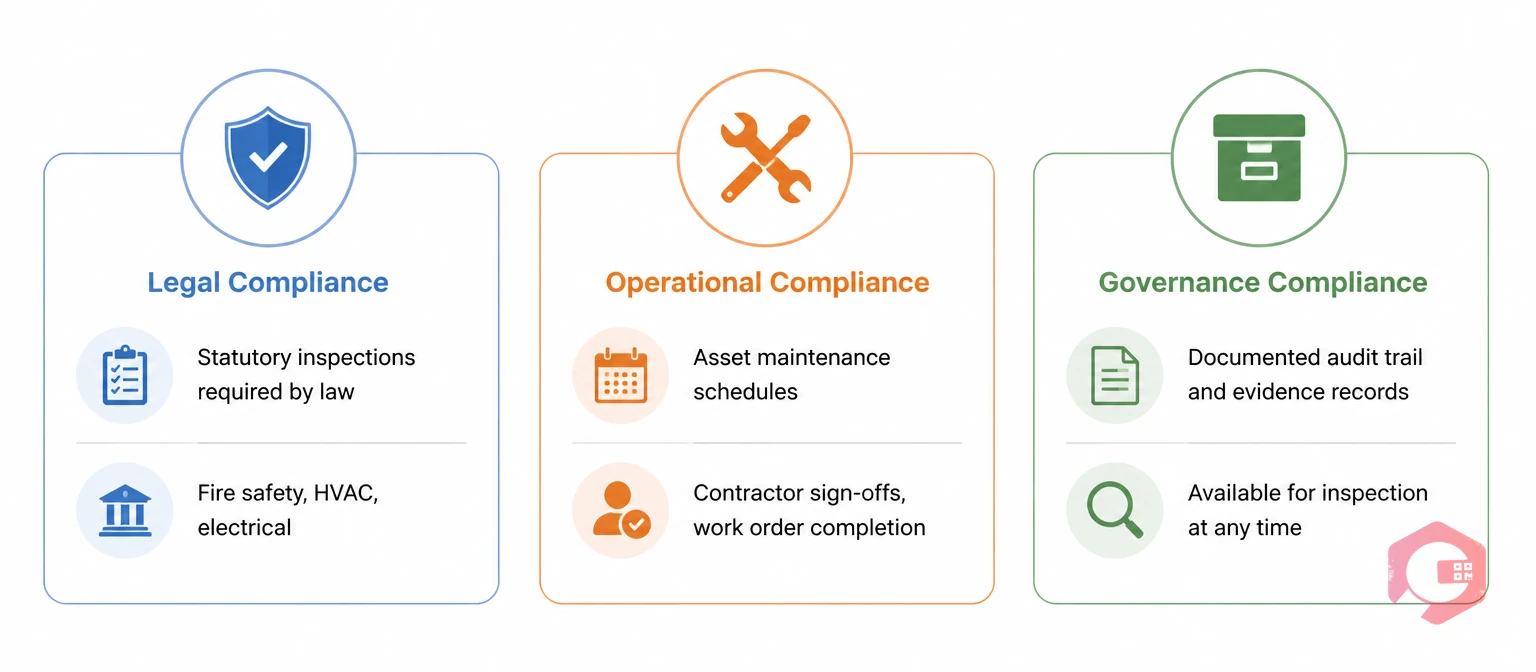
In FM operations, a compliance checklist is a structured record that demonstrates a specific statutory or regulatory obligation was fulfilled — that a qualified person inspected or tested a specific asset, at the correct frequency, checked the correct items, identified any defects, and ensured those defects were addressed within a required timeframe.
The distinction between a task checklist and a compliance checklist is important. A task checklist tells a technician what to do. A compliance checklist provides evidence that the legal requirement was met. The same physical actions — testing an emergency light fitting, flushing a water outlet, testing a fire damper — can be a task without compliance evidence or a compliance record with full evidentiary weight. The difference is in the data captured, how it's stored, and whether it can be retrieved in a form that satisfies a regulatory body or an insurance assessor.
The seven mistakes below are specific to the compliance evidence function — not to the technical content of the inspection tasks themselves. Facility managers who eliminate these mistakes produce checklists that are both operationally useful and legally defensible. Those who don't produce checklists that look the same on the surface but carry significantly higher risk.

The most common compliance checklist failure is the completed tick with no supporting evidence. The form says "fire damper inspection — pass." Nothing in the record shows what was inspected, what condition it was in, whether it was accessible, or what measurement or observation supported the pass verdict. When an auditor asks for the evidence behind the tick, there isn't any.
A compliance-grade checklist requires the technician to record specific observations — not just an outcome verdict. For a fire damper, the record should show the blade position was verified, the intumescent material was intact, the housing showed no physical damage, and the manual drop test was performed and the damper closed fully. Each of those observations is a data point. The tick is a summary. The auditor needs the data, not the summary.
Many compliance checklists set inspection frequencies based on convenience — quarterly, annually, monthly — rather than the regulatory requirement or asset-specific risk profile. A water outlet on a little-used branch of a hot water system has a different flushing requirement under HSE's Legionella management guidance (L8) than a high-use outlet in a main corridor. Setting both to the same monthly schedule fails the low-use outlet's regulatory requirement for weekly flushing, and may be over-maintaining the main outlet without knowing it.
The frequency on a compliance checklist must match the applicable legal standard for that asset type, in that environment, under those operating conditions. Regulatory bodies and insurers don't accept "we do it quarterly" as a defence when the relevant code requires weekly or monthly inspection of a specific asset class.
The checklist records that the task was completed. It doesn't record who completed it or whether that person was competent to do so. This is a critical gap in electrical testing, gas safety, lift inspection, and water hygiene management — all of which require inspections to be carried out or supervised by a competent person with specific qualifications or accreditation.
If the checklist doesn't record the inspector's name, their qualification or accreditation reference, and their employer (if a contractor), it cannot demonstrate that the legal competency requirement was met. When an incident or enforcement action follows, "a technician completed it" is not a defensible position. The name, competency credential, and date must be in the record.
The most dangerous gap in most FM compliance checklists is the orphaned defect — a fault or non-compliance identified during inspection that is recorded on the checklist and then never linked to a corrective work order. The checklist records the defect. There is no subsequent record that a work order was raised, that the work was completed, or that the asset was re-inspected and confirmed compliant after the repair.
This is a compliance failure even if the repair was physically made — because there's no audit trail proving it. An asset that failed its inspection and has no linked corrective action record is an asset with an open compliance deficit. In statutory inspection regimes — fire safety, electrical, pressure systems — this is the most likely path to regulatory prosecution following an incident. The maintenance checklist module in Cryotos automatically generates a corrective work order when an inspection flags a defect, linking it to the relevant asset and the original checklist record — closing the corrective action loop in the system rather than leaving it as an open defect with no follow-through.
Paper checklists stored in site files, emailed PDF reports filed in a shared folder, Excel records maintained by individual site managers — these formats are not wrong in themselves, but they consistently fail the retrieval test. When an auditor or enforcement officer asks for all fire suppression inspection records for the past 24 months, the facility manager needs to produce them in minutes. Paper files get lost. Emails get archived. Excel files get overwritten.
Compliance evidence must be stored in a system that makes retrieval by asset, date range, inspection type, and site instant — not an exercise in finding the right filing cabinet or asking the previous site manager what they did with the records. A CMMS that stores compliance checklist completions against the asset record in a searchable, date-stamped format passes this test. Physical and unstructured digital filing fails it under any serious scrutiny.
The compliance checklist covers the items the facility manager thought to include — which is often a subset of what the applicable regulation or standard actually requires. Emergency lighting checklists that test function but don't record duration are a common example. Electrical installation condition reports that cover distribution boards but miss the sub-mains feeding critical plant are another. HVAC maintenance checklists that record filter changes but omit damper positions, drain tray conditions, and legionella risk points.
The regulatory scope — what a compliant inspection must include — is defined by the relevant standard or code, not by what's convenient to check. Facility managers should map their compliance checklists against the applicable standard annually: L8 for Legionella, BS 5839 for fire detection, BS 5266 for emergency lighting, the Electricity at Work Regulations 1989 for electrical safety. Any gap between the checklist and the standard is a compliance gap, regardless of how consistently the checklist is completed.
The checklist has a signature at the bottom. The date field is blank, or contains the date the form was printed rather than the date the inspection was performed. The asset reference is "Main Plant Room" rather than the specific asset ID. The signature is illegible with no printed name alongside it.
Every compliance record must contain an unambiguous date of inspection, the identity of the person who performed it, and a reference to the specific asset inspected — not the room it's in, the system it's part of, or the general area. Without these three elements, the record cannot be definitively linked to a specific asset on a specific date, which is the minimum requirement for a compliance record to carry evidentiary weight. This is so frequently wrong that it's worth making explicit: a signed and dated checklist with an asset identifier is a compliance record. A ticked form without those three elements is a piece of paper.
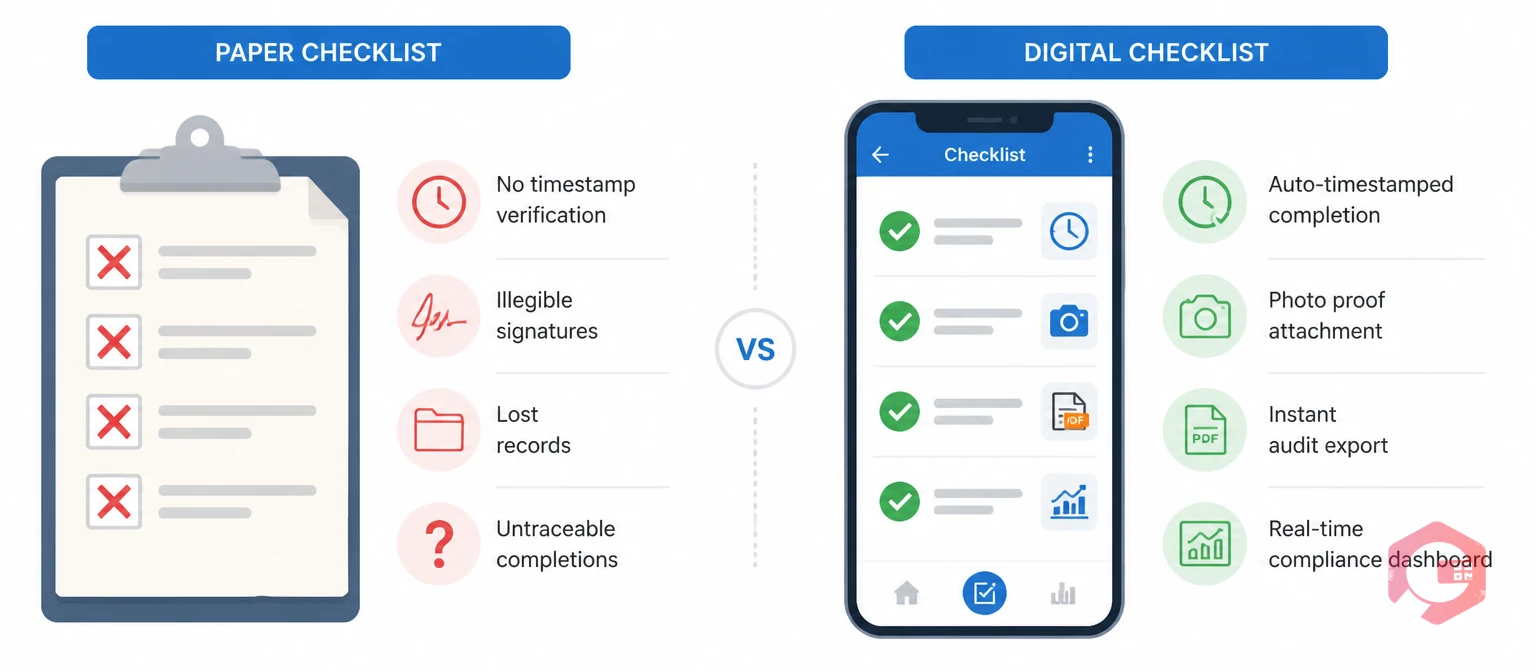
Digital compliance checklists, run through a CMMS, eliminate most of these seven failure modes structurally rather than through discipline. The technician completing the checklist on a mobile device cannot tick a box without the system recording the date, time, GPS location, and user ID automatically. The asset reference is pre-populated from the work order. The competency credential is part of the technician's profile in the system. When a defect is flagged, the corrective work order is generated automatically and linked to the inspection record.
Paper checklists require every piece of evidence to be manually recorded, manually filed, and manually retrieved. Digital checklists capture the evidence as a byproduct of task completion and store it in a retrievable, timestamped format without requiring any additional administrative discipline from the technician. The quality of the compliance record no longer depends on whether the technician remembered to write their name or date the form — it's captured automatically.
This matters particularly for FM organisations managing multiple sites. A paper compliance system across 50 properties is a filing system at 50 locations, each with its own quality of record-keeping, its own storage format, and its own retrieval challenge. A digital system across 50 properties is one retrievable record, searchable by any combination of site, asset, inspection type, and date. The ISO 41001 facility management standard identifies documented information management as a core requirement of a compliant FM system — a requirement that digital compliance checklists satisfy structurally and that paper systems satisfy only through exceptional administrative discipline. According to RICS guidance on FM service delivery, digital audit trails for statutory compliance are increasingly expected as a baseline by insurers, regulators, and institutional building owners — not as a premium capability, but as evidence of competent facilities management.
Cryotos CMMS gives facility managers the infrastructure to produce compliance checklists that are audit-ready from the moment the technician closes the work order — with timestamped evidence, asset linkage, competency records, and automatic corrective action generation built into the task completion workflow.
Key capabilities for compliance checklist management in FM:
FM teams using Cryotos consistently find that digital compliance checklists reduce audit preparation time from days to hours, eliminate the corrective action gap that is the most common source of enforcement exposure, and produce the kind of timestamped, asset-linked evidence trail that institutional building owners and regulators increasingly expect as standard. If your current compliance checklist process is paper-based or unstructured digital, Cryotos CMMS gives your team the infrastructure to close the gap between completing inspections and proving you completed them correctly.
The seven most common mistakes are: ticking without supporting evidence observations; using generic inspection frequencies that don't match the regulatory requirement for each asset type; not recording the competency credential of the person who completed the task; logging defects without generating linked corrective work orders; storing evidence in formats that can't be quickly retrieved for audit; checklist scope that doesn't cover the full regulatory requirement; and signatures or completions without unambiguous dates and asset identifiers. Any one of these mistakes can cause a compliance record that looks complete to fail an audit or an enforcement review.
Paper checklists rely on manual evidence entry, manual filing, and manual retrieval — all of which introduce gaps under operational pressure. A technician who forgets to date the form, doesn't print their name, or omits the asset reference has created an incomplete compliance record even if the inspection itself was thorough. Paper filing systems are subject to loss, damage, and retrieval failure. And paper checklists can't automatically link a defect to a corrective work order, which means the corrective action audit trail depends entirely on someone remembering to raise a separate record.
A corrective action orphan is a defect identified during a compliance inspection that is recorded on the checklist but has no subsequent record linking it to a work order, a repair, and a re-inspection confirmation. The defect was noticed. It was not provably fixed. In statutory inspection regimes for fire safety, electrical systems, or pressure systems, an open defect with no corrective action evidence is a compliance failure even if the repair was physically made — because the absence of the documented trail means the regulatory requirement for defect resolution cannot be demonstrated.
A CMMS improves audit-readiness by capturing compliance evidence automatically — dates, technician identity, asset references, and condition observations are recorded as part of the task completion workflow, not as manual additions that depend on the technician's memory. Defects generate corrective work orders automatically and are tracked to resolution. Evidence is stored against the asset record in a searchable, date-stamped format. Regulatory scope mapping ensures each checklist covers the full standard. The result is a compliance record that satisfies an auditor's evidence requirements without requiring a separate documentation effort.
At minimum annually, and immediately following any change to the applicable regulation, the building's use, or the asset configuration. Regulatory standards for statutory inspection — L8 for Legionella, BS 5839 for fire detection, BS 5266 for emergency lighting — are updated periodically, and the inspection scope requirements change with those updates. A compliance checklist that was correctly scoped two years ago may be deficient today if the standard has been revised or if the facility has changed in a way that brings new assets or areas within the inspection scope.
The compliance checklist that facility managers keep getting wrong isn't the one with missing items — it's the one with all the items present and none of the evidence that makes those items legally defensible. The tick is easy. The audit trail is hard. And the gap between the two is exactly where regulatory prosecution, insurance disputes, and incident liability are decided.
The seven mistakes in this guide — ticking without evidence, wrong frequencies, missing competency records, orphaned corrective actions, inaccessible filing, insufficient scope, and undated signatures — are each independently fixable. But fixing them consistently, across multiple sites, under normal operational pressure, requires a system that captures compliance evidence as a structural output of task completion rather than as a discipline imposed on technicians who are focused on getting the job done.
That system is a CMMS with a proper compliance checklist module. If your current checklists would struggle to satisfy an auditor asking for three years of evidence for a specific asset, book a free Cryotos demo to see what audit-ready compliance documentation looks like when it's built into the maintenance workflow rather than bolted on top of it.




Cryotos AI predicts failures, automates work orders, and simplifies maintenance—before problems slow you down.



