

HVAC is the asset that costs facility teams more in summer than anything else in the building — not because it fails more than other assets, but because when it fails in July or August, the consequences compound in ways they don't in February. An emergency HVAC contractor on a 38°C afternoon costs two to three times the scheduled rate. A replacement part that would take two days to source normally takes two hours at emergency premium pricing. And the business impact of a failed HVAC system during peak summer trading — a retail store too hot for customers, a data centre room running warm, a food production area outside temperature compliance — is measured in revenue and regulatory terms, not just repair cost. According to US Department of Energy HVAC efficiency research, poorly maintained HVAC systems consume up to 25% more energy than maintained equivalents — a cost that runs continuously through every summer month, whether the system fails outright or simply works harder than it should.
This guide covers the specific HVAC failure mechanisms that drive summer cost spikes, why the maintenance calendar approach consistently misses the window that matters, and how a CMMS turns summer HVAC from a reactive cost into a managed program.
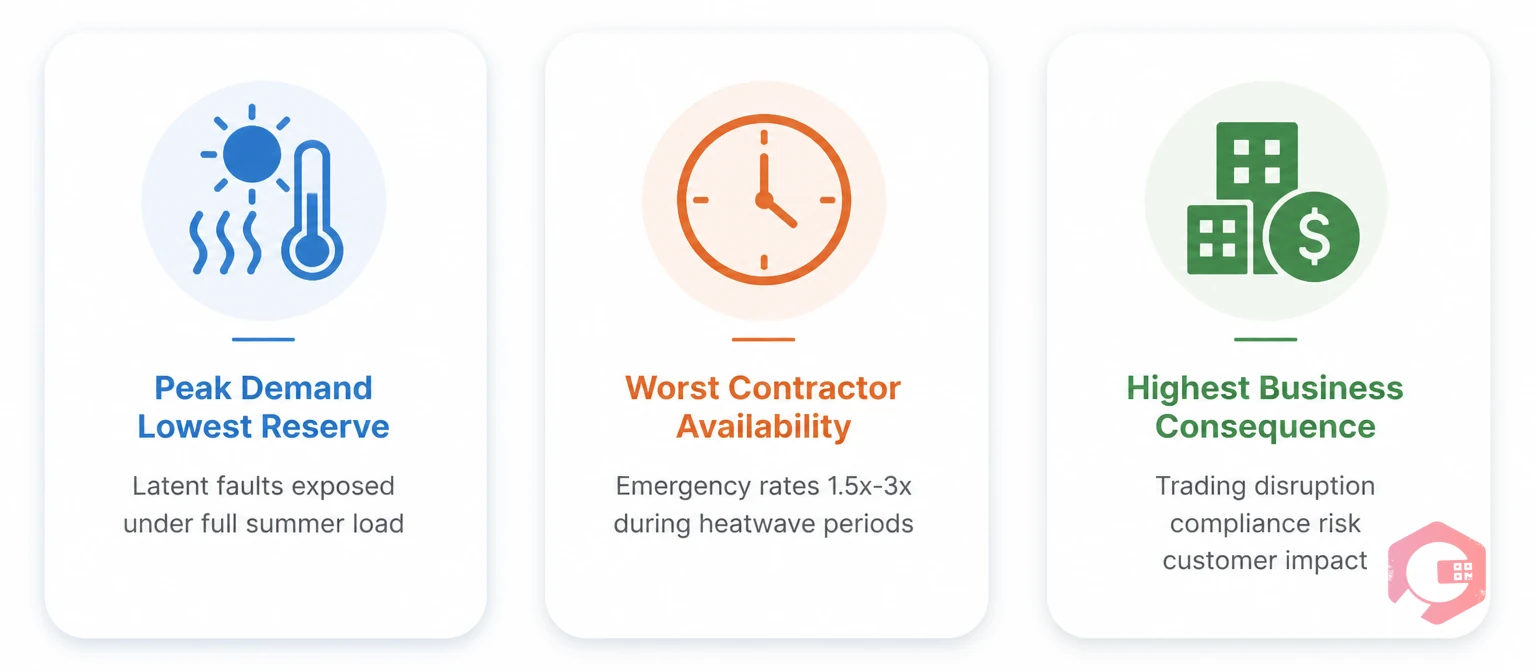
HVAC faults don't only happen in summer — they develop through the year. But summer is when they become visible, expensive, and urgent simultaneously. There are three reasons the summer period concentrates HVAC maintenance cost in a way no other season does.
First, demand peaks exactly when reserve capacity is lowest. An HVAC system running with a partially fouled condenser coil, a slightly undercharged refrigerant circuit, or a filter loaded beyond its optimal replacement point can deliver acceptable cooling in spring when ambient temperatures are moderate and the system isn't running at full load. The same system, in the same condition, fails to maintain set-point temperatures on a hot July afternoon when it's running continuously at full capacity. The fault that was invisible in April becomes a full breakdown in August — not because anything changed, but because the operating conditions exposed the latent degradation.
Second, contractor availability is worst when demand is highest. Every facility in the region is calling HVAC contractors simultaneously during a heatwave. Response times stretch from hours to days. Emergency rates apply. Parts that would be in a contractor's normal van stock get consumed across multiple emergency call-outs and have to be sourced urgently. The combination of extended response times and premium pricing makes summer HVAC failures consistently the most expensive maintenance event a facility team handles across the year.
Third, the business consequence is most severe in summer. A retail facility that's too hot loses customers — and the conversion loss during a summer weekend trading period can be significant for a high-street or shopping centre location. A server room or data centre that overheats risks equipment damage and service interruption. A food production or storage facility that exceeds temperature thresholds risks product loss and regulatory non-compliance. The HVAC repair bill is often the smallest part of the total summer failure cost.
Facility teams that manage HVAC reactively experience all three of these costs annually, often simultaneously. Those that run structured preventive maintenance programs through spring — completing the services that prepare systems for summer peak load — compress both the frequency and severity of summer HVAC failures materially.

Most summer HVAC failures trace back to one of three underlying maintenance deficits. Understanding which failure mechanism is most common on your equipment estate is the starting point for building a maintenance program that prevents rather than responds.
Condenser coil fouling is the most prevalent cause of summer HVAC underperformance and failure in commercial facilities. The condenser coil is where the refrigerant releases heat to the outside air — in rooftop units, external condensers, and split system outdoor units. Over time, the coil fins collect dust, pollen, cottonwood fluff, and debris that blocks airflow and reduces heat rejection efficiency. A moderately fouled condenser coil forces the compressor to work harder to achieve the same refrigerant condensing temperature, increasing both energy consumption and compressor wear. At peak summer ambient temperatures, a heavily fouled condenser coil pushes the system into high-pressure lockout — a fault that shuts the unit down to prevent compressor damage, leaving the facility without cooling until the coil is cleaned and the unit reset.
Condenser coil cleaning is a standard preventive maintenance task — a thorough clean with appropriate coil cleaner takes 30 to 60 minutes per unit and costs a fraction of the emergency call-out it prevents. The critical point is timing: it needs to happen in spring, before ambient temperatures make peak-load operation likely. A condenser coil cleaned in October provides no protection against a July failure. The same clean done in March or April does.
Refrigerant charge loss is the second major driver. Most refrigerant circuit losses in commercial HVAC are gradual — a slow weep at a service valve, a micro-crack in a brazed joint, or a Schrader valve that loses integrity over multiple service cycles. The system works acceptably at partial charge during mild weather but fails to maintain temperatures under full summer load when the full refrigerant charge is needed for rated capacity. A refrigerant check during a spring service identifies undercharge before summer load exposes it. An emergency top-up call during a heatwave costs three to four times the spring service charge, plus the contractor premium for a reactive call-out.
Filter loading is the most preventable cause of summer HVAC performance degradation — and the most frequently missed. Commercial HVAC filters that are changed quarterly in theory often run longer in practice because nobody checked when the last change happened. An overloaded filter restricts airflow through the evaporator coil, reducing cooling capacity and in severe cases causing the evaporator to ice up — shutting the unit down completely. Filter replacement is the lowest-cost preventive action in an HVAC PM program, with a per-unit consumable cost of £5 to £30 depending on specification. The cost of the reactive call-out to investigate and resolve an iced evaporator caused by a blocked filter is typically £200 to £800 depending on contractor rates and the time taken to identify and correct the root cause.
Every HVAC PM task deferred from spring into summer carries a cost premium that compounds the base repair or service cost with emergency contractor rates, parts availability premiums, and business consequence costs. The timing of HVAC maintenance is not a scheduling convenience — it's a cost control decision.
The contractor rate premium for reactive HVAC work in summer varies by market, but a multiplier of 1.5× to 3× standard rates for out-of-hours emergency response during heatwave periods is consistent across most urban and suburban markets. A planned spring coil clean booked as a scheduled PM visit costs the standard service rate. The same work done as an emergency call-out after a summer breakdown costs the emergency rate, plus additional labour for the fault investigation that precedes the cleaning, plus any parts consumed in the process.
Parts availability in summer is a compounding factor. Compressor replacements, condenser fan motors, and capacitors — the components most commonly needed after a summer failure driven by deferred maintenance — are in high demand during heatwave periods. Lead times that would be 2 to 5 days in April stretch to 10 to 14 days in August when regional distributor stock is depleted. Expedited sourcing adds cost. The facility runs without cooling for longer. The business consequence cost accumulates for every additional day the repair is delayed.
The energy cost of deferred maintenance runs continuously rather than as a one-time event. A commercial HVAC unit running with a fouled condenser coil and sub-optimal refrigerant charge through a full summer of operation draws 15 to 25% more electricity than a properly maintained unit providing the same cooling output. For a facility with a significant HVAC electrical load running through a warm summer, that efficiency penalty translates directly to a meaningful increase in electricity spend — in addition to the eventual repair cost when the system eventually fails under peak load.
The cost difference between reactive summer HVAC maintenance and a structured spring preventive program is consistent across facility types and sizes. The table below shows the comparison across the most common summer HVAC cost categories for a typical commercial facility running 4 to 8 rooftop units.
| Cost Category | Reactive Summer Approach | CMMS-Scheduled Spring PM |
|---|---|---|
| Contractor rate (coil clean) | Emergency rate: 1.5× to 3× standard; out-of-hours premium | Standard scheduled rate; booked in advance during lower-demand period |
| Filter replacement | Reactive after fault; investigation labour added to cost | Quarterly PM work order; filter cost only; no call-out charge |
| Refrigerant top-up | Emergency call-out rate + gas charge at spot pricing | Spring service rate + gas charge at contracted pricing |
| Compressor replacement (if deferred maintenance leads to failure) | Emergency sourcing 10–14 day lead time; expedited freight; full emergency labour | Avoided — PM prevents the compressor stress that leads to failure |
| Energy cost (summer months) | 15–25% above baseline from fouled coils and sub-optimal charge | Baseline consumption — maintained unit operates at rated efficiency |
| Business consequence cost | Trading disruption, customer experience impact, food safety or compliance risk | Minimal — system maintains set-point through peak demand periods |
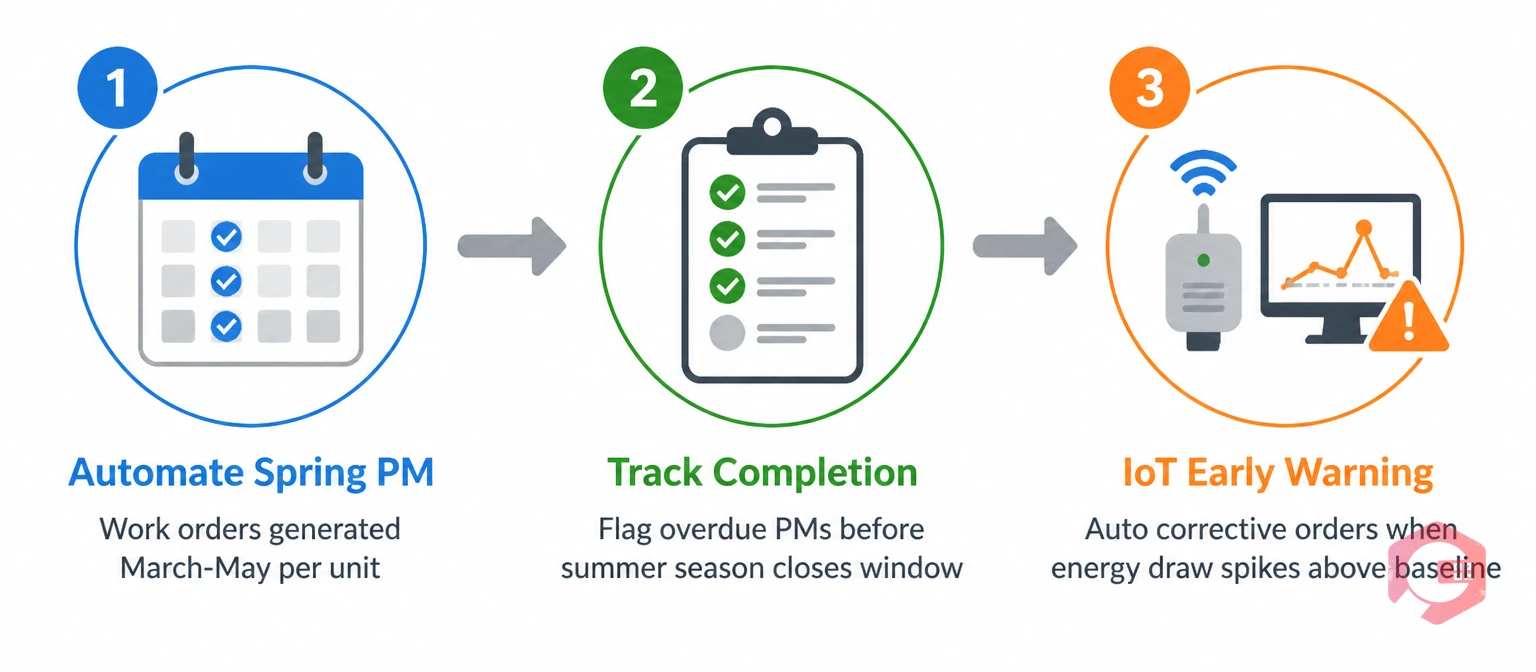
A CMMS prevents the summer HVAC cost spike through three mechanisms: it schedules the right maintenance at the right time before summer, it tracks whether that maintenance actually gets done, and it flags units that need attention before peak load exposes their condition.
The scheduling mechanism is the foundation. Every HVAC unit in the facility gets a PM schedule in the CMMS configured to deliver the spring service in the right window — typically March to May for facilities in temperate climates. Cryotos's preventive maintenance software generates the spring service work order automatically, assigns it to the responsible contractor or technician, and tracks completion. The work order carries the full service checklist: coil condition assessment and clean if required, refrigerant pressure check, filter replacement, belt and motor inspection, drain pan and condensate check, control and thermostat verification. Nothing gets missed because nothing depends on someone remembering.
Completion tracking is the mechanism that separates a CMMS from a calendar. A maintenance schedule that generates work orders but doesn't verify completion is a scheduler, not a maintenance system. Cryotos tracks whether each PM work order closes on time, flags overdue work orders to the facilities manager before the season changes, and surfaces the PM compliance rate per unit and per contractor in the BI Dashboard. A contractor who consistently reschedules spring HVAC PM into summer — eliminating the timing advantage of spring preventive work — becomes visible through their completion rate data. That visibility enables the facilities manager to intervene, reallocate, or replace the contractor before the summer season arrives.
IoT energy monitoring adds early warning capability for units whose condition deteriorates despite recent PM. The IoT meter reading integration connects HVAC sub-meter data to the CMMS asset record. When a unit's energy draw increases materially above its post-service baseline — indicating developing coil fouling, refrigerant loss, or mechanical degradation — the CMMS generates a maintenance alert and a corrective work order automatically. The unit gets investigated before it fails under peak summer load, not after.
For multi-site facility teams, this combination — automated spring PM scheduling, completion tracking by site and contractor, and IoT-triggered corrective alerts — gives a regional facilities manager visibility and control over HVAC maintenance across an entire estate that would be impossible to manage manually. The facilities manager doesn't need to remember which sites have had their spring HVAC service done and which haven't. The Cryotos BI Dashboard shows them.
A summer-ready HVAC program in Cryotos is built in four steps, each of which takes significantly less time than the first summer HVAC failure it prevents.
Step 1 — Register every HVAC unit in the asset register. Each rooftop unit, split system outdoor unit, air handling unit, fan coil unit, and ventilation system gets its own asset record in Cryotos: make, model, serial number, installation year, refrigerant type and charge, filter specification, and the contractor responsible for its service. Sub-assets — compressor, condenser coil, evaporator coil, fan motor — can be nested under the parent unit for facilities running detailed condition monitoring. The facility inspection checklist provides a practical walk-through framework for the initial asset survey.
Step 2 — Configure spring PM work orders with the correct service scope. For each unit, build the PM work order template that will generate every spring: the specific checklist items, the parts that should be reserved (filter sets, belt if due, coil cleaner if coil clean is scheduled this cycle), the contractor assigned, and the completion deadline that ensures the work is done before ambient temperatures make peak-load operation likely. Set the PM to trigger in March for most temperate climates, giving a 6-week window before May when summer conditions may begin to arrive.
Step 3 — Connect energy sub-meters for units with available metering. For facilities with HVAC sub-metering already in place through a BMS or smart meter installation, connect those meter feeds to the relevant asset records in Cryotos via the IoT meter reading module. Configure deviation alerts at 10% above post-service baseline for monitoring-level notifications and 20% above baseline for automatic corrective work order generation. This gives the facility team an early warning system that operates between PM visits, catching the units that degrade faster than their PM interval anticipates.
Step 4 — Review spring PM completion by the end of April. Use the Cryotos BI Dashboard to confirm spring HVAC PM completion rates across the estate before May. Any units with incomplete or rescheduled spring PM should be flagged for urgent completion before ambient temperatures rise. A unit that misses its spring service window faces the summer with unresolved deferred maintenance — which is precisely the condition that generates the emergency summer call-outs that the PM program exists to prevent.
Facility teams using Cryotos report a 30% reduction in downtime and 25% faster repair times — in an HVAC context, those outcomes show up most directly as fewer summer emergency call-outs, lower peak-season contractor costs, and energy consumption that stays at baseline rather than climbing as systems work harder through July and August. The combination of automated spring scheduling, completion tracking, and IoT-triggered corrective alerts makes summer HVAC cost control a system function rather than a facilities manager memory exercise.
If your facility has spent previous summers managing HVAC emergencies, paying emergency contractor rates, and apologising to building occupants for temperature discomfort, Cryotos CMMS gives you the scheduling, tracking, and alerting tools to prevent the summer HVAC cost spike rather than absorb it. Book a demo at cryotos.com to see how the HVAC PM program and energy monitoring integration work for your facility.
HVAC maintenance costs more in summer for three compounding reasons. Contractor emergency rates apply when systems fail during peak demand — typically 1.5× to 3× standard scheduled rates. Parts availability is reduced because multiple facilities are competing for the same replacement components during heatwave periods, extending lead times and adding expedited sourcing premiums. And business consequence costs — trading disruption, customer experience impact, food safety or compliance exposure — are highest in summer when HVAC failure has the most direct operational impact. A reactive HVAC failure in August costs materially more in total than the same failure managed as a planned repair in April.
The three highest-priority pre-summer HVAC tasks are condenser coil inspection and clean (removes fouling that reduces heat rejection and drives compressor failures under peak load), refrigerant pressure check and top-up if required (ensures full charge for rated cooling capacity in high-ambient conditions), and filter replacement (prevents evaporator icing and maintains airflow through peak demand periods). Beyond these three, belt and motor inspection, drain pan and condensate check, and thermostat/controls verification round out a comprehensive spring service that prepares systems for summer peak load. All of these tasks generate in Cryotos as a single annual spring PM work order per unit, with the checklist pre-configured for each service type.
A CMMS helps with HVAC summer maintenance planning by automating the spring PM schedule rather than relying on someone remembering to book each service visit. Every HVAC unit has a PM schedule configured in the CMMS that generates a spring service work order automatically in the correct window — typically March to May. The CMMS tracks whether each work order is completed on time, flags overdue spring PMs before the summer window closes, and gives facilities managers a live view of spring PM completion rates across all units and all sites. This means the spring service program executes reliably whether or not any individual facilities team member remembers to chase it.
A commercial HVAC unit with a fouled condenser coil and sub-optimal refrigerant charge consumes 15 to 25% more electricity than a properly maintained unit delivering the same cooling output, according to US Department of Energy HVAC efficiency research. For a facility with significant HVAC electrical load — a retail store, a commercial office, a warehouse with temperature control — that efficiency penalty running through a full summer of peak cooling demand represents a material increase in electricity spend, in addition to the eventual repair cost when the degraded system fails under peak load. The energy cost of deferred HVAC maintenance is continuous, not a single event.
Yes — multi-site HVAC PM management is one of the core use cases for Cryotos in commercial facility management. All facilities under a single account have their HVAC assets registered in a common asset register, with PM schedules configured per unit and per site. The BI Dashboard shows spring PM completion rates across every site, overdue HVAC work orders by location, and contractor performance across the estate — giving regional facilities managers the visibility to manage summer HVAC readiness across the portfolio without relying on site-level self-reporting. IoT meter reading integration can be configured per site where energy sub-metering is available, providing deviation alerts for units showing elevated consumption between scheduled PM visits.


Cryotos AI predicts failures, automates work orders, and simplifies maintenance—before problems slow you down.



